
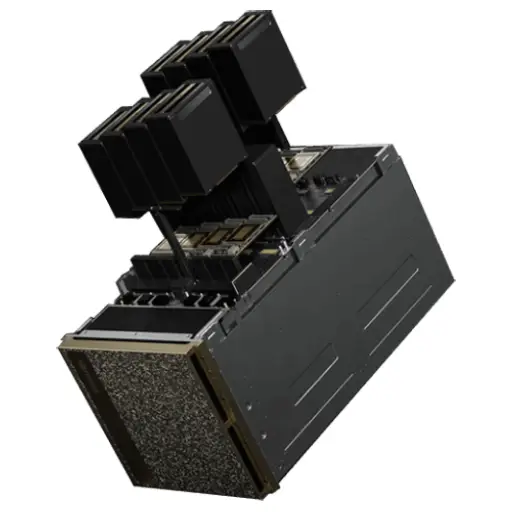
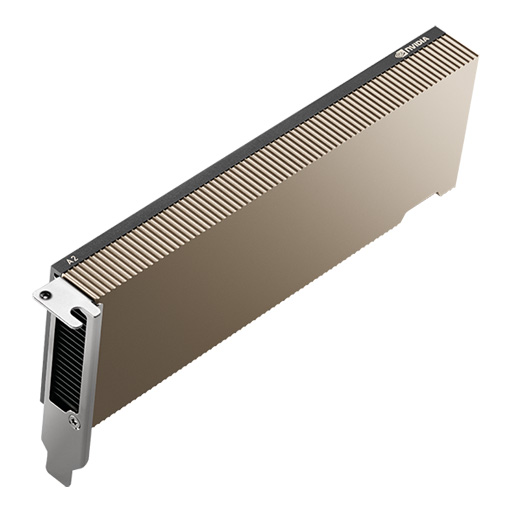
Products Mentioned in This Article

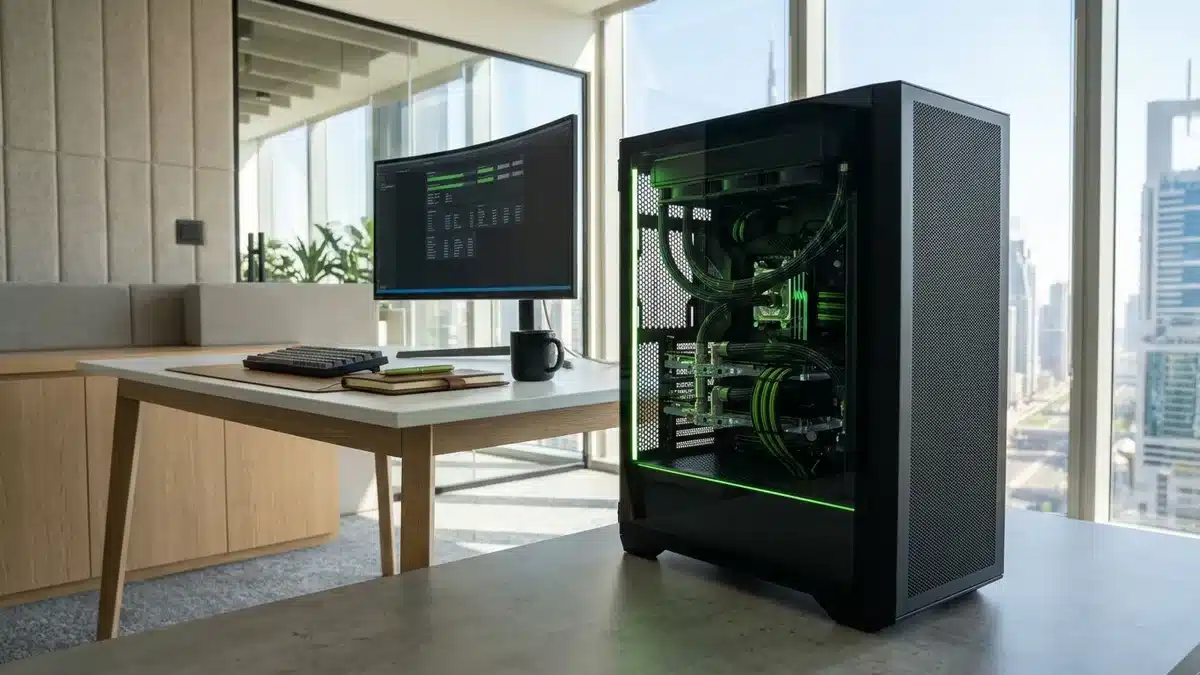
In 2026 NVIDIA’s GB300 Grace Blackwell Ultra Desktop Superchip moved the DGX Station class from announcement to real machines you can order. For the first time a single tower under a desk can hold 748 GB of coherent memory and a Blackwell Ultra GPU — enough to fine-tune and serve models that previously needed a rack. Seven or eight manufacturers now sell their own version, with prices and delivery times that vary enormously. This guide explains what a GB300 workstation is, how the main models compare, who actually needs one, and what to check before you buy.
What is a GB300 desktop superchip?
The GB300 Grace Blackwell Ultra Desktop Superchip combines a 72-core NVIDIA Grace CPU (Arm Neoverse V2) with a Blackwell Ultra (B300) GPU, joined by NVLink-C2C. The CPU side carries 496 GB of LPDDR5X and the GPU side 252 GB of HBM3e, and because the link between them is cache-coherent, software sees one pool of 748 GB of coherent memory. The HBM3e alone delivers roughly 7 TB/s of bandwidth — around 25 times the memory bandwidth of a DGX Spark.
Every GB300 desktop also includes an NVIDIA ConnectX-8 SuperNIC with up to 800 Gb/s of networking (typically two 400GbE QSFP ports), so a station can pull data from shared storage at cluster speed or be linked to a second station. The B300 GPU supports Multi-Instance GPU (MIG), so one machine can be split into up to seven isolated GPU instances for several users or services.
This is the same silicon generation as NVIDIA’s rack-scale GB300 NVL72 systems — but one superchip in one chassis, cooled by a sealed liquid loop and powered from a normal (dedicated) office circuit.
Related reading: How much memory you need to fine-tune a 70B LLM
GB300 workstation vs DGX Spark: two very different machines
The names sound related, and both use Grace Blackwell, but the two classes sit far apart.
| DGX Spark (GB10) | GB300 workstation (DGX Station class) | |
|---|---|---|
| Superchip | GB10 Grace Blackwell | GB300 Grace Blackwell Ultra |
| CPU | 20-core Arm | 72-core Grace (Neoverse V2) |
| Memory | 128 GB unified | 748 GB coherent (496 GB LPDDR5X + 252 GB HBM3e) |
| GPU memory bandwidth | ≈ 273 GB/s | ≈ 7 TB/s (HBM3e) |
| Networking | ConnectX-7 | ConnectX-8, up to 800 Gb/s |
| Form factor / power | Palm-sized desktop | Tower or 5U, ~1,600 W |
| Typical use | Individual developer prototyping | Team-level fine-tuning and serving of very large models |
Put simply: a DGX Spark is a personal development box; a GB300 station is a departmental AI server that happens to fit under a desk. With roughly six times the memory and more than twenty times the bandwidth, it can fine-tune and serve models that a Spark can only load in heavily compressed form, and it can serve several users at once.

The GB300 workstation models available in 2026
NVIDIA does not sell a GB300 desktop at a fixed list price of its own. Instead, partners build their own systems around the same superchip. The core silicon and memory are identical across all of them; they differ in chassis, storage, extra PCIe GPU options, warranty and service, and — most of all — in price and lead time.
| Model | Notes |
|---|---|
| Supermicro ARS-511GD-NB-LCC-01-G2 (Super AI Station, Gold Series) | Tower or 5U, D2C liquid cooling, 4× M.2 NVMe (PCIe 5.0/6.0), one extra double-width PCIe GPU slot, 1600 W Titanium PSU. Factory lead times have run 12–16 weeks. |
| Dell Pro Max with GB300 | Premium positioning with Dell’s service network; among the most expensive configurations, base model with 16 TB storage. |
| HP ZGX Fury | Premium positioning, often quoted with additional storage and an RTX PRO 2000 display GPU. |
| ASUS ExpertCenter Pro ET900N G3 | Commonly sold with multi-year on-site service. |
| MSI XpertStation WS300 | One of the lower-priced options; also the base for some system-integrator builds. |
| Gigabyte W775-V10 | Mid-range positioning. |
| Integrator builds (Exxact, Bizon and others) | Pre-configured systems with integrator support. |
Pricing: across the market in October 2026, GB300 desktops sold for roughly $85,000 to $190,000 before tax, depending on brand, storage, bundled service and — crucially — how soon the unit can actually be delivered. Premium brands with multi-year on-site service and short delivery sit at the top of that range. Memory costs have been rising through 2026, and resellers have warned of further increases into 2027.
Lead times: this is where the models really separate. Reported delivery times in late 2026 ranged from about two weeks for the most expensive premium configurations to 12–16 weeks for factory orders of the lower-priced brands. For many buyers, a unit that is physically available today is worth more than a cheaper unit three or four months away.
What a GB300 workstation can actually do
Fine-tune very large models on-premises
748 GB of coherent memory means large open-weight models can be fine-tuned on a single node — including parameter-efficient methods (LoRA/QLoRA) on models in the hundreds of billions of parameters — without splitting the job across a cluster. Vendors position the class for on-premises work on models up to the trillion-parameter range at reduced precision.
Serve large models privately to a team
With MIG partitioning and the HBM3e bandwidth of Blackwell Ultra, one station can serve a large model to a whole department, or run several smaller models side by side, while keeping all data inside the building. This is the main reason legal, financial, healthcare and government teams look at the category.
Agentic AI and RAG at scale
Agent systems typically hold a large model, an embedding model, a vector index and tool state in memory at the same time. A coherent 748 GB pool removes the constant shuffling between CPU and GPU memory that slows these pipelines on conventional workstations. Supermicro positions its station specifically for AI agent development and deployment.
Validate before buying a rack
Because the station runs the same Blackwell Ultra architecture and NVIDIA software stack as rack-scale systems, it is a practical way to prove a workload before committing to DGX or HGX infrastructure worth ten times as much.
Who does not need a GB300 workstation
Not every AI team should spend six figures on one. If your applications mainly call hosted model APIs, a GB300 station adds little. If you work with models up to around 70–120B parameters for development, a DGX Spark covers that for a fraction of the price. And if you need to train large models from scratch or serve thousands of concurrent users, you have outgrown a single node and should look at multi-GPU HGX servers instead. The GB300 station is the right tool in the middle: very large models, private data, and one team that needs serious capacity now.
GB300 workstation vs a multi-GPU RTX PRO 6000 workstation
The most common alternative buyers consider is a conventional workstation or small server with several RTX PRO 6000 Blackwell cards. Each card has 96 GB of GDDR7 at around 1.8 TB/s, so four cards add up to 384 GB of GPU memory. On paper that sounds close; in practice the architectures behave differently.
| 4× RTX PRO 6000 workstation | GB300 workstation | |
|---|---|---|
| GPU memory | 4 × 96 GB, separate pools | 252 GB HBM3e + 496 GB LPDDR5X, one coherent pool |
| Bandwidth per GPU | ≈ 1.8 TB/s | ≈ 7 TB/s |
| GPU-to-GPU link | PCIe | Single GPU, NVLink-C2C to CPU |
| Model splitting | Large models must be sharded across cards | Large models fit on one node without sharding |
| Best at | Many independent jobs, rendering, mid-size models | Single very large models, long context, large KV caches |
If your workloads are many medium-sized models or a mix of AI and visualisation, a multi-GPU RTX PRO workstation can be the better value. If your bottleneck is one very large model — or memory bandwidth for long-context inference — the GB300’s coherent memory and HBM3e bandwidth remove problems that no amount of PCIe cards can solve.
Software: what runs on a GB300 workstation
GB300 systems ship with an Arm-based Linux environment — NVIDIA DGX OS or a certified distribution such as Ubuntu 24.04 — with the NVIDIA driver, CUDA and container runtime. The full NVIDIA AI stack runs natively: PyTorch and JAX, TensorRT-LLM, Triton and NVIDIA NIM microservices, and NVIDIA AI Enterprise for supported production deployments. Popular open-source serving tools such as vLLM and llama.cpp also support the platform. Because the CPU is Arm-based, check that any third-party x86-only tools you rely on have Arm builds — most of the AI ecosystem already does. MIG lets administrators split the B300 into isolated instances, so several engineers or services can share the machine with guaranteed resources, much like a small shared GPU server.
Buying vs renting GB300 in the cloud
Blackwell Ultra cloud capacity is billed by the GPU-hour, and on-demand B300 rates in late 2026 ranged from roughly $7 to $18 per GPU-hour depending on provider. That puts a simple break-even point within reach: at the high end of cloud pricing, a GB300 station running around the clock pays for itself in a little over a year; against the cheapest neocloud rates it takes closer to two years or more. Power is extra on both sides.
Cost is therefore only part of the case. The stronger arguments for owning are data sovereignty (nothing leaves your network), guaranteed availability (no queueing for scarce cloud capacity), predictable spend, and 748 GB of coherent memory on one node, which is hard to rent at all outside full rack-scale systems.
Deployment requirements
- Power: plan for about 1,600 W at peak on a dedicated circuit.
- Cooling: the direct-to-chip liquid loop is sealed inside the chassis — no facility water or rack cooling is needed — but the room should stay within roughly 15–32°C with clear airflow at the front and rear.
- Space and weight: around 40 kg; place it on the floor or a rack shelf, not on a desk. Several models convert between tower and 5U rack mount.
- Network: to use the ConnectX-8 bandwidth, connect it to 200/400GbE switching and fast shared storage — see our NVMe storage for AI guide.
- Management: enterprise systems provide IPMI/Redfish remote management, so IT can run the station like any other server.
How to buy a GB300 workstation
These are not click-to-buy products. A typical purchase runs: request a quote → receive a formal quotation and configuration → issue a purchase order → pay against an official invoice → delivery and setup. Before ordering, confirm five things in writing: the exact configuration (storage, any extra GPU), the delivery date, how the manufacturer warranty is handled, what setup and support is included, and the payment terms.
ITCT Shop has the Supermicro ARS-511GD-NB-LCC-01-G2 in stock in Dubai — a GB300 Blackwell Ultra station available now rather than after a factory queue — with an official invoice, one-year Supermicro warranty and worldwide shipping. Contact our team on WhatsApp for the current allocation.
Frequently asked questions
What is the difference between DGX Station and a GB300 workstation?
DGX Station is NVIDIA’s name for the class of desktop systems built on the GB300 Grace Blackwell Ultra Desktop Superchip. Manufacturers such as Supermicro, Dell, HP, ASUS, MSI and Gigabyte sell their own GB300 workstations built on the same superchip and memory configuration.
How much does a GB300 workstation cost?
In late 2026 GB300 desktops sold for roughly $85,000 to $190,000 depending on brand, storage, bundled service and delivery time. Premium configurations with on-site service and short lead times sit at the top of the range.
How much memory does a GB300 workstation have?
748 GB of coherent memory: 496 GB of LPDDR5X attached to the Grace CPU and 252 GB of HBM3e on the Blackwell Ultra GPU, shared over NVLink-C2C.
Can a GB300 workstation run in a normal office?
Yes. The liquid cooling loop is self-contained, so no facility cooling is required. It does need a dedicated power circuit for about 1,600 W, a room kept between roughly 15 and 32°C, and floor space for a 40 kg tower.
Is a GB300 workstation better than several RTX PRO 6000 GPUs?
For models that fit across a few 96 GB cards, a multi-GPU RTX PRO 6000 workstation can be more cost-effective. The GB300 station wins when you need one very large coherent memory pool, the HBM3e bandwidth of Blackwell Ultra, and the same architecture as rack-scale Blackwell systems.
How long does delivery take?
Factory lead times in late 2026 ranged from about two weeks for premium configurations to 12–16 weeks for some lower-priced brands. Units already in stock with a reseller can be delivered much sooner.
Last update at December 2025
7 thoughts on “GB300 Workstation Buying Guide 2026: DGX Station vs Supermicro, Dell, HP and ASUS”