


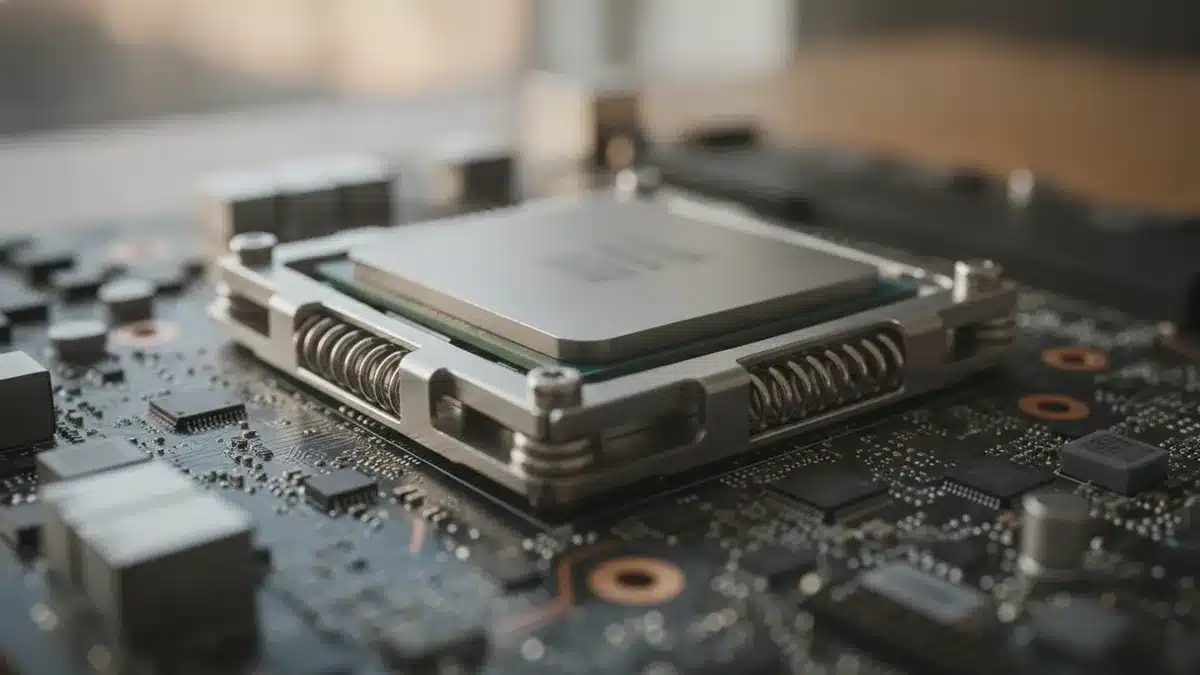
AMD EPYC 9005, codenamed Turin, has become one of the most common host CPUs in new GPU servers. With up to 192 Zen 5c cores, 12 DDR5 memory channels and 128 PCIe Gen5 lanes per socket, it offers a lot of headroom for feeding multiple GPUs, NVMe drives and fast network cards. But the right Turin SKU for a GPU server is rarely the biggest one. This guide explains what matters in a host CPU for AI servers, how EPYC 9005 compares with Intel Xeon 6, and which configurations make sense for inference and training builds.
EPYC 9005 at a glance
| Feature | EPYC 9005 (Turin) |
|---|---|
| Cores | Up to 128 Zen 5 or 192 Zen 5c cores per socket |
| Memory | 12 channels DDR5 per socket, up to 6000 MT/s (platform dependent) |
| PCIe | 128 PCIe Gen5 lanes per socket (up to 160 in some dual-socket layouts) |
| CXL | CXL 2.0 support for memory expansion |
| TDP | Roughly 155 W to 500 W depending on SKU |
| Socket | SP5, compatible with many EPYC 9004 platforms after BIOS update |
Check AMD and your server vendor’s specifications for exact SKU figures.
What a GPU server actually needs from the CPU
- PCIe lanes: enough Gen5 lanes to give every GPU, NIC and NVMe drive full bandwidth, or a well-designed PCIe switch topology.
- Memory bandwidth and capacity: system RAM of roughly 1.5–2× total GPU memory for model loading, caching and data preparation.
- High single-thread speed: data loaders, tokenisation and orchestration often run on a few fast cores.
- Not maximum core count: most GPU servers do not need 192 cores; the money is usually better spent on GPUs.
Recommended Turin SKUs by build
| Build | CPU approach |
|---|---|
| Single-socket, 2–4 GPU inference server | One 32–64 core high-frequency EPYC 9005 (F-series or mainstream) |
| Dual-socket, 8 PCIe GPU server | Two 32–64 core CPUs for lane count and memory channels |
| HGX / SXM 8-GPU training node | Two 48–96 core CPUs per the platform’s reference design |
| CPU-only inference or vector database | High core count Zen 5c with all 12 memory channels populated |
For GPU sizing, see LLM GPU memory requirements and best GPU for LLM inference.
EPYC 9005 vs Intel Xeon 6
| AMD EPYC 9005 | Intel Xeon 6 (P-core) | |
|---|---|---|
| Memory channels | 12 | 8 or 12 depending on platform |
| PCIe Gen5 lanes | 128 per socket | Up to 96 per socket on 6900P |
| AI on CPU | AVX-512 on Zen 5 | AMX accelerators for matrix maths |
| Typical strength | Lanes, memory bandwidth, core density | AMX for CPU inference, wide ecosystem |
Both are solid hosts for GPUs. The bigger decision is usually the server platform and GPU configuration offered by Dell, HPE, Supermicro or Gigabyte.
Configuration tips
- Populate all 12 memory channels with identical DIMMs.
- Check how PCIe slots are wired: direct to CPU or behind a switch.
- Set BIOS power profiles for performance and enable IOMMU settings required by your GPU software.
- Plan cooling for 400–500 W CPUs alongside 600–1,000 W GPUs.
ITCT builds and supplies EPYC 9005 GPU servers from Dubai with H100, H200, L40S and RTX PRO 6000 configurations. For desk-side development, compare with DGX Spark.
Frequently asked questions
Is AMD EPYC 9005 good for GPU servers?
Yes. Its 128 PCIe Gen5 lanes and 12 DDR5 channels per socket make it a strong host for multi-GPU servers.
How many CPU cores does a GPU server need?
Typically 32–64 cores per socket is enough for 4–8 GPUs. Very high core counts rarely improve GPU workloads.
Can EPYC 9005 go into an EPYC 9004 server?
Many SP5 platforms support Turin after a BIOS update, but always confirm with the server vendor.
EPYC or Xeon for AI servers?
EPYC offers more lanes and memory channels; Xeon 6 offers AMX for CPU inference. Both work well as GPU hosts.
How much RAM should an EPYC GPU server have?
Around 1.5–2 times the total GPU memory, using all memory channels.
Last update at December 2025