
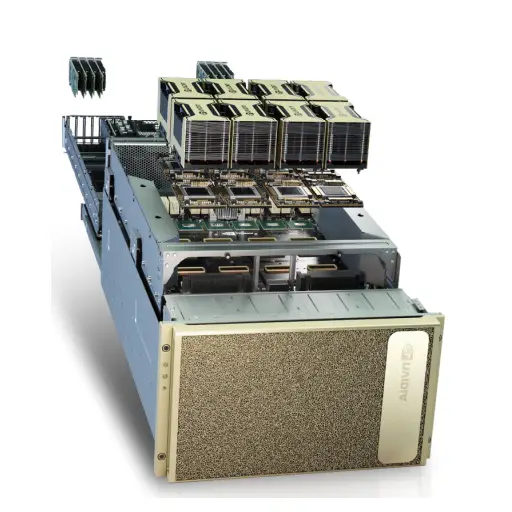
Description
• Balance due before shipment
• Estimated delivery: 4–8 weeks
• New clients: 50% deposit applies
2️⃣ We send your official invoice
3️⃣ Deposit paid → unit ships with 1-Year NVIDIA warranty
The NVIDIA DGX H100 is NVIDIA’s flagship AI infrastructure system, purpose-built for large-scale deep learning training, generative AI, and high-performance inference workloads. Powered by eight NVIDIA H100 Tensor Core GPUs, each equipped with 80GB of ultra-fast HBM3 memory, the DGX H100 delivers a unified pool of 640GB of GPU memory connected through fourth-generation NVLink and NVSwitch, enabling it to function as a single, massive accelerator for training the largest AI models.
At the heart of the system are two Intel Xeon Platinum 8480C processors (56 cores each, 112 cores total) paired with 2TB of DDR5 system memory, providing the CPU horsepower needed to feed data to the GPUs without bottlenecks. Storage is handled by two 1.92TB NVMe M.2 drives in a RAID 1 mirror for the operating system, plus eight 3.84TB NVMe U.2 self-encrypting drives configured in RAID 0, delivering roughly 30TB of high-speed local cache storage for datasets.
The DGX H100 is fully optimized for modern LLM and generative AI frameworks, including vLLM, NVIDIA NeMo Megatron, DeepSpeed, HuggingFace Transformers, TensorRT-LLM, and Triton Inference Server, making it equally capable for research experimentation and production deployment. Its networking backbone relies on NVIDIA ConnectX-7 adapters: four OSFP ports feeding eight single-port ConnectX-7 cards deliver up to 400Gb/s of InfiniBand or Ethernet connectivity per port for scale-out clustering, while two additional dual-port ConnectX-7 Ethernet cards handle storage traffic and in-band management — allowing multiple DGX H100 systems to be linked into an NVIDIA DGX SuperPOD for training trillion-parameter models.
The system ships with NVIDIA DGX OS (built on Ubuntu Linux) and includes NVIDIA Base Command for container orchestration, along with enterprise-grade security features such as UEFI Secure Boot and TPM 2.0. Backed by NVIDIA’s Hopper architecture, the DGX H100 delivers up to 9x faster AI training and up to 30x faster AI inference on large language models compared to the previous-generation DGX A100, making it the gold standard for enterprises building serious AI capabilities on-premises.
Key Features / Specifications
| Specification | Detail |
|---|---|
| System | 8x GPU NVIDIA DGX H100, 8U Rackmount |
| Warranty | 3 Years Parts, 3 Years Labor, 1 Year Critical Response (under limited warranty) |
| CPU | 2x Intel Xeon Platinum 8480C, 56 cores each (112 cores total), 2.0GHz base / 3.8GHz max turbo |
| System Memory | 32x 64GB DDR5-4800 ECC RDIMM — Total: 2TB |
| OS Storage | 2x 1.92TB NVMe M.2 SSD, RAID 1 mirror |
| Data Storage | 8x 3.84TB NVMe U.2 SED, RAID 0 — Total: ~30TB usable |
| GPU | 8x NVIDIA H100 SXM5 Tensor Core GPUs, 80GB HBM3 each — Total: 640GB HBM3 |
| GPU Interconnect | 4th-Gen NVLink via 4x NVSwitch — 900GB/s GPU-to-GPU bandwidth |
| System Performance | 32 PetaFLOPS FP8 (aggregate, with sparsity) |
| Cluster Networking | 4x OSFP ports — 8x single-port ConnectX-7 cards, up to 400Gb/s InfiniBand/Ethernet each |
| Storage/Management Networking | 2x dual-port ConnectX-7 Ethernet cards, up to 400GbE each |
| Security | UEFI Secure Boot, TPM 2.0 |
| Power Supply | 6x 3.3kW Titanium-rated hot-swappable PSUs, 4+2 redundancy — ~10.2kW max system draw |
| Software | NVIDIA DGX OS 6 (Ubuntu-based) with NVIDIA Base Command container orchestration |
| LLM Framework Support | vLLM, NeMo Megatron, DeepSpeed, HuggingFace Transformers, TensorRT-LLM, Triton Inference Server |
| Scale-Out | Full-bandwidth NVLink and InfiniBand-based multi-node clustering (DGX SuperPOD-ready) |
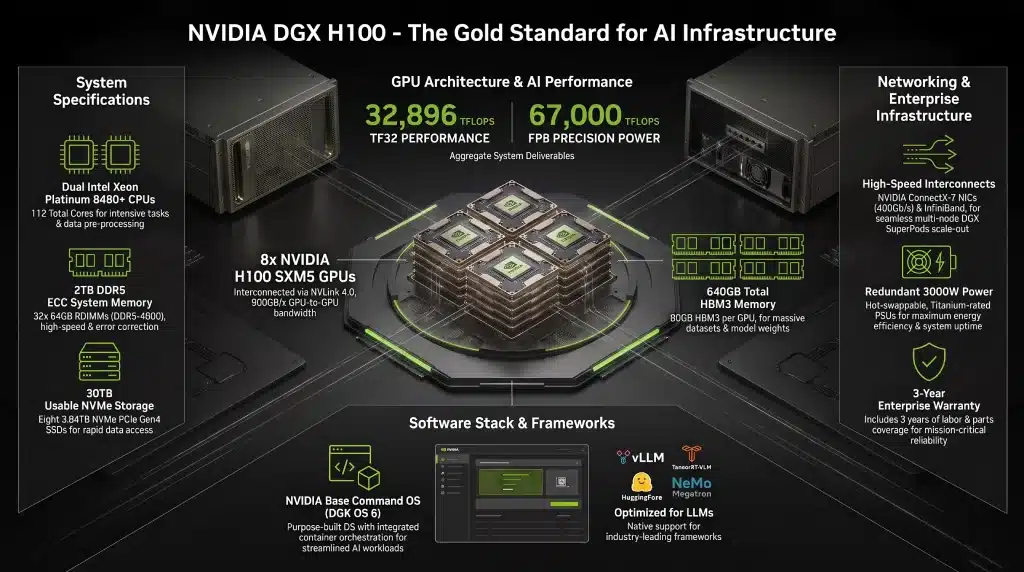
Technical Specifications
| Component | Specification |
|---|---|
| System | NVIDIA DGX H100, 8U Rackmount |
| GPUs | 8x NVIDIA H100 Tensor Core GPUs, 80GB HBM3 each (640GB Total) |
| GPU Interconnect | 4th-Generation NVIDIA NVLink with 4x NVSwitch, 900 GB/s GPU-to-GPU Bandwidth |
| System Performance | 32 PetaFLOPS FP8 (aggregate, with sparsity) |
| CPUs | 2x Intel Xeon Platinum 8480C (56 Cores each, 2.0GHz Base / 3.8GHz Max Turbo) |
| System Memory | 2TB DDR5-4800 ECC RDIMM (32x 64GB) |
| OS Storage | 2x 1.92TB NVMe M.2 Drives (RAID 1) |
| Data Storage | 8x 3.84TB NVMe U.2 SED Drives (RAID 0, ~30TB Usable) |
| Cluster Networking | 4x OSFP Ports — 8x Single-Port ConnectX-7 (up to 400Gb/s InfiniBand/Ethernet each) |
| Storage & Management Networking | 2x Dual-Port ConnectX-7 Ethernet Cards (up to 400GbE each) |
| Out-of-Band Management | 1GbE RJ45 BMC (Redfish, IPMI, SNMP, KVM support) |
| Power Supply | 6x 3.3kW (3300W) Redundant Titanium-Rated PSUs, 4+2 Configuration |
| Max System Power | ~10.2kW |
| Form Factor | 8U Rackmount, 356mm (H) x 482.3mm (W) x 897.1mm (D), ~130.45kg |
| Operating Temperature | 5–30°C (41–86°F) |
| Software | NVIDIA DGX OS 6, NVIDIA Base Command, optional NVIDIA AI Enterprise |
| Security | UEFI Secure Boot, TPM 2.0 |
NVIDIA DGX H100 vs. DGX H200 vs. DGX B200
| Specification | DGX H100 | DGX H200 | DGX B200 |
|---|---|---|---|
| GPU | 8x H100 (Hopper) | 8x H200 (Hopper) | 8x Blackwell |
| GPU Memory | 640GB HBM3 | 1,128GB HBM3e | 1,440GB HBM3e |
| Memory Bandwidth | 3.35TB/s per GPU | 4.8TB/s per GPU | 64TB/s aggregate |
| System Performance (FP8) | 32 PetaFLOPS | 32 PetaFLOPS | 72 PetaFLOPS |
| System Power Usage | ~10.2kW max | ~10.2kW max | ~14.3kW max |
H100 and H200 share the same raw compute (32 PetaFLOPS FP8) — the H200 just adds nearly 2x the GPU memory and higher bandwidth, making it better suited for very large models or high-batch inference. The B200 delivers over 2x the performance but also draws ~40% more power. For most training and inference workloads today, the DGX H100 remains the most proven and cost-effective choice, with the widest ecosystem support. Choose H200/B200 only if your models are outgrowing H100’s 640GB memory ceiling.
2. Who Should (and Shouldn’t) Buy the DGX H100?
Skip it if you’re fine-tuning smaller models (under ~10B parameters) or just experimenting — a single H100 PCIe card will do the job at a fraction of the cost and power draw.
Get it if you’re training or serving LLMs in the 30B+ parameter range, need the full 640GB unified GPU memory, or plan to scale into an NVIDIA DGX SuperPOD cluster. It’s built for production-grade AI at enterprise scale, not light experimentation.
3. Infrastructure Checklist Before You Buy
Before ordering, confirm your facility can support these requirements — this is the most common cause of post-purchase deployment delays:
- Rack space: 8U, ~130kg weight capacity
- Power: Six 3.3kW PSUs (4+2 redundant), ~10.2kW max draw — requires dedicated high-capacity 200-240V circuits, not standard office power
- Cooling: Rated for 5–30°C ambient; needs proper data center cooling, not office AC
- Networking: InfiniBand/high-speed Ethernet switching if clustering multiple units into a SuperPOD
Frequently Asked Questions (FAQ)
Q1: What is the primary difference between the DGX H100 and the previous DGX A100? The DGX H100 represents a major generational leap over the DGX A100. Key advantages include the new NVIDIA Hopper GPU architecture, faster HBM3 memory (versus HBM2e on the A100), fourth-generation NVLink with double the GPU-to-GPU bandwidth, PCIe Gen5 support, and a dedicated Transformer Engine with FP8 precision built specifically to accelerate large language models. According to NVIDIA, these innovations translate into up to 9x faster AI training and up to 30x faster AI inference on large language models compared to the DGX A100.
Q2: Who is the ideal user for a DGX H100 system? The DGX H100 is designed for large enterprises, research institutions, and AI-focused organizations that need to train and deploy state-of-the-art AI models at scale. It’s especially well suited for teams working on large language models, natural language processing, drug discovery, autonomous systems, financial modeling, and other computationally intensive AI workloads that require the full 640GB of unified GPU memory.
Q3: What software is included with the DGX H100? The system ships with NVIDIA DGX OS, built on Ubuntu Linux, and includes NVIDIA Base Command for container-based workflow orchestration, along with system management tools such as NVIDIA System Management (NVSM) and Data Center GPU Manager (DCGM). Customers can optionally add the NVIDIA AI Enterprise software suite, which provides access to optimized frameworks such as PyTorch, TensorFlow, TensorRT-LLM, Triton Inference Server, and NeMo Megatron.
Q4: How does the DGX H100 scale for larger workloads? The DGX H100 is built for cluster-scale deployment. Using its ConnectX-7 InfiniBand fabric across four OSFP ports, multiple DGX H100 systems can be linked together to form an NVIDIA DGX SuperPOD, allowing organizations to build AI supercomputers with dozens or hundreds of DGX nodes capable of training foundation models with trillions of parameters.
Q5: How much power does the DGX H100 require? The system uses six 3.3kW (3300W) Titanium-rated power supplies configured in a 4+2 redundant arrangement, with a maximum total system power draw of approximately 10.2kW. This redundancy ensures the system keeps running even if up to two power supplies fail simultaneously.
مقالات مرتبط
🛡️ Buy with Confidence
- ✅ Genuine, brand-new NVIDIA hardware
- ✅ 1-Year NVIDIA Manufacturer Warranty
- ✅ Official invoice provided
- ✅ Licensed & registered company in Dubai, UAE
- ✅ Fast local delivery across the UAE & worldwide shipping
📞 +971 50 465 0867 (Call / WhatsApp) · info@itctshop.com
Related Technical Guides
- AI Data Center Infrastructure: Networking & Storage
- GPU Cluster Design Guide
- Ethernet Switches: H3C S9827 vs S9855
- AI Storage Solutions for Generative AI
- AI Hardware Trends in MENA 2025
Last update at December 2025
Reviews
There are no reviews yet.