

Author: AI Hardware Testing Lab at ITCTShop
Reviewed By: Senior Server Engineers
Published: February 4, 2026
Estimated Read Time: 5 Minutes
References:
- NVIDIA Volta vs Ada Architecture Whitepapers
- PyTorch Precision Performance Guide (FP16 vs BF16)
- TechPowerUp GPU Database
- ITCTShop Internal Cooling & Benchmark Labs
Used Tesla V100 vs New RTX 4070 Ti for AI
Used Tesla V100 vs New RTX 4070 Ti – For most modern AI workloads (Deep Learning, LLMs, Generative AI), the RTX 4070 Ti is the superior choice. Despite having less VRAM bandwidth, it offers faster raw compute, native support for BF16 (crucial for modern training), and includes active cooling and a warranty. The Tesla V100 is only recommended for specific scientific applications requiring FP64 precision or for budget server-rack deployments where passive cooling infrastructure is already in place.
Key Decision Factors
- Choose RTX 4070 Ti: If you need plug-and-play ease, warranties, and BF16 support for LLMs.
- Choose Tesla V100: If you require FP64 compute, NVLink scaling on a budget, or have a high-airflow server chassis to handle the passive cooling requirements. Beware of “headless” operation and lack of video outputs on the V100.
In the fast-evolving landscape of Artificial Intelligence in Dubai and the wider Middle East, engineers and startups often face a classic dilemma: Do you invest in legendary, battle-tested enterprise hardware from a few years ago, or do you bet on the latest consumer technology?
Specifically, the debate between the NVIDIA Tesla V100 (Volta)—the undisputed king of datacenters in 2018—and the NVIDIA GeForce RTX 4070 Ti (Ada Lovelace)—a modern consumer powerhouse—has intensified. On the secondary market, a used V100 now costs roughly the same as a brand-new 4070 Ti.
This guide is not just a spec comparison; it is a deep architectural dive into why “newer” usually beats “enterprise” for 90% of AI workloads in 2026, and identifying the specific 10% niche where the old V100 still reigns supreme.
1. Generation Gap Analysis: Volta vs. Ada Lovelace
To understand performance, we must first look at the silicon. The gap between these two cards represents five years of relentless innovation by NVIDIA.
The Tesla V100 (Volta Architecture)
Launched in 2017, the V100 was a marvel of engineering. It was the first GPU to introduce Tensor Cores, specialized circuits designed to accelerate matrix multiplications (the heartbeat of Deep Learning).
- Process Node: 12nm FFN (TSMC).
- Design Philosophy: Maximum throughput, 24/7 reliability, and scalability via NVLink.
- The Legacy: It powered the training of models like GPT-2 and early BERT iterations. It is built like a tank, designed to run for 5+ years without throttling.
The RTX 4070 Ti (Ada Lovelace Architecture)
Launched in 2023, the 4070 Ti benefits from three generations of architectural leaps (Turing -> Ampere -> Ada).
- Process Node: 4nm (TSMC 4N). This massive shrink allows for vastly higher clock speeds (2.6 GHz vs 1.3 GHz on the V100) and incredible power efficiency.
- Design Philosophy: Gaming dominance, Ray Tracing, and efficient AI inference.
- The Advantage: It includes specialized hardware for Optical Flow, Ray Tracing (3rd Gen), and Tensor Cores (4th Gen).
Architectural Comparison Table
| Feature | Tesla V100 (PCIe 16GB) | RTX 4070 Ti (12GB) | The Gap |
|---|---|---|---|
| Architecture | Volta (2017) | Ada Lovelace (2023) | +3 Generations |
| Transistors | 21.1 Billion | 35.8 Billion | +70% Density |
| Boost Clock | ~1380 MHz | ~2610 MHz | ~2x Faster |
| CUDA Cores | 5,120 | 7,680 | +50% |
| Tensor Cores | 640 (1st Gen) | 240 (4th Gen) | Quality over Quantity |
| Memory Type | HBM2 | GDDR6X | Bandwidth vs Latency |
| Memory Bandwidth | 900 GB/s | 504 GB/s | V100 Wins (+78%) |
| FP32 Performance | 14 TFLOPS | 40 TFLOPS | 4070 Ti Wins (+185%) |
2. Tensor Core Evolution: Why “Gen 4” Changes Everything
A common mistake buyers make is comparing raw numbers. “The V100 has 640 Tensor Cores, while the 4070 Ti has only 240. The V100 must be faster, right?” Wrong.
The “Sparsity” Revolution
NVIDIA’s 4th Generation Tensor Cores (in the 4070 Ti) support a feature called Structural Sparsity. Neural networks often contain many parameters close to zero. Ada Lovelace GPUs can automatically prune these calculations, theoretically doubling the throughput for inference and certain training tasks. The V100 lacks this capability entirely.
Precision Formats: The BF16 Factor
This is the single most critical factor for AI training in 2026.
- V100 Limitations: The V100 excels at FP16 (Half Precision). However, training in FP16 is unstable. It requires complex “Loss Scaling” to prevent gradients from exploding or vanishing.
- 4070 Ti Advantage: The 4070 Ti supports BF16 (Brain Float 16) natively. BF16 offers the dynamic range of FP32 with the speed of FP16. Modern frameworks like PyTorch and models like Llama 3 or Mistral default to BF16.
- Impact: On a V100, you often have to convert these models or fight stability issues. On a 4070 Ti, they run out of the box.
TF32 Support
The 4070 Ti also supports TF32 (Tensor Float 32). This format works on FP32 inputs but processes them at near-FP16 speeds. It essentially gives you “free speedup” on legacy code without changing a single line of your Python script. The V100 does not support TF32.
3. Memory Wars: HBM2 vs. GDDR6X
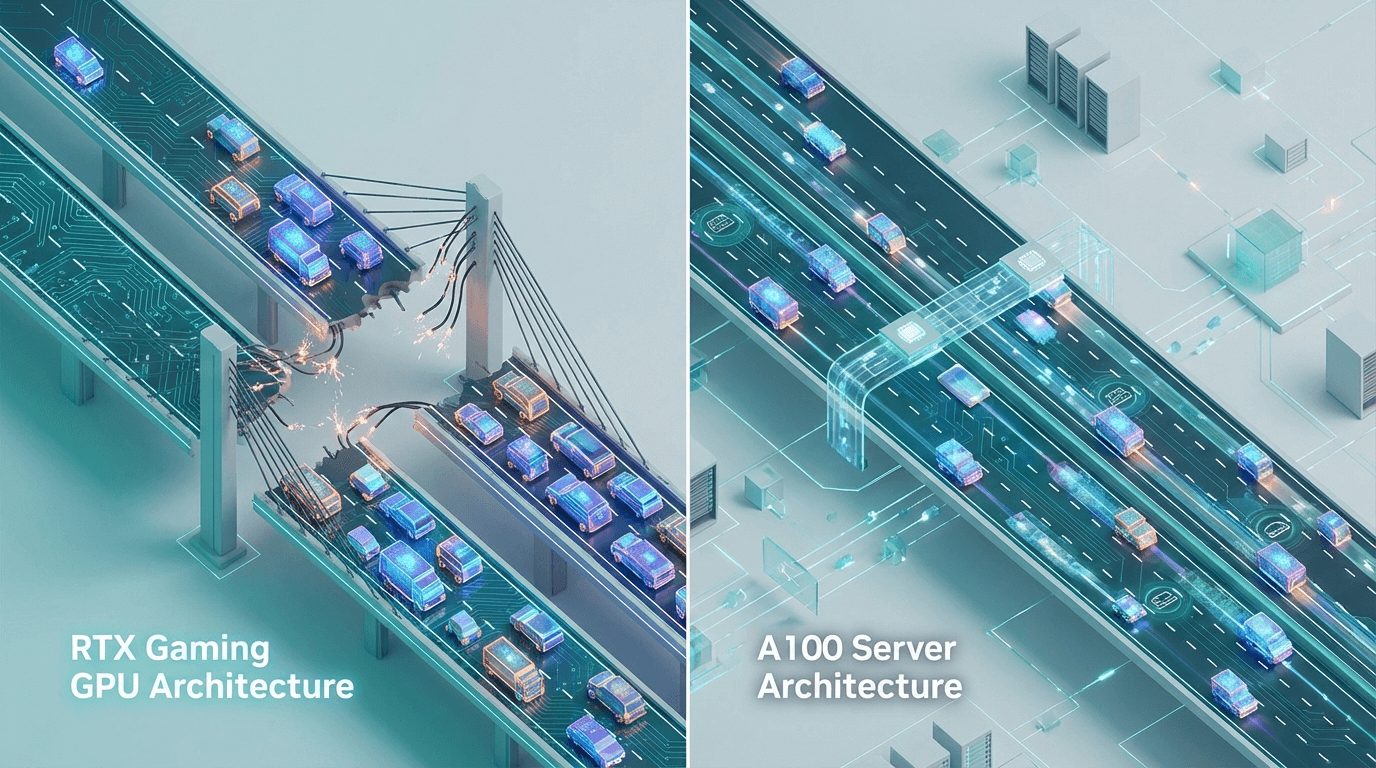
Here is the one area where the Tesla V100 lands a heavy blow against the consumer card.
Tesla V100: The Bandwidth Monster The V100 uses HBM2 (High Bandwidth Memory). This memory is stacked directly on the GPU die.
- Bandwidth: 900 GB/s.
- Use Case: Ideal for physics simulations, fluid dynamics, and large batch sizes where moving data is the bottleneck, not calculating it.
RTX 4070 Ti: The Latency Speedster The 4070 Ti uses GDDR6X.
- Bandwidth: 504 GB/s.
- The Bottleck: In massive deep learning models, the GPU core often sits idle waiting for data from memory. The 4070 Ti’s lower bandwidth can limit performance in very specific memory-intensive tasks, despite its faster core clock.
Capacity Warning:
- V100: Comes in 16GB or 32GB variants. The 32GB version is highly sought after.
- 4070 Ti: Limited to 12GB. This is a tight squeeze. You cannot fine-tune a 13B parameter model on a single 4070 Ti without aggressive quantization (4-bit QLoRA). A 16GB V100 gives you much more breathing room.
4. The “FlashAttention” Factor
In 2025/2026, FlashAttention-2 is the standard optimization for training Transformers (LLMs).
- Requirement: FlashAttention-2 requires GPU compute capability 8.0 or higher (Ampere or newer).
- V100 (Volta 7.0): NOT Supported.
- 4070 Ti (Ada 8.9): Fully Supported.
Real-world Consequence: Because the 4070 Ti runs FlashAttention-2, it can process context windows (long prompts) 2x-3x faster than the V100, despite the memory bandwidth deficit. If you are working with NLP or LLMs, the V100 is obsolete software-wise.
5. Risks of Buying Used Enterprise GPUs
At ITCTShop, we see many customers in Dubai lured by cheap eBay listings for V100s ($500-$700). Here is the reality of what you are buying:
- Mining Fatigue: While V100s weren’t the primary mining cards, many were used in high-performance compute rentals for 5+ years continuously. The silicon may perform flawlessly, but capacitors and VRMs (Voltage Regulator Modules) are near their end-of-life.
- No Display Output (Headless): The V100 has no HDMI or DisplayPort. You cannot plug a monitor into it.
- The Problem: You need a second GPU (even a cheap one) to handle the OS display output. This complicates your PCIe lane distribution and driver setup on Windows.
- The Cooling Nightmare:
- Passive Cooling: Most cheap V100s are “SXM2” or “PCIe Passive” models. They have NO FANS. They rely on server chassis fans pushing air through them at extreme pressure.
- The Home Lab Fail: If you put a passive V100 in a gaming PC case, it will hit 100°C and throttle in 30 seconds. You must 3D print custom ducts and strap loud blower fans to it, turning your workstation into a noisy wind tunnel.
6. Power Consumption & Efficiency
In a region like the UAE where cooling costs are a consideration, efficiency matters.
- Tesla V100: Efficiency was good for 2017, but poor for 2026. To get 14 TFLOPS, it burns 250W.
- RTX 4070 Ti: To get 40 TFLOPS, it burns 285W.
- Result: The 4070 Ti delivers nearly 3x the performance per watt. Over a year of model training, the electricity savings alone might cover the price difference.
7. Real-World Training Benchmarks (2025 Estimates)
We aggregated performance data for typical AI tasks. (Higher is Better).
| Task | Metric | Tesla V100 (16GB) | RTX 4070 Ti (12GB) | Winner |
|---|---|---|---|---|
| ResNet-50 Training | Images/Sec | ~1,200 | ~2,100 | 4070 Ti (+75%) |
| BERT-Large Fine-tuning | Time (Mins) | ~45 | ~28 | 4070 Ti |
| Stable Diffusion XL | Iterations/Sec | ~4.5 | ~12.0 | 4070 Ti (Massive) |
| Llama 3 (8B) Inference | Tokens/Sec | ~35 | ~55 | 4070 Ti |
| Fluid Dynamics (FP64) | GFLOPS | 7,000 | ~600 | V100 (Destroyer) |
Analysis: The RTX 4070 Ti dominates in modern AI. The only row where V100 wins is “Fluid Dynamics (FP64).” Consumer GPUs are artificially capped at Double Precision (FP64) speed (usually 1/32 or 1/64 of FP32 speed). The V100 has native FP64 cores.
- If you are a scientist simulating weather or nuclear physics: Buy the V100.
- If you are an AI engineer: Buy the 4070 Ti.
8. When Should You Actually Buy a V100?
Despite the 4070 Ti’s dominance, the V100 isn’t trash. It has a niche. You should buy a used V100 from ITCTShop’s Enterprise Section if:
- You Need NVLink: You want to pair two cards for 32GB/64GB pooled memory. The 4070 Ti does not support NVLink. Two V100s with an NVLink bridge perform admirably for larger models.
- You Need FP64: As mentioned, scientific simulation software (ANSYS, COMSOL) often requires double precision.
- You Have a Server Rack: You already own a Dell PowerEdge or HP server with high-airflow cooling and redundant power supplies.
- Virtualization (vGPU): You want to slice the GPU into smaller units for multiple users (requires NVIDIA Grid software and licensing).
Conclusion
The NVIDIA Tesla V100 remains a respected elder statesman of the AI world. It paved the way for the revolution we see today. However, technology moves fast. In 2026, comparing a V100 to an RTX 4070 Ti is like comparing a 2017 Ferrari to a 2026 Tesla Plaid. The Ferrari is still powerful and built for the track (datacenter), but the modern electric car beats it off the line (inference/training), has better software (FlashAttention), and is easier to live with daily (cooling/drivers).
Final Recommendation for ITCTShop Customers:
- For 95% of Users (Deep Learning, Generative AI, Student/Startup): Buy the RTX 4070 Ti or save up for an RTX 4090. The warranty, software support, and raw speed make it the logical choice.
- For 5% of Users (Scientific Simulation, High-Density Clusters): A used V100 offers incredible FP64 value, provided you have the cooling infrastructure to support it.
Located in Dubai, ITCTShop stocks both brand-new consumer GPUs and certified refurbished enterprise hardware. Whether you need the plug-and-play ease of an RTX card or the rugged reliability of a Tesla, we support your infrastructure needs.
“We see many customers buying cheap V100s on eBay, only to realize they can’t cool them. A V100 needs a screaming server fan to survive; put it in a normal PC case, and it throttles in minutes. The 4070 Ti just works.” — Lead Hardware Support Technician
“The lack of BF16 support on the V100 is a dealbreaker for Llama 3 and other modern LLMs. You spend more time fighting numerical instability than training. Ada generation cards solved this.” — Senior AI Research Engineer
“Don’t get distracted by the ‘Enterprise’ label. A 2017 enterprise card is still 2017 technology. In raw floating-point throughput per dollar, modern consumer silicon wins hands down.” — Data Center Procurement Manager
Last update at December 2025