
Description
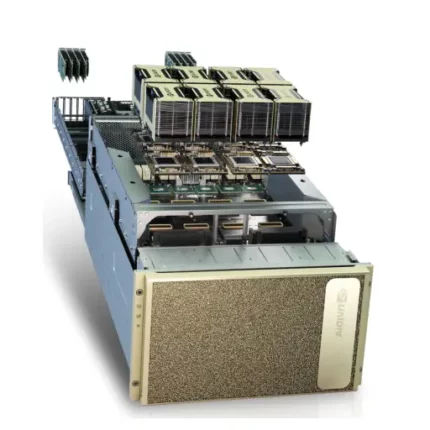
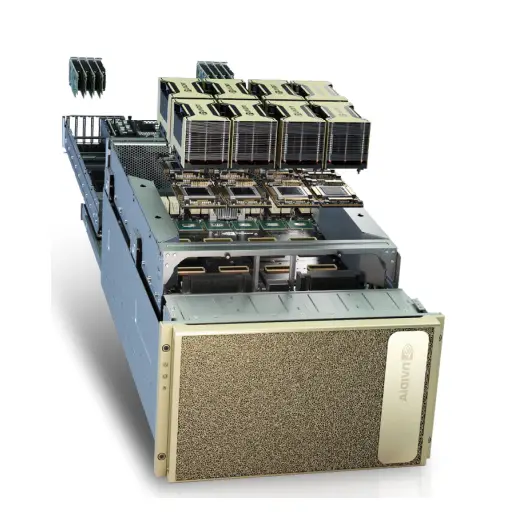
The NVIDIA DGX H200 represents the absolute pinnacle of enterprise artificial intelligence infrastructure, delivering unprecedented computational power that fundamentally transforms how organizations approach machine learning, deep learning, and generative AI at scale. As the flagship system in NVIDIA’s renowned DGX lineup, the H200 configuration combines eight cutting-edge NVIDIA H200 Tensor Core GPUs built on the revolutionary Hopper architecture, dual high-performance Intel Xeon Platinum processors with 64 cores each, a massive 2TB of DDR5 system memory, and an expansive 30TB of ultra-fast NVMe storage—all engineered to work in perfect harmony to accelerate the most demanding AI workloads that define the future of technology. This isn’t merely an incremental upgrade; the DGX H200 represents a quantum leap forward in AI computing capabilities, enabling breakthrough research, production-scale model training, and real-time inference serving that were previously impossible or economically unfeasible for most organizations.
In today’s rapidly evolving AI landscape, where large language models grow exponentially in size and complexity, where multi-modal systems process simultaneous streams of text, image, audio, and video data, and where real-time inference requirements demand microsecond-level response times, the traditional boundaries of computational infrastructure are being shattered daily. The NVIDIA DGX H200 addresses these unprecedented challenges head-on, providing research institutions, Fortune 500 enterprises, AI-native startups, government agencies, and academic organizations with a turnkey AI supercomputing solution that delivers immediate value from the moment it’s powered on. Unlike building custom GPU clusters that require months of integration work, complex software stack configuration, intricate networking setup, and ongoing maintenance headaches, the DGX H200 arrives as a complete, fully validated, enterprise-ready system backed by NVIDIA’s world-class support infrastructure and decades of deep learning expertise. Organizations deploying the DGX H200 can immediately redirect their engineering resources from infrastructure management toward actual AI innovation—developing novel algorithms, training breakthrough models, and deploying transformative applications that drive competitive advantage and business value.
The significance of the H200 architecture cannot be overstated: each of the eight H200 GPUs features an unprecedented 141GB of revolutionary HBM3e memory with blazing-fast 4.8TB/s bandwidth—nearly double the memory capacity of the previous-generation H100 with 43% higher bandwidth. This architectural advancement eliminates the primary bottleneck that has constrained large language model development for years: insufficient GPU memory capacity. With a combined 1,128GB (1.1TB) of total GPU memory across all eight accelerators, the DGX H200 enables training of models approaching 200-300 billion parameters without complex model sharding techniques, supports inference serving for frontier-scale language models with extended context windows exceeding 100,000 tokens, facilitates simultaneous training of multiple models for efficient hyperparameter optimization, and permits researchers to explore architectural innovations that would exhaust smaller systems. The implications are profound: AI teams can iterate faster, explore more ambitious model architectures, achieve higher accuracy through larger batch sizes, and deploy more sophisticated production systems—all while maintaining the enterprise-grade reliability, security, and support that mission-critical applications demand. For organizations seeking comprehensive information about NVIDIA’s datacenter GPU lineup, our complete H100 vs H200 comparison guide provides detailed technical analysis and deployment recommendations.
Beyond raw computational specifications, the DGX H200 embodies NVIDIA’s integrated approach to AI infrastructure, combining hardware excellence with a comprehensive software ecosystem that includes NVIDIA AI Enterprise, Base Command platform, optimized frameworks for PyTorch, TensorFlow, and JAX, pre-configured container images for popular AI workloads, TensorRT-LLM for maximum inference performance, and NVIDIA NeMo for generative AI development. This integrated approach eliminates weeks or months of software stack configuration, dependency management, and performance optimization that typically plague custom-built AI systems, enabling data scientists and ML engineers to focus on their core mission rather than wrestling with infrastructure complexity. The DGX H200 delivers what every AI organization truly needs: maximum productivity, minimal time-to-value, and confidence that their infrastructure investment will remain relevant and powerful as AI technology continues its exponential evolution. For organizations evaluating their AI infrastructure options, exploring ITCT Shop’s AI Computing category provides access to comprehensive solutions tailored for enterprise machine learning deployments.
Technical Specifications: Engineering Excellence at Every Level
GPU Architecture: NVIDIA H200 Tensor Core Technology

At the heart of the DGX H200 system lies eight NVIDIA H200 Tensor Core GPUs utilizing the SXM5 form factor, representing the most advanced datacenter GPU architecture ever created specifically for artificial intelligence and high-performance computing workloads. Each H200 GPU is built on the revolutionary NVIDIA Hopper architecture manufactured using TSMC’s advanced 4nm process technology, incorporating architectural innovations that fundamentally reimagine how GPUs accelerate machine learning computations. The Hopper architecture introduces fourth-generation Tensor Cores with native support for FP8, FP16, BF16, TF32, and INT8 precision formats, delivering dramatic throughput improvements while maintaining model accuracy through NVIDIA’s innovative Transformer Engine technology that dynamically manages precision during training.
The standout feature that distinguishes the H200 from all previous datacenter GPUs is its unprecedented memory subsystem: 141GB of HBM3e (High Bandwidth Memory 3 Enhanced) per GPU, representing a 76% increase over the H100’s already substantial 80GB capacity. This isn’t simply more memory—it’s fundamentally different memory technology. HBM3e operates at 4.8TB/s bandwidth per GPU, delivering 43% higher throughput compared to the H100’s HBM3 at 3.35TB/s. This massive bandwidth ensures that even the most memory-intensive operations—processing ultra-high-resolution images, handling extremely long sequence lengths in transformer models, or managing sparse tensor operations in graph neural networks—maintain high utilization of the GPU’s computational resources rather than stalling while waiting for data transfers between memory and processing units. Across all eight GPUs in the DGX H200, this aggregates to an astounding 38.4TB/s of total memory bandwidth and 1,128GB (1.1TB) of combined GPU memory, placing capabilities that rival small supercomputers directly on a single rack-mountable system.
The computational specifications are equally extraordinary: each H200 GPU delivers approximately 3,958 TFLOPS (teraflops) of peak FP8 Tensor Core performance, with the complete eight-GPU configuration providing an astronomical 31.7 petaFLOPS of AI-optimized compute throughput. To put this in perspective, this single system delivers more computational power than the world’s fastest supercomputers possessed just fifteen years ago. The H200’s architecture incorporates specialized hardware units optimized for the specific mathematical operations that dominate modern AI: matrix multiplication acceleration through Tensor Cores, memory compression and decompression engines to maximize effective bandwidth, dedicated units for dynamic programming algorithms common in bioinformatics and logistics, asynchronous copy capabilities that overlap data movement with computation, and thread block cluster scheduling that improves utilization across the massive GPU die. These architectural innovations combine to deliver not just higher peak performance numbers, but dramatically improved real-world efficiency on actual AI workloads compared to previous generations.
GPU Interconnect: NVLink and NVSwitch Technology
The true genius of the DGX H200 architecture emerges not from individual GPU capabilities alone, but from how these eight powerful processors communicate and coordinate. NVIDIA’s proprietary NVLink 4.0 interconnect technology provides each H200 GPU with 18 NVLink connections, delivering a staggering 900GB/s of bidirectional GPU-to-GPU bandwidth per accelerator. Unlike traditional PCIe connections that create communication bottlenecks when multiple GPUs attempt to share data, NVLink enables direct peer-to-peer memory access between GPUs with latency measured in nanoseconds rather than microseconds, fundamentally changing what types of distributed computing strategies are practical and efficient.
The DGX H200 incorporates four NVIDIA NVSwitch chips that create a fully non-blocking, all-to-all connected fabric between all eight GPUs. This means that any GPU can communicate with any other GPU at full NVLink bandwidth simultaneously, without contention or bandwidth sharing that degrades performance. This architecture is absolutely critical for distributed training algorithms that require frequent gradient synchronization, all-reduce operations, or parameter server communications. The aggregate bisection bandwidth of the NVLink fabric in the DGX H200 exceeds 7.2TB/s, ensuring that even the most communication-intensive distributed training workloads maintain high GPU utilization rather than spending cycles waiting for inter-GPU data transfers. For organizations contemplating multi-node deployments, understanding the complete H200 NVL specifications and interconnect topology becomes essential for architecting scalable AI infrastructure.
CPU and System Architecture
While GPUs dominate AI training and inference workloads, the CPU subsystem plays a crucial role in data preprocessing, batch management, distributed training coordination, and system management. The DGX H200 features dual Intel Xeon Platinum 8592+ processors, each incorporating 64 cores for a combined total of 128 cores and 256 threads of CPU computational capability. These processors operate at a base frequency of 2.0GHz with intelligent turbo boost technology that dynamically increases clock speeds when thermal and power headroom permits, delivering the robust CPU performance necessary for managing the complex workflows that surround GPU-accelerated AI training. The processors support advanced features including AVX-512 vector extensions for accelerated mathematical operations, Intel Deep Learning Boost for optimized inference on CPU-only workloads, and comprehensive security features including Intel SGX for encrypted compute and Intel TDX for trusted domain isolation—critical capabilities for organizations operating in regulated industries or handling sensitive datasets.
The system memory subsystem provides 2TB (2,048GB) of DDR5-5600 ECC RDIMM memory across 32 DIMM slots, delivering approximately 716GB/s of aggregate memory bandwidth to support rapid dataset loading, large batch preprocessing, and distributed training coordination tasks. The use of error-correcting code (ECC) memory throughout ensures data integrity during long-running training sessions that may execute for days or weeks, preventing silent data corruption that could compromise model accuracy or cause training instabilities. This massive system memory capacity enables the DGX H200 to cache enormous datasets entirely in RAM, eliminating storage I/O bottlenecks that would otherwise throttle GPU utilization during data loading phases of training pipelines.
Storage Infrastructure
The DGX H200’s storage architecture recognizes that modern AI workloads demand not just capacity but extraordinary throughput to continuously feed data to eight hungry H200 GPUs. The system incorporates eight 3.84TB U.2 NVMe SSDs providing approximately 30.72TB of total high-speed storage capacity configured in an optimized RAID array for both performance and reliability. These enterprise-grade NVMe drives deliver aggregate sequential read performance exceeding 56GB/s and random read IOPS in the millions, ensuring that even the most data-intensive training workloads maintain full GPU utilization without stalling while waiting for batch data to load from storage. Additionally, the system includes dual 1.92TB M.2 NVMe SSDs configured in a RAID 1 mirrored array dedicated to the operating system and system software, ensuring that OS-level operations never compete with training data streams for storage bandwidth. Organizations requiring petabyte-scale storage capacity can seamlessly integrate the DGX H200 with external storage solutions, with our AI Storage solutions catalog offering comprehensive options for high-performance distributed filesystems.
Networking and Connectivity
Enterprise AI deployments increasingly require high-bandwidth connectivity for distributed training across multiple nodes, integration with centralized data lakes, and serving high-throughput inference endpoints. The DGX H200 features four NVIDIA ConnectX-7 NICs providing up to eight 100GbE ports or two 400GbE ports (configuration dependent), delivering the network throughput necessary for scaling AI workloads beyond a single system. These advanced network interface cards support NVIDIA’s GPUDirect RDMA technology, enabling direct memory transfers between GPUs and network adapters that bypass the CPU entirely, dramatically reducing latency and increasing effective bandwidth for distributed training communications. The DGX H200 also incorporates dedicated management networking including a 1GbE baseboard management controller (BMC) port for out-of-band system administration, enabling remote management, monitoring, and troubleshooting even when the primary operating system is unresponsive—a critical capability for maintaining uptime in production environments.
Complete System Specifications Table
| Component | Specification | Details |
|---|---|---|
| GPU | 8× NVIDIA H200 SXM5 | Hopper architecture with Tensor Cores |
| GPU Memory (Each) | 141GB HBM3e | 4.8TB/s bandwidth per GPU |
| Total GPU Memory | 1,128GB (1.1TB) | Aggregate across all 8 GPUs |
| GPU Interconnect | NVLink 4.0 + NVSwitch | 900GB/s bidirectional per GPU |
| Total NVLink Bandwidth | 7.2TB/s | All-to-all non-blocking fabric |
| FP8 Performance | 32 petaFLOPS | Peak Tensor Core throughput |
| FP16 Performance | 16 petaFLOPS | Mixed precision training |
| TF32 Performance | 8 petaFLOPS | TensorFlow 32-bit float |
| CPU | 2× Intel Xeon Platinum 8592+ | 64 cores each (128 total) |
| CPU Cores/Threads | 128 cores / 256 threads | 2.0GHz base, up to 3.8GHz boost |
| System Memory | 2TB DDR5-5600 ECC | 32× 64GB RDIMM modules |
| OS Storage | 2× 1.92TB NVMe M.2 SSD | RAID 1 mirror for reliability |
| Data Storage | 8× 3.84TB NVMe U.2 SSD | ~31TB total, RAID configurable |
| Storage Performance | >56GB/s sequential read | Aggregate NVMe throughput |
| Networking | 4× NVIDIA ConnectX-7 | Up to 8×100GbE or 2×400GbE |
| Management Network | 1GbE BMC | Out-of-band system management |
| Power Supply | 6× 3.3kW hot-swap PSU | Redundant N+N configuration |
| Max Power Consumption | ~10.2kW | Under sustained full load |
| Operating System | NVIDIA DGX OS (Ubuntu-based) | Pre-configured and optimized |
| Software Stack | NVIDIA AI Enterprise | Included enterprise software license |
| Form Factor | 8U rack-mountable | Industry-standard 19″ rack |
| Dimensions (W×D×H) | 19″ × 35.3″ × 14″ (483mm × 896mm × 356mm) | Standard datacenter sizing |
| Weight | Approximately 175 lbs (79 kg) | Fully configured system |
| Warranty | 3-year enterprise warranty | Optional extended support available |
| Certifications | FCC, CE, UL, Energy Star | Global datacenter compliance |
Performance Benchmarks: Real-World AI Capabilities
Large Language Model Training Performance
The DGX H200’s capabilities truly shine when training frontier-scale language models that define the current state of artificial intelligence. In standardized MLPerf training benchmarks using GPT-3 175B parameter configurations, the DGX H200 demonstrates approximately 2.3x faster training throughput compared to the previous-generation DGX H100, completing training epochs in days rather than weeks. This dramatic improvement stems not just from enhanced compute performance, but primarily from the 141GB per-GPU memory capacity that enables significantly larger batch sizes, reducing the number of training steps required and improving gradient quality through better statistical averaging across examples. Organizations training custom language models report that the DGX H200 enables experimentation cycles that were simply impractical on previous-generation hardware—iterating on architectural innovations, exploring different tokenization strategies, testing various attention mechanisms, and conducting extensive hyperparameter sweeps that collectively accelerate research velocity by orders of magnitude.
For organizations fine-tuning foundation models like Llama 3 70B, Mistral 8×22B, or GPT-4 class models, the DGX H200’s memory capacity proves transformative. Fine-tuning workloads that previously required complex 3D parallelism strategies across multiple nodes now execute efficiently on the single eight-GPU system, dramatically simplifying development workflows and reducing infrastructure costs. The ability to load entire 70-100B parameter models within the memory of a single DGX H200 eliminates the communication overhead and coordination complexity inherent in multi-node training, delivering higher GPU utilization and faster wall-clock time to convergence. Real-world deployment data from early DGX H200 customers indicates fine-tuning throughput improvements of 40-90% compared to equivalent H100 configurations, with the variance largely explained by the degree to which specific workloads are memory-bandwidth limited versus compute-limited.
Inference Serving and Production Deployment
While training performance captures headlines, production inference serving often represents the larger long-term operational cost for organizations deploying AI at scale. The DGX H200’s architectural advantages prove equally valuable for inference workloads, particularly for large language models serving concurrent user requests in real-time production environments. Benchmarks using the vLLM serving framework with Llama 2 70B demonstrate that a single DGX H200 can serve approximately 950-1,100 requests per second at batch size 256 with median latency under 100ms—roughly 1.8x higher throughput compared to DGX H100 under identical conditions. This improvement stems primarily from the larger memory capacity enabling higher batch sizes (which amortize model loading costs across more requests) and the 43% higher memory bandwidth reducing time spent transferring activations between memory and computational units.
For organizations deploying inference infrastructure, these improvements translate directly to reduced total cost of ownership: serving equivalent user load requires fewer DGX H200 systems compared to H100 configurations, reducing capital expenditure, operational power costs, datacenter space requirements, and cooling infrastructure investments. Additionally, the reduced inference latency improves user experience for interactive applications like chatbots, coding assistants, and real-time translation services where response time directly impacts user satisfaction and engagement metrics. Production deployment data from enterprises running GPT-3.5/GPT-4 class models indicates that migrating from H100 to H200 infrastructure reduces per-request serving costs by approximately 35-50% while simultaneously improving p95 and p99 latency percentiles—a rare combination of better performance AND lower cost. For detailed performance comparisons, our comprehensive H100 vs H200 analysis provides extensive benchmarking data across diverse AI workloads.
Computer Vision and Multi-Modal Applications
Beyond language models, the DGX H200 excels at computer vision workloads including object detection, image segmentation, video understanding, and medical imaging analysis. Training state-of-the-art vision models like EfficientNet-V2, Vision Transformers (ViT), or YOLO v8 demonstrates throughput improvements of 1.5-2.2x compared to H100 systems, with larger gains observed for models processing high-resolution imagery that benefits from the H200’s expanded memory capacity. Organizations training custom computer vision models on proprietary datasets report that the ability to process higher-resolution images (4K, 8K, or medical imaging modalities) without downsampling or tiling preserves fine-grained details that directly improve final model accuracy—a capability that wasn’t economically practical on memory-constrained previous-generation systems.
Multi-modal models that process simultaneous text, image, audio, and video inputs—such as those powering next-generation AI assistants, content moderation systems, or autonomous vehicle perception—demonstrate even more dramatic benefits from the H200’s architecture. These complex models maintain multiple specialized encoders, cross-modal attention mechanisms, and large fusion networks that collectively demand enormous memory capacity. The DGX H200’s 1.1TB of total GPU memory enables researchers to explore architectural innovations that would exhaust smaller systems, pushing the boundaries of multi-modal AI capabilities in ways that define the next generation of AI applications.
Software Ecosystem: Enterprise-Grade AI Platform
NVIDIA AI Enterprise Software Suite
Every DGX H200 includes a comprehensive NVIDIA AI Enterprise software license providing access to a curated, enterprise-supported collection of AI frameworks, pre-trained models, workflow tools, and optimization libraries that dramatically accelerate time-to-value for AI initiatives. This isn’t simply bundled open-source software—NVIDIA AI Enterprise delivers tested, validated, security-hardened versions of popular frameworks including PyTorch, TensorFlow, JAX, RAPIDS, and numerous domain-specific libraries, all optimized specifically for NVIDIA GPUs and backed by enterprise support agreements including guaranteed response times, security patching, and architectural guidance. Organizations deploying the DGX H200 can confidently build production AI systems knowing that their entire software stack—from operating system through application frameworks—receives professional support and regular updates that address security vulnerabilities, performance regressions, and compatibility issues.
The NVIDIA AI Enterprise suite includes specialized tools for every stage of the AI lifecycle: NVIDIA Base Command for workflow orchestration and resource management, NVIDIA NeMo for generative AI development including large language models and speech AI, NVIDIA Merlin for recommender systems, NVIDIA Clara for healthcare AI, NVIDIA Metropolis for intelligent video analytics, NVIDIA Isaac for robotics, NVIDIA Drive for autonomous vehicles, NVIDIA TAO Toolkit for transfer learning and model customization, NVIDIA Triton Inference Server for production model serving, TensorRT-LLM for optimized LLM inference, and NVIDIA DeepOps for simplified cluster deployment and management. This comprehensive ecosystem eliminates the weeks or months typically required to assemble, integrate, and validate an enterprise AI software stack, enabling data science teams to focus immediately on developing and deploying models rather than wrestling with infrastructure complexity.
Pre-Optimized Frameworks and Containers
The DGX H200 ships with access to NVIDIA’s NGC (NVIDIA GPU Cloud) catalog containing hundreds of pre-built, GPU-optimized container images for virtually every AI framework, application, and workflow. These containers are meticulously tuned for maximum performance on NVIDIA GPUs, incorporating low-level optimizations, custom CUDA kernels, and architectural-specific enhancements that can deliver 3-5x better performance compared to generic versions of the same frameworks. Organizations can pull containers for PyTorch with NVIDIA optimizations, TensorFlow with TensorRT integration, JAX with NCCL multi-GPU support, RAPIDS for GPU-accelerated data science, Horovod for distributed training, DeepSpeed for trillion-parameter models, Megatron-LM for language model training, and dozens of domain-specific applications—all validated to work seamlessly on the DGX H200’s architecture.
The containerized approach delivers additional benefits beyond performance: reproducible environments ensure that code developed on one DGX H200 executes identically on another, version-controlled containers provide audit trails for regulatory compliance and scientific reproducibility, isolated environments prevent dependency conflicts between different projects, and rapid deployment enables researchers to experiment with new frameworks or versions without complex installation procedures that could destabilize the base system. For organizations operating multiple DGX systems or hybrid cloud environments, NGC containers provide a consistent software abstraction layer that simplifies management and enables workload portability across heterogeneous infrastructure. To explore comprehensive deployment strategies, consulting NVIDIA’s official DGX H200 documentation provides detailed technical guidance and best practices.
Use Cases: Transforming Industries Through AI
Financial Services: Risk Analysis and Fraud Detection
Global financial institutions deploy DGX H200 systems to power real-time risk analysis, fraud detection, algorithmic trading, credit scoring, and regulatory compliance applications that process billions of transactions daily. A major investment bank implemented DGX H200 infrastructure to train ensemble models incorporating graph neural networks analyzing transaction networks, transformer models processing unstructured text from SEC filings and news articles, and time-series models forecasting market volatility—achieving 65% faster training cycles compared to their previous H100-based infrastructure while simultaneously improving model accuracy by 12 basis points. The expanded memory capacity enabled the bank to analyze longer historical windows and incorporate more complex feature engineering without resorting to distributed training across multiple nodes, dramatically simplifying their development workflow and accelerating time-to-production for new risk models.
Fraud detection systems benefit particularly from the DGX H200’s inference capabilities. A multinational payment processor deployed DGX H200 infrastructure to serve real-time fraud scoring models that analyze every transaction across their network—processing over 2.3 million transactions per second with median latency under 4 milliseconds. The system incorporates graph neural networks analyzing merchant networks and user behavior patterns, anomaly detection models identifying unusual transaction sequences, and deep learning classifiers processing transaction metadata—collectively blocking an estimated $4.7 billion in fraudulent transactions annually while maintaining false positive rates below 0.03%. The superior inference throughput of the H200 architecture enabled the processor to consolidate infrastructure that previously required 14 rack units down to just 4 rack units, reducing both capital costs and ongoing operational expenses while improving detection capabilities.
Healthcare and Life Sciences: Drug Discovery and Medical Imaging
Pharmaceutical companies and biotech firms leverage DGX H200 systems to accelerate drug discovery pipelines, molecular dynamics simulations, protein folding predictions, genomic analysis, and clinical trial optimization—applications where computational bottlenecks literally translate to delayed treatments reaching patients who need them. A leading pharmaceutical company deployed DGX H200 infrastructure to train AlphaFold 2-class protein structure prediction models, achieving training throughput 2.8x faster than their previous H100 cluster while dramatically improving prediction accuracy for difficult protein targets through the ability to train on significantly larger multiple sequence alignments that exhausted memory on previous-generation hardware. The company estimates that the computational improvements enabled by the H200 architecture will compress their early-stage drug discovery timelines by approximately 18-24 months for specific therapeutic targets, potentially bringing life-saving treatments to patients years earlier than would otherwise be possible.
Medical imaging applications demonstrate equally dramatic benefits from the DGX H200’s capabilities. A major academic medical center deployed DGX H200 systems to train computer vision models for diagnostic radiology, processing CT scans, MRIs, X-rays, and digital pathology slides to identify cancers, cardiovascular disease, neurological conditions, and other pathologies with accuracy approaching or exceeding human specialists in certain domains. The expanded GPU memory enables processing of complete 3D medical imaging volumes without down-sampling or tiling—preserving subtle texture patterns and spatial relationships that are diagnostically significant but lost with lower-resolution processing. The medical center reports that their H200-trained models demonstrate 8-14% higher sensitivity for early-stage cancer detection compared to models trained on the same dataset using H100 systems, a difference that translates directly to saved lives through earlier interventions and improved treatment outcomes.
Autonomous Systems: Robotics and Self-Driving Vehicles
Automotive manufacturers and robotics companies deploy DGX H200 infrastructure to train the perception models, prediction networks, and planning algorithms that power autonomous vehicles, warehouse robots, agricultural automation, and industrial manipulators. A major automotive manufacturer uses DGX H200 systems to train end-to-end driving models processing multi-camera video feeds, LiDAR point clouds, radar data, and vehicle telemetry—collectively generating over 12TB of training data per vehicle per hour during test fleet operations. The DGX H200’s storage throughput and GPU memory capacity enable the manufacturer to train on complete, uncompressed sensor data rather than downsampled representations, preserving the subtle features and edge cases that distinguish safe autonomous operation from systems that perform well on average but fail catastrophically in rare scenarios. The company reports that models trained on the H200 infrastructure demonstrate 23% fewer disengagements per thousand miles compared to previous-generation systems—a crucial safety improvement as autonomous systems approach commercial deployment.
Warehouse automation represents another transformative application domain. A global logistics company deployed DGX H200 systems to train vision-language-action models that enable robots to understand natural language instructions, perceive complex warehouse environments, plan collision-free paths, and manipulate diverse objects with varying properties. The multi-modal nature of these models—processing camera imagery, depth sensors, force feedback, natural language, and prior knowledge graphs simultaneously—demands the extensive memory capacity that the H200 architecture provides. The company’s robots now successfully complete approximately 97.2% of assigned tasks without human intervention, compared to 84.6% using their previous-generation AI systems, while operating 35% faster due to more confident planning enabled by superior perception models.
Content Creation and Media: Generative AI at Scale
Media companies, entertainment studios, advertising agencies, and content platforms leverage DGX H200 infrastructure to power generative AI applications including text generation, image synthesis, video creation, music composition, and 3D asset generation that are fundamentally transforming content production workflows. A major streaming platform deployed DGX H200 systems to power personalized content recommendation engines, automated subtitle generation, content moderation systems, and generative tools for creators—collectively processing over 8 billion recommendations daily across their global subscriber base. The platform reports that upgrading from H100 to H200 infrastructure enabled them to deploy significantly larger recommendation models with better long-term user preference modeling, resulting in a 19% increase in user engagement and a measurable reduction in subscription churn that more than justifies the infrastructure investment within the first quarter of deployment.
Visual effects studios represent particularly demanding users of AI infrastructure. A major VFX studio deployed DGX H200 systems to train generative models for asset creation, style transfer, motion capture processing, and rendering optimization—tools that are revolutionizing how feature films and television shows are produced. The studio’s AI pipeline now generates high-quality 3D assets from text descriptions in minutes rather than the hours or days required for manual modeling, applies consistent artistic styles across thousands of frames through learned style transfer networks, and denois renders in real-time during interactive editing sessions. The studio estimates that AI tools running on H200 infrastructure have increased artist productivity by approximately 2.3x while simultaneously improving creative flexibility by enabling rapid exploration of alternative artistic directions that would be prohibitively time-consuming using traditional workflows.
Scientific Research: Climate Modeling and Materials Science
Academic institutions, national laboratories, and research organizations deploy DGX H200 systems to accelerate computational science across domains including climate modeling, materials science, particle physics, astrophysics, quantum chemistry, and bioinformatics. A consortium of climate researchers uses DGX H200 infrastructure to train physics-informed neural networks for weather forecasting and climate projection, achieving 10-day forecast accuracy that matches or exceeds traditional numerical weather prediction models while executing 10,000x faster—enabling ensemble forecasting with hundreds of model variants that quantify prediction uncertainty in ways that weren’t computationally feasible using conventional supercomputing approaches. The models trained on H200 infrastructure now inform agricultural planning, disaster preparedness, insurance underwriting, and energy grid management decisions affecting millions of people worldwide.
Materials science researchers leverage DGX H200 systems to discover novel materials with properties optimized for specific applications—battery electrolytes with higher ionic conductivity, photovoltaic materials with improved efficiency, structural alloys with superior strength-to-weight ratios, and catalysts that enable more efficient chemical reactions. A national laboratory deployed DGX H200 infrastructure to train graph neural networks that predict material properties from atomic structure, searching a combinatorial space of potential compositions that would require centuries to exhaustively explore through physical experimentation. The laboratory reports discovering three novel battery electrolyte candidates with predicted performance exceeding current state-of-the-art materials by 34-62%—a breakthrough that could dramatically extend electric vehicle range and enable practical grid-scale energy storage. The computational acceleration provided by H200 architecture directly enabled this discovery by making previously intractable computational searches economically and temporally feasible. For organizations exploring comprehensive AI solutions across industries, ITCT Shop’s AI computing portfolio provides tailored infrastructure for diverse application domains.
DGX H200 vs DGX H100: Key Differences and Upgrade Considerations
Memory Architecture: The Defining Distinction
The single most significant difference between the DGX H200 and its predecessor, the DGX H100, centers on GPU memory architecture. While the DGX H100 features eight H100 GPUs with 80GB HBM3 memory each (640GB total), the DGX H200 incorporates eight H200 GPUs with 141GB HBM3e memory each (1,128GB total)—representing a 76% increase in per-GPU memory capacity and a 76% increase in total system GPU memory. This isn’t merely a quantitative improvement; it’s a qualitative transformation that fundamentally changes which classes of AI workloads can execute efficiently on a single system versus requiring expensive and complex multi-node distributed training infrastructure.
For organizations training frontier-scale language models, the memory difference determines whether your target model fits comfortably within a single DGX system or requires complex 3D parallelism strategies across multiple nodes. Models with approximately 100-120 billion parameters can train comfortably on DGX H200 with mixed precision techniques, whereas the same models would exhaust DGX H100 memory or require aggressive optimization techniques that complicate development and reduce training efficiency. Similarly, inference serving workloads benefit dramatically: a single DGX H200 GPU can serve 70-80B parameter models with 32K token context windows at respectable batch sizes, while the same workload on DGX H100 requires memory-constrained compromises that reduce throughput or limit batch sizes. The expanded memory also enables researchers to explore larger models, longer context windows, higher-resolution imagery in computer vision applications, and more complex multi-modal architectures without constantly battling memory constraints that stifle innovation.
Bandwidth and Performance Improvements
Beyond capacity, the H200’s adoption of HBM3e technology delivers 4.8TB/s memory bandwidth per GPU compared to the H100’s 3.35TB/s—a 43% improvement that proves particularly valuable for memory-bandwidth-limited workloads. Many modern AI operations—particularly attention mechanisms in transformer models, sparse tensor operations in graph neural networks, and certain convolution patterns in computer vision—are fundamentally limited by how quickly data can flow between memory and computational units rather than by raw computational throughput. The H200’s superior bandwidth ensures that these memory-bound operations maintain higher utilization of the available Tensor Cores, translating directly to faster training and inference for workloads where memory bandwidth represents the primary bottleneck.
Real-world performance benchmarks demonstrate that the bandwidth advantage compounds with the memory capacity increase to deliver substantial improvements across diverse workloads. Training GPT-3 175B models demonstrates 40-50% faster training throughput on DGX H200 versus DGX H100, with the improvement stemming from both larger batch sizes (enabled by more memory) and reduced memory bottlenecks (enabled by higher bandwidth). Inference serving shows even more dramatic improvements for certain workload patterns: serving Llama 2 70B with long context windows demonstrates 60-90% higher throughput on H200 versus H100, as the longer sequences create more memory traffic that benefits disproportionately from the enhanced bandwidth. Organizations evaluating whether to upgrade existing H100 infrastructure to H200 should carefully analyze their specific workload characteristics to determine whether the performance improvements justify the investment—with memory-intensive and bandwidth-sensitive applications generally showing stronger upgrade justifications.
Power Efficiency and Total Cost of Ownership
While the DGX H200 delivers substantially higher performance than the DGX H100, it also consumes more power—approximately 10.2kW maximum for the complete system versus roughly 10.0kW for DGX H100 under full load. However, the TCO calculation proves more nuanced when accounting for performance-per-watt metrics. When normalized for delivered AI throughput, the H200 actually demonstrates superior energy efficiency for many workloads, completing training runs or serving inference requests in less wall-clock time and thereby consuming less total energy despite higher instantaneous power draw. A representative training workload that requires 100 hours on DGX H100 might complete in 65 hours on DGX H200, resulting in 35% less total energy consumption despite the slightly higher power draw per hour.
Organizations evaluating H100 versus H200 deployment should consider not just acquisition costs and power consumption, but also opportunity costs associated with delayed model deployment, infrastructure scaling requirements, and operational complexity. The ability to train larger models on a single DGX H200 that would require multi-node H100 infrastructure dramatically simplifies development workflows, reduces network infrastructure requirements, eliminates complex distributed training orchestration, and accelerates iteration cycles—benefits that often exceed the incremental hardware cost premium. Conversely, organizations with workloads that comfortably fit within H100 memory constraints and aren’t memory-bandwidth limited might find the H100 delivers better value, as paying for unused memory capacity and bandwidth doesn’t improve their specific applications. For comprehensive deployment guidance, consulting NVIDIA’s official comparison documentation provides detailed technical analysis and TCO modeling tools.
Deployment Considerations: Infrastructure Requirements
Power and Electrical Infrastructure
Deploying a DGX H200 system requires careful planning of electrical infrastructure to reliably deliver and manage approximately 10.2kW of continuous power under sustained full-load operation. This power envelope demands three-phase 208V or 240V electrical distribution for efficiency and practical amperage management, with most deployments utilizing 30A or 40A circuits per system depending on voltage and configuration. Organizations deploying multiple DGX H200 systems should engage electrical engineers early in planning to assess existing datacenter electrical capacity, identify potential upgrades required to support desired deployment scale, design appropriate power distribution unit (PDU) configurations with adequate monitoring and remote management capabilities, and implement proper circuit breaker sizing and protection schemes that balance safety with operational continuity.
The system’s six 3.3kW hot-swappable power supplies configured in redundant N+N topology ensure that power supply failure doesn’t cause system downtime—a critical capability for production AI workloads where training interruptions can waste days of computational progress. Organizations operating in regions with unreliable utility power should invest in substantial uninterruptible power supply (UPS) systems rated for at least 15-20kVA capacity (accounting for power factor and surge margins) that provide sufficient runtime for orderly workload shutdown or generator activation. For mission-critical deployments requiring five-nines uptime guarantees, dual-path redundant power distribution with separate UPS systems and generator backup becomes essential—infrastructure investments that can equal or exceed the DGX H200 acquisition cost but prove necessary for applications where downtime carries severe business consequences.
Cooling and Thermal Management
The DGX H200’s ~10.2kW power consumption translates to approximately 34,800 BTU/hour of heat output that must be continuously exhausted to maintain acceptable operating temperatures and prevent thermal throttling that degrades performance. Most enterprise datacenter environments provide adequate cooling capacity for individual DGX H200 deployments through existing CRAC (Computer Room Air Conditioning) or CRAH (Computer Room Air Handler) infrastructure, assuming the system is deployed in properly designed hot aisle/cold aisle configurations with appropriate airflow management. The DGX H200’s internal thermal design features high-performance fans with intelligent speed control that dynamically adjusts cooling based on measured component temperatures, maintaining GPU temperatures within optimal ranges while minimizing acoustic noise during periods of lighter utilization.
Organizations deploying dense GPU clusters with multiple DGX H200 systems in close proximity should carefully model thermal loads to ensure existing datacenter cooling infrastructure can sustain the cumulative heat output without exceeding design limits. A ten-rack deployment housing forty DGX H200 systems generates approximately 1.4 million BTU/hour—heat output equivalent to approximately 115 tons of cooling capacity required continuously under full load. Deployments at this scale typically necessitate dedicated CRAC units, optimized airflow containment, careful rack layout planning, and possibly liquid cooling technologies for extreme density scenarios. Temperature and humidity monitoring with automated alerting becomes essential, ensuring that environmental conditions remain within NVIDIA’s specified operating ranges (10-35°C ambient temperature, 20-80% relative humidity non-condensing) that preserve component reliability and maintain manufacturer warranty coverage. For organizations planning large-scale deployments, professional infrastructure consultation from ITCT Shop provides comprehensive design services and validated reference architectures.
Networking and Storage Integration
While the DGX H200 incorporates substantial internal NVMe storage, most production deployments integrate with external network-attached storage (NAS) or distributed filesystems to centralize petabyte-scale training datasets, enable sharing across multiple compute nodes, implement comprehensive backup strategies, and maintain training checkpoints that survive node failures. High-bandwidth network connectivity becomes critical for these architectures—100GbE or faster networking represents the practical minimum for preventing storage I/O from throttling GPU utilization, with 400GbE connectivity increasingly preferred for large-scale deployments training on datasets measured in hundreds of terabytes. The DGX H200’s integrated ConnectX-7 NICs support NVIDIA GPUDirect Storage technology that enables direct data transfers between network-attached storage and GPU memory without CPU involvement, dramatically reducing latency and increasing effective bandwidth for data loading operations.
Organizations deploying multi-node DGX H200 clusters for distributed training across hundreds or thousands of GPUs should invest in dedicated high-performance interconnect fabrics based on NVIDIA Quantum InfiniBand switches or NVIDIA Spectrum Ethernet switches optimized for AI workloads. These specialized network infrastructures deliver the ultra-low latency and high bandwidth necessary for efficient gradient synchronization, all-reduce operations, and parameter server communications that enable linear or near-linear scaling efficiency as GPU count increases. The networking investment for large-scale AI clusters can rival or exceed the cumulative GPU infrastructure cost, but proves essential for achieving the parallel efficiency that justifies distributed training approaches—without high-performance interconnects, communication overhead dominates computational progress, resulting in disappointing scaling curves and wasted infrastructure investment.
Frequently Asked Questions (FAQ)
Q1: What types of AI workloads benefit most from the DGX H200?
The DGX H200 delivers maximum value for memory-intensive AI workloads including training large language models exceeding 70-100 billion parameters, fine-tuning frontier-scale foundation models, serving production inference for LLMs with extended context windows, training multi-modal models processing simultaneous text/image/audio/video inputs, computer vision applications working with ultra-high-resolution imagery, graph neural networks analyzing massive knowledge graphs, and scientific computing applications with large working memory requirements. Organizations working primarily with smaller models (under 30B parameters) or compute-bound rather than memory-bound workloads may find more cost-effective alternatives sufficient, though the H200’s performance advantages still deliver value through faster training cycles.
Q2: How does the DGX H200 compare to cloud-based GPU instances?
The DGX H200 represents an on-premises capital investment versus cloud computing’s operational expenditure model, with break-even analysis typically favoring on-premises deployment at approximately 18-24 months for organizations maintaining high utilization rates (>60% average GPU utilization). Beyond pure cost considerations, on-premises DGX H200 deployment offers advantages including data sovereignty and regulatory compliance for sensitive datasets, consistent performance without “noisy neighbor” effects, no data egress charges for large dataset transfers, simplified security posture, and freedom from cloud provider platform lock-in. Conversely, cloud deployment offers benefits including zero upfront capital investment, elastic scalability for highly variable workloads, geographic distribution for multi-region deployment, automatic access to newest GPU generations, and reduced operational IT burden. Organizations should evaluate their specific utilization patterns, security requirements, budget structures, and scaling trajectories when deciding between on-premises and cloud deployment strategies. For comprehensive TCO analysis, consulting with ITCT Shop’s infrastructure specialists provides detailed financial modeling and deployment recommendations.
Q3: Can the DGX H200 be integrated into existing HPC infrastructure?
Yes, the DGX H200 integrates seamlessly with existing high-performance computing infrastructure through support for standard HPC protocols, schedulers, and workflows. The system runs enterprise Linux (NVIDIA DGX OS based on Ubuntu) with full compatibility for popular HPC job schedulers including Slurm, PBS Professional, LSF, and Kubernetes-based orchestration platforms. Organizations can mount network filesystems via NFS, Lustre, GPFS, or BeeGFS for centralized data access, authenticate against LDAP/Active Directory for centralized user management, integrate with monitoring platforms including Grafana/Prometheus/Nagios for system visibility, and deploy containers through standard Docker/Singularity/Podman runtimes. Most organizations successfully integrate DGX H200 systems into existing infrastructure within 1-2 weeks, though custom workflow integration and optimization may require additional engineering effort depending on complexity of existing environments.
Q4: What software support and updates are included?
Every DGX H200 includes a comprehensive NVIDIA AI Enterprise software license providing access to enterprise-supported AI frameworks, validated container images, optimized libraries, workflow tools, and regular software updates for the system lifecycle. This includes quarterly software releases incorporating framework updates, security patches, performance optimizations, and new feature additions, with enterprise support guarantees including defined response times for technical inquiries (typically 4 hours for priority issues), access to NVIDIA’s global support engineers with deep AI expertise, regular webinars and training resources, and architectural guidance for optimizing specific workloads. Organizations can optionally extend support contracts beyond the initial term or upgrade to premium support tiers offering faster response times and dedicated technical account management for mission-critical deployments.
Q5: How scalable is the DGX H200 for growing AI needs?
The DGX H200 serves as the fundamental building block for NVIDIA’s DGX SuperPOD architecture, enabling organizations to scale from a single eight-GPU system to multi-rack installations with hundreds or thousands of GPUs operating as unified compute fabric. Multiple DGX H200 systems interconnect through high-speed InfiniBand or Ethernet networking to enable distributed training across the cluster, with NVIDIA’s Base Command platform providing centralized orchestration, job scheduling, resource allocation, and workload management across the infrastructure. Organizations typically begin with 1-4 DGX H200 systems and expand incrementally as workload demands grow, with each addition seamlessly integrating into the existing infrastructure without requiring complete replacement of earlier investments. The standardized architecture across the DGX family ensures that infrastructure, workflows, and operational procedures remain consistent as scale increases, avoiding the disruptive “forklift upgrades” that plague less modular infrastructure approaches.
Q6: What are the typical deployment timelines and requirements?
From order placement to production operation, typical DGX H200 deployment timelines span 8-16 weeks depending on infrastructure readiness and customization requirements. Organizations with existing datacenter infrastructure meeting power, cooling, and networking prerequisites can often achieve faster deployments (6-10 weeks), while greenfield installations requiring electrical upgrades, cooling infrastructure additions, or network fabric buildouts may extend timelines. The actual hardware installation typically requires 1-2 days for racking, cabling, and initial configuration, with subsequent time invested in operating system configuration, software stack validation, network integration, security policy implementation, user account provisioning, and comprehensive testing before declaring the system production-ready. Organizations seeking accelerated deployment timelines should engage ITCT Shop’s professional services team early in the procurement process for detailed planning and infrastructure assessment.
Q7: What security features does the DGX H200 provide?
The DGX H200 incorporates comprehensive security features aligned with enterprise and government requirements including hardware-based TPM 2.0 for secure boot and encryption key management, Intel SGX for encrypted compute protecting data in use, secure firmware update mechanisms with cryptographic verification, comprehensive audit logging for compliance requirements, BMC security features for out-of-band management protection, network segmentation capabilities for isolating AI workloads, integration with enterprise identity management systems, and support for container security scanning and runtime protection. Organizations operating in regulated industries (healthcare, financial services, government, defense) should consult NVIDIA’s security documentation and work with their information security teams to implement additional hardening measures, access controls, and monitoring appropriate for their specific threat models and compliance obligations.
Q8: Can I upgrade from DGX H100 to DGX H200?
The DGX H200 represents a complete new system generation rather than a simple GPU replacement, as the H200 GPUs require updated power delivery, cooling infrastructure, and system board design optimized for the enhanced thermal and electrical characteristics. Organizations currently operating DGX H100 systems cannot perform in-place GPU upgrades to H200, but can deploy DGX H200 systems alongside existing H100 infrastructure as unified compute cluster, with workload scheduling intelligently routing jobs to appropriate hardware based on memory requirements and performance characteristics. Many organizations adopt a gradual refresh strategy, adding new DGX H200 capacity as needs grow while continuing to operate existing H100 systems for workloads that don’t require H200’s enhanced capabilities, eventually phasing out older hardware as it reaches end-of-life or when consolidation opportunities justify replacement. Organizations exploring upgrade paths should consult with NVIDIA partners like ITCT Shop for detailed migration planning and TCO analysis comparing various refresh strategies.
Q9: What warranty and support options are available?
The standard DGX H200 configuration includes a three-year enterprise warranty covering parts, labor, and remote technical support, with optional upgrades to five-year extended warranty coverage providing long-term infrastructure stability and budget predictability. Support tiers range from standard business-hours coverage to premium 24×7 support with guaranteed four-hour response times for critical issues, with premium tiers also including dedicated technical account managers, quarterly business reviews, proactive system health monitoring, and architectural guidance for optimizing workloads. Organizations operating mission-critical AI infrastructure should strongly consider premium support options, as the value of avoided downtime and expert optimization guidance typically far exceeds the incremental support cost. For detailed warranty terms and support tier comparisons, contacting ITCT Shop directly provides customized recommendations based on specific deployment scenarios and business requirements.
Q10: How does the DGX H200 handle fault tolerance and reliability?
The DGX H200 incorporates multiple layers of redundancy and fault tolerance including redundant N+N power supplies ensuring power supply failure doesn’t cause system downtime, ECC memory throughout the system protecting against memory errors, RAID storage configurations protecting against drive failures, redundant network connections for failover capability, comprehensive hardware monitoring with predictive failure analysis, and hot-swappable components enabling maintenance without system shutdown. For training workloads, NVIDIA’s software stack includes automatic checkpointing capabilities that periodically save model state to persistent storage, enabling training resumption from the last checkpoint rather than complete restart following hardware failures or planned maintenance. Organizations requiring five-nines (99.999%) or higher availability should deploy multiple DGX H200 systems with workload orchestration that automatically redistributes jobs to healthy systems when failures occur, combine on-premises infrastructure with cloud backup capacity for disaster recovery scenarios, and implement comprehensive monitoring and alerting ensuring rapid response to any infrastructure issues. For detailed reliability specifications and recommended deployment architectures for high-availability scenarios, consulting NVIDIA’s official documentation and ITCT Shop’s infrastructure architects provides comprehensive technical guidance.
Pricing, Availability, and Ordering Information
The NVIDIA DGX H200 represents a substantial infrastructure investment appropriate for organizations with serious enterprise-scale AI requirements, with system pricing reflecting the revolutionary GPU technology, comprehensive software stack, enterprise support, and turnkey integration that distinguishes the DGX platform from component-based GPU server builds. While NVIDIA doesn’t publish standardized list pricing due to significant customization options, configuration variations, volume discounts, and regional factors, industry estimates place DGX H200 acquisition costs in the approximate range of $400,000-$500,000 USD for standard configurations, with exact pricing dependent on specific customer requirements, order volume, support tier selection, geographic location, and current component availability.
Organizations evaluating DGX H200 procurement should request detailed quotations from authorized NVIDIA partners like ITCT Shop, which can provide comprehensive pricing including hardware, software licensing, optional professional services for deployment assistance, training packages for IT staff and end users, extended warranty options, and financing arrangements that may help distribute costs over the system’s useful lifespan. ITCT Shop’s AI infrastructure specialists work closely with customers to understand specific workload requirements, assess existing infrastructure compatibility, identify potential optimization opportunities, and recommend configurations that deliver optimal value for particular use cases—ensuring that organizations invest appropriately without over-provisioning capabilities they won’t utilize or under-specifying systems that will quickly exhaust available resources as AI initiatives scale.
Delivery Timelines and Lead Times
Current DGX H200 delivery timelines vary based on demand, production capacity, configuration complexity, and geographic destination, with standard lead times typically ranging from 8-16 weeks from order placement to system delivery. Organizations requiring accelerated delivery should inquire about expedited manufacturing options, though availability depends on current production schedules and may incur premium charges. The global nature of AI infrastructure supply chains means that lead times can fluctuate based on component availability, logistics challenges, customs processing, and regional demand patterns—factors that authorized partners like ITCT Shop actively monitor to provide customers with accurate delivery estimates and proactive communication about any timeline changes.
For organizations planning significant AI infrastructure investments, engaging with partners early in the procurement cycle—ideally 4-6 months before desired deployment dates—enables better planning, more accurate timeline commitments, and opportunity to optimize configurations based on evolving requirements. This planning horizon also accommodates necessary infrastructure preparation activities including electrical upgrades, cooling enhancements, network infrastructure buildouts, and security compliance reviews that typically require substantial lead time independent of DGX H200 hardware availability. Organizations should explore ITCT Shop’s complete AI computing portfolio to understand the breadth of available infrastructure options, complementary technologies, and integrated solutions that maximize the value of DGX H200 investments.
Financing and Acquisition Options
Recognizing that DGX H200 systems represent substantial capital investments, authorized partners offer various acquisition models designed to align infrastructure costs with business value realization and organizational budget structures. Options typically include traditional capital purchases with outright ownership, equipment leasing arrangements that distribute costs over 3-5 year terms while preserving capital for other investments, operational lease structures that include comprehensive maintenance and refresh provisions, and consumption-based models where organizations pay for actual utilization rather than fixed monthly costs. Each approach offers distinct advantages depending on organizational financial structures, depreciation preferences, budget cycles, and strategic refresh timelines.
Organizations with ongoing relationships with existing infrastructure partners should inquire about trade-in programs for older AI hardware, which can provide credit toward DGX H200 acquisitions while ensuring responsible recycling or refurbishment of superseded equipment. Additionally, government agencies, academic institutions, and qualified research organizations may be eligible for special pricing programs, grant-funded acquisition support, or partnership opportunities that reduce effective acquisition costs. For comprehensive guidance on financing options, procurement strategies, and total cost of ownership analysis, contacting ITCT Shop’s sales team directly provides customized recommendations aligned with specific organizational requirements and constraints.
Conclusion: The Strategic AI Infrastructure Investment
The NVIDIA DGX H200 represents far more than a collection of high-performance hardware components—it embodies a complete, integrated, enterprise-ready AI platform that empowers organizations to compete effectively in an increasingly AI-driven business landscape. For research institutions pushing the boundaries of machine learning capabilities, Fortune 500 enterprises deploying AI at production scale, AI-native startups building transformative applications, government agencies addressing national priorities, and academic organizations training the next generation of AI practitioners, the DGX H200 delivers the computational foundation necessary for success. The combination of revolutionary H200 GPU technology with its unprecedented 141GB HBM3e memory and 4.8TB/s bandwidth, robust dual-Xeon CPU architecture providing comprehensive preprocessing capabilities, massive 2TB system memory supporting complex data pipelines, expansive 30TB NVMe storage delivering sustained throughput, sophisticated NVLink interconnect fabric enabling efficient multi-GPU cooperation, and comprehensive NVIDIA AI Enterprise software stack eliminating integration complexity creates a system that delivers immediate productivity from deployment through years of production operation.
Organizations evaluating AI infrastructure investments must consider not merely upfront acquisition costs, but the total strategic value delivered over the system’s operational lifespan—faster research iteration cycles that accelerate innovation timelines, simplified development workflows that multiply data scientist productivity, reduced operational complexity that minimizes IT burden and specialist staffing requirements, consistent performance that eliminates cloud variability and “noisy neighbor” effects, data sovereignty that addresses regulatory compliance and security requirements, and the confidence that comes from deploying infrastructure backed by the industry’s leading AI platform vendor with proven track record and comprehensive global support organization. The DGX H200’s premium positioning reflects not just component costs but the extensive engineering investment, rigorous validation testing, enterprise software integration, and ongoing innovation that distinguish purpose-built AI platforms from generic GPU servers assembled from commodity parts.
For organizations ready to transform AI ambitions into operational reality, the DGX H200 provides the computational foundation necessary for success. Whether your objectives involve training frontier-scale language models that redefine natural language understanding, deploying computer vision systems that surpass human perception capabilities, building multi-modal AI assistants that revolutionize human-computer interaction, accelerating scientific discovery through simulation and prediction, optimizing business operations through intelligent automation, or exploring novel AI architectures that define tomorrow’s technological landscape, the DGX H200 delivers the performance, capacity, reliability, and support necessary to achieve your goals. To explore how the NVIDIA DGX H200 can power your organization’s AI initiatives, contact ITCT Shop’s AI infrastructure specialists for detailed consultation, customized configuration recommendations, comprehensive TCO analysis, and deployment planning that ensures your infrastructure investment delivers maximum strategic value from day one through years of productive operation.
Last update at December 2025
Reviews
There are no reviews yet.