
What are Edge Boxes?
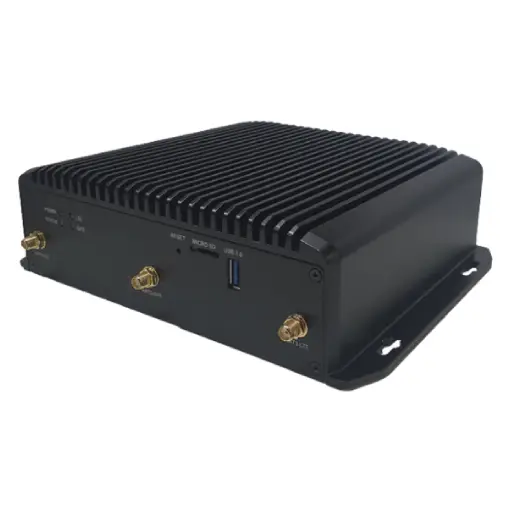
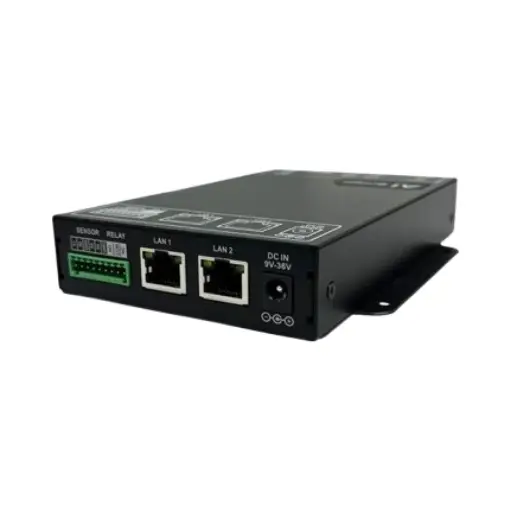
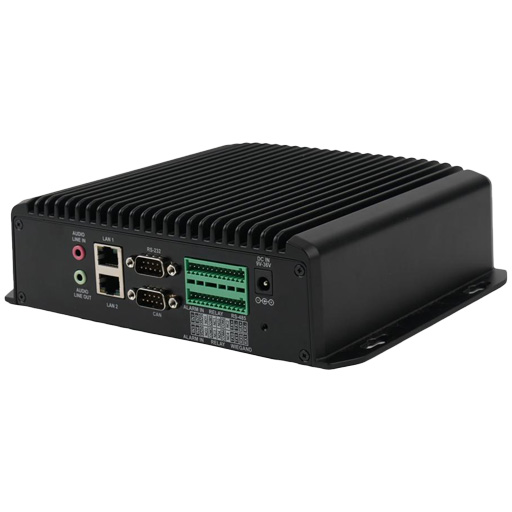
Edge Boxes are compact computing devices designed to process data close to where it is generated, instead of sending everything to centralized cloud servers. By handling data at the edge of the network, these systems significantly reduce latency, improve response time, and enhance data security.
Edge Boxes are commonly equipped with powerful CPUs, GPUs, or AI accelerators and are optimized for running artificial intelligence, machine learning, and real time data processing tasks directly on site.
They are widely used in applications where speed, reliability, and offline performance matter, such as computer vision, industrial automation, smart surveillance systems, robotics, and IoT environments.
How Edge Boxes Work
Edge Boxes are designed to perform data processing and AI inference as close as possible to the data source. Instead of transmitting raw data to centralized servers or cloud platforms, computation is executed locally at the edge, significantly improving speed, efficiency, and reliability.
In a typical workflow, data is first captured from edge devices such as cameras, industrial sensors, medical equipment, or IoT systems. This data is then ingested directly into the Edge Box, where it is processed in real time using high performance CPUs, GPUs, or dedicated AI accelerators.
The Edge Box runs optimized AI models and analytics workloads, including tasks such as computer vision, object detection, facial recognition, predictive maintenance, and anomaly detection. Because inference happens locally, latency is minimized and time sensitive decisions can be made instantly.
After processing, only relevant insights, metadata, or alerts are transmitted to centralized servers or cloud platforms, rather than the full raw data stream. This approach reduces bandwidth consumption, lowers operational costs, and enhances data privacy and security.
Another critical advantage of Edge Boxes is their ability to operate independently of constant network connectivity. Even in environments with unstable or limited internet access, Edge Boxes continue to function autonomously, ensuring uninterrupted processing. This makes them ideal for mission critical deployments in industrial automation, smart cities, retail analytics, healthcare, and advanced AI driven systems.
Architecture of AI Edge Boxes
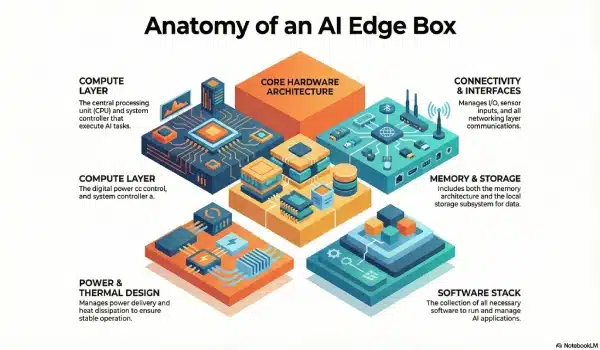
The architecture of AI Edge Boxes is designed to deliver high-performance, low-latency AI processing close to the data source. These systems combine optimized hardware and software components in a compact, industrial-ready form factor to support real-time inference and edge intelligence.
Compute Layer
At the core of an AI Edge Box is the compute engine, typically powered by GPUs (such as NVIDIA Jetson or RTX series), NPUs, or dedicated AI accelerators. This layer is responsible for executing AI inference workloads, computer vision tasks, and real-time analytics with high parallel processing efficiency.
CPU and System Controller
Alongside the accelerator, a multi-core CPU manages system operations, task scheduling, data preprocessing, and communication between hardware components. The CPU also handles workloads that are not optimized for parallel processing.
Memory Architecture
AI Edge Boxes integrate high-speed system memory (RAM) and accelerator-specific memory (such as GPU memory). This ensures fast data access for AI models, input streams, and intermediate results, which is essential for real-time performance.
Storage Subsystem
Local storage, commonly SSD or NVMe-based, is used to store AI models, operating systems, logs, and buffered data. This allows the Edge Box to operate independently, even in environments with limited or unstable network connectivity.
I/O and Sensor Interfaces
Edge Boxes provide a wide range of input and output interfaces, including Ethernet, USB, HDMI, GPIO, serial ports, and industrial protocols. These interfaces enable direct connection to cameras, sensors, robots, PLCs, and other edge devices.
Networking Layer
High-speed networking components support data exchange with other edge devices, on-premise servers, or cloud platforms. This layer enables hybrid edge-cloud architectures for centralized monitoring, model updates, and analytics.
Power and Thermal Design
The architecture includes optimized power delivery and thermal management systems, such as active or passive cooling, to ensure stable operation under continuous AI workloads and harsh environmental conditions.
Software Stack
On top of the hardware architecture, AI Edge Boxes run a software stack that includes the operating system (usually Linux-based), AI frameworks, containerization platforms, and device management tools. This layer ensures scalability, security, and ease of deployment across distributed environments.
Advantages of Using AI Edge Boxes
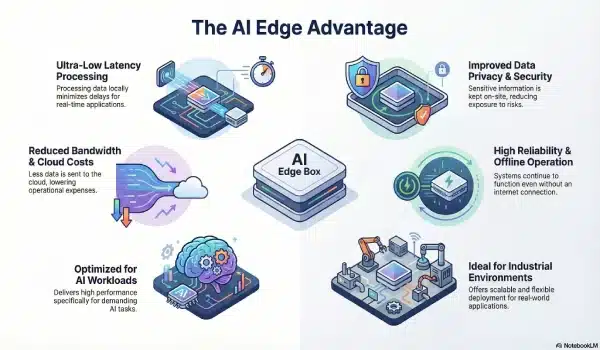
AI Edge Boxes bring intelligence closer to where data is generated, which creates several practical and technical advantages for modern systems. These benefits are especially important in environments that require fast decisions, high reliability, and secure data handling.
Ultra low latency processing
By running AI inference directly at the edge, data does not need to travel to distant cloud servers. This dramatically reduces latency and enables real time responses, which is critical for applications such as video analytics, autonomous systems, and industrial control.
Reduced bandwidth and cloud costs
Instead of continuously sending large volumes of raw data to the cloud, AI Edge Boxes process data locally and transmit only meaningful results or alerts. This minimizes network usage and significantly lowers data transfer and cloud storage expenses.
Improved data privacy and security
Sensitive data can remain on site and be processed locally. This reduces exposure to external networks and helps organizations comply with data protection regulations, especially in healthcare, finance, and surveillance use cases.
High reliability and offline operation
AI Edge Boxes can continue operating even with limited or unstable network connectivity. Local processing ensures uninterrupted performance in remote locations or mission critical environments where downtime is not acceptable.
Optimized performance for AI workloads
Equipped with dedicated GPUs or AI accelerators, AI Edge Boxes are specifically designed for inference tasks. They deliver high performance per watt and efficient execution of complex AI models without relying on centralized infrastructure.
Scalability and deployment flexibility
AI Edge Boxes can be deployed across multiple locations and scaled gradually as needs grow. This distributed architecture allows organizations to expand AI capabilities without redesigning their entire system.
Lower end to end system latency
Combining sensing, processing, and decision making at the edge shortens the entire data pipeline. This leads to faster reactions, more accurate insights, and better overall system responsiveness.
Ideal for real world and industrial environments
Rugged designs, compact form factors, and support for industrial protocols make AI Edge Boxes suitable for factories, smart cities, retail stores, transportation systems, and healthcare facilities.
Disadvantages of Using AI Edge Boxes
Despite their advanced capabilities, AI Edge Boxes come with certain limitations that should be carefully evaluated before adoption. Understanding these challenges helps organizations make more informed and realistic decisions.
High initial investment
AI Edge Boxes often rely on GPUs or dedicated AI accelerators, which significantly increases the upfront cost compared to traditional edge or embedded systems.
Limited compute resources compared to data centers
Although powerful, Edge Boxes cannot match the processing capacity, memory, and storage of large-scale data center servers. They are generally better suited for inference rather than training large AI models.
Complex deployment and management
Managing multiple Edge Boxes across distributed locations can be challenging. Software updates, monitoring, and troubleshooting require centralized management tools and skilled technical teams.
Restricted hardware upgrade options
Due to their compact and integrated design, many AI Edge Boxes offer limited flexibility for hardware upgrades. Scaling performance often requires replacing the entire unit rather than upgrading individual components.
Power consumption and thermal constraints
Running AI workloads on GPUs in compact enclosures can lead to higher power consumption and heat generation, requiring efficient cooling solutions, especially in industrial or remote environments.
Dependency on specific software ecosystems
Some Edge Boxes are optimized for specific AI frameworks or vendor platforms. This can limit flexibility and make future migration to other systems more complex.
Higher technical expertise requirements
Deploying and maintaining AI Edge Boxes typically demands expertise in AI model optimization, embedded systems, and edge networking, which may not be readily available in all organizations.
History of AI Edge Boxes
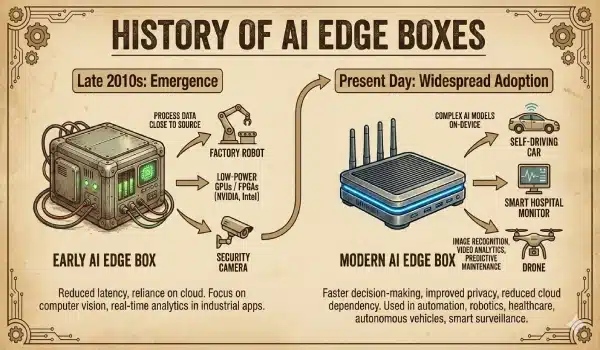
AI Edge Boxes emerged in the late 2010s to process data close to the source, reducing latency and reliance on cloud servers. Early devices, developed by companies like NVIDIA and Intel, focused on computer vision and real-time analytics in industrial and robotic applications using low-power GPUs or FPGAs.
With advances in deep learning, modern Edge Boxes now run complex AI models on-device, enabling real-time tasks like image recognition, video analytics, and predictive maintenance. They are widely used in industrial automation, robotics, healthcare, autonomous vehicles, and smart surveillance, offering faster decision-making, improved privacy, and reduced cloud dependency.
Buying AI Edge Boxes
If you’re looking to purchase AI Edge Boxes, ITCT Shop is a reliable choice. They offer some of the best prices on the market, worldwide shipping, and even same-day delivery to Dubai. With a purchase from a trusted store, you can be confident that you’re getting the latest models of Edge Boxes with the most up-to-date technology, along with full support and guaranteed authenticity.