

Author: Data Center Infrastructure Team
Reviewed By: Senior Network Architect
Last Updated: January 6, 2026
Reading Time: 12 Minutes
References:
- NVIDIA Quantum-2 InfiniBand Platform Technical Specifications.
- H3C S9855 & S9827 Series Switch Datasheets.
- Huawei OceanStor Dorado V6 Architecture Whitepapers.
- ITCT Shop GPU Cluster Design Standards (2025).
Quick Answer
Modern AI infrastructure requires a fundamental architectural shift from traditional enterprise designs, prioritizing massive east-west traffic capacity, sub-microsecond latency, and zero packet loss. For organizations deploying GPU clusters, the core requirements include high-bandwidth fabrics (using InfiniBand NDR or 800G RoCEv2 Ethernet), all-flash NVMe storage capable of multi-gigabyte-per-second throughput, and a non-blocking spine-leaf network topology. This infrastructure is essential for feeding data to accelerators like the NVIDIA H200/B200 without creating bottlenecks that leave expensive compute resources idle.
When choosing between networking protocols, InfiniBand (NVIDIA Quantum-2) remains the gold standard for pure performance and lowest latency in large-scale model training. However, RoCEv2-optimized Ethernet (using platforms like H3C S9855) has matured significantly, offering a cost-effective, high-performance alternative for converged networks that need to support both AI and traditional workloads. Decision Tip: Choose InfiniBand for dedicated, hyperscale training clusters; choose 800G Ethernet for flexible, multi-tenant environments where ease of integration with existing stacks is a priority.
The explosive growth of artificial intelligence workloads has fundamentally transformed data center infrastructure requirements. Modern AI applications demand unprecedented levels of network bandwidth, ultra-low latency connectivity, and high-performance storage systems capable of feeding massive datasets to GPU clusters at line-rate speeds. This comprehensive guide explores the critical components of AI infrastructure, including InfiniBand switches, NVMe storage solutions, optical transceivers, and advanced data center networking technologies that power today’s most demanding machine learning and deep learning workloads.
Table of Contents
- Understanding AI Infrastructure Requirements
- InfiniBand Switch Technology for GPU Clusters
- High-Performance Ethernet Switches for AI Networks
- 400G Optical Transceivers and Beyond
- NVMe Storage Solutions for AI Workloads
- GPU Cluster Design Architecture
- Data Center Networking Best Practices
- Integration and Deployment Strategies
- Frequently Asked Questions
Understanding AI Infrastructure Requirements
Artificial intelligence infrastructure differs fundamentally from traditional enterprise computing environments. While conventional data centers prioritize north-south traffic patterns between servers and external clients, AI workloads generate massive east-west traffic flows as GPU nodes communicate during distributed training operations. A single training job for large language models can involve hundreds or thousands of GPUs synchronizing gradients multiple times per second, creating network traffic patterns that can easily saturate conventional switching infrastructure.
The three pillars of modern AI infrastructure include high-bandwidth, low-latency networking fabric, ultra-fast storage systems capable of sustained multi-gigabyte-per-second throughput, and intelligent orchestration that coordinates data movement between storage, memory, and compute resources. Organizations building AI infrastructure must carefully balance these components to prevent bottlenecks that would leave expensive GPU resources idle while waiting for data or network operations to complete.
Key Performance Metrics for AI Infrastructure
| Component | Traditional Data Center | AI/HPC Data Center |
|---|---|---|
| Network Latency | 10-100 microseconds | < 1 microsecond |
| Network Bandwidth | 10-100 Gbps | 200-800 Gbps |
| Storage Throughput | 1-5 GB/s per server | 10-50 GB/s per server |
| East-West Traffic | 20-30% | 70-80% |
| Packet Loss Tolerance | 0.01-0.1% | Zero (lossless) |
InfiniBand Switch Technology for GPU Clusters
InfiniBand has emerged as the gold standard for AI cluster networking, delivering the ultra-low latency and zero packet loss characteristics that distributed training workloads absolutely require. Unlike traditional Ethernet networks that employ “best effort” delivery semantics, InfiniBand implements credit-based flow control mechanisms that guarantee lossless transport, ensuring that every packet arrives at its destination without requiring retransmission.
NVIDIA Quantum-2 NDR InfiniBand Platform
The NVIDIA Quantum-2 QM9790 InfiniBand Switch represents the cutting edge of AI networking technology, delivering 51.2 terabits per second of switching capacity across 64 ports of 400 Gigabit NDR (Next Data Rate) InfiniBand connectivity. This revolutionary platform enables organizations to build non-blocking GPU clusters with thousands of nodes, providing the bandwidth required to keep modern accelerators fully utilized during distributed training operations.
The Quantum-2 architecture incorporates advanced congestion management algorithms including adaptive routing that dynamically selects optimal paths based on real-time network conditions, and sharp in-network computing capabilities that accelerate collective communication operations by performing reduction calculations directly within the switching fabric. These innovations reduce communication overhead by up to 30% compared to traditional host-based collective operations, translating directly to faster training iterations and improved GPU utilization.
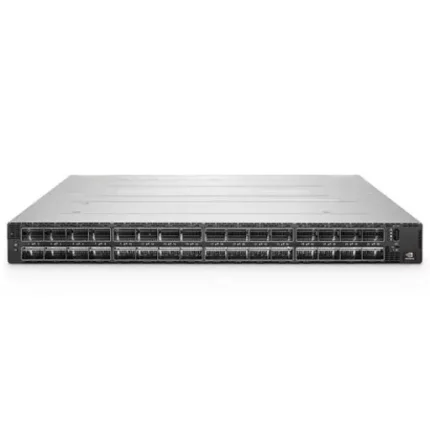
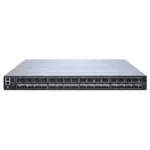
NVIDIA Quantum-2 QM9790 InfiniBand Switch 64-Port 400Gb/s NDR
Key Features of NVIDIA Quantum-2 InfiniBand:
- 51.2 Tbps switching capacity with 64x 400G NDR ports
- Sub-microsecond port-to-port latency
- Hardware-accelerated RDMA operations
- Adaptive routing for optimal load balancing
- SHARP v3 in-network computing support
- Telemetry streaming for real-time monitoring
- Modular design with redundant power and cooling
InfiniBand vs Ethernet for AI Clusters
The debate between InfiniBand and Ethernet for AI clusters continues to evolve as Ethernet technologies mature and adopt features traditionally associated with InfiniBand. Organizations must weigh several factors when selecting networking technology for GPU clusters.
InfiniBand Advantages:
InfiniBand delivers proven ultra-low latency performance with consistent sub-microsecond switching delays, while lossless transport guarantees eliminate the performance unpredictability caused by packet loss and retransmission in Ethernet networks. The technology provides comprehensive RDMA support with hardware offload engines that minimize CPU overhead for network operations, and mature ecosystem including drivers, management tools, and validated configurations from leading GPU server vendors.
Modern Ethernet Considerations:
Recent advances in Ethernet switching technology have dramatically narrowed the performance gap with InfiniBand. RoCEv2 (RDMA over Converged Ethernet version 2) enables lossless RDMA operations over standard Ethernet infrastructure, while 400G and 800G Ethernet switches now deliver bandwidth comparable to InfiniBand at competitive price points. Organizations with existing Ethernet expertise and infrastructure may find converged networks that support both AI and traditional workloads more operationally efficient than maintaining separate InfiniBand fabrics.
High-Performance Ethernet Switches for AI Networks
As Ethernet technology evolves to address AI workload requirements, next-generation switches deliver capabilities previously exclusive to specialized interconnects. Modern AI-optimized Ethernet platforms combine massive bandwidth, comprehensive RoCEv2 implementation, and intelligent congestion management to create lossless fabrics suitable for demanding machine learning applications.
H3C S9855 Series: RoCEv2-Optimized Ethernet
The H3C S9855 Series switches provide purpose-built Ethernet infrastructure for AI and high-performance computing environments. These advanced platforms implement H3C’s Intelligent Lossless Network technology that combines Priority-based Flow Control (PFC), Explicit Congestion Notification (ECN), and AI-enhanced congestion prediction algorithms to maintain zero packet loss even during intense traffic bursts generated by gradient synchronization operations.
The series offers multiple models addressing diverse deployment scenarios. The S9855-48CD8D delivers 48 ports of 100 Gigabit connectivity plus eight 400G uplinks for high-density top-of-rack deployments, while the S9855-32D flagship model provides 32 ports of native 400 Gigabit Ethernet with 25.6 Tbps switching capacity for spine layer implementations.
S9855 Series Model Comparison:
| Model | Port Configuration | Use Case | Switching Capacity |
|---|---|---|---|
| S9855-48CD8D | 48x100G + 8x400G | High-density ToR | 16 Tbps |
| S9855-24B8D | 24x200G + 8x400G | Balanced density | 16 Tbps |
| S9855-40B | 40x200G | GPU server access | 16 Tbps |
| S9855-32D | 32x400G | Spine layer | 25.6 Tbps |
The comprehensive RoCEv2 implementation goes beyond basic PFC and ECN support to include intelligent algorithms that predict congestion before it occurs, dynamically adjusting flow control thresholds based on traffic patterns. This proactive approach maintains higher overall network utilization while preserving the lossless guarantees that RDMA protocols require.
H3C S9827 Series: 800G Revolution
The H3C S9827 Series represents the next generation of data center switching with native 800 Gigabit Ethernet support. Built on innovative Co-Packaged Optics (CPO) silicon photonics technology, these switches deliver unprecedented port density and bandwidth efficiency by co-locating optical transceivers directly with switching silicon.
The flagship S9827-128DH model provides 128 QSFP112 ports supporting flexible configurations from native 800GbE to breakout modes enabling 400G, 200G, or 100G connectivity. This versatility allows organizations to deploy unified switching infrastructure that accommodates diverse server generations and bandwidth requirements within a single platform.
CPO Technology Advantages:
Co-packaged optics fundamentally reimagines the integration of optical components with switching ASICs. By eliminating the lengthy electrical traces between switch chips and traditional pluggable optical modules, CPO technology reduces power consumption by approximately 30 percent while improving signal integrity and enabling higher port densities. The S9827-128DH achieves 102.4 Terabits per second of total switching capacity, positioning it at the forefront of data center networking technology.
The platform’s comprehensive data center feature set includes VXLAN overlay support with MP-BGP EVPN control plane for massive Layer 2 domain extension, complete RoCEv2 protocol stack for lossless RDMA operations, and advanced telemetry capabilities including In-band Network Telemetry (INT) that embeds real-time performance metadata directly into packet headers for unprecedented visibility into network behavior.
400G Optical Transceivers and Beyond
Optical transceiver technology forms the critical physical layer connection between switches and servers in modern AI infrastructure. The transition to 400 Gigabit and 800 Gigabit connectivity requires careful selection of optical modules that balance performance, power consumption, and distance requirements while maintaining compatibility with existing fiber infrastructure.
400G Transceiver Technology Overview
The 400G optical transceiver landscape encompasses multiple form factors and reach categories designed for specific deployment scenarios. QSFP-DD (Quad Small Form-factor Pluggable Double Density) has emerged as the dominant form factor for 400G connectivity, offering backward compatibility with QSFP modules while doubling electrical lane count to eight for increased bandwidth.
Common 400G Transceiver Types:
| Type | Reach | Fiber Type | Use Case | Power |
|---|---|---|---|---|
| SR8 | 100m | OM4 MMF | Intra-rack | 12W |
| DR4 | 500m | SMF | Rack-to-rack | 14W |
| FR4 | 2km | SMF | Campus/building | 14W |
| LR4 | 10km | SMF | Inter-building | 18W |
| ZR | 80km | SMF | Metro/DCI | 22W |
Organizations building AI clusters typically deploy SR8 transceivers for very short reach connections within cabinets and DR4 modules for rack-to-rack connectivity within the same data center hall. The shift to single-mode fiber for DR4 and longer reach variants provides future migration flexibility as link distances increase with data center expansion.
Linear Pluggable Optics (LPO) Innovation
A significant development in transceiver technology is the emergence of Linear Pluggable Optics that eliminate power-hungry digital signal processing (DSP) chipsets. LPO modules leverage high-quality passive optical components and optimized analog circuitry to achieve compliant signal transmission without active equalization or retiming.
The power savings are substantial. Traditional DSP-based 400G transceivers consume 14-18 watts per module, while LPO variants operate at 8-10 watts for equivalent performance. In large-scale deployments with hundreds or thousands of optical connections, these per-module savings accumulate to meaningful reductions in total facility power consumption and cooling requirements.
Both the H3C S9827 and S9855 series support full-port insertion of LPO modules alongside traditional transceivers, enabling organizations to optimize connectivity strategy based on specific link requirements and power budgets.
NVIDIA/Mellanox 400G Transceivers for InfiniBand
InfiniBand NDR platforms require specialized optical modules designed for the protocol’s unique signaling characteristics. The NVIDIA/Mellanox MMA4Z00-NS400 represents the reference design for 400G NDR InfiniBand connectivity, featuring OSFP form factor optimized for the thermal and electrical requirements of NDR switching platforms.
These transceivers implement InfiniBand-specific features including inline Forward Error Correction optimized for NDR encoding schemes, comprehensive diagnostic capabilities exposing per-lane optical power and bit error statistics, and validated interoperability with NVIDIA ConnectX-7 and ConnectX-8 network adapters that power modern GPU servers.
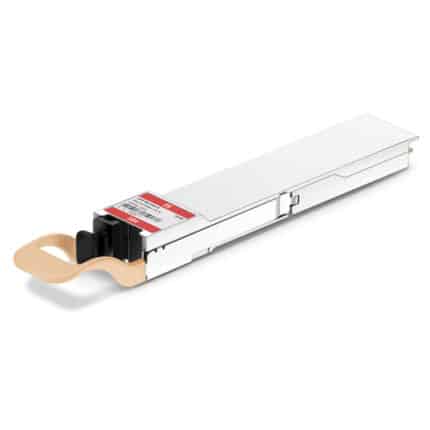
NVIDIA/Mellanox MMA4Z00-NS400 Compatible 400GBASE-SR4 OSFP Flat Top PAM4 850nm 50m DOM MPO-12/APC MMF InfiniBand NDR Optical Transceiver Module for ConnectX-7 HCA
| Specification Category | Parameter | Value |
|---|---|---|
| Data Rate | Maximum Throughput | 400 Gbps |
| Form Factor | Module Type | OSFP (Octal Small Form Factor Pluggable) |
| Housing Design | Flat Top for ConnectX-7 HCA | |
| Optical Interface | Wavelength | 850nm VCSEL |
| Modulation Format | PAM4 (4-Level Pulse Amplitude Modulation) | |
| Fiber Type | Multimode Fiber (MMF) | |
| Connector Type | MPO-12/APC (12-fiber MTP with Angled Polish) | |
| Transmission Distance | OM3 Fiber | Up to 30 meters |
| OM4 Fiber | Up to 50 meters | |
| Electrical Interface | Signaling Rate per Lane | 53.125 GBd |
| Number of Channels | 4 channels (4x100G) | |
| Host Interface | PCIe 5.0 x16 compatible |
NVMe Storage Solutions for AI Workloads
Storage performance has become a critical bottleneck in AI infrastructure as datasets grow to multi-petabyte scales and GPU computing power continues to advance. Modern AI training workflows require storage systems capable of delivering sustained throughput measured in tens of gigabytes per second to keep GPU clusters fed with training data. NVMe (Non-Volatile Memory Express) technology provides the low-latency, high-throughput storage foundation that AI workloads demand.

Local NVMe vs Network Storage Architecture
AI infrastructure architects face a fundamental decision between local NVMe storage within GPU servers versus centralized network-attached storage. Each approach offers distinct advantages that align with different deployment scenarios and workload characteristics.
Local NVMe Advantages:
Direct-attached NVMe SSDs within GPU servers provide the absolute lowest latency storage access, with typical read latencies under 100 microseconds. The NVIDIA DGX H100 platform exemplifies this approach with eight 3.84TB NVMe drives providing approximately 30TB of local storage and aggregate sequential read performance exceeding 56 GB/s. This architecture works well for workloads where datasets fit within local storage capacity and jobs run independently without requiring data sharing across multiple nodes.
Network Storage Benefits:
Centralized storage systems enable flexible capacity scaling independent of compute resources, simplified data management with single copy of datasets accessible by all compute nodes, and efficient resource utilization where storage systems can be upgraded or replaced without impacting GPU servers. Modern NVMe-over-Fabric (NVMe-oF) protocols leverage RDMA to deliver network storage performance approaching local NVMe speeds.
Huawei OceanStor Dorado All-Flash Arrays
The Huawei OceanStor Dorado 6000 V6 exemplifies enterprise-grade all-flash storage optimized for AI and high-performance computing workloads. Built on a fully distributed architecture with active-active controllers, the platform delivers consistent sub-millisecond latency (0.05ms typical) even under sustained maximum load conditions.
The Dorado architecture implements intelligent SSD lifecycle management that monitors drive health metrics and proactively redistributes data before failures occur, contributing to industry-leading availability ratings of 99.9999 percent. Native support for NVMe-oF protocols including NVMe/RoCE enables seamless integration with lossless Ethernet fabrics built on H3C S9855 switches, providing GPU clusters with scalable, high-performance storage that grows independently of compute infrastructure.
Key Dorado 6000 V6 Capabilities:
- End-to-end NVMe architecture from drives through host interface
- 0.05ms average latency with 20M IOPS capability
- Inline deduplication and compression with zero performance impact
- SmartMatrix 3.0 full-mesh architecture eliminating controller bottlenecks
- Native replication and disaster recovery for business continuity
- AI-driven predictive analytics for proactive maintenance
NVMe Palm Disk Units for Compact Storage
For distributed storage architectures and edge AI deployments, compact NVMe solutions provide dense storage in minimal physical footprints. The 3.84TB and 15.36TB SSD NVMe Palm Disk Units deliver enterprise-grade storage performance in form factors specifically designed for integration with all-flash arrays and hyper-converged infrastructure platforms.
These drives typically deliver sequential read performance exceeding 6,800 MB/s with random read IOPS capabilities above 1,000K, providing ample throughput for AI inference workloads and training data preprocessing operations. The compact 7-inch form factor enables high storage density within standard rack enclosures, crucial for space-constrained data center environments.
GPU Cluster Design Architecture
Designing effective GPU clusters for AI workloads requires careful orchestration of compute, network, and storage resources to eliminate bottlenecks that would limit training throughput. Modern cluster architectures follow spine-leaf topologies that provide non-blocking bandwidth between any two endpoints, ensuring that GPU-to-GPU communication never waits for available network capacity.
Spine-Leaf Network Topology
The spine-leaf architecture has become the de facto standard for AI cluster networking, replacing traditional hierarchical designs that created oversubscription and unpredictable latency. In this topology, leaf switches connect directly to GPU servers while every leaf maintains connections to all spine switches, ensuring that traffic between any two servers traverses exactly two hops regardless of physical location.
Recommended Spine-Leaf Configuration:
For clusters up to 1,000 GPU servers, a practical spine-leaf design employs 32 leaf switches built with H3C S9855-40B models providing 40 ports of 200G connectivity. Each leaf switch connects to approximately 30-32 GPU servers while dedicating eight 400G uplinks to spine layer switches. The spine layer consists of 8-16 S9855-32D switches, each offering 32 ports of native 400G connectivity.
This configuration delivers non-blocking bandwidth between servers, meaning every GPU can communicate with every other GPU at full 200 Gbps simultaneously without contention. The fabric provides 12.8 Tbps of total uplink capacity from the leaf layer to the spine, sufficient to accommodate the most intense all-to-all communication patterns generated by distributed training operations.
InfiniBand Cluster Topology
Organizations standardizing on InfiniBand for AI cluster networking typically deploy similar spine-leaf architectures using NVIDIA Quantum-2 switches. A reference design for 512-GPU cluster might employ:
- Leaf layer: 32x Quantum-2 QM9700 switches with 40 server-facing ports each
- Spine layer: 16x Quantum-2 QM9790 switches providing 64-port full spine capacity
- Server connectivity: Dual-port 400G NICs per GPU server for redundancy
- Storage fabric: Dedicated 400G connections from each leaf to shared storage
The dual-rail redundancy provided by connecting each server to two leaf switches eliminates single points of failure while enabling active-active bandwidth utilization through proper routing configuration. InfiniBand’s adaptive routing automatically load-balances traffic across available paths, maximizing fabric utilization even when link failures reduce available capacity.
GPU Server Integration
Modern GPU servers designed for AI workloads integrate high-performance networking directly with GPU subsystems to minimize latency for distributed operations. The NVIDIA DGX H200 platform exemplifies this integration with eight H200 GPUs interconnected via NVLink for intra-node communication and ConnectX-7 network adapters providing 400 Gbps InfiniBand or Ethernet connectivity to the cluster fabric.
Critical to cluster performance is the implementation of GPUDirect RDMA technology that enables direct data transfers between network adapters and GPU memory without CPU involvement. This capability eliminates the latency and CPU overhead of copying data through system memory, reducing communication overhead by 30-50 percent compared to traditional network stacks.
Recommended GPU Server Networking:
- Compute-optimized: Dual-port 400G NICs for primary cluster fabric
- Storage-optimized: Additional dual-port 200G NICs for storage traffic isolation
- Management: Separate 10G management network for out-of-band access
- Convergence: Single dual-port 400G with QoS for combined compute/storage
Data Center Networking Best Practices
Deploying AI infrastructure at scale requires adherence to networking best practices that ensure reliable, predictable performance across thousands of interconnected components. These guidelines apply regardless of whether organizations standardize on InfiniBand or high-performance Ethernet switching platforms.
RoCEv2 Configuration Essentials
Implementing lossless RDMA over Ethernet requires meticulous attention to configuration details across the entire network path. Even a single misconfigured switch or network adapter can compromise lossless guarantees and severely degrade application performance.
Priority-based Flow Control (PFC) Configuration:
Enable PFC on all switch ports and network adapter queues carrying RDMA traffic, typically priority class 3 for RoCEv2. Configure PFC thresholds conservatively at 5-10 percent of buffer capacity to provide adequate headroom before triggering pause frames. Implement PFC deadlock watchdog mechanisms on all switches to detect and automatically recover from circular pause dependencies that could stall traffic indefinitely.
Explicit Congestion Notification (ECN) Tuning:
Configure ECN marking thresholds higher than PFC trigger points to ensure that rate-based congestion control activates before credit-based flow control mechanisms engage. Typical configurations mark packets when instantaneous queue depth exceeds 15-20 percent of buffer capacity, allowing endpoints to reduce transmission rates before buffers fill sufficiently to trigger PFC pause frames.
Enable ECN in both NP (notification point) and RP (response point) directions to support proactive congestion management. Modern platforms like the H3C S9855 series implement AI-enhanced ECN algorithms that dynamically adjust marking thresholds based on observed traffic patterns, optimizing congestion response without manual tuning.
Cable Infrastructure Planning
Physical layer infrastructure profoundly impacts achievable performance in high-speed networks. For AI clusters deploying 200G and 400G connectivity, organizations must carefully specify cabling that meets stringent signal integrity requirements while accommodating data center layout constraints.
Recommended Cable Types:
| Connection Type | Distance | Cable Type | Connector |
|---|---|---|---|
| Intra-rack (< 3m) | 0-3m | Passive DAC | QSFP-DD/OSFP |
| Inter-rack (< 5m) | 3-5m | Active DAC | QSFP-DD/OSFP |
| Row-to-row (< 30m) | 5-30m | Active Optical Cable | QSFP-DD/OSFP |
| Building (> 30m) | 30m-2km | DR4/FR4 Transceivers | MPO-12 SMF |
Passive direct attach copper cables provide the lowest cost and power consumption for very short connections within racks, while active optical cables deliver superior signal integrity for moderate distances. Organizations should standardize on MPO-12 single-mode fiber infrastructure for structured cabling systems, providing migration flexibility as transceiver technology evolves.
Network Monitoring and Telemetry
Comprehensive monitoring infrastructure provides the visibility required to troubleshoot performance issues and optimize cluster configurations. Modern AI networking platforms implement advanced telemetry capabilities that capture detailed performance metrics without impacting production traffic.
Platforms like the H3C S9827 series support In-band Network Telemetry (INT) that embeds real-time performance data directly into packet headers as they traverse the network. This approach enables continuous, line-rate monitoring of critical metrics including per-hop latency, queue depths, and forwarding paths without requiring separate monitoring infrastructure.
Essential Monitoring Metrics:
- Per-interface bandwidth utilization and packet rates
- Queue depth histograms showing buffer occupancy distribution
- PFC pause frame frequency and duration by priority class
- ECN marking rates indicating congestion conditions
- Optical transceiver health including power levels and bit error rates
- Temperature sensors across switch chassis and transceivers
Integrate switch telemetry with application-level monitoring that tracks GPU utilization, training iteration times, and data pipeline throughput. Correlating network performance with application metrics enables identification of bottlenecks and validates that infrastructure delivers expected performance to workloads.
Integration and Deployment Strategies
Successfully deploying AI infrastructure requires systematic planning that addresses technical, operational, and organizational considerations. Organizations should adopt phased implementation approaches that validate designs incrementally rather than attempting complete cutover in single maintenance windows.
Phase 1: Design and Validation
The planning phase establishes requirements and validates architectural decisions through comprehensive testing before production deployment. Develop detailed network diagrams documenting switch placement, port assignments, and connectivity patterns. Create standardized configuration templates that ensure consistency across multiple switches while incorporating best practices for RoCEv2 deployment.
Establish laboratory environment that accurately represents production configuration, including representative GPU servers, switching infrastructure, and storage systems. Validate end-to-end lossless operation by monitoring PFC and ECN behavior under various load conditions, and benchmark application performance to establish baseline metrics for comparison after production deployment.
Phase 2: Infrastructure Deployment
Roll out physical infrastructure following systematic procedures that minimize risk of configuration errors or connectivity issues. Begin by deploying and configuring leaf layer switches, validating local connectivity before establishing spine layer connections. This bottom-up approach enables troubleshooting of individual leaf domains before introducing complexity of multi-tier fabric.
Implement spine layer connectivity after validating leaf switch operation, confirming that routing protocols converge properly and that ECMP load balancing distributes traffic across available paths. Deploy GPU servers progressively, validating proper network adapter configuration and verifying RDMA functionality before proceeding with additional servers.
Phase 3: Application Onboarding
Migrate AI workloads to new infrastructure incrementally, starting with non-critical development and test jobs before transitioning production training operations. Monitor application performance closely during initial migrations, comparing training iteration times and GPU utilization metrics against baseline measurements from previous infrastructure.
Tune network parameters based on observed application behavior, adjusting PFC thresholds, ECN marking points, and QoS policies to optimize performance for specific workload characteristics. Document configuration changes and performance impacts to build operational knowledge that accelerates future optimization efforts.
Scaling Considerations
Plan for infrastructure growth by selecting switching platforms with adequate port density and bandwidth headroom to accommodate additional GPU servers without requiring forklift upgrades. The modular nature of spine-leaf architectures enables horizontal scaling by adding leaf switches for server connectivity and expanding spine layer capacity to maintain non-blocking performance.
For organizations anticipating rapid growth, consider deploying H3C S9827 series switches with 800G capability from the start, even if initial servers connect at 200G or 400G speeds. This forward-looking approach provides seamless migration path as server networking speeds increase over the infrastructure lifecycle.
Frequently Asked Questions
What is the difference between InfiniBand and Ethernet for AI clusters?
InfiniBand provides proven ultra-low latency and comprehensive RDMA support specifically designed for high-performance computing, delivering consistent sub-microsecond switching delays with guaranteed lossless transport. Modern high-speed Ethernet with RoCEv2 has narrowed the performance gap significantly, offering comparable bandwidth at competitive costs while enabling converged networks that support both AI and traditional workloads. Organizations with extensive Ethernet expertise may prefer RoCEv2 solutions, while those prioritizing absolute minimum latency often standardize on InfiniBand.
How much network bandwidth does GPU training require?
Network bandwidth requirements scale with GPU performance and cluster size. A single NVIDIA H100 GPU can generate 200-400 Gbps of network traffic during gradient synchronization in distributed training operations. For clusters with 8-16 GPUs per server, organizations typically deploy dual-port 400G network adapters providing 800 Gbps total bandwidth per server. Larger clusters require careful capacity planning to ensure that spine layer switches deliver sufficient bandwidth to prevent oversubscription that would limit training throughput.
What storage throughput is needed for AI workloads?
Storage throughput requirements vary dramatically based on workload characteristics. Image-based computer vision training typically requires 5-10 GB/s sustained storage throughput per GPU server to prevent data pipeline stalls, while natural language processing workloads with cached embeddings may need only 1-2 GB/s. Organizations should benchmark specific applications during planning phases to right-size storage infrastructure. The Huawei OceanStor Dorado 6000 delivers scalable performance from tens to hundreds of GB/s through scale-out architectures.
Can I mix different speed transceivers in the same network?
Yes, modern switches like the H3C S9855 and S9827 series support mixed-speed deployments through flexible port breakout capabilities. A single 800G port can be split into multiple lower-speed connections, enabling gradual migration from 100G to 200G to 400G as server populations upgrade. Organizations should maintain consistent speeds within individual server cohorts to simplify management and prevent performance imbalances during distributed training operations.
What is RoCEv2 and why is it important for AI?
RoCEv2 (RDMA over Converged Ethernet version 2) enables Remote Direct Memory Access operations over standard Ethernet infrastructure, allowing applications to access memory on remote servers without CPU involvement. This capability dramatically reduces latency and eliminates CPU overhead for network operations, making it essential for AI training where gradient synchronization generates massive amounts of memory-to-memory transfers between GPU servers. Proper RoCEv2 implementation with PFC and ECN creates lossless networks that prevent packet loss from degrading training performance.
How do I choose between local NVMe and network storage?
Local NVMe storage provides absolute lowest latency and highest throughput for individual servers, making it ideal for workloads where datasets fit within local capacity and jobs run independently. Network storage enables flexible scaling, simplified data management, and efficient resource utilization where multiple GPU clusters share common datasets. Many organizations deploy hybrid architectures with local NVMe for working datasets and checkpoints, backed by centralized storage for long-term dataset repositories and cross-cluster data sharing.
What is the role of optical transceivers in AI infrastructure?
Optical transceivers form the critical physical layer connection between switches and servers, converting electrical signals to optical pulses for transmission over fiber cables. The transition to 400G and 800G connectivity requires careful transceiver selection that balances performance, power consumption, and distance requirements. Linear Pluggable Optics (LPO) technology reduces power consumption by 30-40 percent compared to traditional DSP-based transceivers for short and medium reach connections, delivering meaningful energy savings in large-scale deployments.
How important is network monitoring for AI clusters?
Comprehensive network monitoring is essential for maintaining optimal performance in AI clusters where even brief degradation can significantly impact training throughput. Advanced telemetry capabilities like In-band Network Telemetry provide real-time visibility into network behavior without requiring separate monitoring infrastructure. Organizations should monitor key metrics including bandwidth utilization, buffer occupancy, PFC pause events, and ECN marking rates, correlating network performance with application-level metrics like GPU utilization and training iteration times.
What is the typical lifespan of AI infrastructure components?
Network switches and storage systems typically remain in production for 5-7 years before being replaced due to capacity growth or technology obsolescence. GPU servers have shorter lifecycles of 3-4 years as accelerator performance doubles approximately every two years. Organizations can extend infrastructure value by selecting switches with bandwidth headroom like H3C S9827 800G platforms that accommodate multiple generations of GPU servers without requiring network upgrades.
How do I ensure zero packet loss in Ethernet-based AI networks?
Zero packet loss in Ethernet networks requires comprehensive implementation of Priority-based Flow Control (PFC) and Explicit Congestion Notification (ECN) across the entire network path. Every switch and network adapter must be configured consistently with appropriate buffer thresholds and priority mappings. Modern platforms like H3C S9855 implement intelligent lossless networking with AI-enhanced algorithms that automatically optimize congestion management parameters, simplifying deployment while ensuring robust lossless operation.
Conclusion: Building Future-Ready AI Infrastructure
The rapid evolution of artificial intelligence workloads demands data center infrastructure that delivers unprecedented levels of performance, reliability, and scalability. Organizations investing in AI infrastructure must carefully balance networking, storage, and compute resources to eliminate bottlenecks that would limit return on expensive GPU investments.
Modern AI infrastructure built on high-performance InfiniBand switches, RoCEv2-optimized Ethernet platforms, all-flash NVMe storage arrays, and advanced 400G/800G optical transceivers provides the foundation for training next-generation AI models while maintaining operational efficiency at scale.
Success requires more than selecting appropriate hardware components. Organizations must invest in comprehensive planning, systematic deployment methodologies, and ongoing optimization based on observed performance metrics. The best practices and architectural guidelines outlined in this guide provide a roadmap for building AI infrastructure that delivers maximum value from GPU investments while positioning organizations for continued growth as workload demands evolve.
For additional guidance on specific deployment scenarios or technical questions about AI infrastructure components, explore our related resources on GPU cluster design, data center networking best practices, and enterprise GPU server comparisons.
“The biggest mistake we see in 2025 is under-provisioning the storage fabric. You can have the fastest GPUs on the market, but if your NVMe storage cannot deliver data at line-rate speed—typically 10-50 GB/s per server—your training jobs will stall, wasting significant capital.” — Lead Storage Solutions Architect
“While InfiniBand has historically held the crown, the arrival of 800G Ethernet switches with AI-driven congestion control has changed the equation. For many of our enterprise clients, a well-tuned RoCEv2 fabric delivers 95% of the performance of InfiniBand with significantly lower operational complexity.” — Senior Network Engineer
“Power efficiency in the physical layer is no longer optional. Switching to Linear Pluggable Optics (LPO) instead of traditional DSP-based transceivers can reduce the power consumption of the optical fabric by 30%. across a 1,000-node cluster, that is a massive operational saving.” — Data Center Facility Manager
Last update at December 2025