

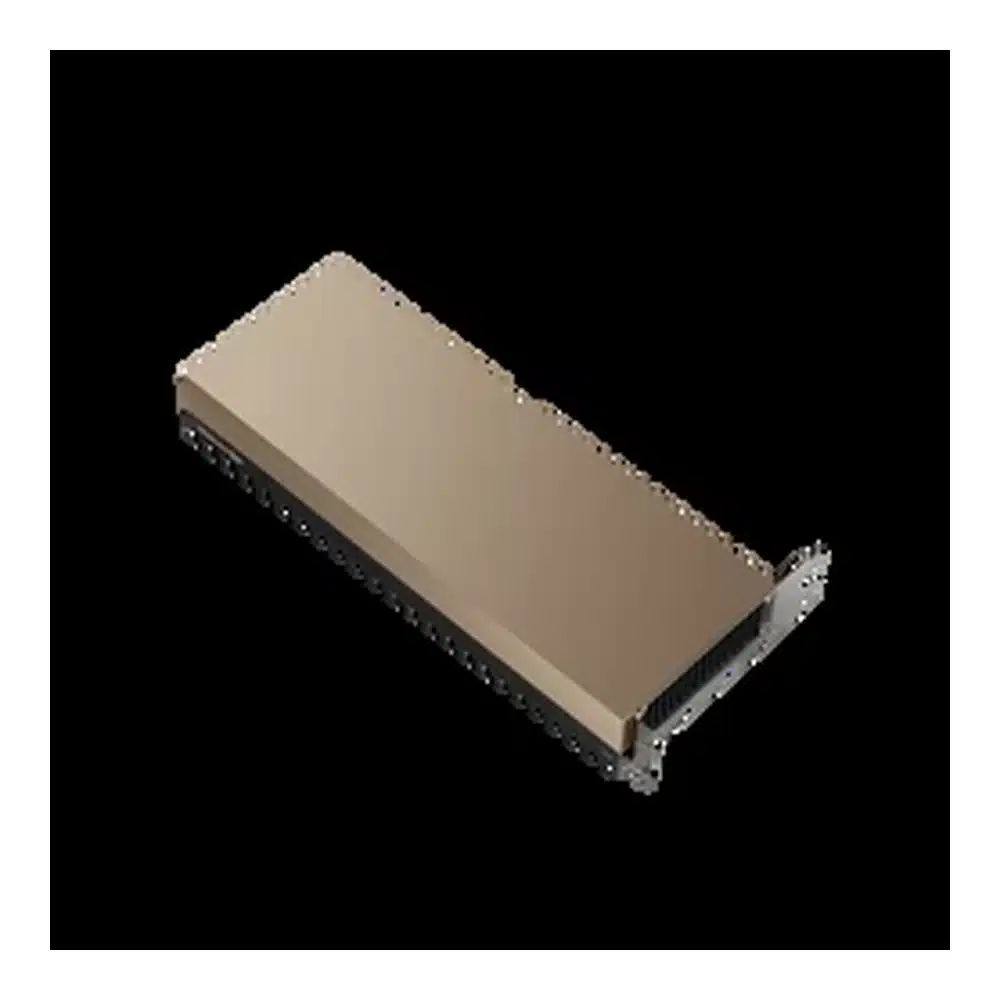
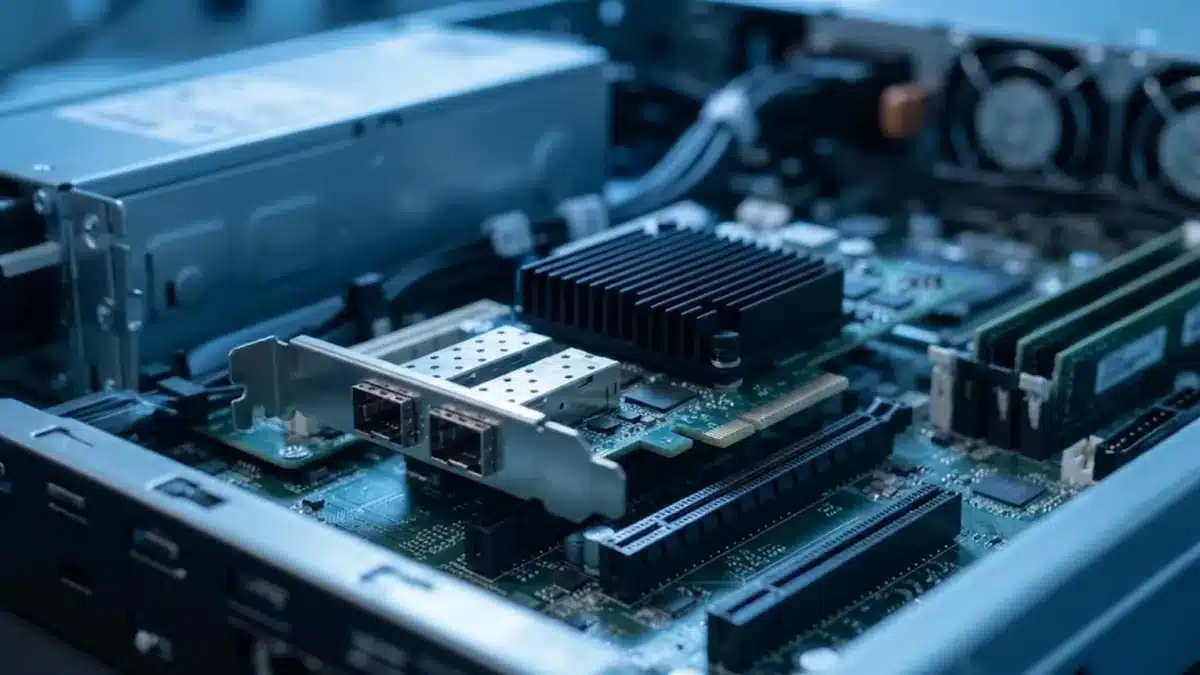
As AI clusters grow, a surprising amount of server CPU time goes into work that has nothing to do with the model itself: moving packets, encrypting traffic, handling storage protocols and enforcing network policies. A Data Processing Unit, or DPU, takes over that infrastructure work so CPUs and GPUs can focus on applications. NVIDIA’s BlueField family is the best-known DPU line in AI data centers today. This guide explains what a DPU is, how it differs from a regular NIC or SmartNIC, where BlueField fits in an AI cluster and when it is worth adding to your server design.
What is a DPU?
A DPU is a programmable network processor that sits on a PCIe card or module inside the server. It combines three things on one device:
- High-speed networking (Ethernet or InfiniBand) with hardware offloads.
- Its own Arm CPU cores and memory, so it can run software independently of the host server.
- Acceleration engines for tasks such as encryption, compression, storage protocols and packet processing.
Because it runs its own operating system, a DPU can host infrastructure services such as virtual switching, firewalling or storage virtualization while staying isolated from the host CPU. That separation is the main reason DPUs are popular in multi-tenant and security-sensitive environments.
NIC vs SmartNIC vs DPU
- Standard NIC: moves data between the server and the network with basic offloads such as checksums. The host CPU does almost all the processing.
- SmartNIC: adds more fixed-function offloads, for example RDMA, overlay networking or some flow processing.
- DPU: a fully programmable infrastructure computer on the card, with general-purpose cores, accelerators and the ability to run a separate trust domain.
NVIDIA’s ConnectX adapters are high-performance NICs with strong RDMA support; BlueField builds on ConnectX networking and adds the Arm cores and acceleration engines that make it a DPU.
What BlueField does in an AI data center
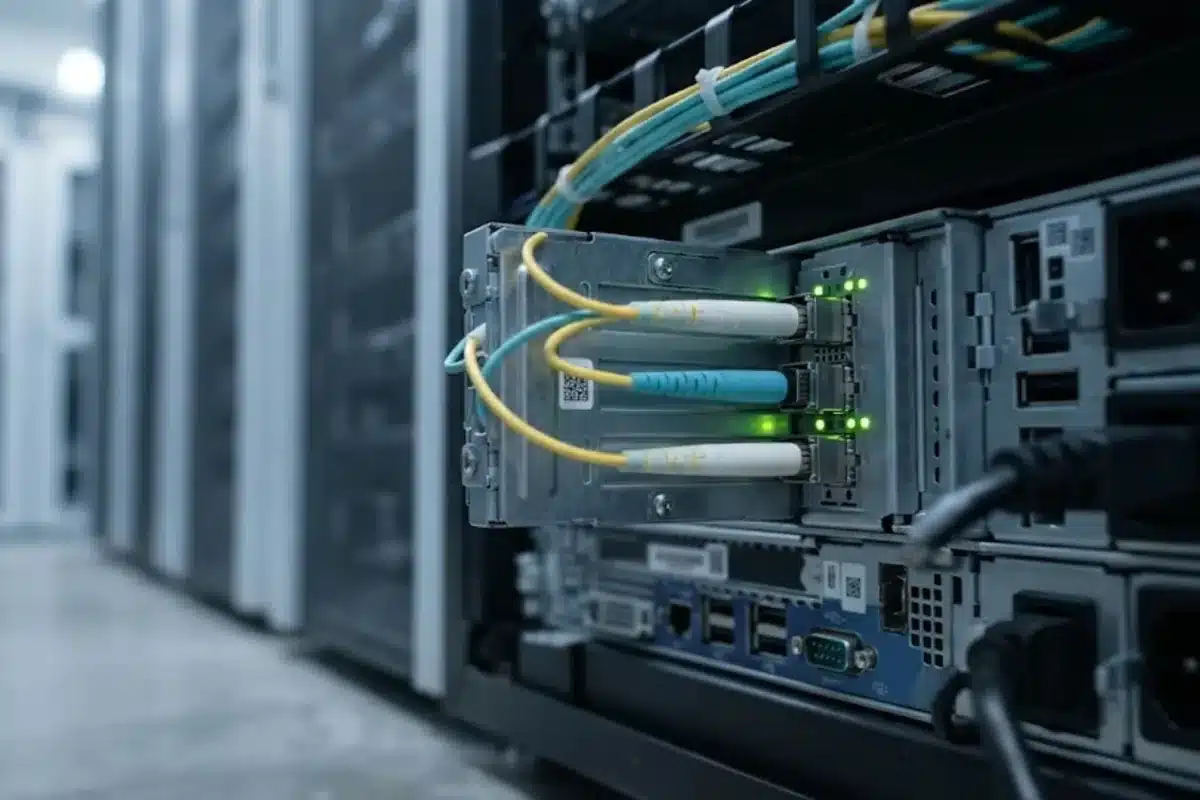
- Network offload: virtual switching, overlay networks and RoCE traffic handling run on the DPU instead of the host CPU. This matters on Ethernet-based AI fabrics; see our comparison of InfiniBand vs RoCEv2.
- Storage acceleration: NVMe over Fabrics and storage virtualization can be presented to the host as local drives while the DPU handles the protocol work, which helps feed GPUs from shared NVMe storage.
- Security isolation: firewalling, encryption and telemetry run outside the host’s operating system, so a compromised host cannot easily switch them off.
- Multi-tenant GPU clouds: cloud and GPU-as-a-service providers use DPUs to separate tenants and enforce policies at line rate.
- Bare-metal provisioning: the DPU can manage the server’s network identity and provisioning without software on the host.
BlueField-3 at a glance
BlueField-3 is NVIDIA’s current mainstream DPU generation. Key points to know when planning servers:
- Networking up to 400Gb/s, with Ethernet and InfiniBand options depending on the model.
- PCIe Gen5 host interface.
- Up to 16 Arm cores on the DPU for running infrastructure software.
- Programmed through NVIDIA’s DOCA software framework, which provides libraries and services for networking, storage and security.
NVIDIA also positions BlueField-3 SuperNICs for east-west GPU traffic in Spectrum-X Ethernet AI fabrics, while full DPU models are typically used for north-south traffic, storage and infrastructure services. Check exact port speeds, form factor and power for the specific part number before ordering.

When does a DPU make sense?
A DPU is not mandatory for every GPU server. It is usually worth it when:
- You run a multi-tenant environment, such as a private GPU cloud shared by several departments or customers.
- Host CPUs are noticeably busy with networking, encryption or storage work instead of feeding GPUs.
- You build an Ethernet AI fabric and want hardware offload for RoCE, telemetry and congestion handling.
- Security policy requires an isolated control plane that the host operating system cannot modify.
For a single training server or a small inference node, a high-quality ConnectX NIC is often enough. The bigger savings usually come from right-sizing GPUs and memory first; our guide to GPU cluster design covers the full picture.
Planning tips
- Confirm server support: check that the chassis has the right PCIe Gen5 slot, airflow and power budget for the DPU card.
- Match the fabric: choose Ethernet or InfiniBand models to match your switches and cables.
- Plan software early: decide which services will run on the DPU and whether your team will use DOCA directly or through a vendor platform.
- Budget for operations: DPUs have their own firmware and operating system that need updates and monitoring.
Frequently asked questions
Is a DPU the same as a SmartNIC?
Not exactly. A SmartNIC adds offloads to a network card, while a DPU also includes general-purpose cores and memory that can run independent infrastructure software and a separate security domain.
Do I need a DPU for AI training?
Not always. Many training clusters use high-speed NICs for GPU traffic. DPUs add the most value for storage access, security isolation, multi-tenancy and offloading infrastructure work from host CPUs.
What software runs on NVIDIA BlueField?
BlueField runs its own Linux-based operating system and is programmed with NVIDIA DOCA. Many networking, storage and security vendors also offer software that runs on the DPU.
Can BlueField work with InfiniBand?
Yes, there are BlueField models with InfiniBand support as well as Ethernet. Choose the model that matches your cluster fabric.
Conclusion
A DPU moves networking, storage and security work off the host CPU and into a dedicated, isolated processor on the network card. NVIDIA BlueField-3 is the leading option for AI data centers that need multi-tenancy, storage acceleration or strong isolation at 400Gb/s speeds. For smaller deployments, a fast NIC may be enough. If you are planning a GPU cluster and are unsure whether DPUs belong in the design, contact the ITCT team for a configuration review.
Last update at December 2025