
-
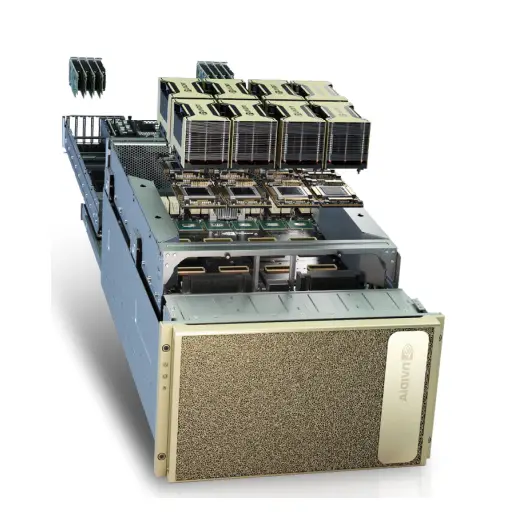
 NVIDIA DGX B200 (AI Supercomputer – 8× Blackwell B200 SXM5 GPUs, 2× Intel Xeon 8570, 2TB DDR5, 34TB NVMe)
USD600,000
NVIDIA DGX B200 (AI Supercomputer – 8× Blackwell B200 SXM5 GPUs, 2× Intel Xeon 8570, 2TB DDR5, 34TB NVMe)
USD600,000
-
NVIDIA H100 80GB PCIe Tensor Core GPU
USD28,000Original price was: USD28,000.USD24,500Current price is: USD24,500. -
 NVIDIA RTX A4500
USD5,500
NVIDIA RTX A4500
USD5,500
-
Aetina MegaEdge AIP-KQ67 (PCIe AI Workstation)
USD16,000
-
NVIDIA RTX A5000
Rated 4.67 out of 5USD9,500
-
NVIDIA DGX H100 ( 8×H100 SXM5 AI Supercomputing Platform )
USD520,000

Thermal Management for AI: Liquid Cooling Strategies for Middle East Data Centers
- Author: AI Infrastructure & Hardware Team (ITCTShop)
- Technical Review: Data Center Engineering Unit
- Published Date: January 3, 2026
- Estimated Reading Time: 12 Minutes
- References & Citations:
- NVIDIA Technical Blog (H100 & B200 Thermal Specifications)
- Uptime Institute (Data Center Cooling Best Practices 2025)
- ASHRAE TC 9.9 (Liquid Cooling Guidelines)
- Supermicro Liquid Cooling Solutions Whitepaper
- The Green Grid (PUE Standards in Hot Climates)
Data Center Cooling Dubai
Liquid Cooling Solutions for AI Data Centers
Liquid cooling is a critical infrastructure requirement for AI data centers in hot climates like the Middle East, offering up to 24x better heat transfer than air. It is essential for managing the high Thermal Design Power (TDP) of next-gen hardware like NVIDIA H100 and B200 chips (700W+), which often cause air-cooled systems to throttle. By eliminating power-hungry server fans and reducing chiller load, liquid cooling can lower Power Usage Effectiveness (PUE) to under 1.2, significantly cutting operational costs in cities like Dubai and Riyadh.
When selecting a topology, Direct-to-Chip (DTC) is generally best for retrofitting existing facilities, capturing ~70-80% of heat with minimal disruption to current operations. Conversely, Immersion Cooling, which submerges the entire server in fluid, is ideal for new, high-density projects (100kW+ per rack). While Immersion offers the highest efficiency and protection against desert dust, it requires specialized floor loading and handling equipment for maintenance.
Data Center Cooling Dubai – As Artificial Intelligence adoption accelerates across the Gulf Cooperation Council (GCC), the infrastructure supporting these workloads faces a critical bottleneck: heat. The region’s ambitious AI initiatives—driven by Saudi Vision 2030 and Dubai’s Universal Blueprint for Artificial Intelligence—are colliding with the harsh physical reality of high ambient temperatures.
For data centers in Dubai, Riyadh, and Doha, the challenge is twofold. First, the latest generation of AI hardware, such as the NVIDIA H100 GPU, has pushed Thermal Design Power (TDP) to unprecedented levels. Second, traditional cooling methods are becoming economically and environmentally unsustainable in desert climates. This guide explores why liquid cooling is no longer a luxury but a necessity for AI deployments in the Middle East.
Why Traditional Air Cooling Fails for H100 and B200 Deployments
The era of air-cooled data centers for high-performance computing (HPC) is rapidly drawing to a close. While air cooling served the industry well for decades, the density of modern AI clusters has exposed its physical limitations.
The Thermodynamics of Modern AI Silicon
The power density of AI chips is rising exponentially. The NVIDIA A100 80GB operates at a TDP of up to 400W. Its successor, the H100, pushes this to 700W per GPU. The roadmap for future architectures, including the Blackwell series (B200), suggests TDPs exceeding 1000W per chip.
When you stack eight of these GPUs into a single AI Server, the chassis alone generates over 6-10kW of heat, not including CPUs and networking gear. A standard rack filled with these servers can easily exceed 50kW to 100kW.
The “Heat Island” Effect in GCC Data Centers
In cooler climates like Northern Europe, data centers can utilize “free cooling” (using outside air) for significant portions of the year. In the GCC, where summer temperatures regularly exceed 45°C (113°F), free cooling is impossible. Air cooling systems must work overtime, compressing mechanical refrigeration cycles to combat both the internal server heat and the external ambient heat.
This results in:
- Thermal Throttling: Fans spinning at 100% create vibration and noise, yet may still fail to keep GPU junction temperatures low enough to prevent clock speed reduction.
- Exorbitant Energy Costs: A significant portion of the energy bill goes to cooling fans and CRAC (Computer Room Air Conditioning) units rather than compute processing.
- Hardware Degradation: Consistent operation at peak thermal limits reduces the lifespan of critical components like High-Performance Storage drives and motherboard VRMs.
Direct-to-Chip (DTC) vs. Immersion Cooling: Pros and Cons
Transitioning to liquid cooling offers a solution by leveraging the superior thermal conductivity of fluids (water or dielectric fluid) compared to air. Water conducts heat approximately 24 times better than air. However, choosing the right topology—Direct-to-Chip or Immersion—depends on your facility’s specific constraints.
1. Direct-to-Chip (DTC) / Cold Plate Cooling
DTC involves routing liquid coolants directly to the hottest components (GPUs and CPUs) via cold plates.
- How it Works: A closed loop of liquid flows through cold plates attached to the processors. The heated liquid is pumped to a Coolant Distribution Unit (CDU) and heat exchanger.
- Best For: Retrofitting existing data centers or hybrid setups where some air cooling is still used for less critical components (like RAM or storage).
- Advantages:
- High Efficiency: Removes 70-80% of heat directly from the source.
- Manageability: Rack maintenance is similar to standard setups; technicians don’t need to handle fluids directly during a server swap.
- Compatibility: Supported by major OEMs like Dell PowerEdge AI Servers and Supermicro AI Servers.
- Disadvantages:
- Leak Risk: Requires numerous couplings and hoses inside the rack.
- Partial Solution: Still requires some air movement for components not covered by cold plates (RAM, VRMs).
2. Single-Phase Immersion Cooling
In this method, the entire server is submerged in a bath of non-conductive dielectric fluid.
- How it Works: The fluid absorbs heat from every component on the board. The heated fluid is pumped to a heat exchanger, cooled, and returned to the tank.
- Best For: Greenfield data center projects in the Middle East designed specifically for extreme density (100kW+ per rack).
- Advantages:
- Total Thermal Capture: Captures nearly 100% of server heat.
- Silence: Eliminates server fans entirely, reducing noise and power consumption significantly.
- Protection: The fluid protects hardware from dust, oxidation, and humidity—common issues in desert environments.
- Disadvantages:
- Operational Complexity: Swapping a drive or GPU requires lifting the server out of oil, which can be messy and requires specialized equipment (cranes).
- Weight: Tanks are extremely heavy, requiring reinforced flooring.
3. Two-Phase Immersion Cooling
Similar to single-phase, but the fluid boils at a low temperature (e.g., 50°C) on the chip surface, turning into vapor. The vapor rises, hits a condenser coil, turns back to liquid, and rains back down.
- Pros: The phase change offers the highest possible thermal transfer efficiency.
- Cons: The fluids (often PFAS-based) are expensive and face environmental regulatory scrutiny. Leaking vapor is costly and hazardous.
Table 2: Comparison of Cooling Technologies for AI Workloads
| Feature | Air Cooling | Direct-to-Chip (DTC) | Single-Phase Immersion |
|---|---|---|---|
| Max Rack Density | ~20-30 kW | ~60-80 kW | 100 kW+ |
| Cooling Medium | Air | Water/Glycol | Dielectric Fluid |
| PUE Potential | 1.5 – 2.0 | 1.2 – 1.4 | < 1.05 |
| Water Usage | High (Evaporative) | Low (Closed Loop) | Low (Closed Loop) |
| Maintenance | Standard | Specialized | Complex (Requires Cranes) |
Improving PUE (Power Usage Effectiveness) in High-Ambient Temperatures
Power Usage Effectiveness (PUE) is the ratio of total facility energy to IT equipment energy. A PUE of 1.0 is perfect efficiency. In the GCC, air-cooled data centers often struggle with PUEs above 1.6 due to the AC load.
Liquid Cooling as a PUE Driver
Liquid cooling drastically reduces the PUE by removing the need for power-hungry fans.
- Server Fan Removal: In immersion systems, server fans are removed. Fans can consume up to 15-20% of a server’s total power.
- Higher Inlet Temperatures: Liquid cooling loops can operate with warmer water (up to 40°C/104°F) and still effectively cool the chips. This means the external chillers don’t have to work as hard to sub-cool the liquid, even when it is 45°C outside in Dubai.
- Heat Reuse: The return liquid from these systems is hot enough (60°C+) to be used for district heating or industrial processes, though this is less applicable in the GCC compared to colder regions. However, it can be used for absorption chillers or desalination processes.
Infrastructure Considerations for Implementation
Deploying liquid cooling requires a holistic view of the infrastructure. It is not just about the racks; it involves the Data Center Networking and plumbing.
- CDU Redundancy: The Coolant Distribution Unit is the heart of the system. Redundancy (N+1) is critical to prevent thermal runaway.
- Leak Detection Systems: For DTC implementation, advanced sensing cables must be deployed within racks to detect the slightest glycol leak immediately.
- Floor Loading: Liquid-filled tanks are significantly heavier than standard racks. Structural engineers must verify floor load capacities, especially in retrofits.
Choosing the Right Solution for Your Enterprise
The decision between DTC and Immersion often comes down to the scale of deployment and the specific hardware being used. For enterprises deploying clusters of NVIDIA L40S GPUs for inference, DTC might be sufficient and less disruptive. However, for massive training clusters using B200s, immersion might be the only viable path to manage the heat density.
Consulting with Experts in Dubai
Navigating the complexities of liquid cooling requires local expertise. Importing solutions designed for Norway or Canada may not account for the humidity and dust profiles of the Gulf region.
At ITCTShop.com, located in the heart of Dubai, we specialize in high-performance AI hardware that is certified for various cooling environments. Whether you are looking for liquid-cooled ready chassis from Supermicro or high-density networking gear to support your cluster, our team understands the unique logistical and technical challenges of the region.
Conclusion As the AI arms race heats up, the winners will be those who can cool their infrastructure efficiently. For the Middle East, liquid cooling represents the bridge between the harsh desert climate and the sensitive, high-power requirements of next-gen AI. By adopting these technologies today, GCC businesses can ensure their infrastructure is future-proof, sustainable, and capable of unlocking the full potential of Artificial Intelligence.
“In our testing with H100 clusters in Riyadh, air cooling simply hit a wall. We saw fans consuming nearly 20% of the rack’s total power budget just to fight the ambient heat. Moving to liquid cooling wasn’t just about stability; it was the only way to get the PUE down to a financially viable level.” — Senior Facility Engineer, GCC Data Center Operations
“Retrofitting is the biggest challenge we see. For existing concrete floors, Direct-to-Chip is usually the pragmatic choice. You get most of the thermal benefits without needing to reinforce the slab to hold the massive weight of immersion tanks.” — Lead Infrastructure Architect, AI Colocation Services
“Don’t underestimate the maintenance aspect. While immersion offers incredible cooling density, swapping a failed drive requires lifting a dripping server out of dielectric fluid. It changes your entire operational workflow compared to just sliding a server out of a rack.” — Technical Operations Manager, HPC Solutions
Last update at December 2025
One thought on “Thermal Management for AI: Liquid Cooling Strategies for Middle East Data Centers”
good