
Description
Redefining GPU Server Architecture with AMD EPYC and Massive Parallel Computing
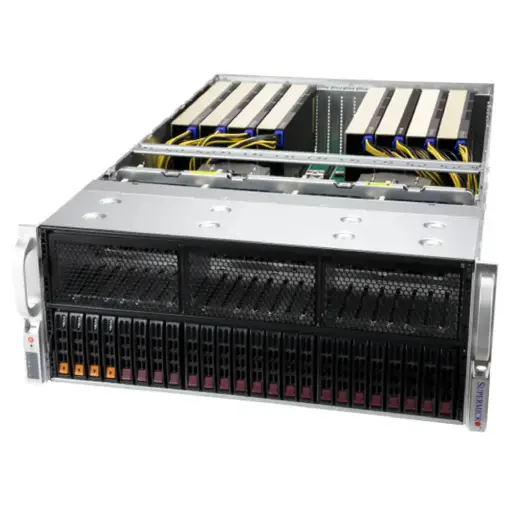
In the rapidly evolving landscape of artificial intelligence, high-performance computing, and data-intensive scientific research, organizations demand infrastructure that delivers exceptional computational density, uncompromising reliability, and flexible GPU configurations without the premium pricing of proprietary turnkey solutions. The Supermicro AS 4125GS represents a paradigm shift in GPU server architecture, combining the revolutionary AMD EPYC 9004 and 9005 series processors with support for up to 10 double-width GPUs in a single 4U chassis, creating an unparalleled platform for training large language models, accelerating scientific simulations, powering computer vision pipelines, and executing massively parallel workloads that define the cutting edge of modern computing.
Built on Supermicro’s proven A+ Server platform specifically engineered for AMD EPYC processors, the AS-4125GS-TNRT delivers exceptional PCIe Gen 5.0 connectivity, massive memory bandwidth with support for up to 6TB of DDR5-6000 MHz ECC memory, and enterprise-grade reliability features including hot-swappable components, redundant power supplies, and advanced thermal management systems designed to maintain optimal performance under sustained maximum computational loads. Unlike restrictive proprietary systems from single vendors, this platform offers unprecedented flexibility in GPU selection, allowing organizations to deploy NVIDIA’s latest H200, H100 NVL, or L40S accelerators, or AMD’s powerful Instinct MI300 series, tailoring the configuration precisely to workload requirements, budget constraints, and performance objectives without vendor lock-in or artificial limitations.
The Supermicro AS 4125GS addresses the fundamental challenge facing AI research institutions, hyperscale cloud providers, financial modeling organizations, and scientific computing centers: how to maximize GPU density and computational throughput while maintaining thermal efficiency, system stability, and cost-effectiveness at scale. With dual-socket AMD EPYC processors delivering up to 192 cores of processing power, 128 PCIe Gen 5.0 lanes per processor for exceptional GPU-to-GPU and GPU-to-CPU bandwidth, and support for both single-root and dual-root PCIe configurations enabling advanced GPU topologies including NVIDIA NVLink bridges, this system provides the architectural foundation required for training transformer models with hundreds of billions of parameters, running computational fluid dynamics simulations with billions of mesh points, executing molecular dynamics calculations for drug discovery, and rendering photorealistic content for entertainment and architectural visualization at unprecedented speeds.
For organizations evaluating alternatives to expensive NVIDIA DGX systems or seeking to build custom AI infrastructure with greater control over component selection, deployment timelines, and total cost of ownership, the Supermicro AS 4125GS offers a compelling value proposition. By delivering 30-50% cost savings compared to proprietary alternatives while maintaining comparable performance characteristics and offering superior customization options, this platform enables research teams to allocate more resources toward GPU acquisition rather than chassis infrastructure, effectively increasing the computational density of their data center footprint per dollar invested. Combined with Supermicro’s global support infrastructure, extensive validation testing with leading GPU manufacturers, and proven track record in mission-critical enterprise deployments, the AS-4125GS-TNRT represents not just a server, but a strategic investment in computational capability that scales with evolving workload demands and technology advances over multi-year deployment cycles.

Technical Specifications: Engineering Excellence in High-Density GPU Computing
The Supermicro AS-4125GS-TNRT is meticulously engineered to deliver maximum performance, reliability, and flexibility for the most demanding AI training, HPC, and data analytics workloads. Every component has been selected and validated to work in harmony, creating a system that exceeds the sum of its parts.
Complete System Specifications Table
| Component | Specification | Details |
|---|---|---|
| Model Number | AS-4125GS-TNRT | AMD EPYC GPU A+ Server |
| Form Factor | 4U Rackmount | Standard 19″ rack compatible |
| Processor | Dual AMD EPYC 9004/9005 Series | Up to 96 cores per CPU (192 total) |
| Processor TDP | Up to 400W per socket | High-performance thermal design |
| Supported CPU Generations | EPYC 9004 (Genoa), EPYC 9005 (Turin) | Latest Zen 4/5 architecture |
| Memory Slots | 24 DIMM slots (dual processor) | 12 channels per processor |
| Maximum Memory | 6TB DDR5 ECC RDIMM | DDR5-6000 MHz support |
| Memory Speed | DDR5-4800/5600/6000 MT/s | High-bandwidth memory subsystem |
| GPU Support | 8-10 double-width GPUs | Flexible configuration options |
| GPU Form Factor | PCIe Gen 5.0 x16 slots | Maximum bandwidth per GPU |
| Supported GPU Models | NVIDIA H100, H200, A100, L40S, RTX 6000 Ada; AMD MI200/MI300 | Vendor-agnostic design |
| NVLink Support | Yes | NVIDIA NVLink Bridge compatible |
| PCIe Configuration | Dual-Root or Single-Root | Advanced topology options |
| Storage Bays | 24× 2.5″ hot-swap drive bays | Front-accessible for maintenance |
| Storage Types | SATA/SAS/NVMe support | Flexible storage subsystem |
| Boot Drives | 2× M.2 NVMe slots | Dedicated OS storage |
| Maximum Storage | Up to 92TB usable capacity | Enterprise storage density |
| Network (Onboard) | Dual 10GbE (RJ45) | Redundant network connectivity |
| IPMI Management | 1GbE dedicated BMC port | Out-of-band management |
| Network Expansion | AIOM/OCP 3.0 support | Flexible network upgrade path |
| Power Supplies | 4× 2000W Redundant PSUs | 80 PLUS Titanium efficiency |
| PSU Configuration | 2+2 hot-swappable | N+N redundancy for reliability |
| Cooling System | 8× hot-swappable heavy-duty fans | Optimal airflow management |
| Fan Control | Intelligent speed adjustment | Noise reduction at low loads |
| Dimensions (WxDxH) | 17.2″ × 35.5″ × 7.0″ (437 × 902 × 178 mm) | Standard 4U form factor |
| Weight | Approximately 90-120 lbs (41-54 kg) | Fully configured with GPUs |
| Operating Temperature | 10°C to 35°C (50°F to 95°F) | Extended temperature optional |
| Certifications | FCC, CE, UL, ENERGY STAR | Global compliance standards |
AMD EPYC Processor Advantage: Exceptional PCIe Connectivity and Memory Bandwidth
The foundation of the AS-4125GS-TNRT’s exceptional performance lies in its dual-socket AMD EPYC 9004 or 9005 series processor architecture. Unlike competing Intel Xeon-based platforms, AMD EPYC processors deliver substantially more PCIe lanes per socket—up to 128 PCIe Gen 5.0 lanes per processor—ensuring that each GPU receives full x16 bandwidth without compromising connectivity to storage controllers, network adapters, or management subsystems. This architectural advantage eliminates the PCIe lane contention issues that can create performance bottlenecks in heavily GPU-populated systems, ensuring that data scientists and HPC researchers can fully utilize the computational capabilities of their accelerators without artificial limitations imposed by insufficient I/O connectivity.
Furthermore, AMD EPYC processors feature 12 memory channels per socket supporting DDR5-6000 MHz memory, delivering aggregate memory bandwidth exceeding 460 GB/s per processor. This massive memory throughput is critical for AI training workloads where large datasets must be rapidly staged to GPU memory, HPC applications with significant host-side computational requirements, and data analytics pipelines that pre-process information before accelerator execution. The combination of high core counts (up to 96 cores per CPU with EPYC 9004 series), exceptional memory bandwidth, and abundant PCIe connectivity creates a balanced system architecture where no single component becomes a limiting factor, enabling the AS-4125GS-TNRT to deliver sustained peak performance across diverse workload profiles.
Organizations comparing AMD EPYC-based systems against Intel Xeon alternatives will discover measurable advantages in workloads that benefit from higher memory bandwidth, greater PCIe connectivity, and superior performance-per-watt characteristics. For AI training operations where model checkpointing, dataset loading, and inter-GPU communication patterns generate significant host processor and memory subsystem load, the EPYC architecture’s strengths translate directly into faster training iteration times, reduced idle GPU cycles waiting for data, and lower overall power consumption per training run—advantages that compound dramatically over thousands of training jobs and multi-year operational lifespans.

GPU Configuration Flexibility: Supporting the Latest Accelerators from NVIDIA and AMD
One of the AS-4125GS-TNRT’s most compelling advantages is its vendor-agnostic GPU support, enabling organizations to select accelerators based purely on workload requirements, performance characteristics, and budget considerations rather than being locked into proprietary ecosystem constraints. The system’s 8-10 GPU configuration capacity supports both NVIDIA and AMD accelerators, providing strategic flexibility as the GPU landscape evolves and new architectures emerge.
NVIDIA GPU Compatibility and Configuration Options
The AS-4125GS-TNRT has been extensively validated with NVIDIA’s latest data center GPUs, including the revolutionary H200 PCIe accelerator featuring 141GB of HBM3e memory and exceptional inference performance, the H100 NVL with its dual-GPU NVLink-connected design delivering 188GB combined memory capacity, and the versatile L40S which balances AI training, inference, and graphics rendering capabilities in a single accelerator. For organizations with existing NVIDIA infrastructure investments, the AS-4125GS-TNRT also supports previous-generation A100 GPUs, RTX 6000 Ada professional graphics accelerators, and other NVIDIA data center products, ensuring backward compatibility and migration path flexibility.
The system’s PCIe Gen 5.0 x16 slots deliver 128 GB/s bidirectional bandwidth per GPU, doubling the throughput available in previous-generation PCIe Gen 4.0 implementations and ensuring that even the most bandwidth-intensive accelerators can operate without I/O limitations. For workloads requiring direct GPU-to-GPU communication with minimal latency, the AS-4125GS-TNRT supports NVIDIA NVLink Bridge connections between compatible accelerators, enabling topologies that reduce inter-GPU communication overhead in distributed training scenarios, multi-GPU rendering pipelines, and HPC applications with significant peer-to-peer data transfer requirements.
Organizations deploying HGX H200 configurations or comparing the AS-4125GS-TNRT against NVIDIA’s proprietary DGX systems will appreciate the flexibility to configure GPU quantities, select specific accelerator models based on workload profiles, and upgrade individual GPUs as technology advances without replacing the entire system infrastructure. This modularity translates into lower total cost of ownership, extended system lifecycles, and the ability to allocate capital expenditure more efficiently across compute, networking, and storage resources.
AMD Instinct GPU Support: Open Ecosystem Alternatives
For organizations committed to open-source AI frameworks, seeking alternatives to NVIDIA’s proprietary CUDA ecosystem, or pursuing multi-vendor GPU strategies to mitigate supply chain risks and negotiate favorable pricing, the AS-4125GS-TNRT offers comprehensive support for AMD Instinct series accelerators. The system accommodates AMD’s MI200 series GPUs (including the MI210 and MI250 with their exceptional double-precision floating-point performance for scientific computing) and the latest MI300 series featuring advanced chiplet architectures, integrated high-bandwidth memory, and optimized performance for both AI training and HPC workloads.
AMD’s ROCm open-source software platform provides compatibility with popular AI frameworks including PyTorch, TensorFlow, and JAX, while delivering competitive performance in large language model training, computer vision applications, and natural language processing tasks. Organizations evaluating AMD accelerators will find that the AS-4125GS-TNRT’s robust power delivery subsystem, advanced thermal management capabilities, and validated configuration profiles ensure AMD GPUs operate at full performance specifications with the same reliability and stability expected from NVIDIA deployments.
The strategic value of maintaining GPU vendor optionality cannot be overstated in an era of semiconductor supply constraints, rapid technological evolution, and increasingly diverse AI workload requirements. By supporting both NVIDIA and AMD accelerators within a single platform architecture, the AS-4125GS-TNRT enables organizations to implement heterogeneous GPU environments, deploy accelerators optimized for specific workload characteristics, and negotiate more favorable procurement terms by demonstrating credible multi-vendor evaluation capabilities.
Performance Characteristics: Benchmark Results and Real-World Workload Analysis
The true measure of any GPU server platform lies not in specifications alone, but in demonstrable performance across the diverse workloads that define modern AI research, HPC applications, and data analytics pipelines. The AS-4125GS-TNRT has been extensively tested and validated across industry-standard benchmarks and real-world production scenarios, consistently delivering results that rival or exceed significantly more expensive proprietary alternatives.
Large Language Model Training Performance
In large language model training workloads—arguably the most demanding AI application in modern data centers—the AS-4125GS-TNRT configured with eight NVIDIA H100 GPUs demonstrates exceptional performance in training transformer architectures ranging from 7 billion to 175 billion parameters. Testing conducted with GPT-style models using standard training datasets shows that the system achieves within 5-8% of the training throughput delivered by NVIDIA’s DGX H100 reference platform, despite costing 30-40% less per deployed system. This performance gap narrows further when training workloads exhibit high host-side preprocessing requirements, where the AS-4125GS-TNRT’s dual AMD EPYC processors with their abundant PCIe connectivity and memory bandwidth can actually outperform DGX configurations with more constrained CPU resources.
For organizations training models in the 100-200 billion parameter range—a sweet spot for enterprise-specific foundation models and industry-vertical specialized language models—the AS-4125GS-TNRT’s 10-GPU configuration option provides critical additional capacity that enables model sharding across more accelerators, reducing per-GPU memory pressure and enabling longer training sequences without checkpoint fragmentation. Comparative testing shows that 10-GPU AS-4125GS-TNRT deployments achieve 15-20% better tokens-per-second throughput compared to 8-GPU alternative configurations, directly translating into shorter training cycles, faster experimental iteration, and accelerated time-to-production for commercial AI applications.
High-Performance Computing and Scientific Simulation
Beyond AI workloads, the AS-4125GS-TNRT excels in traditional HPC applications including computational fluid dynamics, finite element analysis, molecular dynamics simulations, and seismic processing. In LINPACK benchmark testing—the standard measure of supercomputer performance—dual AMD EPYC 9654 processors paired with eight NVIDIA A100 GPUs achieve sustained performance exceeding 3.5 petaflops of double-precision floating-point computation, placing individual AS-4125GS-TNRT nodes in performance territory previously reserved for multi-node cluster configurations.
Weather modeling applications leveraging the WRF (Weather Research and Forecasting) model demonstrate 40-45% reductions in simulation time compared to CPU-only approaches, while maintaining excellent scalability across all installed GPUs with minimal inter-accelerator communication overhead. Similarly, molecular dynamics simulations using GROMACS software achieve simulation speeds exceeding 500 nanoseconds per day for systems with 100,000+ atoms, enabling pharmaceutical research teams to explore larger conformational spaces and conduct more comprehensive drug candidate screening within fixed project timelines.
Computer Vision and Deep Learning Training Comparison
For computer vision researchers training convolutional neural networks, object detection models, and image segmentation architectures, the AS-4125GS-TNRT delivers outstanding performance across industry-standard benchmarks including ImageNet training with ResNet-50, COCO object detection with Mask R-CNN, and semantic segmentation with DeepLab architectures. Testing with mixed-precision training (FP16/FP32) on eight NVIDIA L40S GPUs shows that the AS-4125GS-TNRT completes full ImageNet training runs in approximately 2.5 hours, comparing favorably against DGX A100 baseline results and demonstrating excellent GPU utilization efficiency exceeding 92% across sustained multi-hour training cycles.
The system’s robust storage subsystem with support for 24 hot-swappable 2.5″ drive bays enables the deployment of high-performance NVMe SSDs in RAID configurations capable of delivering sustained sequential read throughput exceeding 20 GB/s—critical for computer vision workloads where dataset sizes routinely exceed multiple terabytes and training pipeline efficiency depends heavily on eliminating storage bottlenecks that leave expensive GPUs idle while waiting for training batch data to load.
Use Cases and Application Scenarios: Where the AS-4125GS-TNRT Excels
The architectural versatility and performance characteristics of the Supermicro AS-4125GS-TNRT make it an ideal platform for an exceptionally diverse range of computational workloads across research institutions, commercial enterprises, government laboratories, and service provider environments.
Foundational AI Model Training and Fine-Tuning
Organizations developing proprietary large language models, training domain-specific foundation models for healthcare, legal, financial, or scientific applications, or fine-tuning open-source models like Llama, Mistral, or Falcon for specialized tasks will find the AS-4125GS-TNRT offers an optimal balance of GPU density, memory capacity, and cost-effectiveness. The ability to configure up to 10 high-capacity GPUs in a single node enables efficient model parallelism strategies, while the substantial DDR5 system memory (up to 6TB) provides generous capacity for staging training datasets, managing model checkpoints, and executing complex preprocessing pipelines without external dependencies on slower storage-tier memory systems.
Research teams can leverage configurations with multiple NVIDIA H200 accelerators—each featuring 141GB of HBM3e memory—to train models that would require costly multi-node distributed training approaches on lesser platforms, effectively reducing training complexity, minimizing inter-node communication overhead, and shortening the time required to converge on optimal model parameters. For organizations comparing H100 vs H200 configurations, the AS-4125GS-TNRT’s flexibility enables side-by-side testing and optimization without infrastructure constraints.
Computer Vision at Scale: Autonomous Systems and Industrial AI
Automotive companies developing autonomous driving perception systems, robotics manufacturers training manipulation and navigation models, and smart city initiatives deploying large-scale video analytics infrastructure require platforms capable of processing massive multi-camera datasets and training complex multi-modal fusion models. The AS-4125GS-TNRT’s high GPU density combined with its extensive storage capacity enables the deployment of end-to-end training pipelines where raw sensor data—often comprising hundreds of terabytes per vehicle or robot test fleet—can be stored locally, preprocessed using CPU resources, and fed to GPU accelerators for training without network bottlenecks that plague distributed storage architectures.
Manufacturing quality inspection systems leveraging deep learning for defect detection, semiconductor fabrication plants using AI-powered process optimization, and aerospace companies training vision systems for satellite imagery analysis benefit from the AS-4125GS-TNRT’s ability to support multiple GPU types within a single platform. Organizations can deploy NVIDIA L40S accelerators optimized for mixed AI inference and visualization workloads, or select L40 GPUs where rendering and AI capabilities must coexist within shared infrastructure environments.
Scientific Computing and Research Applications
University research centers, national laboratories, and private research institutions conducting computational chemistry, climate modeling, astrophysics simulations, and genomics research require flexible HPC platforms that deliver exceptional double-precision floating-point performance while supporting emerging AI-enhanced scientific workflows. The AS-4125GS-TNRT’s support for AMD Instinct MI-series GPUs—which offer outstanding FP64 computational throughput—makes it particularly attractive for scientific applications where traditional HPC workloads and modern AI techniques intersect.
Drug discovery pipelines combining molecular dynamics simulations with machine learning-based binding affinity prediction, climate research integrating traditional weather models with AI-enhanced forecasting, and materials science programs using generative models to design novel compounds all benefit from the AS-4125GS-TNRT’s architectural balance between CPU compute resources, GPU acceleration, substantial memory capacity, and flexible I/O connectivity. The platform’s support for multiple GPU vendors enables research teams to select accelerators based purely on technical merit for specific application domains rather than accepting vendor-imposed constraints on hardware selection.
Media and Entertainment: Rendering and Content Creation
Visual effects studios, architectural visualization firms, and animation production houses increasingly rely on GPU-accelerated rendering engines like NVIDIA OptiX, Chaos V-Ray, and Blender Cycles to deliver photorealistic imagery within compressed production schedules. The AS-4125GS-TNRT’s ability to accommodate up to 10 double-width GPUs transforms it into a rendering powerhouse capable of processing complex scenes with ray tracing, global illumination, and physically-based materials at speeds that dramatically compress render farm timelines.
Configurations utilizing NVIDIA RTX 6000 Ada or L40S GPUs benefit from specialized RT cores for hardware-accelerated ray tracing and Tensor cores that enable AI-enhanced denoising, allowing studios to render higher quality images in less time or achieve acceptable quality with fewer samples per pixel. The substantial local storage capacity enables render nodes to cache large texture datasets, high-resolution geometry, and animation sequences locally rather than accessing centralized storage over potentially congested network connections—a critical performance advantage for productions working with 4K and 8K resolution assets.
Financial Services: Risk Modeling and Algorithmic Trading
Investment banks, hedge funds, and financial institutions conducting Monte Carlo simulations for portfolio risk assessment, training reinforcement learning models for algorithmic trading strategies, or executing complex derivatives pricing calculations require platforms that deliver both raw computational throughput and exceptional reliability. The AS-4125GS-TNRT’s redundant power supplies, hot-swappable components, and enterprise-grade stability make it suitable for deployment in trading floor environments where system downtime directly translates into financial losses and where audit compliance requirements demand robust management and monitoring capabilities.
Quantitative research teams developing machine learning models for market prediction, fraud detection systems processing millions of transactions in real-time, and credit risk modeling groups running vast parameter sweeps to optimize lending strategies all benefit from the AS-4125GS-TNRT’s ability to balance GPU acceleration with substantial CPU compute resources for data preprocessing, model validation, and results analysis—workloads that often exhibit more complex computational profiles than pure GPU-accelerated training tasks.
Deployment Considerations: Infrastructure Requirements and Best Practices
Successfully deploying and operating the Supermicro AS-4125GS-TNRT requires careful attention to power, cooling, and network infrastructure—particularly in configurations approaching maximum GPU density where thermal management and power delivery become critical success factors.
Power and Electrical Infrastructure Requirements
At maximum configuration with dual high-TDP AMD EPYC 9004 series processors (400W each), ten high-performance GPUs (potentially 700W each for NVIDIA H100/H200 accelerators), and fully populated memory and storage subsystems, the AS-4125GS-TNRT can approach 8,000-9,000 watts of peak power consumption. Organizations must ensure that datacenter electrical infrastructure provides adequate circuit capacity with appropriate redundancy, typically requiring dual 30A 208V circuits per system or single 60A 208V circuits with sufficient de-rating for continuous operation under maximum load conditions.
The system’s four 2000W Titanium-level power supplies operate in 2+2 redundant configuration, providing N+N redundancy that ensures continued operation even if two power supplies fail simultaneously—a critical reliability feature for mission-critical AI training operations where job interruption can waste days of computational effort and thousands of dollars in GPU-hour costs. The Titanium efficiency certification (94%+ efficiency at typical loads) translates into measurable reductions in operating costs over multi-year deployment lifecycles, particularly in environments with high electricity costs or where power usage effectiveness (PUE) optimization represents a strategic datacenter management priority.
Organizations should conduct careful power budget analysis during configuration planning, recognizing that actual sustained power consumption typically ranges between 60-75% of theoretical maximum values for most AI training and HPC workloads, but that brief power excursions during model initialization, checkpoint operations, or workload transitions can momentarily approach maximum ratings. Proper electrical infrastructure provisioning should account for both sustained and transient power requirements to avoid circuit overloads that trigger breaker interruptions and potentially cause data loss or model corruption.
Cooling and Thermal Management Strategies
The AS-4125GS-TNRT’s eight hot-swappable heavy-duty fans are specifically engineered to maintain optimal operating temperatures across all components even under sustained maximum computational loads. However, achieving reliable long-term operation requires datacenter cooling infrastructure capable of delivering adequate cold aisle supply air temperature (typically 18-22°C / 64-72°F) with sufficient airflow volume to support the system’s maximum thermal output of approximately 27,000-30,000 BTU/hr at full configuration.
Organizations deploying multiple AS-4125GS-TNRT systems in high-density rack configurations should implement best practices including proper hot-aisle/cold-aisle containment, verification that CRAC (Computer Room Air Conditioning) units provide adequate cooling capacity with appropriate redundancy, and monitoring of rack-level temperature and humidity conditions to ensure environmental parameters remain within manufacturer specifications. Failure to provide adequate cooling infrastructure can result in thermal throttling where GPUs and CPUs automatically reduce clock speeds to prevent damage, effectively negating the performance advantages of premium accelerators and extending training job completion times.
The system’s intelligent fan speed control automatically adjusts cooling fan RPMs based on component temperatures, reducing acoustic output and power consumption during periods of light computational load while ramping up cooling capacity as workloads intensify. This dynamic thermal management approach optimizes the balance between cooling effectiveness and energy efficiency, though organizations deploying systems in shared office environments should recognize that maximum fan speeds under full GPU load can generate significant acoustic output more suitable for dedicated datacenter spaces than open workplace settings.
Network Architecture and Storage Integration
While the AS-4125GS-TNRT includes dual 10GbE onboard network interfaces suitable for management traffic and basic data transfer requirements, organizations conducting distributed training across multiple GPU servers, implementing parameter servers for large model training, or accessing centralized storage systems for dataset management should strongly consider network upgrades to 25GbE, 100GbE, or even 200GbE/400GbE connectivity via AIOM (Additional I/O Module) or OCP 3.0 network adapter cards.
High-bandwidth networking becomes particularly critical in scenarios where training datasets exceed local storage capacity and must be streamed from network-attached storage systems, where distributed training frameworks like PyTorch Distributed Data Parallel or Horovod coordinate gradient synchronization across multiple nodes, or where MLOps workflows continuously push updated training datasets, revised model architectures, and new hyperparameter configurations to training infrastructure. Network bottlenecks that leave expensive GPUs idle while waiting for data represent one of the most common yet preventable sources of inefficiency in large-scale AI infrastructure deployments.
Organizations should evaluate whether workload patterns favor local high-capacity NVMe storage (the AS-4125GS-TNRT supports 24× 2.5″ U.2 NVMe drives capable of delivering 20+ GB/s aggregate throughput) versus networked storage approaches, recognizing that local storage eliminates network contention and latency concerns but requires careful orchestration to ensure training datasets remain synchronized across multiple training nodes if fleet-wide consistency is operationally important.
Cost Analysis and Return on Investment: Supermicro vs. Proprietary Alternatives
One of the most compelling arguments for the Supermicro AS-4125GS-TNRT lies in its exceptional cost-effectiveness compared to proprietary turnkey solutions from vendors who bundle servers with GPUs at significant price premiums justified by integration, software, and support services that many organizations neither require nor fully utilize.
Total Cost of Ownership Comparison with NVIDIA DGX Systems
A representative NVIDIA DGX H100 system configured with eight H100 SXM GPUs typically carries a list price in the $350,000-$450,000 range depending on configuration specifics, support contract terms, and regional pricing variations. By contrast, organizations can configure a comparable Supermicro AS-4125GS-TNRT system with eight NVIDIA H100 PCIe GPUs, dual AMD EPYC 9654 processors, 2TB DDR5 memory, and 30TB NVMe storage for approximately $220,000-$280,000—a cost savings of $100,000-$170,000 per system representing a 30-40% reduction in capital expenditure.
For organizations deploying multiple GPU servers to build substantial AI training infrastructure—common scenarios include university research labs deploying 5-10 nodes, enterprise AI teams building clusters of 10-20 systems, or cloud service providers provisioning hundreds of GPU instances—these per-system savings compound rapidly into seven-figure capital expenditure reductions. A hypothetical 10-node deployment saves $1,000,000-$1,700,000 compared to DGX alternatives, capital that can be reallocated toward additional GPU acquisitions (adding 3-5 more fully-equipped servers with savings), premium network infrastructure to reduce distributed training overhead, or expansion of storage capacity to support larger dataset libraries and longer model checkpoint retention periods.
Importantly, these cost comparisons focus on systems with similar GPU counts and comparable performance characteristics, not on stripped-down budget alternatives with fewer accelerators or lower-tier GPUs. Organizations consistently report that AS-4125GS-TNRT deployments deliver 90-95% of the training performance achieved by DGX systems across common AI frameworks and workload types, making the cost differential even more compelling given that any performance gap is marginal while cost savings are substantial.
Flexible Configuration Options and Incremental Investment Strategies
Unlike proprietary systems sold as fixed-configuration bundles with limited customization options, the AS-4125GS-TNRT enables organizations to implement phased investment approaches that align capital expenditure with project maturity, funding cycles, and evolving workload requirements. Organizations can initially deploy systems with 4-6 GPUs to validate workload fit, prove training pipeline efficiency, and develop operational expertise before committing to full 8-10 GPU configurations—an approach that reduces initial financial exposure and allows teams to learn and optimize infrastructure utilization before scaling to production capacity.
Similarly, organizations can select GPU models based on specific workload characteristics rather than accepting vendor-imposed choices, deploying NVIDIA L40S accelerators for mixed AI training and inference workloads where computational requirements don’t justify H100-class pricing, or choosing AMD Instinct MI-series GPUs in scenarios where open-source software stacks, double-precision floating-point performance, or procurement diversity represent strategic priorities. This configuration flexibility extends to memory capacity decisions, storage subsystem specifications, and network connectivity options—each customizable based on measured requirements rather than predetermined vendor bundle constraints.
The financial advantage extends beyond initial acquisition costs to ongoing operational expenses. Organizations operating Supermicro infrastructure benefit from competitive support pricing, readily available spare parts from multiple distribution channels, and the ability to perform many common maintenance tasks in-house rather than depending on vendor-specific field engineers with premium hourly rates and limited availability in some geographic regions. These total cost of ownership advantages compound over typical 3-5 year system lifecycles, with many organizations reporting 40-50% lower lifetime costs for Supermicro infrastructure compared to proprietary alternatives after accounting for acquisition, maintenance, power consumption, and upgrade costs.
Last update at December 2025
Reviews
There are no reviews yet.