
Description
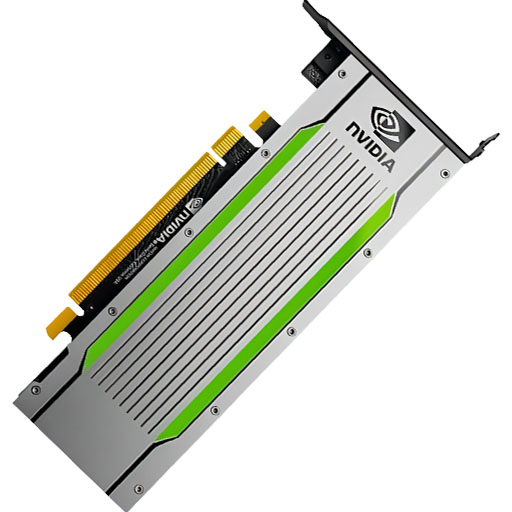
The NVIDIA T4 Tensor Core GPU revolutionizes artificial intelligence deployment in enterprise data centers by delivering exceptional inference performance in a remarkably efficient package. Designed specifically for mainstream computing environments, this compact powerhouse combines cutting-edge Turing architecture with energy-efficient design to accelerate diverse cloud workloads at scale. From AI inference to video transcoding, the T4 delivers breakthrough performance while consuming only 70 watts of power.
Understanding the NVIDIA T4 Architecture
Launched in September 2018, the NVIDIA T4 represents a strategic shift toward inference-optimized computing. Built on the revolutionary Turing architecture using TSMC’s 12nm process technology, the T4 houses 13.6 billion transistors across a 545mm² die area. This GPU introduces first-generation Ray Tracing Cores and second-generation Tensor Cores, creating a versatile accelerator capable of handling multiple precision formats from FP32 down to INT4.
The TU104 graphics processor at the heart of the T4 delivers remarkable computational density despite its single-slot form factor. With 2,560 CUDA cores, 320 Tensor Cores, and 40 RT Cores working in harmony, this GPU provides up to 40 times higher performance than CPUs for AI inference workloads. The architecture’s multi-precision capabilities enable developers to optimize models for maximum throughput without sacrificing accuracy.

Technical Specifications: Efficiency Meets Performance
Core Architecture Details
| Specification | Details |
|---|---|
| GPU Architecture | NVIDIA Turing (TU104) |
| GPU Variant | TU104-895-A1 |
| CUDA Cores | 2,560 |
| Tensor Cores | 320 (2nd Generation) |
| RT Cores | 40 (1st Generation) |
| Base Clock | 585 MHz |
| Boost Clock | 1590 MHz |
| Memory Capacity | 16 GB GDDR6 |
| Memory Interface | 256-bit |
| Memory Bandwidth | 320 GB/s |
| Process Technology | 12nm (TSMC) |
| Transistor Count | 13.6 Billion |
| Die Size | 545 mm² |
| TDP | 70W |
| Power Connector | None (powered via PCIe slot) |
| Form Factor | Single-slot, Low-profile |
| PCIe Interface | PCIe 3.0 x16 |
| Display Outputs | None (headless design) |
| Cooling Solution | Passive cooling |
Multi-Precision Performance Metrics
The T4’s revolutionary Turing Tensor Cores deliver exceptional performance across multiple precision formats:
- FP32 Performance: 8.1 TFLOPS
- FP16 Performance: 65 TFLOPS
- INT8 Performance: 130 TOPS (Tera Operations Per Second)
- INT4 Performance: 260 TOPS
- Texture Fill Rate: 254.4 GTexel/s
- Pixel Fill Rate: 101.8 GPixel/s
This multi-precision capability enables AI developers to choose optimal precision for their specific models, maximizing throughput while maintaining accuracy requirements. The INT8 and INT4 performance figures particularly shine in inference scenarios where reduced precision delivers massive performance advantages.
16GB GDDR6 Memory: Balancing Capacity and Efficiency
The T4’s 16GB of GDDR6 memory strikes an optimal balance between capacity and cost-effectiveness for inference workloads. Running at 1250 MHz (10 Gbps effective), the 256-bit memory interface delivers 320 GB/s bandwidth sufficient for most inference scenarios.
Memory Architecture Advantages
Inference Optimization:
- Batch processing: Handle multiple inference requests simultaneously
- Model hosting: Accommodate large neural networks without external memory management
- Concurrent workloads: Support multiple models or applications sharing GPU resources
- Video buffer: Sufficient capacity for multi-stream video transcoding
Cost-Effective Deployment:
- Right-sized capacity: Avoids over-provisioning for typical inference workloads
- Power efficiency: Lower memory capacity contributes to 70W TDP
- Density optimization: Enables high GPU count per server rack
- TCO advantages: Reduces both capital and operational expenses
Unlike training-focused GPUs requiring massive memory pools, the T4’s 16GB configuration addresses the sweet spot for production inference deployments where responsiveness and efficiency matter more than absolute memory capacity.
Turing Tensor Cores: AI Inference Acceleration
The 320 second-generation Tensor Cores represent the T4’s primary innovation for AI workloads. These specialized processing units accelerate matrix multiplication operations fundamental to neural network inference.
Multi-Precision Intelligence
Turing Tensor Cores support multiple data formats simultaneously:
FP16 (Half Precision):
- Ideal for models trained in mixed precision
- Maintains accuracy for most computer vision and NLP tasks
- Delivers 65 TFLOPS throughput
INT8 (8-bit Integer):
- Doubles throughput compared to FP16 with minimal accuracy loss
- Perfect for quantized models in production
- Achieves 130 TOPS performance
INT4 (4-bit Integer):
- Quadruples throughput for extremely latency-sensitive applications
- Enables aggressive model compression
- Delivers 260 TOPS peak performance
This precision flexibility enables AI teams to optimize the price-performance ratio by selecting appropriate precision for each model based on accuracy requirements and latency constraints.
Framework and Software Support
The T4 integrates seamlessly with modern AI development ecosystems:
- TensorFlow: Native TensorRT integration for optimized inference
- PyTorch: TorchScript compilation with GPU acceleration
- ONNX Runtime: Cross-framework model deployment
- TensorRT: NVIDIA’s inference optimization SDK
- Triton Inference Server: Scalable model serving platform
This comprehensive software stack ensures developers can deploy models from any training framework without extensive porting or optimization efforts.
Video Transcoding and Media Acceleration
Beyond AI inference, the T4 excels at video processing workloads through dedicated hardware acceleration engines.
NVENC/NVDEC Capabilities
7th Generation NVENC:
- Hardware-accelerated H.264 and HEVC encoding
- Support for 4K and 8K video streams
- Multiple concurrent encode sessions
- Low-latency encoding for live streaming applications
4th Generation NVDEC:
- Up to 38 full-HD video stream decoding simultaneously
- Support for H.264, HEVC, VP9, and AV1 codecs
- Hardware-based video processing pipelines
- Offloads CPU for concurrent AI processing
Real-World Video Applications
Data centers leverage T4 video capabilities for:
- Content delivery networks: Transcode uploaded videos to multiple formats
- Video surveillance: Decode multiple security camera streams for AI analysis
- Cloud gaming: Encode gameplay video for streaming to clients
- Video conferencing: Process multiple participant streams simultaneously
- Media processing pipelines: Integrate AI analysis with video transcoding
The combination of AI inference and video processing in a single GPU enables innovative applications like real-time content moderation, automated video summarization, and intelligent video search at scale.
Energy Efficiency: The 70-Watt Advantage
The T4’s remarkable 70-watt power consumption revolutionizes data center GPU deployment economics.
Power Efficiency Benefits
Infrastructure Advantages:
- No auxiliary power: Powered entirely through PCIe slot
- Dense deployments: Multiple GPUs per standard server without power upgrades
- Cooling simplification: Passive cooling reduces fan complexity
- Rack density: Higher compute per rack with reduced thermal output
Operational Cost Reduction:
- Lower electricity bills: Approximately one-quarter the power of training GPUs
- Reduced cooling costs: Less heat generation means lower HVAC requirements
- Extended hardware lifespan: Lower temperatures improve reliability
- Sustainability goals: Reduced carbon footprint per inference operation
Total Cost of Ownership: Over a three-year deployment cycle, the T4’s efficiency translates to substantial savings:
- Power consumption: ~613 kWh per year per GPU versus 2,628 kWh for 300W alternatives
- Cooling overhead: Reduced by approximately 60% compared to high-power GPUs
- Infrastructure costs: Avoids power distribution and cooling system upgrades
Performance Benchmarks: Real-World Results
AI Inference Performance
Independent testing demonstrates the T4’s inference capabilities across popular AI workloads:
Natural Language Processing:
- BERT-Base: 1,360 sentences/second (INT8)
- BERT-Large: 430 sentences/second (INT8)
- GPT-2: 270 tokens/second (FP16)
Computer Vision:
- ResNet-50: 6,250 images/second (INT8)
- Inception-v3: 3,850 images/second (INT8)
- EfficientNet: 2,100 images/second (FP16)
Object Detection:
- YOLOv4: 340 FPS at 416×416 resolution (INT8)
- SSD-MobileNet: 1,200 FPS (INT8)
- Mask R-CNN: 28 FPS at 1024×1024 (FP16)
Video Transcoding Benchmarks
According to NVIDIA testing, a single T4 GPU can:
- Decode: 38 simultaneous 1080p H.264 streams
- Encode: 15 simultaneous 1080p H.264 streams
- Transcode: 8 simultaneous 1080p to 720p streams
- 4K processing: 6 simultaneous 4K streams with AI analysis
These figures represent 2x improvement over previous-generation Pascal GPUs, enabling consolidation of video infrastructure onto fewer servers.
Cost-Performance Analysis
Cloud GPU pricing reveals the T4’s value proposition:
| Cloud Provider | Hourly Cost | Use Case Fit |
|---|---|---|
| Google Cloud (GCP) | $0.35 | General inference, video processing |
| AWS (G4 instances) | $0.526 | AI inference, graphics virtualization |
| Azure | $0.45 | ML inference, batch processing |
| Lambda Labs | $0.25 | Development and testing |
With purchase prices around $845 for new units and $400-600 for refurbished models, the T4 offers accessible entry into GPU-accelerated computing for organizations of all sizes.
T4 vs. Competing GPUs: Market Positioning
T4 vs. V100: Training vs. Inference
| Feature | NVIDIA T4 | NVIDIA V100 |
|---|---|---|
| Architecture | Turing | Volta |
| Primary Use Case | Inference | Training & Inference |
| CUDA Cores | 2,560 | 5,120 |
| Tensor Cores | 320 | 640 |
| Memory | 16GB GDDR6 | 16GB/32GB HBM2 |
| Memory Bandwidth | 320 GB/s | 900 GB/s |
| TDP | 70W | 300W |
| Form Factor | Single-slot | Dual-slot |
| Price Point | ~$850 | ~$8,000+ |
Key Differentiation: The V100 delivers 125 TFLOPS training performance at 300W, while the T4 provides 65 TFLOPS inference performance at 70W. Organizations should choose V100 for model training and T4 for cost-effective production inference deployment.
T4 vs. A10: Generational Evolution
The A10, based on Ampere architecture, represents NVIDIA’s next-generation inference GPU:
T4 Advantages:
- Lower power consumption (70W vs. 150W)
- Better cost-per-inference for INT8 workloads
- Wider cloud availability and ecosystem maturity
- Established driver stability for production deployments
A10 Advantages:
- 3.5x more CUDA cores (9,216 vs. 2,560)
- 24GB memory vs. 16GB
- Support for newer GPU features and technologies
- Better performance for mixed workloads
Decision Criteria: Choose T4 for pure inference optimization and maximum density; select A10 when workloads require additional memory or mixed training/inference capabilities.
T4 vs. A100: Consumer vs. Enterprise Data Center
The A100 represents NVIDIA’s flagship data center GPU targeting different use cases:
- Performance: A100 delivers 10x higher training performance
- Memory: A100 offers 40GB/80GB options with HBM2e
- Price: A100 costs 15-20x more than T4
- Use cases: A100 for large-scale training; T4 for production inference
According to Microsoft Azure documentation, the T4 provides better cost-performance ratio for inference workloads, while the A100 excels in scenarios requiring maximum raw performance regardless of cost.
Enterprise Applications and Use Cases
AI-Powered Services
Organizations deploy T4 GPUs to accelerate customer-facing AI applications:
Conversational AI:
- Chatbot response generation with sub-second latency
- Voice assistant natural language understanding
- Real-time language translation services
- Sentiment analysis for customer feedback
Recommendation Systems:
- E-commerce product recommendations
- Content personalization for streaming platforms
- Advertisement targeting optimization
- Fraud detection in financial transactions
Visual Search and Recognition:
- Reverse image search for retail applications
- Medical image analysis and diagnosis assistance
- Security and surveillance video analytics
- Quality inspection in manufacturing
Cloud Gaming and Graphics Virtualization
The T4’s RT Cores enable graphics-accelerated virtual desktop infrastructure:
NVIDIA Virtual GPU (vGPU) Solutions:
- Virtual workstation deployment for remote employees
- Cloud gaming infrastructure for streaming services
- Graphics-intensive application virtualization
- Virtual reality content streaming
Use Case Benefits:
- Share single GPU across multiple virtual machines
- Provide consistent graphics performance to end users
- Simplify hardware management for IT departments
- Scale graphics resources dynamically based on demand
Video Intelligence Platforms
Media companies leverage T4 for intelligent video processing:
Content Analysis:
- Automated video tagging and metadata generation
- Scene detection and highlight extraction
- Content moderation for user-generated videos
- Copyright detection and protection
Production Workflows:
- Real-time video enhancement with AI upscaling
- Automated video summarization for news agencies
- Live streaming with AI-powered effects
- Multi-format transcoding for content delivery
Healthcare and Life Sciences
Medical institutions deploy T4 GPUs for diagnostic assistance:
Medical Imaging:
- CT and MRI scan analysis with AI models
- Pathology slide examination automation
- Radiology report generation assistance
- Tumor detection and measurement
Drug Discovery:
- Molecular dynamics simulation acceleration
- Protein folding prediction
- Virtual screening of compound libraries
- Clinical trial data analysis
Financial Services
Banks and trading firms utilize T4 for real-time analytics:
Risk Assessment:
- Credit scoring with machine learning models
- Fraud detection in transaction streams
- Portfolio optimization calculations
- Regulatory compliance monitoring
Algorithmic Trading:
- Market sentiment analysis from news feeds
- Pattern recognition in trading data
- Real-time risk calculations
- High-frequency trading signal generation
Deployment and Integration
Server Compatibility
The T4’s single-slot, low-profile design enables flexible deployment:
Supported Server Platforms:
- Dell PowerEdge R740, R740xd, R7525
- HPE ProLiant DL360 Gen10, DL380 Gen10
- Lenovo ThinkSystem SR650, SR670
- Supermicro SYS-2029GP, SYS-1029GQ
- Custom white-box servers with PCIe 3.0 slots
Installation Requirements:
- PCIe 3.0 x16 slot (PCIe 4.0 backward compatible)
- No auxiliary power connector required
- Adequate airflow for passive cooling
- Operating system with NVIDIA driver support
Multi-GPU Configurations
Organizations can deploy multiple T4 GPUs in single servers:
Density Options:
- 4x T4 in standard 1U servers
- 8x T4 in 2U servers with optimal cooling
- 16x T4 in specialized 4U servers
Scaling Considerations:
- PCIe bandwidth sharing across multiple GPUs
- Thermal management for densely packed configurations
- Network bandwidth for distributed inference
- Load balancing across GPU resources
Cloud and Container Deployment
The T4 integrates seamlessly with modern cloud-native infrastructure:
Kubernetes Integration:
- NVIDIA GPU Operator for automated driver management
- GPU resource scheduling and allocation
- Multi-tenant GPU sharing with time-slicing
- Container-native GPU monitoring
Containerized Inference:
- Docker containers with NVIDIA runtime
- NVIDIA Triton Inference Server deployment
- TensorFlow Serving with GPU acceleration
- PyTorch inference in production containers
Cloud Platform Support:
- Google Cloud Platform (GCP) T4 instances
- Amazon Web Services (AWS) G4 instances
- Microsoft Azure NC T4 v3 virtual machines
- Alibaba Cloud GPU instances with T4
Software Ecosystem and Tools
NVIDIA AI Enterprise
Professional organizations benefit from NVIDIA’s enterprise software stack:
Included Components:
- Optimized AI frameworks and libraries
- NVIDIA Triton Inference Server
- TensorRT inference optimization toolkit
- Rapids data science acceleration libraries
- Enterprise support and certification
Business Benefits:
- Guaranteed compatibility across software versions
- Security updates and vulnerability patches
- Technical support from NVIDIA experts
- Predictable software lifecycle management
Development and Optimization Tools
Developers access comprehensive tooling for T4 optimization:
NVIDIA TensorRT:
- Automatic model optimization for inference
- Layer fusion and precision calibration
- Dynamic tensor memory management
- Platform-specific kernel selection
NVIDIA Nsight Systems:
- Application profiling and performance analysis
- GPU utilization monitoring
- Bottleneck identification
- Optimization opportunity discovery
CUDA Toolkit:
- Direct GPU programming capabilities
- Optimized libraries (cuBLAS, cuDNN)
- Debugging and profiling tools
- Performance primitives
Total Cost of Ownership Analysis
Capital Expenditure
Hardware Costs:
- New T4 GPU: $845-1,200
- Refurbished T4: $400-600
- Server integration: Variable based on platform
- Network infrastructure: Dependent on deployment scale
Software Licensing:
- NVIDIA vGPU licenses: $1,000-2,000 per GPU annually (for virtualization)
- NVIDIA AI Enterprise: Volume pricing for enterprise support
- Container orchestration: Kubernetes (open source) or commercial alternatives
Operational Expenditure
Power and Cooling (3-year projection per GPU):
- Electricity: ~$185 at $0.10/kWh
- Cooling overhead: ~$92 (assumes PUE of 1.5)
- Total energy costs: ~$277
Maintenance and Support:
- Hardware warranty extensions
- Software maintenance subscriptions
- Staff training and certification
- Ongoing optimization and tuning
Return on Investment Scenarios
Cloud Migration Avoidance: Organizations running 1,000 inference requests per second can save significantly by deploying on-premises T4 clusters versus cloud GPU instances. At $0.35/hour cloud cost, annual expenses reach $3,066 per GPU. An on-premises T4 pays for itself within 4-6 months.
Infrastructure Consolidation: Migrating CPU-based inference workloads to T4 GPUs enables dramatic server count reduction. With 40x performance advantage, organizations can replace dozens of CPU servers with handful of GPU-accelerated systems, reducing data center footprint and operational complexity.
Frequently Asked Questions
What is the primary purpose of the NVIDIA T4 GPU?
The NVIDIA T4 is specifically designed for AI inference workloads in data center environments. Unlike training-focused GPUs that prioritize raw computational power, the T4 optimizes for energy efficiency, deployment density, and cost-effective inference at scale. Its 70-watt power consumption and single-slot form factor enable organizations to deploy numerous GPUs in standard server infrastructure for production AI services.
Can the T4 be used for AI model training?
While the T4 can perform model training, it is not optimized for this workload. Training typically requires hours or days of computation where raw performance matters more than efficiency. The T4’s 8.1 TFLOPS FP32 performance is adequate for fine-tuning pre-trained models or training smaller networks, but organizations requiring dedicated training infrastructure should consider A100, V100, or newer Hopper-architecture GPUs designed specifically for training workloads.
How does T4 compare to consumer RTX GPUs for inference?
The T4 offers several advantages over consumer RTX GPUs for production inference: passive cooling for reliable 24/7 operation, optimized INT8/INT4 performance for quantized models, enterprise driver support with long-term stability, and form factor designed for server deployment. Consumer RTX GPUs may offer better FP16 performance and cost less initially, but lack the reliability features, driver support, and deployment flexibility required for production data center environments.
What is the difference between T4 and T4G GPUs?
The T4G is an AWS-specific variant optimized for ARM-based Graviton2 processors. Both share the same GPU architecture and capabilities, but T4G provides optimized integration with AWS infrastructure and ARM server platforms. For standard x86 server deployments, the standard T4 is appropriate. Organizations using AWS and considering ARM-based instances should evaluate T4G for potential cost-performance advantages.
Does the T4 support virtualization?
Yes, the T4 extensively supports GPU virtualization through NVIDIA vGPU software. This enables sharing a single T4 across multiple virtual machines, with each VM receiving dedicated GPU resources. NVIDIA offers multiple vGPU licensing tiers including vPC (virtual desktop), vApps (application virtualization), and vCS (compute and AI workloads). Virtualization requires additional software licensing from NVIDIA.
How many video streams can a single T4 process simultaneously?
A single T4 GPU can decode up to 38 full-HD (1080p) video streams simultaneously using its hardware decode engines. For encoding, the T4 supports approximately 15 concurrent 1080p H.264 streams. When combining decoding, AI inference, and encoding in video analytics pipelines, the exact stream count depends on the complexity of AI models applied. Real-world deployments typically process 8-12 video streams with simultaneous object detection or scene analysis.
What cloud providers offer T4 GPU instances?
All major cloud providers offer T4-powered instances: Google Cloud Platform (N1 instances with T4 GPUs), Amazon Web Services (G4 instance family), Microsoft Azure (NCasT4_v3 series), and Alibaba Cloud. Pricing varies by provider and region, typically ranging from $0.25 to $0.55 per GPU hour. Cloud deployment enables flexible scaling without capital investment, ideal for variable workloads or proof-of-concept projects before on-premises deployment.
Is the T4 still relevant in 2025?
Despite being launched in 2018, the T4 remains highly relevant for cost-sensitive inference deployments in 2025. While newer GPUs like the L4 offer improved performance and efficiency, the T4’s mature ecosystem, proven reliability, and significantly lower cost make it attractive for organizations prioritizing TCO over cutting-edge performance. The extensive cloud availability and driver maturity ensure the T4 will remain viable for inference workloads through 2026 and beyond.
Where to Buy NVIDIA T4 GPUs
Organizations can acquire T4 GPUs through multiple channels:
Direct Purchase Options:
- Authorized Distributors: Ingram Micro, Tech Data, Arrow Electronics
- System Integrators: Purchase as part of complete server configurations
- Online Retailers: CDW, Insight, Connection for individual GPU units
- Refurbished Market: Reputable vendors offering tested used units
Cloud Deployment:
- Pay-per-use: Rent T4 instances by the hour without capital investment
- Reserved instances: Commit to longer terms for discounted rates
- Spot instances: Access unused capacity at steep discounts
For organizations deploying multiple GPUs, consulting with NVIDIA Solution Architects ensures optimal configuration for specific workload requirements and provides access to volume pricing.
Conclusion: Strategic Inference Acceleration
The NVIDIA T4 Tensor Core GPU represents a fundamental shift in data center GPU design philosophy. By prioritizing inference efficiency over raw training performance, NVIDIA created an accelerator perfectly suited for production AI deployment at scale. The combination of 70-watt power consumption, single-slot form factor, and exceptional inference throughput enables organizations to deploy AI services economically while meeting demanding latency and throughput requirements.
For enterprises transitioning AI projects from research to production, the T4 offers an accessible entry point into GPU-accelerated inference. Its multi-precision Tensor Cores deliver outstanding performance across diverse AI workloads, from natural language processing to computer vision. The integrated video acceleration engines add versatility, enabling unified infrastructure for AI and media processing workloads.
While newer GPU generations offer incremental improvements, the T4’s proven track record, mature software ecosystem, and compelling total cost of ownership ensure its continued relevance for cost-conscious inference deployments. Organizations prioritizing efficiency, density, and value will find the T4 delivers exceptional inference performance where it matters most: in production systems serving real users.
Ready to accelerate your AI inference workloads? Explore the NVIDIA T4 Tensor Core GPU at ITCTShop.com and discover how this efficient accelerator can transform your data center capabilities.
Last update at December 2025
Additional information
| GPU Architecture |
NVIDIA Turing |
|---|---|
| NVIDIA Turing Tensor Cores |
320 |
| NVIDIA CUDA® Cores |
2,560 |
| Single-Precision |
8.1 TFLOPS |
| Mixed-Precision (FP16/FP32) |
65 TFLOPS |
| INT8 |
130 TOPS |
| INT4 |
260 TOPS |
| GPU Memory |
16 GB GDDR6 |
| ECC |
Yes |
| Interconnect Bandwidth |
32 GB/sec |
Reviews
There are no reviews yet.