
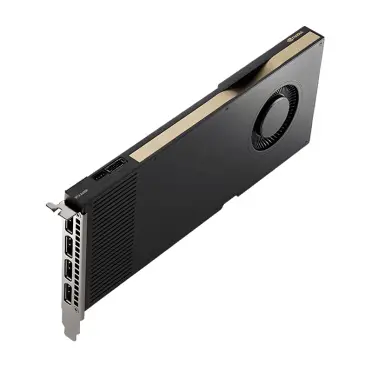
Description
The NVIDIA RTX A6000 represents a paradigm shift in professional graphics technology, delivering unprecedented performance for designers, engineers, data scientists, and creative professionals. Built on the revolutionary Ampere architecture, this workstation powerhouse combines cutting-edge ray tracing capabilities with massive memory capacity to handle the most demanding computational tasks across industries.
Understanding the NVIDIA RTX A6000 Architecture
Launched in October 2020, the RTX A6000 established new benchmarks for professional GPU performance. At its core lies the GA102 graphics processor manufactured on Samsung’s 8nm process node, housing an impressive 28.3 billion transistors across a 628mm² die area. This architectural foundation enables the GPU to deliver exceptional performance across rendering, simulation, AI training, and real-time visualization applications.
The Ampere architecture introduces second-generation RT Cores and third-generation Tensor Cores, providing significant improvements over previous generations. These specialized processing units work in concert with 10,752 CUDA cores to accelerate workloads that traditional GPUs struggle to handle efficiently.

Technical Specifications: Power Meets Precision
Core Architecture Specifications
| Specification | Details |
|---|---|
| GPU Architecture | NVIDIA Ampere (GA102) |
| CUDA Cores | 10,752 |
| Tensor Cores | 336 (3rd Generation) |
| RT Cores | 84 (2nd Generation) |
| Base Clock | 1410 MHz |
| Boost Clock | 1800 MHz |
| Memory Capacity | 48 GB GDDR6 with ECC |
| Memory Interface | 384-bit |
| Memory Bandwidth | 768 GB/s |
| Process Technology | 8nm (Samsung) |
| Transistor Count | 28.3 Billion |
| TDP | 300W |
| Power Connector | 1x 8-pin EPS |
| Form Factor | Dual-slot, Full-height |
| Display Outputs | 4x DisplayPort 1.4a |
| PCIe Interface | PCIe 4.0 x16 |
| NVLink Support | Yes (2-GPU configuration) |
Computational Performance Metrics
The RTX A6000 delivers remarkable computational throughput across various precision levels:
- FP32 Performance: 38.71 TFLOPS
- FP16 Performance: 38.71 TFLOPS (1:1 ratio)
- Texture Fill Rate: 604.8 GTexel/s
- Pixel Fill Rate: 201.6 GPixel/s
These specifications translate to real-world performance advantages in applications ranging from photorealistic rendering to complex scientific simulations.
48GB GDDR6 Memory: Breaking Through Limitations
One of the RTX A6000’s most compelling features is its massive 48GB of GDDR6 memory with Error-Correcting Code (ECC) support. This memory configuration addresses critical bottlenecks that professionals encounter in memory-intensive workflows.
Why 48GB Makes a Difference
Professional applications increasingly demand substantial video memory:
- 3D Rendering: Complex scenes with high-resolution textures and geometry require extensive VRAM
- AI/ML Training: Large neural networks and datasets benefit from increased memory capacity
- Scientific Visualization: Medical imaging and computational fluid dynamics simulations process massive datasets
- Video Production: 8K RAW footage editing demands significant frame buffer capacity
The ECC memory protection ensures data integrity during long computational tasks, preventing costly errors in mission-critical applications. When paired via NVLink, two RTX A6000 cards can scale to an impressive 96GB of unified memory, further extending capabilities for the most demanding workflows.
Ray Tracing and AI Acceleration Technologies
Second-Generation RT Cores
The RTX A6000 features 84 second-generation RT Cores optimized for hardware-accelerated ray tracing. These dedicated processing units calculate light behavior in real-time, enabling professionals to visualize designs with photorealistic accuracy during the creative process rather than waiting hours for offline renders.
Performance improvements include:
- 2x faster ray-triangle intersection testing compared to first-generation RT Cores
- Concurrent ray tracing and shading for improved overall throughput
- Motion blur acceleration for animated content
Third-Generation Tensor Cores
The 336 third-generation Tensor Cores provide substantial acceleration for AI and deep learning workloads. Supporting multiple precision formats including INT8, INT4, FP16, and TF32, these cores deliver:
- Enhanced matrix multiplication performance for neural network training
- DLSS (Deep Learning Super Sampling) support for real-time applications
- AI-denoising capabilities for rendering workflows
These Tensor Cores enable professionals to leverage AI-powered tools directly within their applications, from automated rotoscoping in video editing to generative design in CAD software.
Professional Features and Software Ecosystem
Multi-Display Technology
The RTX A6000 supports sophisticated multi-display configurations essential for professional environments:
- Four DisplayPort 1.4a outputs enable connection of multiple 4K or 5K monitors
- 8K display support at 60Hz with HDR color for ultra-high-resolution workflows
- NVIDIA Mosaic technology with bezel correction for seamless video wall deployments
- Warp and Blend SDK for immersive projection mapping applications
These capabilities make the A6000 ideal for control rooms, design studios, and collaborative visualization environments.
NVIDIA RTX Enterprise Drivers
Professional reliability requires more than raw performance. The RTX A6000 benefits from NVIDIA RTX Enterprise drivers that provide:
- Extensive ISV certification across 100+ professional applications
- Long-term support branches for production stability
- Optimized performance for certified workflows
- Priority technical support for enterprise deployments
This software foundation ensures consistent performance and compatibility across tools like Autodesk Maya, Adobe Creative Suite, SolidWorks, and countless other professional applications.
Advanced Video Encode/Decode Engines
Dedicated hardware encode and decode engines accelerate video workflows:
- 7th Generation NVENC supports H.264 and HEVC encoding
- 5th Generation NVDEC handles multiple concurrent decode streams
- AV1 decode support for next-generation video formats
- Multi-stream capabilities for broadcast and security applications
These engines offload video processing from the main GPU cores, enabling efficient multi-stream workflows without compromising rendering or compute performance.
Performance Benchmarks: Real-World Results
3D Rendering Performance
Independent benchmarks demonstrate the RTX A6000’s substantial performance advantages:
V-Ray GPU Rendering:
- Up to 92% faster than previous-generation Quadro RTX 8000
- 2.32x performance improvement over Quadro RTX 6000 in CUDA workloads
KeyShot Real-Time Rendering:
- Significantly improved interactive frame rates with complex materials
- Enhanced ray tracing performance for product visualization
Blender Cycles:
- Dramatic reduction in render times for production-quality animations
- Efficient handling of large scene files with high polygon counts
AI and Machine Learning Performance
The RTX A6000 excels in AI development workflows:
- TensorFlow training: Competitive performance with data center GPUs for many model architectures
- PyTorch inference: Low-latency prediction for deployment testing
- Large model support: 48GB memory enables training models that don’t fit on consumer GPUs
According to Puget Systems testing, the A6000 provides up to 80% performance increase over the RTX 8000 while maintaining a lower price point.
CAD and Engineering Simulation
Professional CAD applications show measurable improvements:
- Siemens NX: Dramatic viewport performance improvements
- ANSYS: Faster solver times for finite element analysis
- SolidWorks Visualize: Reduced render times for photorealistic product imagery
RTX A6000 vs. Competitors: Positioning in the Market
RTX A6000 vs. RTX 3090
While both GPUs share the GA102 architecture, key differences define their markets:
| Feature | RTX A6000 | RTX 3090 |
|---|---|---|
| Memory Capacity | 48GB GDDR6 ECC | 24GB GDDR6X |
| Form Factor | Dual-slot passive | Triple-slot active cooling |
| Target Market | Professional workstations | High-end gaming/prosumer |
| Driver Support | Enterprise certified | Consumer GeForce |
| NVLink Support | Yes | Yes |
| Price Positioning | Premium professional | Enthusiast tier |
The A6000’s ECC memory and double capacity make it essential for professionals requiring data integrity and handling large datasets, despite the 3090’s slightly higher memory bandwidth.
RTX A6000 vs. RTX 6000 Ada Generation
NVIDIA’s Ada Lovelace successor brings notable improvements:
- Performance: RTX 6000 Ada delivers 1.93-2.05x faster rendering performance
- Architecture: Third-generation RT Cores and fourth-generation Tensor Cores
- Power efficiency: Improved performance-per-watt despite higher TDP
- Price: Significantly higher initial cost
For budget-conscious professionals, the RTX A6000 remains an excellent value proposition, offering robust performance at a more accessible price point. Many workflows won’t fully utilize the Ada generation’s additional capabilities, making the A6000 a practical choice for established production environments.
RTX A6000 vs. AMD Radeon Pro W6800
AMD’s professional GPU offering provides an alternative ecosystem:
- Memory: 32GB vs. A6000’s 48GB
- Ray tracing: NVIDIA’s RT Cores generally outperform AMD’s ray accelerators
- AI performance: Tensor Cores provide substantial advantages for AI workloads
- Price: AMD often positions products more competitively on initial cost
Professional software support and driver maturity typically favor NVIDIA in enterprise deployments, though AMD solutions merit consideration for specific rendering-focused workflows.
Industry Applications and Use Cases
Architecture and Construction Visualization
Architects and designers leverage the RTX A6000 for:
- Real-time walkthroughs of building designs with accurate lighting simulation
- BIM (Building Information Modeling) workflows with complex assemblies
- Photorealistic rendering for client presentations and marketing materials
- VR design reviews enabling immersive stakeholder experiences
The combination of ray tracing capabilities and substantial memory allows professionals to work with entire building models without LOD (level of detail) compromises.
Media and Entertainment Production
Content creators across disciplines benefit from A6000 capabilities:
- Visual effects: Real-time preview of complex particle simulations and volumetric effects
- Animation: Faster viewport performance with high-resolution character rigs
- Color grading: 8K HDR video editing with real-time effects processing
- Virtual production: LED wall content creation and in-camera VFX workflows
The NVIDIA Studio ecosystem provides optimized drivers and exclusive features for creative applications.
Scientific Research and Data Analysis
Research institutions deploy RTX A6000 GPUs for:
- Molecular dynamics: Protein folding simulations and drug discovery computations
- Climate modeling: Weather prediction and climate change research
- Medical imaging: CT and MRI reconstruction with AI-enhanced diagnostics
- Astronomical data processing: Deep space imagery analysis and simulation
The ECC memory protection proves critical for long-running scientific computations where data integrity cannot be compromised.
AI and Deep Learning Development
Data scientists and AI researchers utilize the A6000 for:
- Model training: Development of computer vision and NLP models
- Transfer learning: Fine-tuning of large pre-trained models
- Inference deployment: Low-latency prediction for edge deployment testing
- Dataset preprocessing: GPU-accelerated data augmentation and transformation
The 48GB memory capacity enables training model architectures that require substantial VRAM, reducing the need for distributed training infrastructure for many projects.
Product Design and Manufacturing
Engineers across industries employ the RTX A6000 for:
- Generative design: AI-powered design optimization exploring thousands of alternatives
- Digital twins: Real-time simulation of manufacturing processes
- Quality inspection: AI-powered defect detection system development
- Ergonomic analysis: Human factors simulation and validation
Integration with CAD platforms like SOLIDWORKS and Autodesk Fusion 360 provides seamless workflows from concept to production.
System Integration and Compatibility
Workstation Requirements
Deploying the RTX A6000 requires proper system specifications:
Minimum Requirements:
- PCIe 4.0 x16 slot (PCIe 3.0 compatible with reduced bandwidth)
- 700W power supply with 8-pin EPS connector
- Adequate chassis cooling for 300W TDP
- Compatible operating system (Windows 10/11, Linux)
Recommended Configuration:
- Intel Xeon or AMD Threadripper/EPYC processor
- 128GB+ system RAM for memory-intensive workflows
- NVMe SSD storage for fast asset loading
- PCIe 4.0 motherboard for optimal bandwidth
Multi-GPU Configurations
The RTX A6000 supports NVLink for multi-GPU setups:
- 2-GPU configuration: Scale to 96GB unified memory
- Rendering applications: Near-linear performance scaling for ray tracing
- VR/simulation: Assign dedicated GPU per eye for maximum performance
- Bandwidth: 112.5 GB/s bidirectional NVLink interconnect
Professional workstation manufacturers like HP, Dell, and Lenovo offer certified systems with validated multi-GPU configurations.
Operating System Support
The RTX A6000 provides comprehensive OS compatibility:
- Windows 10/11: Full driver support with DirectX 12 Ultimate
- Linux: Ubuntu, CentOS, RHEL with CUDA toolkit support
- Virtualization: Support for GPU virtualization technologies
- Container deployment: Docker and Kubernetes compatibility for cloud-native workflows
Purchasing Considerations and Total Cost of Ownership
Pricing and Availability
The RTX A6000 launched at an MSRP of $4,649, positioning it as a premium professional solution. Current market pricing varies based on:
- New retail: $4,500-$5,500 depending on manufacturer and region
- Refurbished options: $3,000-$4,000 from authorized resellers
- Regional availability: Enterprise distribution partners worldwide
Return on Investment Analysis
While the initial investment is substantial, professionals should consider:
Productivity Gains:
- Reduced render times directly translate to faster project completion
- Real-time feedback accelerates iterative design processes
- Ability to handle larger projects without workflow compromises
Long-Term Value:
- Extended product lifecycle with long-term driver support
- Lower failure rates compared to consumer GPUs in 24/7 operation
- Resale value retention in professional markets
Avoiding Infrastructure Costs:
- Eliminating render farm dependencies for many projects
- Reducing cloud computing expenses for AI development
- Consolidating multiple systems into single powerful workstations
For many professional workflows, the RTX A6000’s capabilities can pay for themselves within months through efficiency improvements and reduced external service dependencies.
Warranty and Support Options
NVIDIA and partners offer enterprise-grade support:
- Standard warranty: 3-year manufacturer warranty
- Extended coverage: Available through resellers and system integrators
- Enterprise support: Priority technical assistance for certified configurations
- On-site service: Available through workstation OEMs
Future-Proofing Your Investment
Software Ecosystem Evolution
The RTX A6000 remains well-positioned for future software developments:
- Ongoing driver optimization: Continued performance improvements for existing and new applications
- AI feature integration: Support for emerging AI-powered creative tools
- API advancement: DirectX 12 Ultimate and Vulkan 1.4 support future graphics technologies
- CUDA compatibility: Extensive CUDA 8.6 support ensures longevity for compute applications
Technology Transition Planning
Professional organizations should consider:
- Current generation adequacy: Many workflows won’t benefit from next-generation GPUs immediately
- Software certification cycles: ISV certifications often lag hardware releases
- Budget optimization: Strategic timing of upgrades based on project demands
- Scalability: NVLink enables incremental performance increases without full system replacement
For established professional environments with defined workflows, the RTX A6000 provides several years of reliable service before performance limitations necessitate upgrades.
Environmental and Operational Considerations
Power Efficiency and Cooling
The 300W TDP requires adequate cooling infrastructure:
- Passive cooling design: Enables quiet operation in noise-sensitive environments
- Dual-slot form factor: Maintains compatibility with standard workstation chassis
- Power management: Dynamic clock adjustment optimizes power consumption during variable workloads
- Heat output: Approximately 1,024 BTU/hour thermal dissipation to consider for facility planning
Sustainability Factors
Professional technology decisions increasingly consider environmental impact:
- Extended lifecycle: Professional GPUs’ longevity reduces electronic waste
- Energy efficiency: Ampere architecture delivers performance improvements with reasonable power increase
- Recycling programs: NVIDIA and partners offer responsible disposal and recycling services
- Certifications: Compliance with environmental standards (RoHS, WEEE)
Frequently Asked Questions
What is the difference between RTX A6000 and consumer GeForce RTX 3090?
The RTX A6000 offers 48GB of ECC memory compared to the RTX 3090’s 24GB non-ECC memory, enterprise-grade drivers with ISV certification, passive cooling for quieter operation, and professional support. While sharing similar GPU architecture, the A6000 is optimized for reliability and memory capacity critical to professional workflows, whereas the RTX 3090 prioritizes gaming and prosumer content creation with higher memory bandwidth.
Can the RTX A6000 be used for gaming?
Yes, the RTX A6000 can handle gaming excellently due to its powerful GA102 GPU core. However, it’s designed and priced for professional applications. The passive cooling design, lack of gaming-specific optimizations in professional drivers, and significantly higher cost make dedicated gaming GPUs more cost-effective for gaming-focused use cases. The A6000 excels when workstation duties are the primary requirement with occasional gaming.
How many displays can the RTX A6000 support?
The RTX A6000 features four DisplayPort 1.4a outputs, supporting up to four independent displays. Configuration options include four 5K monitors at 60Hz, dual 8K displays at 60Hz, or various combinations of 4K displays. NVIDIA Mosaic technology enables these displays to function as a single large desktop, ideal for video walls and multi-monitor professional setups.
Does the RTX A6000 support ray tracing?
Absolutely. The RTX A6000 includes 84 second-generation RT Cores specifically designed for hardware-accelerated ray tracing. These cores deliver significantly faster ray tracing performance than software-based solutions, enabling real-time path tracing in professional applications like Autodesk VRED, KeyShot, and various rendering engines including V-Ray and Arnold.
What power supply is required for the RTX A6000?
The RTX A6000 has a 300W TDP and requires one 8-pin EPS power connector. NVIDIA recommends a minimum 700W power supply for single-GPU configurations. For dual-GPU NVLink setups, an 850W or higher power supply is advisable, depending on the rest of your system components, particularly high-core-count workstation processors.
Is ECC memory important for my workflow?
ECC (Error-Correcting Code) memory detects and corrects data corruption, critical for applications where accuracy is paramount. Scientific computing, financial modeling, medical imaging, and long-running simulations benefit significantly from ECC protection. Creative workflows like rendering and video editing gain reliability advantages, though the performance impact of memory errors is less catastrophic than in computational sciences.
Can I upgrade from RTX A6000 to newer GPUs later?
Yes, the RTX A6000 uses standard PCIe 4.0 interface, ensuring compatibility with future GPU upgrades. Your workstation’s PCIe slots, power supply, and cooling capacity determine upgrade flexibility. The A6000’s strong performance and 48GB memory provide longevity, potentially delaying upgrade needs compared to lower-capacity alternatives.
How does NVLink work with two RTX A6000 cards?
NVLink creates a high-bandwidth bridge between two RTX A6000 GPUs, enabling 96GB of combined memory accessible to both cards at 112.5 GB/s bidirectional bandwidth. Applications must specifically support NVLink to benefit; many rendering engines and scientific computing frameworks leverage this technology for near-linear performance scaling. Not all applications benefit equally—some workflows see dramatic improvements while others show minimal gains.
Where to Buy NVIDIA RTX A6000
Professional users can acquire the RTX A6000 through several channels:
- Authorized System Integrators: Configure complete workstations with warranty support
- Enterprise Distributors: Volume pricing for organizational deployments
- Online Retailers: Individual GPU purchases from certified vendors
- Direct from Manufacturers: PNY, ASUS, Gigabyte offer branded variants
For organizations requiring multiple units, consulting with NVIDIA professional solutions partners ensures optimal configuration for specific workflow requirements.
Conclusion: Professional GPU Excellence
The NVIDIA RTX A6000 represents a mature, powerful solution for professional computing demands. Its combination of 48GB ECC memory, comprehensive ray tracing acceleration, robust AI performance, and enterprise-grade reliability addresses the diverse needs of creative professionals, engineers, scientists, and researchers across industries.
While newer GPU generations offer incremental improvements, the RTX A6000 delivers exceptional value for organizations seeking proven performance without bleeding-edge pricing. The extensive software ecosystem, long-term driver support, and substantial memory capacity ensure this workstation GPU remains relevant for demanding professional workflows well into the future.
For professionals requiring uncompromising performance, memory capacity, and reliability, the RTX A6000 continues to represent a sound investment in computational capability. Whether accelerating creative iteration, enabling breakthrough research, or powering mission-critical visualization, this professional GPU delivers the performance modern workflows demand.
Ready to elevate your professional workflow? Explore the NVIDIA RTX A6000 at ITCTShop.com and discover how this powerful workstation GPU can transform your productivity.
Last update at December 2025
Additional information
| NVIDIA CUDA® Processing Cores |
10,752 |
|---|---|
| NVIDIA RT Cores |
84 (2nd Gen) |
| Tensor Cores |
336 (3rd Gen) |
| GPU Memory |
48 GB |
| Peak Memory Bandwidth |
768 GB/s |
| NVIDIA® NVLink® |
Yes* |
| Floating-Point Performance, Single Precision (TFLOPS, Peak)2 |
38.7 |
| Tensor Performance (TFLOPS, Peak) 3,4 |
309.7 |
| Error-Correcting Code (ECC) Memory |
Yes ( #12) |
| Maximum Active Displays |
4 |
| DisplayPort 1.2 5 and 1.46 |
4 |
| HDMI via Adaptors, HDMI |
4 |
| NVIDIA SLI® 7 |
Yes* |
| High-Dynamic Range (HDR)8 |
Yes* |
| NVIDIA Quadro® Mosaic Technology |
Yes* |
| VR Ready 9 |
Yes* |
| Variable Rate Shading |
Yes* |
| GPUDirect® for Video |
Yes* |
| Graphics Synchronization with Sync II |
Yes* |
| 3D Stereo* |
Yes* |
| Encode/Decode10 |
Yes* |
Reviews
There are no reviews yet.