


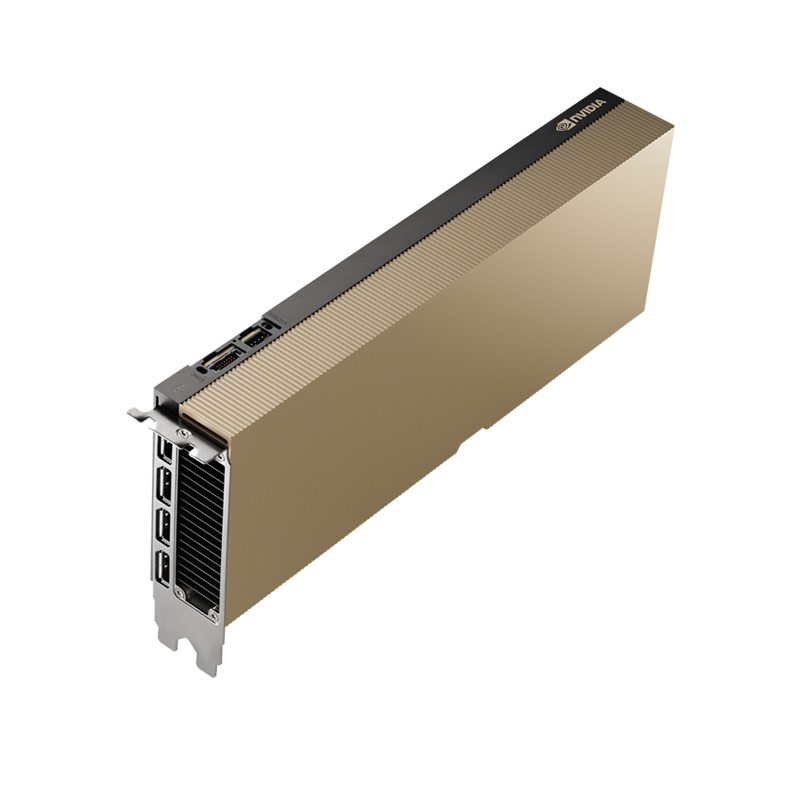
Description
The NVIDIA L40 GPU represents a paradigm shift in data center computing, delivering a truly universal acceleration platform that excels across the complete spectrum of modern enterprise workloads. Built on the groundbreaking NVIDIA Ada Lovelace architecture, this revolutionary GPU combines next-generation ray tracing capabilities, advanced AI acceleration, and exceptional graphics performance in a single, versatile accelerator designed specifically for demanding data center environments operating around the clock.
What distinguishes the L40 from specialized accelerators that optimize for narrow use cases is its remarkable versatility across fundamentally different workload types. Whether your organization runs professional 3D visualization and rendering applications, AI training and inference workloads, high-performance virtual desktop infrastructure, video streaming and encoding operations, or complex scientific simulations, the L40 delivers exceptional performance without requiring separate specialized hardware for each workload category. This consolidation capability represents a transformative opportunity for enterprises to simplify infrastructure, reduce capital expenditure, and maximize GPU utilization rates across diverse departmental needs.
At ITCT Shop, we understand that modern enterprises face increasingly complex and diverse computing requirements spanning traditional graphics-intensive workloads, emerging AI applications, and hybrid scenarios combining multiple disciplines. The NVIDIA L40 consistently emerges as the optimal foundation for organizations seeking to build unified GPU infrastructure capable of supporting their complete portfolio of visual computing, AI, and computational workloads. This comprehensive guide explores every facet of the L40 GPU, from its revolutionary architectural innovations and technical specifications to real-world deployment scenarios and performance characteristics across diverse enterprise applications.
Key Specifications at a Glance
- 48GB GDDR6 ECC Memory with 864 GB/s bandwidth
- NVIDIA Ada Lovelace Architecture with 18,176 CUDA Cores
- Third-Generation RT Cores (142) for advanced ray tracing
- Fourth-Generation Tensor Cores (568) for AI acceleration
- 300W TDP with passive cooling design
- PCIe Gen4 x16 Interface (64 GB/s bidirectional)
- 4x DisplayPort 1.4a outputs supporting 8K resolution
- Triple NVENC/NVDEC Engines with AV1 support
- vGPU Software Support for virtualization
- NEBS Level 3 Certified for data center deployment
NVIDIA Ada Lovelace Architecture: Revolutionary Data Center Performance
The NVIDIA L40 is powered by the Ada Lovelace architecture, representing the most significant generational leap in GPU technology in over a decade. This revolutionary architecture introduces fundamental innovations across every subsystem, from substantially enhanced ray tracing capabilities to dramatically improved AI performance, all delivered within a power-efficient design optimized for continuous data center operation.
Third-Generation RT Cores: Ray Tracing Excellence
The L40 incorporates 142 third-generation RT Cores delivering 209 TFLOPS of ray tracing performance, enabling photorealistic rendering and visualization capabilities that were previously accessible only through expensive offline rendering farms. These specialized hardware accelerators have been fundamentally redesigned to provide enhanced throughput and concurrent ray-tracing and shading capabilities, enabling real-time ray tracing for professional visualization workflows that demand absolute fidelity.
Professional applications including NVIDIA Omniverse, Autodesk VRED, Chaos V-Ray, Blender Cycles, and architectural visualization platforms leverage these RT Cores to deliver stunning photorealistic renders in real-time or dramatically accelerated batch rendering modes. Architects can evaluate accurate lighting scenarios within their building designs, product designers can visualize how materials and finishes will appear under different illumination conditions, and content creators can achieve film-quality renders in a fraction of the time required by traditional CPU-based rendering approaches. The RT Cores also enable hardware-accelerated motion blur, delivering smooth, cinematic animations for product demonstrations and architectural walkthroughs.
Fourth-Generation Tensor Cores: AI and Deep Learning Acceleration
The inclusion of 568 fourth-generation Tensor Cores positions the L40 as an exceptionally capable AI acceleration platform, delivering up to 724 TFLOPS of AI performance at FP8 precision with sparsity optimization. These specialized processing units support an comprehensive range of mathematical precisions from FP32 down through INT4, enabling organizations to optimize their AI workloads for the ideal balance between accuracy and throughput.
Modern AI applications leverage Tensor Cores across the complete model lifecycle. During training, Tensor Cores accelerate the forward and backward propagation passes that dominate computational requirements, dramatically reducing training times compared to CPU-only approaches. For inference deployment, the Tensor Cores’ support for lower-precision operations including INT8 and INT4 enables exceptional throughput for production AI services processing millions of requests daily. Organizations building AI computing infrastructure find that the L40’s versatile Tensor Core capabilities eliminate the need for separate training and inference hardware, simplifying architecture and improving infrastructure utilization.
The fourth-generation Tensor Cores introduce hardware support for structural sparsity, an optimization technique that can deliver up to 2x performance improvement for appropriately structured neural networks. Additionally, optimized TF32 format support provides automatic acceleration for AI frameworks including TensorFlow and PyTorch without requiring code modifications, delivering immediate performance benefits for existing AI development workflows.
CUDA Cores: Versatile Parallel Processing
At the foundation of the L40’s computational capabilities lies an array of 18,176 CUDA cores delivering 90.5 TFLOPS of FP32 performance. This massive parallel processing capacity accelerates diverse workloads including scientific simulation, computational fluid dynamics, seismic analysis, molecular dynamics, weather forecasting, and data analytics operations that require substantial floating-point computational throughput.
The CUDA cores also provide the foundation for professional graphics rendering, viewport manipulation in 3D design applications, video encoding and transcoding operations, and general-purpose GPU computing tasks. Applications optimized for CUDA acceleration, including over 2,000 scientific and enterprise applications, automatically leverage these computational resources to deliver dramatically improved performance compared to CPU-only execution.
Memory Architecture: 48GB GDDR6 with ECC

The NVIDIA L40 incorporates an exceptionally generous 48GB of GDDR6 memory with Error Correction Code (ECC) protection, delivering the capacity and reliability required for the most demanding professional and enterprise workloads. This substantial memory allocation, accessed through a high-bandwidth interface providing 864 GB/s of throughput, enables professionals and data scientists to work with extraordinarily large datasets, complex 3D scenes, high-resolution textures, and sophisticated AI models without encountering memory limitations.
Capacity for Complex Workflows
The 48GB memory capacity represents a strategic sweet spot for diverse enterprise applications. Professional visualization workflows benefit from the ability to load massive 3D assemblies, ultra-high-resolution textures exceeding 8K, complex particle simulations with millions of elements, and detailed architectural models incorporating photogrammetry data—all resident in GPU memory for optimal interactive performance. AI practitioners training moderate-to-large neural networks, fine-tuning foundation models, or deploying ensemble inference architectures find the 48GB capacity eliminates memory constraints that would otherwise limit model complexity or batch sizes.
Virtual desktop infrastructure deployments particularly benefit from the substantial memory capacity, as administrators can allocate appropriate memory quantities to individual virtual GPU instances supporting users with varying requirements. A data scientist might receive 12GB for model development, an engineer gets 8GB for CAD workflows, and multiple designers share the remaining capacity for creative applications—all from a single physical L40 GPU through NVIDIA vGPU virtualization technology.
ECC Protection for Mission-Critical Reliability
The inclusion of Error Correction Code (ECC) memory protection ensures data integrity for mission-critical applications where computational errors could have serious consequences. ECC memory automatically detects and corrects single-bit errors and detects multi-bit errors, providing the reliability required for long-running simulations, financial modeling, scientific research, and production AI inference where accuracy is paramount. This enterprise-grade reliability feature distinguishes professional data center GPUs like the L40 from consumer gaming hardware, providing the confidence organizations require when deploying GPU acceleration for business-critical applications.
Complete Technical Specifications
| Specification | Details |
|---|---|
| GPU Architecture | NVIDIA Ada Lovelace |
| GPU Memory | 48GB GDDR6 with ECC |
| Memory Bandwidth | 864 GB/s |
| CUDA Cores | 18,176 |
| RT Cores | 142 (3rd Generation) |
| Tensor Cores | 568 (4th Generation) |
| RT Core Performance | 209 TFLOPS |
| FP32 Performance | 90.5 TFLOPS |
| TF32 Tensor Core | 181 TFLOPS (with sparsity) |
| BFLOAT16 Tensor Core | 362.1 TFLOPS (with sparsity) |
| FP16 Tensor Core | 362.1 TFLOPS (with sparsity) |
| FP8 Tensor Core | 724 TFLOPS (with sparsity) |
| INT8 Tensor Performance | 724 TOPS (with sparsity) |
| INT4 Tensor Performance | 1448 TOPS (with sparsity) |
| System Interface | PCIe Gen4 x16 (64 GB/s bidirectional) |
| Form Factor | Dual-slot, 4.4″ H x 10.5″ L |
| TDP | 300W |
| Power Connector | 16-pin |
| Cooling | Passive |
| Display Outputs | 4x DisplayPort 1.4a |
| Video Encode/Decode | 3x NVENC / 3x NVDEC (with AV1) |
| vGPU Support | Yes |
| MIG Support | No |
| NVLink Support | No |
| Secure Boot | Yes (Root of Trust) |
| Certifications | NEBS Level 3 |
Professional Visualization and Graphics Excellence
The NVIDIA L40 delivers unprecedented professional graphics and visualization capabilities for data center deployment, bringing desktop-class visual computing performance to virtualized and cloud environments. Organizations deploying professional creative applications, engineering software, or visualization platforms find the L40 provides the computational and graphics horsepower required for responsive, high-fidelity experiences comparable to local workstations.
3D Design and Product Development
Engineering and design teams working with professional CAD applications including Autodesk AutoCAD, Inventor, Revit, SOLIDWORKS, Siemens NX, PTC Creo, and Dassault Systemes CATIA leverage the L40’s robust graphics capabilities for smooth viewport manipulation, rapid regeneration of complex assemblies, and real-time rendering of design iterations. The combination of substantial CUDA core count, generous memory capacity, and certified professional drivers ensures that even the most complex assemblies containing tens of thousands of components remain responsive during design reviews and collaborative sessions.
The L40’s ray tracing capabilities transform product visualization workflows. Instead of waiting hours or days for photorealistic renders from traditional CPU-based rendering engines, designers can generate multiple visualization alternatives in minutes using GPU-accelerated ray tracing. This acceleration enables more thorough design exploration, better communication with stakeholders, and faster iteration cycles that ultimately improve product quality and reduce time-to-market.
Architectural Visualization and Building Information Modeling
Architects and building designers working with BIM platforms including Autodesk Revit and visualization tools such as Enscape, Lumion, Twinmotion, and V-Ray benefit dramatically from the L40’s advanced ray tracing capabilities. The third-generation RT Cores enable real-time photorealistic rendering directly within design applications, allowing architects to evaluate accurate lighting conditions, material reflections, and environmental effects immediately as designs evolve.
This real-time visualization capability fundamentally transforms architectural workflows. Rather than creating designs, submitting rendering jobs, waiting for results, identifying issues, and repeating the cycle, architects can now iterate designs with immediate photorealistic feedback. Client presentations become interactive experiences where stakeholders can explore proposed buildings, evaluate different material options, and experience spaces from multiple viewpoints—all rendered in real-time with film-quality fidelity. Organizations building AI workstations for architectural practices find the L40’s graphics capabilities essential for competitive differentiation and client satisfaction.
Media and Entertainment Production
Content creators working in video production, motion graphics, visual effects, and broadcast operations leverage the L40’s exceptional encoding capabilities and graphics performance. The GPU incorporates three dedicated NVENC hardware encoders supporting formats up to 8K resolution including the efficient AV1 codec, enabling real-time encoding of high-resolution video streams for live broadcasting, cloud gaming, or collaborative editing workflows. Three corresponding NVDEC decode engines accelerate video playback and transcoding operations.
Applications including Adobe Premiere Pro, DaVinci Resolve, Autodesk Maya, Blender, Foundry Nuke, and Blackmagic Design Fusion all leverage GPU acceleration for real-time playback of complex timelines, faster effect rendering, responsive viewport performance when manipulating 3D scenes, and accelerated final rendering. The L40’s substantial memory capacity accommodates multiple 4K or 8K video streams simultaneously, enabling editors to work with high-resolution source material without requiring proxy workflows that introduce additional complexity and storage requirements.
AI Training and Inference: Comprehensive Acceleration
The NVIDIA L40 delivers exceptional AI performance across the complete machine learning lifecycle from initial model development through production inference deployment, eliminating the traditional requirement for separate specialized hardware for different phases of AI application development.
Training Performance and Versatility
Data scientists and machine learning engineers training neural networks benefit from the L40’s 568 fourth-generation Tensor Cores delivering up to 362.1 TFLOPS of FP16 training performance. This substantial computational throughput accelerates training for computer vision models processing images and video, natural language processing applications analyzing text, recommendation systems predicting user preferences, time-series forecasting models for financial and operational analytics, and reinforcement learning agents for robotics and optimization applications.
The TF32 format support provides automatic acceleration for popular frameworks including TensorFlow and PyTorch without requiring code modifications or precision tuning. Data scientists can develop models using familiar FP32 workflows while automatically benefiting from Tensor Core acceleration, dramatically reducing training times while maintaining model accuracy. For organizations implementing AI computing systems, the L40’s training capabilities enable decentralized AI development where individual departments can train models locally rather than competing for access to centralized training infrastructure.
Production Inference Deployment
The L40’s support for lower-precision operations including INT8 and INT4 enables exceptional inference throughput for production AI services. Organizations deploying conversational AI assistants, real-time recommendation engines, fraud detection systems, predictive maintenance applications, or computer vision services for manufacturing quality control find the L40 delivers the low-latency, high-throughput inference performance required for responsive user experiences and cost-effective scaling.
NVIDIA TensorRT inference optimizer analyzes trained models and generates highly optimized inference engines specifically targeting the L40’s architecture. This optimization process applies layer fusion, precision calibration, kernel auto-tuning, and other advanced techniques to maximize throughput while maintaining accuracy requirements. Organizations incorporating TensorRT into their MLOps pipelines achieve substantially higher inference throughput compared to deploying unoptimized models, directly translating to reduced infrastructure costs and improved application responsiveness.
Virtual Desktop Infrastructure: GPU-Accelerated Remote Workstations
The NVIDIA L40 excels as the foundation for high-performance virtual desktop infrastructure deployments, enabling organizations to provide remote access to GPU-accelerated workstations for distributed teams of engineers, designers, data scientists, and creative professionals. NVIDIA vGPU software partitions the L40’s 48GB memory and computational resources into multiple independent virtual GPU instances, each providing dedicated graphics and compute capabilities to individual users.
Flexible Resource Allocation
IT administrators configure vGPU profiles to match actual user requirements, optimizing GPU utilization while ensuring each user receives appropriate performance. A CAD engineer might receive an 8GB vGPU instance providing sufficient resources for manipulating complex assemblies, while a graphic designer gets a 6GB instance for creative applications, and multiple knowledge workers share 4GB instances for general productivity with occasional graphics requirements. This flexible allocation maximizes the number of concurrent users supported per physical GPU, dramatically improving infrastructure ROI compared to assigning entire GPUs to individual users.
The L40’s substantial memory capacity enables higher-density VDI deployments compared to GPUs with smaller memory footprints. Organizations can support more concurrent users per server, reducing data center footprint, power consumption, and total infrastructure costs while still providing each user with dedicated GPU resources sufficient for their actual workload requirements.
Security and Isolation
Each vGPU instance operates in complete isolation with dedicated memory and compute resources, ensuring that individual users’ workloads cannot interfere with each other or access other users’ data. This hardware-level isolation provides the security and performance predictability required for multi-tenant environments including managed service providers, enterprise IT departments supporting diverse business units, and educational institutions serving students and faculty with varying requirements.
The L40 incorporates Secure Boot with Root of Trust technology, providing additional security layers for environments handling sensitive intellectual property, regulated data, or classified information. Organizations in financial services, healthcare, government, and defense sectors benefit from these enterprise-grade security features when deploying VDI infrastructure supporting users with diverse security clearance levels.
NVIDIA Omniverse Enterprise: Real-Time Collaborative 3D Workflows
The NVIDIA L40 is specifically optimized for NVIDIA Omniverse Enterprise, a platform enabling real-time collaborative 3D design, simulation, and visualization workflows. Omniverse connects industry-leading design applications including Autodesk Maya, 3ds Max, Revit, Bentley MicroStation, Trimble SketchUp, and others into unified collaborative environments where teams can work simultaneously on shared 3D assets with full design fidelity maintained across all applications.
For complex Omniverse workloads, the L40 enables accelerated ray-traced and path-traced rendering of materials with physically accurate simulations, real-time global illumination providing photorealistic lighting, and interactive manipulation of massive datasets including photogrammetry scans, point clouds from LiDAR, and procedurally generated environments. Architects, product designers, filmmakers, and game developers leverage Omniverse powered by L40 GPUs to collaborate across geographical boundaries, compress iteration cycles, and visualize designs with unprecedented realism before physical prototyping or construction begins.
Video Encoding and Streaming: Triple Engine Performance
The L40 incorporates three dedicated NVENC hardware video encoders and three corresponding NVDEC decoders, providing exceptional video processing capabilities for streaming, broadcasting, cloud gaming, and collaborative editing workflows. This triple-engine configuration enables simultaneous encoding of multiple video streams, critical for applications including:
Cloud Gaming and Application Streaming: Service providers delivering interactive applications to remote users leverage the L40’s encoding capabilities to provide low-latency, high-quality streams supporting multiple concurrent sessions from a single GPU. The AV1 codec support enables superior visual quality at lower bitrates compared to older codecs, reducing bandwidth requirements and improving user experiences on constrained networks.
Live Broadcasting and Production: Broadcasters encoding multiple camera angles simultaneously, producing multi-bitrate streams for adaptive streaming platforms, or transcoding content for different distribution channels benefit from the triple NVENC architecture enabling parallel encoding operations without performance degradation.
Video Surveillance and Analytics: Organizations processing video from numerous cameras for security monitoring, retail analytics, or smart city applications leverage the L40’s decode engines for efficient multi-stream ingestion combined with AI-powered analytics identifying events of interest in real-time.
Performance Comparison: L40 vs Alternative Solutions
L40 vs L40S: Enhanced AI Focus
The NVIDIA L40S represents an enhanced variant optimized specifically for AI workloads, featuring increased Tensor Core performance and higher power consumption (350W vs 300W). The L40S delivers approximately 30-40% higher AI training and inference performance compared to the standard L40, making it the preferred choice for AI-heavy deployments. However, the standard L40 provides a more balanced profile for organizations running mixed workloads combining graphics, visualization, and AI applications where absolute peak AI performance is less critical than versatile capabilities across diverse application types.
For organizations building infrastructure primarily for AI inference or training, the L40S represents optimal value. For those requiring substantial graphics capabilities alongside AI workloads—particularly organizations running Omniverse, professional visualization, or virtual desktop infrastructure—the standard L40’s balanced design and lower power consumption often prove more suitable.
L40 vs A40: Generational Advancement
The L40 represents a substantial generational upgrade from the previous-generation A40, delivering approximately 2x higher ray tracing performance through third-generation RT Cores, enhanced AI capabilities via fourth-generation Tensor Cores with sparsity support, increased memory capacity (48GB vs 48GB but newer GDDR6), and support for modern codecs including AV1 encoding and decoding. Organizations currently deploying A40 infrastructure should view the L40 as the natural upgrade path, providing comprehensive performance improvements across graphics, AI, and video processing workloads while maintaining familiar form factors and data center integration characteristics.
Data Center Deployment and Infrastructure Integration
Power and Cooling Considerations
The L40’s 300W thermal design power represents a carefully balanced compromise between computational capability and data center infrastructure compatibility. While higher than mid-range GPUs, the 300W profile remains deployable in standard enterprise rack infrastructure without requiring specialized power distribution or cooling systems. The passive cooling design eliminates active fans, reducing acoustic emissions and improving reliability by eliminating mechanical components subject to wear.
Organizations should ensure adequate chassis airflow when deploying L40 GPUs, as the passive cooling approach relies on server fans to move air across GPU heatsinks. Typical 2U rack servers accommodate one or two L40 GPUs with standard cooling configurations, while 4U servers can house four or more GPUs with appropriately designed airflow paths. The 16-pin power connector requires compatible server power supplies; organizations should verify PSU compatibility during server specification.
NEBS Level 3 Certification
The L40’s NEBS (Network Equipment-Building System) Level 3 certification indicates compliance with stringent reliability, thermal management, and electromagnetic compatibility standards required for telecommunications and carrier-grade data centers. This certification provides confidence for deployment in mission-critical infrastructure operating 24×7 with high availability requirements, including telecommunications central offices, content delivery networks, cloud service provider facilities, and enterprise data centers supporting critical business operations.
Why Choose ITCT Shop for Your NVIDIA L40 Deployment
At ITCT Shop, we specialize in providing comprehensive GPU computing solutions for enterprises deploying professional visualization, AI, and hybrid workloads at data center scale. Our extensive experience with NVIDIA data center GPUs ensures that your L40 infrastructure is optimally configured for your specific application requirements, properly integrated with your existing IT environment, and supported throughout the complete lifecycle from initial deployment through ongoing operations.
We offer comprehensive consultation services including:
- Workload Analysis: Characterizing your graphics, AI, and compute requirements to determine optimal L40 deployment architecture
- Infrastructure Design: Specifying server configurations, networking topology, storage systems, and virtualization platforms for L40-based infrastructure
- Software Optimization: Ensuring your applications leverage L40 capabilities through appropriate drivers, frameworks, and optimization techniques
- Virtualization Planning: Designing vGPU configurations that maximize utilization while ensuring appropriate performance for diverse user populations
Our team brings deep expertise deploying NVIDIA GPUs across industries including media and entertainment, architecture and engineering, financial services, healthcare, manufacturing, and telecommunications. We understand the unique technical requirements, compliance constraints, and operational considerations facing enterprise IT organizations.
Contact our data center GPU specialists today to discuss how the NVIDIA L40 can power your organization’s visual computing and AI initiatives, or explore our complete portfolio of AI GPU cards to compare the full spectrum of data center acceleration solutions.
Frequently Asked Questions
What makes the NVIDIA L40 different from gaming GPUs?
The NVIDIA L40 is a professional data center GPU designed specifically for enterprise deployment, incorporating numerous features absent from consumer gaming hardware. These include 48GB of ECC-protected memory ensuring data integrity for mission-critical workloads, passive cooling design optimized for rack-mount server deployment, NEBS Level 3 certification for telecommunications-grade reliability, Secure Boot with Root of Trust for enhanced security, vGPU software support enabling efficient multi-user virtualization, certified professional drivers tested extensively with enterprise applications, triple NVENC/NVDEC engines for video processing at scale, and 300W power envelope compatible with standard data center infrastructure. Additionally, the L40 receives long-term driver support, comprehensive warranty coverage, and access to NVIDIA enterprise support organization—critical capabilities for organizations deploying GPU infrastructure for business-critical applications requiring predictable performance, guaranteed reliability, and comprehensive support.
Can the L40 be used for both graphics and AI workloads simultaneously?
Yes, the NVIDIA L40 excels at supporting mixed workloads combining professional graphics, AI processing, and general computation within unified infrastructure. The Ada Lovelace architecture provides dedicated hardware resources for different workload types—RT Cores for ray tracing, Tensor Cores for AI operations, and CUDA cores for general computation—enabling concurrent execution without resource conflicts. Organizations commonly deploy L40 infrastructure where some users run professional visualization applications while others execute AI training or inference workloads, with workload schedulers automatically allocating jobs to available GPU resources based on current utilization. The vGPU virtualization capability further enhances flexibility by partitioning physical L40 GPUs into multiple virtual instances, each dedicated to specific users or applications. This workload versatility represents one of the L40’s most significant advantages, enabling infrastructure consolidation where organizations previously required separate specialized hardware for graphics, AI, and compute applications.
What are the power and cooling requirements for the L40?
The NVIDIA L40 has a 300W thermal design power (TDP) and requires a server equipped with a 16-pin PCIe power connector. For complete server power supply sizing, organizations should specify redundant power supplies with sufficient capacity for intended GPU count, CPU configuration, memory complement, and storage subsystems; typical 2U servers with dual L40 GPUs require 1600W redundant PSUs, while 4U servers accommodating four L40 GPUs typically use 2000-2400W redundant configurations. The L40 employs passive cooling relying on chassis airflow, requiring servers with front-to-back airflow design providing approximately 150-200 CFM per GPU. Organizations should select servers explicitly validated for L40 deployment from OEM vendors including Dell EMC, HPE, Lenovo, Supermicro, and others offering NVIDIA-Certified Systems designs tested specifically with L40 hardware. The passive cooling approach eliminates fan noise and improves reliability but requires careful attention to server airflow design and rack thermal management to ensure GPUs maintain appropriate operating temperatures under sustained load.
Does the L40 support Multi-Instance GPU (MIG)?
No, the NVIDIA L40 does not support Multi-Instance GPU (MIG) technology. Instead, the L40 supports NVIDIA vGPU virtualization software, which partitions the GPU into multiple virtual GPU instances for multi-user scenarios. While MIG provides hardware-level partitioning creating completely independent GPU instances with guaranteed resources, vGPU operates at the hypervisor level enabling more flexible resource allocation and supporting a broader range of operating systems and applications. For organizations specifically requiring MIG capability for their workloads, NVIDIA offers alternative data center GPUs including the A30, A100, and H100 that support MIG partitioning. However, most enterprise virtualization scenarios are well-served by vGPU software combined with the L40’s substantial 48GB memory capacity, which enables administrators to create numerous virtual GPU profiles accommodating diverse user requirements from knowledge workers requiring basic graphics acceleration through engineers and data scientists needing substantial computational resources.
What professional applications are certified for the L40?
The NVIDIA L40 is certified with an extensive portfolio of professional applications spanning diverse industries and disciplines. CAD and engineering applications include Autodesk AutoCAD, Inventor, Revit, SOLIDWORKS, Siemens NX, PTC Creo, Dassault Systemes CATIA, and Bentley MicroStation. Media and entertainment tools encompass Adobe Creative Cloud (Premiere Pro, After Effects, Photoshop), DaVinci Resolve, Autodesk Maya, 3ds Max, Blender, Foundry Nuke, Maxon Cinema 4D, and SideFX Houdini. Visualization and rendering platforms include Chaos V-Ray, Lumion, Enscape, Twinmotion, and NVIDIA Omniverse. Scientific and simulation applications span ANSYS suite, COMSOL Multiphysics, MATLAB, Abaqus, OpenFOAM, and numerous domain-specific packages for computational fluid dynamics, finite element analysis, and molecular dynamics. AI and data science frameworks including TensorFlow, PyTorch, MXNet, JAX, and NVIDIA RAPIDS are optimized for L40’s Tensor Cores. Organizations should consult NVIDIA’s official certification database for their specific applications, as the certified application list expands continuously with each driver release and ISV certification cycle.
Can multiple L40 GPUs be connected with NVLink?
No, the NVIDIA L40 does not support NVLink high-speed interconnect technology. For workloads requiring multi-GPU scaling, the L40 relies on PCIe Gen4 connectivity providing 64 GB/s bidirectional bandwidth per GPU. While this PCIe bandwidth proves sufficient for many multi-GPU scenarios including batch rendering, parallel video encoding, and loosely-coupled inference serving, workloads with intensive inter-GPU communication patterns—such as large-scale distributed training with frequent gradient synchronization—may experience bandwidth limitations compared to NVLink-equipped alternatives. Organizations requiring NVLink connectivity for tightly-coupled multi-GPU workloads should consider alternative NVIDIA data center GPUs including the A100, H100, or specialized configurations. However, the majority of enterprise graphics, visualization, and AI inference workloads operate effectively with PCIe-connected multi-GPU configurations, particularly when workload schedulers distribute independent jobs across available GPUs rather than requiring tight coordination between GPUs for individual workload execution.
What virtualization platforms support the L40 with vGPU software?
The NVIDIA L40 supports NVIDIA vGPU software for comprehensive virtualization capabilities across major enterprise virtualization platforms. VMware vSphere is fully supported, enabling L40 deployment in VMware-based virtual desktop infrastructure and server virtualization environments. Red Hat Enterprise Virtualization (RHEV) and Red Hat OpenStack provide GPU virtualization for organizations standardized on Red Hat infrastructure. Citrix Hypervisor enables L40-accelerated virtual desktops and applications in Citrix-based VDI deployments. Additionally, bare-metal GPU passthrough is supported on KVM, Xen, and other hypervisors for scenarios where applications require direct GPU access without virtualization overhead. Organizations should verify their specific hypervisor version against NVIDIA vGPU software release notes, as compatibility depends on hypervisor version and vGPU software release. The vGPU software enables administrators to create multiple vGPU profiles with different memory allocations, supporting diverse user populations from knowledge workers requiring basic GPU acceleration through power users demanding substantial computational resources for professional applications.
How does the L40 compare for AI inference versus dedicated inference GPUs like the L4?
The NVIDIA L40 and L4 target different segments of the AI inference market with distinct optimization profiles. The L4 represents a compact, power-efficient solution (72W TDP) optimized specifically for high-throughput, low-latency inference deployment at scale, incorporating smaller form factor, lower power consumption, and optimization for batch inference workloads. The L40 provides substantially higher absolute AI performance with 724 TFLOPS INT8 throughput versus the L4’s lower specifications, larger memory capacity (48GB vs 24GB), and critically, comprehensive graphics and visualization capabilities the L4 lacks. Organizations deploying pure inference workloads at massive scale in space-constrained or power-limited environments often prefer the L4’s efficiency, while those requiring versatile infrastructure supporting graphics workloads alongside AI inference find the L40’s balanced capabilities more suitable. For mixed deployments, organizations commonly deploy L4 GPUs for dedicated inference clusters while using L40 GPUs for infrastructure supporting developers, designers, and applications requiring substantial graphics alongside AI capabilities. The optimal choice depends on specific workload mix, infrastructure constraints, and whether graphics capabilities provide value beyond pure AI inference throughput.
Conclusion: Universal GPU Excellence for Modern Data Centers
The NVIDIA L40 GPU represents a transformative opportunity for enterprises seeking to consolidate diverse acceleration workloads onto unified GPU infrastructure. Its unprecedented combination of professional graphics capabilities through third-generation RT Cores, comprehensive AI acceleration via fourth-generation Tensor Cores, substantial 48GB memory capacity, and enterprise-grade features including ECC protection and vGPU support positions it as the definitive universal GPU for modern data center deployment.
Whether your organization deploys professional visualization and design applications, AI training and inference workloads, high-performance virtual desktop infrastructure, video encoding and streaming services, or hybrid scenarios combining multiple disciplines, the L40 delivers exceptional performance without requiring separate specialized hardware for each workload category. This consolidation capability simplifies infrastructure management, improves GPU utilization rates, reduces capital and operational expenditures, and provides flexibility to reallocate resources as organizational priorities evolve.
For enterprises building next-generation AI computing infrastructure, upgrading aging visualization infrastructure, or deploying VDI solutions for distributed workforces, the NVIDIA L40 consistently emerges as the optimal foundation. Its Ada Lovelace architecture provides future-proof capabilities supporting emerging workflows including generative AI, neural graphics, and real-time collaborative 3D design, ensuring infrastructure investments remain relevant as application requirements evolve.
At ITCT Shop, we’re committed to helping organizations successfully deploy GPU-accelerated infrastructure that delivers measurable business value. The NVIDIA L40 represents exceptional value for enterprises requiring versatile GPU capabilities across diverse workload types, and our team brings the expertise required to design, deploy, and optimize L40-based infrastructure for your specific requirements.
Ready to Transform Your Data Center with Universal GPU Acceleration?
Explore NVIDIA L40 Solutions at ITCT Shop
Questions? Contact Our Data Center GPU Experts
Last update at December 2025
1 review for NVIDIA L40 GPU: Universal Data Center Accelerator for Graphics, AI, and Compute
Additional information
| GPU Architecture |
NVIDIA Ada Lovelace architecture |
|---|---|
| GPU Memory |
48GB GDDR6 with ECC |
| Memory Bandwidth |
864GB/s |
| Interconnect Interface |
PCIe Gen4x16: 64GB/s bi-directional |
| RT Core performance TFLOPS |
209 |
| FP32 TFLOPS |
90.5 |
| TF32 Tensor Core TFLOPS |
90.5 ,181** |
| BFLOAT16 Tensor Core TFLOPS |
181.05 ,362.1** |
| FP16 Tensor Core |
181.05 ,362.1** |
| FP8 Tensor Core |
362 ,724** |
| Peak INT8 Tensor TOPS |
362 ,724** |
| Peak INT4 Tensor TOPS |
724 ,1448** |
| Form Factor |
4.4” (H) x 10.5” (L) – dual slot |
| Display Ports |
4 x DisplayPort 1.4a |
| Max Power Consumption |
300W |
| Power Connector |
16-pin |
| Thermal |
Passive |
| Virtual GPU (vGPU) software support |
Yes |
| vGPU Profiles Supported |
See Virtual GPU Licensing Guide |
| NVENC / NVDEC |
3x / 3x (Includes AV1 Encode & Decode) |
| Secure Boot with Root of Trust |
Yes |
| NEBS Ready |
Level 3 |
| MIG Support |
No |
| NVLink Support |
No |
tiada –
very good.