
Description
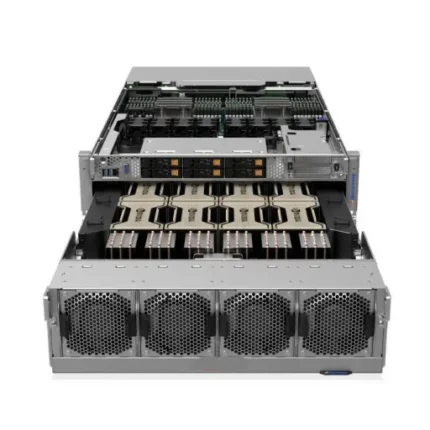
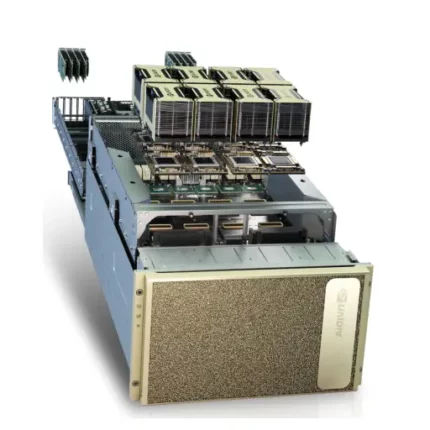
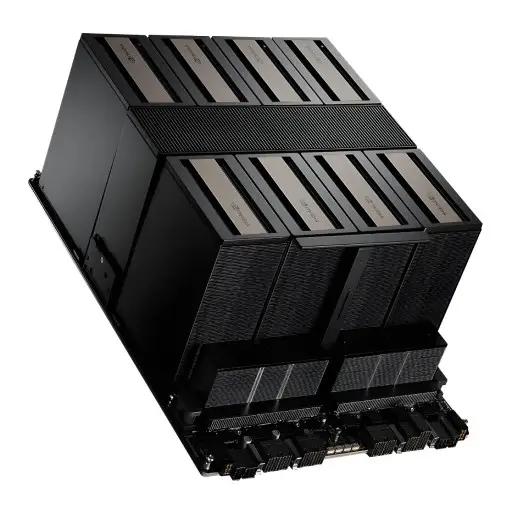
The NVIDIA HGX B200 represents a quantum leap in artificial intelligence infrastructure, delivering unprecedented computational power through eight Blackwell B200 Tensor Core GPUs interconnected via fifth-generation NVLink technology. This revolutionary platform establishes new benchmarks for AI training and inference performance, achieving up to 144 petaFLOPS of FP4 Tensor Core performance and 72 petaFLOPS of FP8 training throughput within a single unified system. Designed as the cornerstone of next-generation AI factories, the HGX B200 enables organizations to tackle the most demanding generative AI workloads, including trillion-parameter large language models, multimodal foundation models, and real-time inference serving at unprecedented scale.
Built on NVIDIA’s groundbreaking Blackwell architecture featuring 208 billion transistors per GPU, the HGX B200 platform delivers transformational improvements over previous-generation systems. Organizations deploying this platform experience up to 4X faster training performance for large language models compared to Hopper-based H200 systems, alongside 15X higher inference throughput enabling real-time serving of complex AI applications. The platform’s 1,440GB total GPU memory capacity with aggregate 64TB/s memory bandwidth eliminates bottlenecks in model training and inference, while 14.4TB/s of NVLink interconnect bandwidth ensures seamless multi-GPU scaling without communication overhead compromising performance.
At ITCT Shop, we recognize that successful deployment of cutting-edge AI infrastructure requires comprehensive expertise spanning hardware architecture, system integration, and operational optimization. Our team provides end-to-end support for organizations implementing NVIDIA HGX B200 platforms, from initial architecture design through ongoing performance tuning and capacity planning. Whether you’re building large-scale training clusters for foundation model development, deploying high-throughput inference infrastructure for production AI services, or establishing hybrid environments supporting diverse workloads, the HGX B200 delivers unmatched performance, scalability, and flexibility. Integration with our comprehensive portfolio of AI computing solutions and enterprise GPU infrastructure ensures cohesive system architecture optimized for your specific requirements.
The HGX B200’s architectural innovations extend beyond raw computational performance to address critical operational concerns including energy efficiency, total cost of ownership, and sustainable AI deployment. Advanced power management capabilities and optimized precision formats enable organizations to achieve up to 25X better energy efficiency compared to previous-generation platforms when running equivalent workloads. This dramatic improvement in performance-per-watt translates directly into reduced operational costs, lower carbon footprint, and expanded deployment options in power-constrained data center environments. Organizations committed to sustainable AI practices benefit from the HGX B200’s ability to deliver exponentially greater computational capabilities while maintaining responsible energy consumption profiles.

Complete Technical Specifications
NVIDIA HGX B200 Platform Specifications
| Specification Category | Parameter | Value |
|---|---|---|
| GPU Configuration | GPU Type | 8x NVIDIA B200 Tensor Core GPUs |
| GPU Architecture | Blackwell (208 billion transistors per GPU) | |
| GPU Form Factor | SXM5 module with integrated cooling interface | |
| Manufacturing Process | TSMC 4NP (4nm process technology) | |
| Memory Architecture | Total GPU Memory | 1,440GB HBM3e (180GB per GPU) |
| Memory Type | HBM3e (High Bandwidth Memory 3 Enhanced) | |
| Memory Interface per GPU | 4,096-bit | |
| Memory Speed | 8 Gbps per pin | |
| Per-GPU Memory Bandwidth | 8 TB/s | |
| Aggregate Memory Bandwidth | 64 TB/s (across all 8 GPUs) | |
| Memory Error Correction | ECC (Error Correcting Code) enabled | |
| Compute Performance | FP4 Tensor Core Peak | 144 petaFLOPS (aggregate) / 18 PFLOPS per GPU |
| FP6 Tensor Core Peak | 72 petaFLOPS (aggregate) / 9 PFLOPS per GPU | |
| FP8 Tensor Core Peak | 72 petaFLOPS (aggregate) / 9 PFLOPS per GPU | |
| FP16 Tensor Core Peak | 36 petaFLOPS (aggregate) | |
| BF16 Tensor Core Peak | 36 petaFLOPS (aggregate) | |
| TF32 Tensor Core Peak | 18 petaFLOPS (aggregate) | |
| FP32 Peak Performance | 9 petaFLOPS (aggregate) | |
| FP64 Peak Performance | 4.5 petaFLOPS (aggregate) | |
| Interconnect Technology | NVLink Generation | NVLink 5 (fifth generation) |
| NVLink GPU-to-GPU Bandwidth | 1.8 TB/s bidirectional per GPU | |
| Total NVLink Bandwidth | 14.4 TB/s aggregate across platform | |
| NVLink Switch Technology | NVLink Switch (18-port configuration) | |
| GPU-to-GPU Topology | Fully connected all-to-all mesh | |
| PCIe Host Interface | PCIe Gen5 x16 per GPU | |
| PCIe Aggregate Bandwidth | 1 TB/s (128 GB/s per GPU bidirectional) | |
| Processor Configuration | CPU Support | Dual-socket Intel Xeon Scalable (5th/4th Gen) |
| Dual-socket AMD EPYC (4th/3rd Gen) | ||
| Dual Intel Xeon CPU Max Series | ||
| CPU-GPU Communication | PCIe Gen5 direct attach | |
| System Memory | DDR5 Memory Support | 8-channel DDR5 RDIMM per socket |
| Maximum System Memory | Up to 4TB (32x DIMMs configuration) | |
| Memory Speed | DDR5-5600 or DDR5-4800 | |
| Networking Integration | InfiniBand Support | NVIDIA ConnectX-7 (400Gb/s NDR) |
| Ethernet Support | NVIDIA ConnectX-7 (400GbE) | |
| Network Topology | 1:1 GPU-to-network ratio available | |
| RDMA Support | GPUDirect RDMA enabled | |
| RoCE Support | RDMA over Converged Ethernet | |
| Storage Configuration | Boot Drive | Dual NVMe M.2 SSDs (RAID1 configuration) |
| Data Storage | Up to 8x U.2/U.3 NVMe SSDs | |
| Storage Interface | PCIe Gen5 for maximum throughput | |
| Maximum Storage Capacity | 122.88TB (8x 15.36TB SSDs) | |
| Power Specifications | Per-GPU TDP | 1000W (configurable 700-1000W) |
| Total GPU Power | 8000W maximum (8x 1000W GPUs) | |
| System Power Consumption | 10.2-14.3kW total system power | |
| Power Supply Redundancy | N+1 or 2N redundant PSU configuration | |
| Power Efficiency | 94%+ Titanium efficiency rating | |
| Thermal Management | Cooling Architecture | Liquid cooling recommended for 8-GPU config |
| Air cooling supported with enhanced airflow | ||
| Operating Temperature | 5°C to 30°C ambient (liquid cooling) | |
| 5°C to 25°C ambient (air cooling) | ||
| Maximum GPU Temperature | 85°C sustained | |
| Physical Dimensions | Form Factor | 10U rackmount chassis (air-cooled) |
| 5U rackmount chassis (liquid-cooled) | ||
| Chassis Depth | 950mm (37.4 inches) standard depth | |
| Weight | 150-180kg depending on configuration | |
| Multi-Instance GPU | MIG Partitioning | Up to 7 MIG instances per GPU |
| MIG Memory Allocation | Flexible partitioning from 20GB to 180GB | |
| MIG Compute Allocation | Independent SM allocation per instance | |
| MIG Use Cases | Multi-tenant, QoS-guaranteed workloads | |
| Software Support | Operating Systems | Ubuntu 22.04/24.04 LTS |
| RHEL 8.x/9.x | ||
| VMware vSphere 8.0+ | ||
| CUDA Version | CUDA 12.0 and newer | |
| AI Frameworks | TensorFlow, PyTorch, JAX, TensorRT | |
| Management Software | NVIDIA Base Command Manager | |
| NVIDIA AI Enterprise | ||
| Certifications | Hardware Certification | NVIDIA-Certified Systems |
| Security Standards | FIPS 140-2, Common Criteria | |
| Environmental | RoHS, REACH, ENERGY STAR | |
| Warranty and Support | Standard Warranty | 3-year hardware warranty |
| Extended Support | Available through NVIDIA Enterprise | |
| RMA Process | Advanced replacement available |
Performance Comparison Matrix
| Metric | HGX B200 (8-GPU) | HGX H200 (8-GPU) | Performance Advantage |
|---|---|---|---|
| Training Performance | |||
| LLM Training (GPT-3 175B) | 1.0X baseline | 0.44X | 2.25X faster |
| LLaMA-2 70B Fine-tuning | 1.0X baseline | 0.50X | 2.0X faster |
| Stable Diffusion XL Training | 1.0X baseline | 0.63X | 1.6X faster |
| Inference Performance | |||
| Llama 2 70B Interactive (tokens/sec) | 60,000/GPU | 19,355/GPU | 3.1X faster |
| GPT-3 175B Batch Inference | 1.0X baseline | 0.43X | 2.3X faster |
| BERT-Large (INT8) | 1.0X baseline | 0.56X | 1.8X faster |
| Memory and Bandwidth | |||
| Total GPU Memory | 1,440GB | 1,120GB | 28.6% more capacity |
| Aggregate Memory Bandwidth | 64 TB/s | 48 TB/s | 33.3% higher |
| NVLink Total Bandwidth | 14.4 TB/s | 14.4 TB/s | Equivalent |
| Power and Efficiency | |||
| Training Performance/Watt | 1.0X baseline | 0.61X | 1.64X better efficiency |
| Inference Performance/Watt | 1.0X baseline | 0.42X | 2.38X better efficiency |
| Total System Power | 10.2-14.3kW | 10.2-11.5kW | Similar power envelope |
Revolutionary Blackwell Architecture
Second-Generation Transformer Engine
The NVIDIA Blackwell architecture introduces groundbreaking advancements in AI processing capabilities through its second-generation Transformer Engine, purpose-built to accelerate the attention mechanisms that form the backbone of modern large language models and generative AI systems. This architectural innovation implements native support for FP4, FP6, and FP8 floating-point formats alongside traditional FP16, BF16, and TF32 precision levels, enabling optimal trade-offs between model accuracy and computational throughput. The Transformer Engine dynamically analyzes tensor operations in real-time, automatically selecting optimal precision formats for each layer to maximize performance while maintaining model quality within acceptable tolerance bounds.
Advanced numerical format support extends beyond simple precision reduction to incorporate sophisticated quantization-aware training capabilities that preserve model accuracy even at extremely low precision levels. The FP4 format, representing the lowest precision tier, achieves remarkable 18 petaFLOPS throughput per GPU for specific inference operations where ultra-high throughput outweighs minor accuracy trade-offs. This capability proves particularly valuable for serving large language models at massive scale, where doubling or quadrupling inference throughput directly translates into reduced infrastructure requirements and operational costs. Organizations deploying AI workstation configurations for model development benefit from seamless precision format experimentation without code modifications.
The Transformer Engine’s automatic mixed-precision capabilities eliminate manual optimization burden from AI practitioners, enabling them to focus on model architecture and training strategies rather than low-level numerical format selection. During training workflows, the engine continuously monitors gradient statistics and activation magnitudes, dynamically adjusting precision formats across different model components to optimize the training process. Critical layers affecting model convergence maintain higher precision formats, while compute-intensive but less sensitivity-prone operations leverage lower precision for maximum throughput. This intelligent precision management achieves training speedups of 4X compared to H200 systems running equivalent workloads at fixed precision, dramatically reducing time-to-solution for foundation model development.
Advanced NVLink 5 Interconnect Fabric
The fifth-generation NVLink technology represents NVIDIA’s most advanced GPU interconnect solution, delivering 1.8TB/s bidirectional bandwidth per GPU through 18 independent high-speed links. This massive interconnect bandwidth enables true all-to-all communication patterns where any GPU can directly communicate with any other GPU in the 8-GPU configuration without routing through intermediate hops or suffering bandwidth degradation. The fully connected topology proves essential for training workflows where gradient synchronization, all-reduce operations, and parameter updates require frequent inter-GPU communication that would bottleneck on slower interconnects.
NVLink 5’s architectural improvements over previous generations extend beyond raw bandwidth increases to incorporate sophisticated traffic management and quality-of-service mechanisms ensuring predictable latency characteristics under heavy load. Advanced link-level error correction and retry mechanisms maintain data integrity without compromising throughput, while adaptive routing algorithms dynamically balance traffic across available paths to prevent hotspot formation. Organizations building multi-GPU training infrastructure benefit from NVLink’s ability to maintain near-linear scaling efficiency even when distributing massive models across all eight GPUs, with communication overhead consuming less than 5% of total training time for well-optimized workloads.
The NVLink Switch component integrated into HGX B200 systems implements a non-blocking crossbar architecture providing dedicated bandwidth for every GPU-to-GPU connection simultaneously. Unlike PCIe-based communication requiring CPU involvement and suffering from limited bandwidth, NVLink Switch enables direct GPU-to-GPU memory transfers that bypass system memory and PCIe infrastructure entirely. This architectural approach proves critical for emerging AI techniques including pipeline parallelism, where different model layers reside on different GPUs and must rapidly exchange activation tensors during forward and backward passes. The 14.4TB/s aggregate NVLink bandwidth available in 8-GPU configurations exceeds aggregate system memory bandwidth, ensuring inter-GPU communication never becomes a bottleneck even in communication-intensive training scenarios.
Massive HBM3e Memory Subsystem
Each B200 GPU incorporates 180GB of HBM3e memory connected via a 4,096-bit wide interface delivering 8TB/s bandwidth, representing substantial improvements over previous HBM3 and HBM2e memory technologies. The 28.6% increase in per-GPU memory capacity compared to H200’s 141GB enables training of larger models within single GPUs, reducing the need for model parallelism techniques that introduce communication overhead and complexity. Organizations training large language models benefit from the ability to fit significantly larger model states entirely within GPU memory, eliminating expensive CPU-GPU memory transfers that would otherwise constrain training throughput.
HBM3e’s enhanced bandwidth characteristics prove equally important as capacity increases, with 8TB/s per GPU representing the memory throughput required to feed B200’s massive compute capabilities without starvation. Memory-bound operations including attention mechanism computations, embedding lookups, and normalization layers benefit dramatically from increased bandwidth, achieving higher utilization of available compute resources. The aggregate 64TB/s memory bandwidth across eight GPUs enables sustained multi-teraFLOP computational rates even for memory-intensive workloads that would bottleneck on systems with lower memory bandwidth. This capability proves particularly valuable for inference serving where batch sizes must remain small to maintain acceptable latency, limiting opportunities to amortize memory access costs across large batches.
Advanced memory management features including on-demand paging, unified virtual addressing across multiple GPUs, and hardware-accelerated memory pooling simplify application development while improving memory utilization efficiency. Applications can allocate memory dynamically across all available GPUs in the system, with hardware transparently migrating data between GPUs as access patterns evolve. This capability eliminates the need for explicit memory management code tracking which data resides on which GPU, reducing programming complexity and enabling more sophisticated workload patterns. Organizations implementing AI storage solutions benefit from seamless integration between NVMe storage and GPU memory hierarchies, enabling efficient data pipelines that minimize preprocessing bottlenecks.
Key Features and Technological Innovations
Multi-Instance GPU for Resource Optimization
The HGX B200 platform implements advanced Multi-Instance GPU (MIG) technology enabling each of the eight B200 GPUs to be partitioned into up to seven independent instances with dedicated compute resources, memory allocation, and quality-of-service guarantees. This capability transforms single physical GPUs into multiple virtual GPUs, each providing secure isolation and guaranteed performance for different workloads or tenants. Organizations operating multi-tenant AI infrastructure benefit from MIG’s ability to maximize GPU utilization while maintaining strict isolation between customers, workloads, or development teams sharing the same physical hardware.
MIG partitioning granularity ranges from small 20GB instances suitable for inference serving or interactive development to large 180GB instances approaching full GPU capacity for demanding training workloads. System administrators dynamically reconfigure MIG partitions without system reboots, enabling adaptive resource allocation matching evolving workload requirements throughout the day. Development teams provision dedicated MIG instances for continuous integration testing, while production inference services consume separate instances with guaranteed throughput, all sharing the same underlying GPU hardware efficiently. This flexibility proves particularly valuable for organizations building AI edge infrastructure requiring diverse workload support within constrained hardware footprints.
Advanced scheduling algorithms integrated into CUDA runtime and container orchestration platforms including Kubernetes enable intelligent workload placement across MIG instances, optimizing for factors including memory requirements, compute intensity, and latency sensitivity. Time-sensitive inference requests automatically route to dedicated MIG instances with guaranteed resources, while batch processing workloads utilize shared instances maximizing overall cluster utilization. The combination of hardware-level isolation and software-level orchestration creates robust multi-tenant environments where noisy neighbor effects cannot degrade performance of critical production workloads, addressing a primary concern for organizations consolidating diverse AI applications onto shared infrastructure.
Confidential Computing and Security
Enterprise AI deployments increasingly handle sensitive data subject to regulatory requirements including GDPR, HIPAA, and financial services regulations, creating demand for hardware-level security mechanisms protecting data confidentiality throughout the compute pipeline. The HGX B200 platform integrates comprehensive confidential computing capabilities including secure boot, attestation, and encrypted memory isolation ensuring that even system administrators and hypervisor operators cannot access data being processed within GPU compute environments. These security features enable organizations to process confidential training data or serve proprietary models in multi-tenant cloud environments while maintaining compliance with data sovereignty and privacy requirements.
Hardware-based attestation mechanisms enable verification that GPU firmware, drivers, and runtime environments have not been tampered with, providing cryptographic proof of system integrity before processing sensitive workloads. Organizations deploying AI applications in regulated industries implement continuous attestation workflows that verify system state before each batch of sensitive data enters the processing pipeline, ensuring compliance with security policies. Encrypted memory isolation prevents unauthorized access to GPU memory contents even by privileged software with physical access to the host system, protecting intellectual property embedded in proprietary models and preventing data exfiltration through memory dump attacks or malicious hypervisor modifications.
Integration with enterprise security infrastructure including hardware security modules, key management systems, and security information and event management platforms enables comprehensive audit logging and compliance reporting. Every access to confidential compute environments generates tamper-proof audit records documenting which workloads processed which data at what times, providing the forensic capabilities required for regulatory compliance and security incident investigation. Organizations operating in highly regulated industries benefit from HGX B200’s ability to provide cloud-scale AI capabilities while maintaining on-premises-equivalent security controls, eliminating the traditional trade-off between infrastructure flexibility and security requirements.
Advanced Cooling Technologies
The HGX B200’s massive computational density generating up to 14.3kW thermal load within a single system requires sophisticated cooling solutions beyond traditional air-cooling approaches common in previous-generation GPU servers. NVIDIA partners with leading OEM manufacturers to provide both air-cooled and liquid-cooled configurations optimized for different data center environments and operational requirements. Liquid-cooled configurations implement direct-to-chip cooling where coolant flows through cold plates mounted directly on GPU and CPU packages, extracting heat at the source with minimal temperature delta and enabling higher power densities than air cooling supports.
Direct liquid cooling delivers multiple operational advantages beyond thermal management, including dramatically reduced acoustic noise enabling deployment in office environments and reduced cooling infrastructure costs through higher coolant temperatures eliminating the need for expensive chilled water plants. Organizations implementing AI network infrastructure in co-location facilities benefit from liquid cooling’s ability to achieve 10kW+ per rack densities without specialized cooling infrastructure, reducing floor space requirements and associated rental costs. The elimination of high-velocity air movement also reduces dust accumulation and vibration-induced hardware failures, improving overall system reliability and reducing maintenance requirements.
Advanced thermal management extends beyond primary cooling to incorporate comprehensive monitoring and control systems that continuously optimize cooling performance based on workload characteristics and environmental conditions. Intelligent fan speed control, pump speed modulation, and temperature-aware job scheduling work in concert to minimize energy consumption while maintaining components within optimal temperature ranges. Organizations committed to energy efficiency appreciate the HGX B200’s ability to achieve 25X better performance per watt compared to previous-generation systems, with advanced cooling technologies contributing significantly to this improvement by enabling sustained high-performance operation without thermal throttling degrading computational throughput.
Comprehensive Systems Management
Enterprise deployment of HGX B200 platforms requires sophisticated management infrastructure providing visibility, control, and automation capabilities across fleets of GPU servers deployed in distributed data centers. NVIDIA Base Command Manager provides comprehensive cluster management functionality including automated deployment, configuration management, health monitoring, and firmware updates for HGX B200 systems at scale. System administrators gain centralized visibility into GPU utilization, memory consumption, temperature, and power draw across all nodes in the cluster, enabling capacity planning, troubleshooting, and performance optimization from unified management interfaces.
Integration with enterprise IT management platforms including VMware vCenter, Red Hat Ansible, and Kubernetes operators enables HGX B200 systems to integrate seamlessly into existing operational workflows without requiring specialized GPU expertise from IT staff. Automated provisioning workflows deploy standardized configurations across new systems joining the cluster, ensuring consistency and reducing manual configuration errors. Health monitoring systems continuously validate GPU functionality, memory integrity, and interconnect performance, automatically generating trouble tickets and coordinating with vendor support when hardware issues requiring intervention are detected, minimizing downtime and improving mean time to resolution.
Advanced telemetry and logging capabilities generate detailed performance metrics and event logs supporting both operational troubleshooting and long-term capacity planning activities. Machine learning models trained on historical telemetry data predict component failures before they occur, enabling proactive replacement during scheduled maintenance windows rather than emergency repairs disrupting production workloads. Organizations building large-scale AI infrastructure appreciate these enterprise management capabilities that reduce operational burden, improve reliability, and lower total cost of ownership compared to consumer-grade GPU hardware lacking comprehensive management support. The combination of hardware excellence and operational maturity positions HGX B200 as the foundation for production AI factories operating at cloud scale.
Application Scenarios and Use Cases
Large Language Model Training and Fine-Tuning
The HGX B200 platform establishes new benchmarks for training efficiency across large language model architectures ranging from 70-billion-parameter models suitable for specialized domains to trillion-parameter foundation models pushing the boundaries of AI capability. Organizations training GPT-style autoregressive language models benefit from the platform’s massive 1,440GB aggregate memory capacity enabling larger batch sizes and longer context windows that improve training stability and final model quality. The 4X training performance advantage over H200 systems directly translates into reduced time-to-convergence, enabling faster iteration cycles during model development and more frequent retraining to incorporate fresh data.
Advanced training techniques including mixture-of-experts architectures, retrieval-augmented generation, and multi-task learning particularly benefit from HGX B200’s architectural capabilities. Mixture-of-experts models distribute specialized sub-networks across multiple GPUs with NVLink providing the high-bandwidth communication required for efficient expert routing and gradient synchronization. Organizations implementing these advanced architectures achieve better model quality and training efficiency compared to dense model architectures of equivalent parameter count, while HGX B200’s communication infrastructure eliminates the bottlenecks that limited MoE adoption on previous-generation platforms.
Fine-tuning workflows adapting pre-trained foundation models to specific domains or tasks represent another high-value application for HGX B200 capabilities. Parameter-efficient fine-tuning techniques including LoRA, prompt tuning, and adapter layers minimize computational requirements while achieving excellent task-specific performance, enabling organizations to create specialized models without the massive resource investments required for full pre-training. The HGX B200’s FP8 and FP4 precision support accelerates fine-tuning throughput while maintaining accuracy, enabling rapid experimentation with different adaptation strategies and hyperparameter configurations. Organizations can fine-tune dozens of task-specific variants from a single foundation model within days rather than weeks, accelerating AI application development timelines.
High-Throughput AI Inference Serving
Production deployment of large language models for interactive applications including chatbots, code generation assistants, and content creation tools demands extremely high throughput while maintaining acceptable response latency. The HGX B200’s 15X inference performance advantage compared to H200 systems enables serving orders of magnitude more concurrent users from the same physical infrastructure, dramatically reducing per-query infrastructure costs and improving return on AI investment. Organizations deploying customer-facing AI applications benefit from the ability to scale to millions of users without proportional infrastructure expansion, maintaining acceptable economics even for free-tier services that generate advertising or subscription revenue rather than per-query charges.
Advanced batching and scheduling algorithms implemented in inference serving frameworks including NVIDIA Triton Inference Server and frameworks like vLLM optimize HGX B200 utilization by dynamically grouping queries with compatible characteristics for batch processing. Continuous batching techniques aggregate incoming requests in real-time rather than waiting for fixed batch boundaries, minimizing latency while maximizing throughput. The platform’s massive memory capacity enables serving multiple large models simultaneously, with intelligent request routing directing queries to appropriate model endpoints based on content, language, or specialized capabilities, eliminating the need for separate infrastructure for each model variant deployed.
Multi-instance GPU capabilities enable sophisticated resource allocation strategies for inference serving, with dedicated MIG instances providing guaranteed capacity for premium users or latency-sensitive applications while shared instances handle best-effort traffic. Organizations implementing tiered service models allocate guaranteed throughput to paying customers while opportunistically serving free-tier traffic on remaining capacity, maximizing infrastructure utilization and revenue per GPU. The ability to dynamically adjust MIG partitioning based on traffic patterns enables responsive capacity allocation matching demand fluctuations throughout the day, reducing infrastructure over-provisioning and associated costs.
Multimodal Foundation Model Development
Next-generation AI applications increasingly demand multimodal capabilities processing and generating content across text, images, audio, and video modalities within unified model architectures. The HGX B200’s computational capabilities and memory capacity prove essential for training these complex models that require processing diverse data types with varying computational characteristics. Vision-language models including CLIP variants, Flamingo, and emerging architectures benefit from the platform’s ability to efficiently process both convolutional neural network operations for visual feature extraction and transformer operations for language understanding within the same training loop.
Generative multimodal models including Stable Diffusion XL, DALL-E variants, and text-to-video architectures particularly benefit from HGX B200’s FP8 precision support and massive memory bandwidth. These models generate high-resolution imagery through iterative denoising processes requiring billions of operations per generated sample, with inference latency directly impacting user experience in interactive applications. The B200’s specialized tensor processing capabilities accelerate both the U-Net architectures common in diffusion models and the attention mechanisms used for text conditioning, achieving generation speeds enabling near-real-time interactive experiences where previous-generation platforms required seconds of latency per image.
Audio and video processing applications including speech recognition, music generation, and video understanding models leverage HGX B200’s computational density to process temporal data at unprecedented scales. Automatic speech recognition models processing multi-hour audio recordings benefit from the ability to maintain large contexts spanning entire conversations or meetings, improving accuracy through better context utilization. Video understanding models analyzing high-resolution footage extract fine-grained temporal and spatial features without downsampling or frame-dropping that would sacrifice quality, enabling applications including automated video editing, surveillance analytics, and autonomous vehicle perception systems operating on full-resolution sensor data.
Scientific Computing and Simulation
While AI workloads represent primary design targets for HGX B200, the platform’s massive computational capabilities and FP64 support enable breakthrough scientific computing applications across physics simulation, computational chemistry, climate modeling, and engineering analysis. Organizations simulating complex physical phenomena benefit from the ability to run higher-resolution simulations or longer time-scale integrations within acceptable wall-clock times, enabling scientific discoveries and engineering optimizations previously infeasible with available computational resources. The platform’s 4.5 petaFLOPS FP64 performance matches or exceeds dedicated HPC accelerators while providing superior AI integration for hybrid workflows.
Computational fluid dynamics applications simulating turbulent flows, combustion processes, or aerodynamic forces achieve faster time-to-solution through HGX B200’s ability to maintain massive computational grids entirely within GPU memory. The elimination of CPU-GPU data transfers between simulation time steps reduces overhead and enables longer sustained computational rates. Organizations implementing digital twin applications for industrial equipment monitoring benefit from the ability to run ensemble simulations exploring parameter spaces or quantifying uncertainties, with results informing predictive maintenance strategies and operational optimizations delivering measurable cost savings and reliability improvements.
Molecular dynamics simulations for drug discovery and materials science leverage HGX B200’s capabilities to explore larger chemical systems over longer time scales, improving accuracy of binding affinity predictions and conformational analysis. Integration with AI-powered approaches including AlphaFold for protein structure prediction and generative models for molecular design creates comprehensive computational pipelines accelerating discovery timelines. Organizations in pharmaceutical development reduce time-to-market for new therapeutics by identifying promising candidates earlier in the discovery process, while materials science researchers design novel materials with desired properties optimized through computational screening validated by targeted experimental synthesis, dramatically reducing experimental costs and iteration cycles.
Recommendation Systems and Personalization
Large-scale recommendation systems powering e-commerce platforms, content streaming services, and social media applications process billions of user interactions daily to generate personalized content suggestions and product recommendations. The HGX B200’s inference capabilities enable real-time recommendation generation for massive user populations, with deep learning models capturing complex interaction patterns that simpler collaborative filtering approaches miss. Organizations operating large-scale recommendation systems benefit from improved recommendation quality translating directly into increased user engagement, higher conversion rates, and measurable revenue improvements justifying infrastructure investments.
Advanced recommendation architectures including deep learning recommendation models (DLRM) and two-tower neural networks leverage HGX B200’s massive embedding table support and efficient categorical feature processing. The platform’s large memory capacity enables caching entire user and item embedding spaces within GPU memory, eliminating CPU memory accesses that would otherwise bottleneck inference throughput. Organizations serving recommendations to hundreds of millions of users achieve sub-10-millisecond latency requirements enabling real-time personalization of every page view, search result, and content feed, delivering experiences comparable to consumer internet giants while using dramatically less infrastructure.
Real-time personalization extends beyond traditional recommendation scenarios to encompass dynamic pricing, fraud detection, and audience targeting applications where millisecond-scale inference latency enables sophisticated per-transaction decision-making. Financial services organizations deploy HGX B200-powered fraud detection systems analyzing transaction patterns in real-time, blocking suspicious transactions before completion while minimizing false positives that would frustrate legitimate customers. The combination of high throughput, low latency, and sophisticated model capabilities enables risk management approaches impossible with previous-generation infrastructure, protecting organizations and customers while maintaining excellent user experiences.
Software Ecosystem and Framework Support
Comprehensive AI Framework Integration
The HGX B200 maintains seamless compatibility with all major AI development frameworks including PyTorch, TensorFlow, JAX, and MXNet, enabling data scientists and ML engineers to leverage existing codebases and workflows without modification. NVIDIA provides optimized framework containers through NGC (NVIDIA GPU Cloud) that incorporate performance-tuned libraries, drivers, and runtime components specifically optimized for Blackwell architecture capabilities. Organizations adopting HGX B200 benefit from immediate access to these pre-configured environments eliminating weeks of software stack configuration and optimization that would otherwise delay production deployment.
Framework-specific optimizations leverage Blackwell’s advanced capabilities including FP8 automatic mixed precision, transformer engine acceleration, and NVLink-aware distributed training primitives. PyTorch users benefit from native integration with CUDA graphs, TorchScript compilation, and distributed data parallel implementations that automatically leverage NVLink bandwidth for gradient synchronization. TensorFlow implementations utilize XLA compilation generating optimized Blackwell-specific kernels achieving higher computational density than generic implementations, while JAX programs benefit from automatic differentiation and JIT compilation producing highly efficient training loops matching hand-optimized CUDA performance.
The democratization of advanced optimization techniques through framework integration proves particularly valuable for organizations lacking deep GPU programming expertise. Data scientists implement complex model architectures using high-level Python APIs, with framework backends automatically translating these descriptions into optimized execution plans leveraging Blackwell’s specialized capabilities. This abstraction layer enables rapid experimentation and iteration without requiring expertise in CUDA programming, tensor core utilization, or distributed training protocols, dramatically reducing the expertise barrier for implementing state-of-art AI systems. Organizations transitioning from AI workstation development to production deployment find this seamless scaling from single-GPU prototypes to distributed 8-GPU training invaluable for maintaining development velocity.
NVIDIA AI Enterprise Software Suite
NVIDIA AI Enterprise provides comprehensive commercial software support for HGX B200 deployments, including production-grade AI frameworks, pre-trained models, workflow optimization tools, and enterprise support services. This end-to-end software stack eliminates integration challenges and accelerates time-to-production for organizations implementing AI applications. The subscription-based licensing model includes regular updates, security patches, and access to NVIDIA’s AI experts for architectural guidance and troubleshooting assistance, providing the operational support required for production deployments serving business-critical applications.
The software suite includes optimized implementations of popular AI workloads including large language model inference servers, computer vision pipelines, and speech recognition systems that organizations can deploy with minimal customization. These reference implementations incorporate best practices for batching, caching, model optimization, and monitoring developed through NVIDIA’s extensive deployment experience with leading AI companies. Organizations benefit from immediate access to production-quality implementations rather than developing these capabilities from scratch, reducing time-to-market and avoiding common pitfalls that delay projects or result in suboptimal performance.
Integration with enterprise IT infrastructure including Kubernetes orchestration, monitoring platforms, and CI/CD pipelines enables HGX B200 systems to fit seamlessly into existing operational workflows. NVIDIA GPU Operator automates driver installation, GPU feature discovery, and monitoring stack deployment in Kubernetes environments, while native support for Helm charts and Operators simplifies application deployment. Organizations can implement GitOps workflows managing entire AI infrastructure as code, with declarative configurations versioned in source control and automatically deployed through standard DevOps tooling, bringing software engineering best practices to AI infrastructure operations.
TensorRT Inference Optimization
NVIDIA TensorRT provides advanced model optimization capabilities specifically targeting inference workloads, applying aggressive optimizations including layer fusion, precision calibration, and kernel auto-tuning that maximize HGX B200 inference throughput. The optimizer analyzes neural network architectures, identifies optimization opportunities, and generates highly efficient inference engines leveraging Blackwell’s FP8 and FP4 precision capabilities. Organizations deploying production inference services achieve up to 10X additional throughput improvement beyond framework-native inference through TensorRT optimization, dramatically reducing per-query infrastructure costs and improving responsiveness.
Advanced optimization techniques including automatic precision calibration analyze model sensitivity to quantization, automatically determining optimal precision for each layer that maximizes throughput while maintaining accuracy within acceptable bounds. This capability eliminates tedious manual quantization tuning, enabling rapid deployment of optimized inference services. Dynamic shape support allows single optimized engines to efficiently serve requests with varying input sizes, eliminating the need for multiple model variants and simplifying deployment architecture. Organizations serving diverse request patterns benefit from reduced memory footprints and simplified operational complexity.
TensorRT’s plugin architecture enables integration of custom operations and domain-specific optimizations not possible through generic framework implementations. Organizations implementing specialized algorithms or proprietary model architectures develop custom TensorRT plugins in CUDA, achieving performance matching hand-optimized implementations while maintaining compatibility with standard deployment infrastructure. The plugin system proves particularly valuable for research organizations deploying novel architectures or commercial AI companies protecting intellectual property through custom operation implementations that resist reverse engineering while maintaining excellent performance characteristics.
Distributed Training Frameworks
Large-scale AI training across multiple HGX B200 systems requires sophisticated distributed training frameworks coordinating gradient computation, communication, and parameter updates across dozens or hundreds of GPUs. NVIDIA provides comprehensive distributed training support through NCCL (NVIDIA Collective Communications Library) implementing highly optimized multi-GPU and multi-node communication primitives. NCCL automatically detects system topology including NVLink, PCIe, and InfiniBand connectivity, generating optimal communication schedules that minimize latency and maximize bandwidth utilization across complex network topologies.
Higher-level distributed training frameworks including Megatron-LM, DeepSpeed, and Fairscale build on NCCL primitives to implement complete training systems supporting trillion-parameter models. These frameworks automatically partition models across GPUs using tensor parallelism, pipeline parallelism, and data parallelism strategies that maintain high computational efficiency while distributing memory requirements across many devices. Organizations training foundation models benefit from battle-tested implementations encoding years of optimization experience from leading AI research institutions, eliminating the need to develop distributed training expertise from scratch.
Elastic training capabilities enable dynamic resource allocation where training jobs automatically adapt to changing GPU availability, enabling efficient resource sharing in multi-tenant environments. Jobs can scale up by recruiting additional GPUs when capacity becomes available or scale down gracefully when other high-priority workloads require resources, maximizing cluster utilization. Integration with cluster scheduling systems including Slurm and Kubernetes enables sophisticated policies balancing competing priorities including job urgency, fairness, and resource efficiency, ensuring that expensive HGX B200 infrastructure delivers maximum value through high sustained utilization across diverse workloads.
Deployment and System Integration
Rack-Scale Infrastructure Design
Deploying HGX B200 systems within data center racks requires careful attention to power distribution, cooling infrastructure, and network connectivity ensuring systems operate reliably at maximum performance. Each 8-GPU system consuming 10-14kW represents substantial power density necessitating high-capacity power distribution units and careful load balancing across facility electrical infrastructure. Organizations should specify 400V or 480V three-phase power distribution enabling higher current carrying capacity with reduced conductor sizes compared to traditional 208V single-phase approaches, improving power delivery efficiency and reducing installation costs in new facilities.
Liquid-cooled HGX B200 configurations integrate with facility coolant distribution systems delivering water or dielectric fluid to rack-level coolant distribution units. These CDUs regulate flow rates and monitor coolant temperatures, providing facility interfaces that integrate with building management systems for centralized monitoring and control. Organizations implementing enterprise GPU infrastructure should plan coolant infrastructure capacity accommodating future expansion, with distribution piping and CDU capacity sized for target rack densities including planned growth over 3-5 year refresh cycles, avoiding costly retrofits as deployments scale.
Network infrastructure represents another critical deployment consideration, with each HGX B200 system requiring high-bandwidth, low-latency connectivity to other systems in the training cluster and to external storage infrastructure. Organizations building large training clusters typically implement spine-leaf network topologies with 1:1 oversubscription ratios, ensuring any GPU can communicate with any other GPU at full link bandwidth simultaneously. InfiniBand NDR (400Gb/s) or Ethernet 400GbE provide network fabrics matching HGX B200’s computational capabilities, preventing network bottlenecks from constraining distributed training scalability. Careful attention to network topology design, optical module selection, and cable management proves essential for achieving optimal performance and operational reliability.
Data Pipeline Optimization
Training and inference workloads on HGX B200 systems demand sustained high-bandwidth data delivery from storage systems to GPU memory, with data pipeline bottlenecks constraining GPU utilization and wasting expensive computational resources. Organizations should implement high-performance parallel file systems including WekaFS, BeeGFS, or Lustre providing aggregate bandwidth matching or exceeding GPU consumption rates. For 8-GPU training systems consuming 1-2TB/s aggregate bandwidth during data loading phases, storage systems should provide at least 200-400GB/s delivered through multiple 400Gb/s network connections distributing load across many storage servers.
Dataset preprocessing and augmentation operations introduce additional computational overhead that can bottleneck training pipelines if not carefully optimized. NVIDIA DALI (Data Loading Library) provides GPU-accelerated data augmentation operations including image decoding, resizing, normalization, and domain-specific transformations, offloading these operations from CPU and feeding pre-processed data directly into GPU memory. Organizations achieve dramatic training speedups by eliminating CPU preprocessing bottlenecks, enabling GPUs to maintain high utilization throughout training rather than idling while waiting for next batch availability. The elimination of CPU-GPU data transfers for intermediate preprocessing results further improves pipeline efficiency.
Advanced data loading strategies including distributed data parallel loaders, prefetching, and asynchronous I/O overlap data loading with GPU computation, hiding storage latency behind useful computation. Careful tuning of prefetch buffer sizes, worker thread counts, and batch assembly strategies proves essential for maximizing throughput while managing system memory consumption. Organizations should monitor data loading times and GPU utilization metrics during training to identify pipeline bottlenecks, iteratively optimizing configurations to achieve target GPU utilization above 90% during steady-state training. The investment in data pipeline optimization delivers substantial returns through dramatically reduced training times and improved infrastructure ROI.
Monitoring and Telemetry
Production operation of HGX B200 infrastructure demands comprehensive monitoring systems providing visibility into hardware health, performance characteristics, and resource utilization supporting capacity planning and troubleshooting activities. NVIDIA Data Center GPU Manager (DCGM) provides standardized telemetry collection APIs gathering GPU-specific metrics including temperature, power consumption, utilization, memory usage, and error counters. Integration with enterprise monitoring platforms including Prometheus, Grafana, and commercial observability solutions enables centralized dashboards displaying fleet-wide status and alerting on anomalous conditions requiring intervention.
Application-level telemetry complementing hardware monitoring captures training loss curves, validation metrics, throughput measurements, and resource utilization trends informing model development decisions. ML experiment tracking platforms including MLflow, Weights & Biases, and Neptune integrate with training scripts to automatically log these metrics, providing historical records supporting reproducibility and comparative analysis. Organizations benefit from unified views combining infrastructure metrics and application performance data, enabling correlation of training anomalies with infrastructure events like network interruptions or thermal throttling that might otherwise escape notice.
Advanced analytics leveraging historical telemetry data identify optimization opportunities and predict component failures before service impact occurs. Machine learning models trained on GPU telemetry data detect early indicators of pending failures including gradual temperature increases, memory error rate escalation, or performance degradation signaling failing components. Predictive maintenance capabilities enable proactive component replacement during scheduled maintenance windows rather than emergency repairs, improving overall infrastructure availability and reducing operational costs. Organizations operating large GPU clusters benefit from these advanced capabilities that reduce downtime and extend hardware operational lifetimes through early intervention.
Return on Investment and Total Cost of Ownership
Performance Economics Analysis
Organizations evaluating HGX B200 investments must consider total cost of ownership spanning initial hardware acquisition, ongoing operational expenses, and opportunity costs from delayed AI capabilities or competitive disadvantage. While HGX B200 systems command premium pricing reflecting cutting-edge capabilities, the platform’s dramatic performance advantages generate measurable economic benefits justifying upfront investment. A single HGX B200 system delivering 2.25X higher LLM training throughput compared to H200 alternatives completes training jobs in less than half the time, proportionally reducing electricity consumption, data center rental costs, and engineering time blocked waiting for training completion.
The performance advantages compound when considering inference serving economics where 15X higher throughput enables serving dramatically more users from equivalent infrastructure. Organizations deploying customer-facing AI applications achieve substantially lower per-query infrastructure costs, improving unit economics and enabling profitable scaling to larger user bases. An inference deployment requiring 15 H200-based systems to achieve target throughput consolidates to a single HGX B200 system, reducing capital expenditure, ongoing maintenance costs, rack space requirements, and operational complexity. These savings accumulate throughout the infrastructure lifecycle, with lower operational costs generating ongoing financial benefits year after year.
Energy efficiency improvements delivering 25X better performance per watt compared to previous-generation systems generate substantial operational cost savings in electricity bills and cooling infrastructure. Data centers paying $0.10 per kWh for electricity find that a 10kW HGX B200 system achieving 25X H100 performance-per-watt costs less to operate than a single H100 system while delivering dramatically higher computational throughput. Organizations operating in regions with high electricity costs or carbon-conscious policies benefit additionally from reduced environmental impact and improved regulatory compliance, avoiding future carbon taxation or achieving sustainability certifications that enhance corporate reputation and open new business opportunities.
Infrastructure Consolidation Benefits
HGX B200’s massive computational capabilities enable infrastructure consolidation strategies where single systems replace multiple previous-generation GPUs, reducing data center footprint requirements and associated costs. Organizations currently operating 8 H100 systems for training workloads can consolidate to 4 HGX B200 systems achieving equivalent or superior throughput while consuming half the rack space. This consolidation reduces facility costs including rack rental in co-location environments, reduces network equipment requirements through fewer systems requiring connectivity, and simplifies operational management through smaller fleet sizes requiring monitoring and maintenance.
The reduced physical footprint proves particularly valuable in constrained data center environments where rack space availability limits deployment scale. Organizations expanding AI capabilities within existing facility constraints leverage HGX B200’s density advantages to increase computational capacity without facility expansion investments that would delay deployments months or years awaiting new space availability. The ability to deliver exponentially greater capabilities within existing infrastructure accelerates AI adoption timelines and improves competitive positioning, generating strategic value beyond simple cost reduction.
Operational simplicity benefits from smaller fleet sizes reduce maintenance burden, software update complexity, and troubleshooting time investment. Managing 4 HGX B200 systems requires substantially less operational effort than managing 8 H100 systems, freeing IT staff to focus on value-adding activities rather than routine maintenance. Reduced fleet sizes also improve change management success rates, as updates and configurations apply to fewer systems reducing the probability of operator error or overlooked systems operating outdated configurations. These operational benefits prove difficult to quantify precisely but generate measurable improvements in deployment velocity and operational reliability that contribute to overall platform ROI.
Comparative Cloud vs On-Premises Economics
Organizations must evaluate whether HGX B200 capabilities should be acquired through capital expenditure for on-premises deployment or consumed as operational expense through cloud GPU rentals. Cloud providers including AWS, Azure, GCP, and specialized GPU clouds offer Blackwell-based instances with hourly pricing enabling consumption-based scaling without upfront investment. For organizations with intermittent or unpredictable workload patterns, cloud consumption models provide cost advantages through paying only for actual usage rather than maintaining infrastructure incurring costs during idle periods.
Conversely, organizations with sustained workload requirements benefit economically from on-premises deployment where payback periods typically range from 12-24 months depending on utilization levels and cloud pricing. An organization utilizing HGX B200 systems above 50% average capacity typically achieves lower total cost of ownership through capital acquisition compared to equivalent cloud consumption, with savings accumulating throughout the 3-5 year infrastructure lifecycle. The cumulative savings over multi-year periods prove substantial, with on-premises deployment potentially costing 50-70% less than equivalent cloud consumption for sustained high-utilization workloads.
Hybrid approaches combining on-premises infrastructure for base load with cloud burst capacity for peak demands optimize economics by right-sizing capital investment to average utilization while maintaining flexibility for periodic demand spikes. Organizations implementing AI computing strategies across hybrid environments benefit from workload portability, with containers and orchestration platforms enabling seamless workload migration between on-premises HGX B200 clusters and cloud instances as economic optimization or capacity constraints dictate. This architectural flexibility proves increasingly valuable as AI workload characteristics evolve and organizational priorities shift, avoiding lock-in to suboptimal deployment strategies.
Comparison with Alternative Solutions
HGX B200 vs GB200 NVL72 Deployment Models
NVIDIA offers Blackwell architecture in multiple form factors optimizing for different deployment scenarios, with HGX B200 representing air/liquid-cooled rack-scale systems while GB200 NVL72 implements liquid-cooled rack-scale integration combining 36 dual-GPU Grace-Blackwell nodes. The GB200 NVL72 configuration delivers exceptional performance for specific workloads benefiting from tight CPU-GPU integration and massive aggregate bandwidth across 72 GPUs sharing unified 130TB/s NVLink fabric. Organizations training trillion-parameter models benefit from GB200’s ability to maintain entire model states within the 72-GPU memory pool, eliminating pipeline parallelism overhead required when distributing across multiple 8-GPU systems.
However, GB200 NVL72’s rack-scale integration creates deployment constraints including liquid cooling requirements, specialized power distribution, and limited configuration flexibility compared to HGX B200’s modular design. Organizations must consume entire 72-GPU racks rather than incrementally scaling with 8-GPU increments, increasing upfront capital requirements and reducing ability to match capacity to actual workload demand. The HGX B200’s deployment flexibility proves valuable for organizations with diverse workload portfolios requiring different system configurations, enabling mixed deployments combining training systems, inference servers, and development workstations within the same data center infrastructure.
Cost considerations also differentiate these platforms, with GB200 NVL72 commanding significant price premiums reflecting specialized integration and higher performance characteristics. Organizations should evaluate whether their workloads genuinely require GB200’s extreme capabilities or whether HGX B200’s already exceptional performance suffices at substantially lower acquisition cost. For most enterprise AI deployments, HGX B200 provides optimal balance of capability, flexibility, and cost-effectiveness, with GB200 reserved for truly exceptional workloads pushing absolute performance boundaries where cost becomes secondary to achieving specific research or business objectives.
HGX B200 vs Multi-Node H200 Clusters
Organizations can alternatively achieve similar aggregate computational capacity through deploying multiple H200-based systems interconnected via InfiniBand fabric, raising questions about when consolidated HGX B200 systems offer advantages over distributed H200 alternatives. HGX B200’s 2.25X per-system training performance compared to H200 means that organizations can achieve target training throughput with fewer nodes, simplifying cluster deployment and reducing network infrastructure requirements. A 32-node H200 cluster might be replaced by a 14-node HGX B200 cluster achieving equivalent throughput while consuming half the network switch ports and interconnect cabling.
The reduced node count delivers operational benefits including simplified failure domain analysis, reduced update and maintenance burden, and lower probability of simultaneous component failures causing job disruptions. Smaller clusters also experience improved distributed training scaling efficiency, as collective communication operations including all-reduce and all-gather scale super-linearly with participant count. The HGX B200 deployment achieves higher per-node efficiency and requires fewer inter-node communications for equivalent model sizes, improving training stability and reducing sensitivity to network latency fluctuations that would degrade larger cluster performance.
However, distributed H200 deployments offer advantages including graceful degradation where individual node failures reduce cluster capacity without complete service interruption, and incremental scaling enabling organizations to expand clusters gradually as workload demand grows. Organizations with highly variable workload patterns or uncertain capacity requirements may prefer H200’s deployment flexibility despite HGX B200’s superior per-node efficiency. The optimal strategy depends on specific organizational requirements, workload characteristics, and operational priorities, with ITCT Shop’s technical team providing guidance matching technology capabilities to customer needs through comprehensive workload analysis and requirements assessment.
Competitive Alternatives from AMD and Intel
While NVIDIA dominates AI accelerator markets, AMD and Intel offer competitive solutions targeting similar workloads with different architectural approaches and ecosystem characteristics. AMD Instinct MI300X GPUs provide substantial HBM3 memory capacity and competitive FP16/FP8 training performance at lower acquisition costs than Blackwell-based systems, attracting price-sensitive organizations and those seeking vendor diversity. However, AMD’s software ecosystem maturity lags NVIDIA’s decade-plus investment in CUDA, deep learning libraries, and framework optimizations, creating integration challenges and limiting achievable performance compared to published specifications.
Intel’s Gaudi 3 accelerators target training workloads with competitive pricing and strong integration with Intel’s broader portfolio including Xeon CPUs and networking solutions. Organizations heavily invested in Intel ecosystems may find Gaudi’s architectural consistency appealing, though the platform similarly lacks CUDA’s mature ecosystem and extensive framework optimizations. Benchmark comparisons consistently demonstrate NVIDIA platforms achieving 50-100% higher real-world training throughput compared to AMD and Intel alternatives when running identical workloads with equivalent software optimization efforts, reflecting the compound advantages of architecture, software maturity, and ecosystem development.
Organizations evaluating competitive alternatives should consider total solution value beyond hardware acquisition cost, including software maturity, ecosystem support, operational expertise availability, and future product roadmap commitments. NVIDIA’s market leadership position ensures sustained R&D investment, broad ISV support, and abundant trained personnel available for hire. While competitive alternatives may appear attractive from first-cost perspectives, the hidden costs of immature software, limited expertise availability, and compatibility challenges often outweigh upfront savings. The HGX B200 represents the safest choice for organizations prioritizing operational success and long-term viability over minimizing initial capital expenditure, delivering proven technology with comprehensive ecosystem support ensuring project success.
Frequently Asked Questions
Q: What is the difference between HGX B200 and DGX B200 systems?
A: The HGX B200 represents NVIDIA’s reference platform design incorporating eight B200 GPUs with NVLink Switch interconnect, provided as a complete subsystem that OEM partners integrate into their server designs. DGX B200 represents NVIDIA’s own complete server product built around HGX B200, including pre-integrated dual-socket CPUs, system memory, storage, networking, and comprehensive systems management software. DGX systems come pre-configured with validated software stacks and comprehensive support from NVIDIA, offering turnkey solutions ideal for organizations seeking complete validated systems with single-vendor support.
OEM partners including Dell, HPE, Lenovo, and Supermicro build their own server designs incorporating HGX B200 platforms, providing alternative configurations optimizing for different requirements including enhanced storage capacity, specialized networking, or integration with existing infrastructure management systems. These OEM systems enable organizations to maintain consistent server architectures across GPU and CPU-only systems, simplifying operational procedures and leveraging existing vendor relationships. Both approaches deliver equivalent GPU computational capabilities, with selection driven by organizational preferences regarding vendor relationships, configuration requirements, and support models.
Organizations should evaluate whether DGX’s premium pricing and NVIDIA-direct support justifies costs compared to OEM alternatives offering HGX B200 at lower price points. For organizations building AI centers of excellence requiring maximum performance and comprehensive software support, DGX systems provide substantial value through validated configurations and NVIDIA’s deep expertise. Conversely, organizations with established OEM relationships and in-house expertise may prefer OEM systems leveraging existing operational processes and vendor agreements, achieving lower acquisition costs while maintaining equivalent performance characteristics for well-managed deployments.
Q: How much does an HGX B200 system cost, and when will it be available?
A: NVIDIA HGX B200 platform pricing varies significantly based on configuration, OEM partner, order volume, and contractual terms, with typical complete 8-GPU systems ranging from $450,000 to $700,000 depending on specifications. The wide price range reflects variations in CPU selection, memory capacity, storage configuration, networking integration, and cooling architecture, with liquid-cooled configurations commanding premiums over air-cooled alternatives. Volume purchasers negotiating fleet deployments often secure substantial discounts compared to single-unit pricing, with some large-scale deployments achieving 20-30% reductions through committed volume agreements.
Availability timelines for HGX B200 systems vary by OEM partner and order volumes, with initial availability beginning in Q1 2025 for early access partners and broader availability expanding throughout 2025 as production volumes increase. Organizations requiring HGX B200 systems should engage with OEM partners or ITCT Shop sales teams early in procurement cycles, as demand significantly exceeds supply during initial availability periods creating extended lead times. Priority allocation typically favors large volume orders and strategic customers, with smaller orders experiencing longer wait times as manufacturing capacity scales to meet market demand.
Cloud availability provides alternative access models for organizations unable to secure hardware allocations or preferring consumption-based pricing over capital expenditure. Major cloud providers including AWS, Azure, and GCP have announced Blackwell-based instance availability with hourly pricing starting around $3-5 per GPU hour depending on instance configuration and commitment terms. These cloud options enable immediate access to Blackwell capabilities without capital investment or procurement delays, though sustained usage quickly accumulates costs exceeding on-premises deployment economics for high-utilization workloads as discussed in earlier TCO analysis sections.
Q: Can HGX B200 systems run existing AI models and codebases without modifications?
A: Yes, HGX B200 maintains complete backward compatibility with existing CUDA applications, AI frameworks, and trained models, enabling organizations to deploy current codebases without modifications. Applications developed for previous NVIDIA GPU generations including Volta, Turing, Ampere, and Hopper architectures execute correctly on Blackwell systems, with CUDA runtime automatically leveraging new architectural features where beneficial while maintaining functional compatibility. This backward compatibility protects existing software investments while enabling gradual adoption of Blackwell-specific optimizations as development resources permit.
However, achieving optimal performance on HGX B200 often requires incorporating architecture-specific optimizations including FP8/FP4 precision support, second-generation transformer engine utilization, and NVLink 5-aware distributed training strategies. Framework updates from PyTorch, TensorFlow, and JAX communities progressively expose these capabilities through high-level APIs enabling adoption without low-level CUDA programming. Organizations should plan phased optimization approaches starting with baseline compatibility validation, progressing through framework updates incorporating Blackwell support, and ultimately implementing custom optimizations for performance-critical components justifying development investment.
The software ecosystem maturity surrounding Blackwell architecture benefits from years of preparatory work, with AI framework communities collaborating with NVIDIA throughout development cycles ensuring day-one support for key capabilities. Organizations adopting HGX B200 systems immediately upon availability benefit from comprehensive framework support rather than waiting months for software ecosystem maturation typical of new hardware generations. This coordinated ecosystem development reflects industry recognition of Blackwell’s strategic importance and shared commitment to enabling rapid adoption, differentiating NVIDIA’s ecosystem approach from competitors lacking comparable software development coordination and community investment.
Q: What cooling infrastructure is required for HGX B200 deployment?
A: HGX B200 systems are available in both air-cooled and liquid-cooled configurations, with selection driven by data center infrastructure capabilities, density requirements, and operational preferences. Air-cooled configurations implement enhanced airflow designs requiring 200+ cubic feet per minute airflow across GPU heatsinks, necessitating front-to-back airflow with minimal restriction and adequate cold aisle supply temperatures maintained below 25°C. Organizations with existing air-cooled infrastructure can deploy HGX B200 systems provided sufficient cooling capacity exists, though 10kW+ power densities strain traditional raised-floor cooling approaches requiring careful thermal modeling validation before deployment.
Liquid-cooled configurations prove superior for dense deployments, implementing direct-to-chip cooling where coolant circulates through cold plates mounted on GPU and CPU packages. Facility integration requires coolant distribution units regulating flow rates and temperatures, with rack-level CDUs connecting to building chilled water systems through quick-disconnect couplings enabling rapid system installation and removal. Typical coolant specifications include 15-25°C supply temperature with 10-15°C delta-T across system, returning to facility at 25-40°C well above dew point eliminating condensation concerns that plagued earlier liquid cooling implementations.
Organizations should engage mechanical engineering expertise during planning phases to ensure cooling infrastructure adequately supports HGX B200 thermal loads, with computational fluid dynamics modeling validating airflow patterns and temperature distributions before hardware installation. Many facilities require cooling infrastructure upgrades including increased chiller capacity, larger air handling units, or new coolant distribution piping before HGX B200 deployment at scale. ITCT Shop provides facility assessment services evaluating existing infrastructure against HGX B200 requirements, identifying necessary upgrades and coordinating implementation timelines ensuring infrastructure readiness coinciding with hardware delivery schedules.
Q: How does HGX B200 support multi-tenant environments and resource sharing?
A: HGX B200 implements comprehensive multi-tenancy capabilities through Multi-Instance GPU (MIG) technology enabling each physical GPU to be partitioned into up to seven independent instances with dedicated compute resources, memory allocation, and quality-of-service guarantees. MIG instances provide hardware-level isolation ensuring tenant workloads cannot interfere with each other, with hypervisor and container runtime enforcement preventing unauthorized access across instance boundaries. Organizations operating shared AI infrastructure serve multiple teams, projects, or customers from consolidated hardware while maintaining strict isolation comparable to separate physical systems.
Dynamic MIG reconfiguration enables adaptive resource allocation matching evolving workload requirements throughout the day without system reboots. Administrative interfaces including nvidia-smi and NVML APIs enable programmatic MIG management integrating with orchestration platforms including Kubernetes and Slurm. Organizations implement policies allocating MIG instances to different priority classes, with production inference services receiving guaranteed capacity through dedicated instances while best-effort training workloads consume opportunistic capacity from shared instances. This flexibility maximizes utilization while maintaining performance guarantees for latency-sensitive applications.
Advanced scheduling algorithms in Kubernetes and cloud management platforms implement intelligent workload placement across available MIG instances, optimizing for factors including memory requirements, compute intensity, and locality preferences. Organizations implement chargeback accounting tracking MIG instance consumption by team or project, enabling cost allocation aligning infrastructure expenses with business unit consumption. The combination of hardware isolation, dynamic resource allocation, and sophisticated orchestration creates robust multi-tenant environments where diverse workloads coexist efficiently, maximizing return on expensive HGX B200 infrastructure investments through high sustained utilization across heterogeneous AI workload portfolios.
Q: What networking requirements should organizations plan for HGX B200 clusters?
A: Large-scale HGX B200 training clusters require high-bandwidth, low-latency networking infrastructure matching GPU computational capabilities to prevent communication bottlenecks constraining distributed training scalability. Organizations should implement 400Gb/s network fabrics using either InfiniBand NDR or Ethernet 400GbE technologies providing sufficient bandwidth for multi-node training workloads. Network design typically implements 1:1 GPU-to-network ratios where each GPU connects to dedicated 400Gb/s network ports, eliminating oversubscription that would throttle inter-node communication during all-reduce operations consuming substantial bandwidth during gradient synchronization phases.
Spine-leaf network topologies provide non-blocking connectivity where any node communicates with any other node at full link bandwidth simultaneously, essential for training workloads with unpredictable communication patterns. Organizations building 32-node or larger clusters should implement multi-tier spine-leaf architectures with sufficient spine switch capacity avoiding oversubscription at the spine layer. RDMA support through InfiniBand or RoCE eliminates CPU involvement in network operations, enabling GPUDirect RDMA where GPUs directly transfer data across network without traversing system memory or CPU caches, dramatically reducing latency and improving bandwidth efficiency.
Storage network integration represents another critical consideration, with separate high-bandwidth networks connecting compute clusters to parallel file systems providing training data. Organizations should implement dedicated storage networks preventing training data transfers from competing with inter-GPU communications on the compute fabric, maintaining predictable performance for both workload types. Network monitoring and telemetry systems continuously validate performance characteristics including latency, packet loss, and bandwidth utilization, alerting operations teams to degradations requiring investigation before they impact production workloads. Investment in robust networking infrastructure proves essential for achieving HGX B200’s full potential, with inadequate networks severely limiting achievable training performance and negating the platform’s substantial computational advantages.
Q: What training is available for teams adopting HGX B200 systems?
A: NVIDIA offers comprehensive training programs through the Deep Learning Institute (DLI) covering fundamental through advanced topics enabling teams to effectively leverage HGX B200 capabilities. Courses span GPU programming, deep learning framework utilization, distributed training strategies, inference optimization, and production deployment best practices. Organizations can access self-paced online training providing flexibility for distributed teams, instructor-led workshops offering deep-dive technical content with hands-on labs, or custom training programs tailored to specific organizational requirements and skill levels. Completion certificates document acquired competencies supporting professional development and career progression.
OEM partners and system integrators including ITCT Shop provide complementary training focused on platform-specific operational procedures, systems management, troubleshooting methodologies, and integration with existing infrastructure. These operational training programs ensure IT teams effectively manage HGX B200 systems throughout lifecycle including initial deployment, ongoing maintenance, capacity planning, and incident response. Hands-on lab environments using actual HGX B200 hardware enable practical experience before production deployment, reducing risk of configuration errors or operational missteps during early adoption phases when team expertise remains limited.
Organizations should budget adequate time and resources for team education as part of HGX B200 adoption planning, with typical ramp-up periods spanning 2-3 months from initial training through operational proficiency. Early investment in comprehensive training programs accelerates time-to-value, enables independent problem resolution reducing vendor support dependencies, and improves overall infrastructure utilization through team competence maximizing available capabilities. The combination of NVIDIA’s extensive training resources and partner-provided operational expertise creates comprehensive educational pathways supporting successful technology adoption regardless of initial team skill levels, ensuring organizations realize maximum value from HGX B200 platform investments.
Q: How does HGX B200 address sustainability and environmental concerns?
A: The HGX B200 platform delivers dramatic energy efficiency improvements achieving up to 25X better performance per watt compared to previous-generation AI infrastructure, directly addressing environmental concerns associated with rapidly growing AI computational demands. This efficiency improvement means organizations can deliver exponentially greater AI capabilities while maintaining or reducing absolute energy consumption, supporting corporate sustainability commitments and regulatory compliance with emerging environmental regulations. The improved efficiency translates directly into reduced operational costs and carbon emissions, aligning financial incentives with environmental objectives.
Advanced power management capabilities enable dynamic power capping where organizations can limit peak power consumption to available facility capacity while maintaining high performance levels. This capability proves particularly valuable during demand response events where utilities request consumption reductions, enabling continued HGX B200 operation at reduced power levels rather than complete shutdown. Organizations participating in demand response programs benefit financially from utility incentives while contributing to grid stability and renewable energy integration, demonstrating how advanced AI infrastructure can support rather than conflict with sustainability objectives.
Comprehensive lifecycle environmental impact analysis extending beyond operational energy consumption addresses embedded carbon in manufacturing, transportation, and end-of-life disposal. NVIDIA publishes product carbon footprint summaries documenting HGX B200’s environmental impact across complete lifecycle, enabling organizations to incorporate these factors into procurement decisions and sustainability reporting. The platform’s improved performance characteristics enable extended operational lifetimes before technology obsolescence forces replacement, reducing manufacturing impact amortization and supporting circular economy principles. Organizations can confidently deploy HGX B200 knowing the platform represents industry-leading sustainability performance across multiple environmental dimensions, supporting both business objectives and corporate social responsibility commitments.
Why Choose ITCT Shop
ITCT Shop stands as a premier provider of enterprise AI infrastructure, delivering comprehensive solutions spanning hardware procurement, system integration, deployment services, and ongoing operational support. Our deep technical expertise across GPU computing, high-performance networking, and storage systems enables us to provide authoritative guidance throughout the entire HGX B200 adoption journey. When you partner with ITCT Shop, you benefit from decades of cumulative experience deploying AI infrastructure for organizations ranging from startups to Fortune 500 enterprises, ensuring your investment delivers maximum value through expert architecture design and operational best practices.
Our comprehensive product portfolio encompasses complete AI infrastructure solutions including GPU computing platforms, networking infrastructure, storage systems, and edge computing solutions, enabling single-source procurement simplifying vendor management and ensuring component compatibility. We maintain strategic relationships with leading OEM partners including Dell, HPE, Lenovo, and Supermicro, providing access to diverse HGX B200 system configurations optimized for different requirements and budgets. Our volume purchasing power enables competitive pricing protecting customer budgets while maintaining uncompromising quality standards.
Beyond hardware sales, ITCT Shop provides comprehensive professional services including datacenter capacity assessment, thermal modeling, network design, deployment planning, installation coordination, and operational training ensuring successful technology adoption. Our team collaborates closely with customer stakeholders throughout project lifecycles, from initial requirements gathering through production deployment and beyond, serving as trusted advisors guiding strategic infrastructure decisions. We provide ongoing technical support post-deployment, helping customers optimize performance, troubleshoot issues, and plan capacity expansion as AI initiatives scale, establishing long-term partnerships rather than transactional vendor relationships.
Our commitment to customer success extends to providing educational resources including detailed technical guides like our HGX platform comparison, GPU server configuration recommendations, and AI infrastructure architecture patterns helping organizations make informed decisions. These resources represent knowledge accumulated through hundreds of successful deployments, distilled into practical guidance accelerating customer success. Contact ITCT Shop today to discuss how the NVIDIA HGX B200 platform can transform your AI capabilities and accelerate your organization’s artificial intelligence journey.
Ordering Information and Availability
Product Configurations and Pricing
Platform Designation: NVIDIA HGX B200 8-GPU Platform Availability: Q1 2025 with expanding capacity throughout 2025 Lead Time: 12-16 weeks for initial orders, subject to allocation Minimum Order: Contact for requirements and volume discounts Warranty: 3-year comprehensive hardware warranty with optional extensions
Technical Support and Professional Services
ITCT Shop provides comprehensive support services for HGX B200 deployments:
- Pre-Sales Consultation: Architecture design, workload analysis, ROI modeling
- Deployment Planning: Facility assessment, thermal design, network architecture
- Integration Services: Installation coordination, configuration, validation testing
- Training Programs: Operational training, best practices, troubleshooting methodology
- Ongoing Support: Remote assistance, on-site services, performance optimization
- Managed Services: Optional full infrastructure management and monitoring
Contact Information
For detailed quotations, technical consultations, or deployment planning:
Website: https://itctshop.com Product Category: AI Computing Infrastructure Global Shipping: Available worldwide through established logistics partners Financing: Leasing and financing options available for qualified organizations
Conclusion
The NVIDIA HGX B200 (8-GPU) Platform represents a transformational advancement in AI computing infrastructure, delivering unprecedented performance that fundamentally redefines what organizations can achieve with artificial intelligence. Its revolutionary Blackwell architecture combining 208-billion transistor GPUs, 1,440GB aggregate HBM3e memory, 14.4TB/s NVLink interconnect bandwidth, and advanced FP4/FP6/FP8 precision support establishes new benchmarks across training and inference workloads. Organizations deploying this platform gain immediate access to capabilities that were impossible with previous-generation infrastructure, enabling breakthrough applications in large language model development, multimodal foundation models, high-throughput inference serving, and scientific computing at unprecedented scale.
The platform’s 4X training performance advantage and 15X inference throughput improvement compared to H200 systems translate directly into measurable business value through reduced time-to-market for AI applications, lower infrastructure costs, and improved competitive positioning. The 25X energy efficiency improvement addresses critical sustainability concerns while reducing operational expenses, aligning financial incentives with environmental objectives. Organizations committed to leadership in artificial intelligence cannot ignore the HGX B200’s transformational capabilities that separate market leaders from followers in an increasingly AI-driven competitive landscape.
At ITCT Shop, we understand that successful AI infrastructure deployment requires comprehensive expertise spanning technology, operations, and business strategy. Our team provides end-to-end support ensuring your HGX B200 investment delivers maximum value through expert guidance, proven best practices, and ongoing operational excellence. Whether you’re building large-scale training clusters for foundation model development, deploying production inference infrastructure serving millions of users, or establishing comprehensive AI factories supporting diverse workloads, the HGX B200 provides the computational foundation enabling success. Explore our complete portfolio of enterprise AI solutions and contact our team to begin your AI transformation journey with the industry’s most advanced GPU computing platform.
Last update at December 2025
Ethan Miller –
HGX B200 delivers exceptional performance for our AI model training. The GPU density and memory bandwidth make multi-node setups effortless and highly efficient.
Sofia Hernandez –
We deployed HGX B200 in our data center, and it handles large-scale simulations with ease. Scaling across multiple GPUs is seamless, and reliability has been excellent.
Jacob Thompson –
Using HGX B200 for high-performance computing has been impressive. It manages heavy workloads without hiccups, and integration with NVIDIA software stack is flawless.