
Description
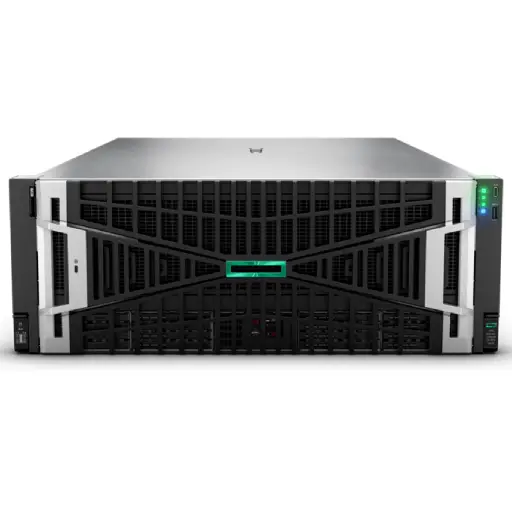
The HPE ProLiant DL380A Gen12 represents a paradigm shift in enterprise artificial intelligence computing, delivering unprecedented performance density in a 4U air-cooled form factor. Engineered specifically for organizations demanding serious GPU acceleration without the complexity of liquid cooling infrastructure, this powerhouse server combines dual Intel® Xeon® 6 processors with support for up to 10 double-width GPUs, each rated at 600W TDP. Whether you’re deploying large language models (LLMs), running complex deep learning training, performing AI inference at scale, or processing massive datasets for analytics, the DL380A Gen12 delivers the computational muscle and thermal efficiency your enterprise AI initiatives demand.
This server isn’t just about raw power—it’s about intelligent engineering. HPE has meticulously designed every aspect of the DL380A Gen12 to maximize GPU performance while maintaining operational stability in traditional data center environments. The system supports up to 4TB of DDR5 memory running at blazing 6400 MT/s speeds, ensuring that memory bandwidth never becomes the bottleneck for your AI workloads. With 32 DIMM slots, advanced PCIe Gen5 connectivity, and support for both SFF NVMe and EDSFF storage, this platform provides the flexibility and scalability that modern AI applications require.
What truly sets the HPE DL380A Gen12 apart is its comprehensive approach to enterprise readiness. From the Silicon Root of Trust security foundation to HPE iLO 7 remote management capabilities, every component is designed with enterprise standards in mind. The server integrates seamlessly with HPE GreenLake cloud services and HPE Compute Ops Management, enabling hybrid cloud deployments and streamlined lifecycle management. For organizations transitioning from traditional compute infrastructure to AI-focused architectures, the DL380A Gen12 offers the perfect balance of familiar enterprise-grade reliability and cutting-edge AI acceleration technology.

Why the HPE DL380A Gen12 Matters for Your AI Strategy
In today’s rapidly evolving AI landscape, infrastructure decisions can make or break your competitive advantage. The HPE DL380A Gen12 addresses the most critical challenges facing enterprise AI teams: achieving production-grade AI performance, maintaining cost efficiency, ensuring operational reliability, and preserving flexibility for future growth. Unlike specialized AI appliances that lock you into proprietary ecosystems, the DL380A Gen12 provides open, standards-based architecture that integrates with your existing data center infrastructure while delivering the GPU density and memory bandwidth that AI workloads demand.
The server’s support for NVIDIA’s latest GPU architectures—including the H200 NVL, H100 NVL, L40S, and RTX PRO 6000 Server Edition—means you’re investing in a platform that can scale with the AI industry’s rapid innovation cycle. The 4-way NVLink Bridge support enables direct GPU-to-GPU communication at up to 900 GB/s, dramatically accelerating training performance for models that require multi-GPU parallelism. For inference workloads, the platform’s ability to host up to 10 double-width GPUs (or 16 single-width accelerators) provides exceptional throughput density, maximizing your return on rack space and power infrastructure.
Organizations choosing the HPE DL380A Gen12 benefit from HPE’s decades of enterprise server expertise. The server includes three independent power domains with dedicated GPU power supplies configured in 2+1 redundancy, ensuring continuous operation even during power supply failures. The advanced cooling architecture features 4 dual-rotor and 8 single-rotor hot-plug fans specifically engineered to deliver optimal airflow across GPU arrays, maintaining thermal efficiency even under sustained 600W per-GPU loads. This level of engineering excellence translates directly to lower total cost of ownership, reduced downtime, and predictable performance characteristics that AI teams can rely on for production deployments.
Technical Specifications: Built for Maximum AI Performance
| Category | Specification | Details |
|---|---|---|
| Form Factor | 4U Rackmount | 6.88″ x 17.63″ x 31.60″ (H x W x D), Weight: 82.7-137.8 lbs |
| Processor | Dual Intel® Xeon® 6 | Up to 144 cores total, 250W TDP per CPU, up to 2.4 GHz base frequency |
| Processor Family | 6th Gen Intel Xeon Scalable | Performance cores optimized for AI workloads |
| Memory Capacity | Up to 4TB DDR5 | 2TB per processor, maximum configuration |
| Memory Slots | 32 DIMM Slots | 16 slots per CPU, full population supported |
| Memory Type | HPE DDR5 Smart Memory | 6400 MT/s, 5600 MT/s, 4800 MT/s speeds available |
| Memory Protection | Advanced ECC, Mirroring | Online spare, lockstep, HPE Fast Fault Tolerant Memory (ADDDC) |
| GPU Support | Up to 10 Double-Width GPUs | 600W TDP per GPU, 4-way NVLink Bridge compatible |
| GPU Configurations | Flexible Options | 10 DW, 8 DW, 4 DW, or 16 single-width configurations |
| Supported GPUs | NVIDIA H200 NVL (141GB) | NVIDIA H100 NVL (94GB), L40S (48GB), L20 (48GB), L4 (24GB), RTX PRO 6000 (96GB) |
| Storage Bays | 4 or 8 Bay Options | SFF NVMe or EDSFF E3.S configurations |
| Storage Capacity | Scalable NVMe | Up to 16 E3.S bays in maximum configuration |
| Boot Device | 2x M.2 NVMe | Hot-pluggable boot drives for OS redundancy |
| Expansion Slots | 6x PCIe Gen5 x16 | Full-height, full-length slots for maximum flexibility |
| OCP Slots | 2x OCP 3.0 Slots | For high-speed network adapters |
| Network Options | PCIe & OCP NICs | 100GbE, 200GbE, InfiniBand HDR support |
| Power Supplies | Up to 8 M-CRPS | 1500W, 2400W, 3200W Titanium options available |
| Power Redundancy | 1+1 System, 2+1 GPU | Independent power domains for system and GPUs |
| Cooling System | Hybrid Fan Design | 4 dual-rotor (92x56mm) + 8 single-rotor (40x28mm) hot-plug fans |
| Management | HPE iLO 7 Standard | Integrated Lights-Out with Intelligent Provisioning |
| Security Features | Silicon Root of Trust | TPM 2.0, Secure Boot, Intrusion Detection, Firmware Validation |
| Quantum Resistance | Post-Quantum Cryptography | 4096-bit RSA, quantum-resistant algorithms supported |
| Cloud Integration | HPE GreenLake Ready | HPE Compute Ops Management, OneView Advanced compatible |
| Operating Systems | Multi-OS Support | Linux (RHEL, Ubuntu, SLES), Windows Server, VMware ESXi |
| Warranty | 3/3/3 Server Warranty | 3 years parts, 3 years labor, 3 years on-site support |
Processor & Memory Architecture: Intel Xeon 6 Performance
Dual Intel® Xeon® 6 Processors
The heart of the HPE DL380A Gen12 lies in its dual-socket Intel Xeon 6 processor architecture, delivering up to 144 cores of compute power across both sockets. These 6th generation Intel Xeon Scalable processors represent a significant leap in performance-per-watt efficiency, featuring advanced Performance-cores (P-cores) optimized specifically for sustained parallel processing—the exact workload characteristic of AI training and inference operations.
Each processor supports 250W TDP, providing substantial power budget for high-frequency operation under continuous load. The processors feature Intel’s latest microarchitecture enhancements, including improved branch prediction, larger cache hierarchies, and optimized instruction pipelines for matrix operations commonly found in AI workloads. With base frequencies up to 2.4 GHz and boost capabilities extending beyond 3.0 GHz on select SKUs, these processors deliver exceptional single-thread performance for control plane operations while maintaining outstanding multi-thread throughput for data processing.
DDR5 Memory Subsystem
The memory architecture of the DL380A Gen12 is equally impressive, featuring 32 DDR5 DIMM slots arranged in 16 channels (8 per processor). This configuration supports up to 4TB of total memory with 2TB per processor, ensuring that even the largest AI models can remain memory-resident for optimal performance. The DDR5 technology delivers up to 6400 MT/s transfer rates at 1 DIMM per channel, with graceful degradation to 5200 MT/s at 2 DIMMs per channel—maintaining exceptional memory bandwidth even in fully-populated configurations.
HPE’s Smart Memory technology includes advanced error correction mechanisms beyond standard ECC, featuring memory mirroring, online spare, and HPE Fast Fault Tolerant Memory (ADDDC). These features provide enterprise-grade data integrity protection, critical for long-running AI training jobs where memory errors could corrupt models or cause hours of lost compute time. The lockstep (combined channel) functionality further enhances reliability for mission-critical deployments.
GPU Acceleration: Unparalleled AI Computing Density
10 Double-Width GPU Configuration
The HPE DL380A Gen12’s defining feature is its ability to host up to 10 double-width GPUs in a single 4U chassis—an achievement that sets new standards for AI compute density in air-cooled servers. Each GPU slot is engineered to support accelerators with up to 600W TDP, connected via PCIe Gen5 x16 interfaces that deliver up to 128 GB/s of bidirectional bandwidth per slot. This configuration enables deployment of the most powerful datacenter GPUs available, including NVIDIA’s H200 NVL and H100 NVL series.
The server’s GPU architecture supports multiple configuration options to match different workload requirements:
- 10 Double-Width (DW) Configuration: Maximum GPU density for inference farms and parallel training
- 8 Double-Width Configuration: Balanced approach with additional storage and expansion flexibility
- 4 Double-Width Configuration: Optimal for development environments and model fine-tuning
- 16 Single-Width Configuration: Maximum accelerator count for specialized inference workloads
NVIDIA GPU Ecosystem Support
The DL380A Gen12 is validated and certified for NVIDIA’s complete enterprise GPU portfolio:
NVIDIA H200 NVL (141GB HBM3e): The flagship accelerator for large language model training and inference, delivering 141GB of ultra-high-bandwidth memory and exceptional FP8 Tensor Core performance. Ideal for organizations working with 100B+ parameter models.
NVIDIA H100 NVL (94GB HBM3): Balanced performance for production AI workloads, offering 94GB memory capacity with excellent performance-per-watt efficiency. Perfect for mixed training and inference deployments.
NVIDIA L40S (48GB GDDR6): Multi-purpose accelerator combining AI compute with professional visualization capabilities, featuring 48GB memory and Ada Lovelace architecture. Excellent for virtual workstation deployments alongside AI inference.
NVIDIA RTX PRO 6000 Server Edition (96GB GDDR7): Latest Blackwell architecture with 96GB of ECC GDDR7 memory, FP4 Tensor Core capabilities, and 600W TDP. Optimized for production AI inference with professional-grade reliability.
NVIDIA L20 (48GB) and L4 (24GB): Cost-optimized accelerators for inference-focused deployments, delivering excellent performance-per-dollar for production serving.
4-Way NVLink Bridge Technology
For training workloads requiring tight GPU-to-GPU coupling, the DL380A Gen12 supports NVIDIA 4-way NVLink Bridge configurations. NVLink provides up to 900 GB/s of aggregate GPU interconnect bandwidth—dramatically faster than PCIe-only communication. This enables model parallelism strategies where a single large model is distributed across multiple GPUs, with parameter updates synchronized at near-memory bandwidth speeds. The result is near-linear scaling for distributed training workloads, maximizing the effectiveness of your GPU investment.
Storage & I/O Architecture
High-Performance NVMe Storage
The DL380A Gen12 offers flexible storage configurations optimized for AI data pipeline performance. The server supports both SFF (Small Form Factor) NVMe and EDSFF (Enterprise and Data Center SSD Form Factor) E3.S drives, with configurations ranging from 4 to 16 drive bays depending on GPU density requirements.
For AI workloads, storage performance is often as critical as compute capability. The server’s PCIe Gen5 NVMe connectivity delivers up to 16 GT/s per lane, enabling individual drives to achieve read speeds exceeding 14 GB/s. This throughput is essential for feeding training data to GPUs without creating pipeline stalls, directly translating to higher GPU utilization and shorter training times.
The dual M.2 NVMe boot device configuration provides hot-pluggable OS redundancy, ensuring that a boot drive failure doesn’t result in extended downtime. This feature is particularly valuable for production AI inference servers that require maximum uptime.
PCIe Gen5 Expansion Ecosystem
With 6 full-height, full-length PCIe Gen5 x16 slots, the DL380A Gen12 provides exceptional expansion flexibility beyond GPU acceleration. These slots support:
- High-speed networking: 100GbE, 200GbE Ethernet adapters, InfiniBand HDR/NDR adapters for AI cluster interconnects
- NVMe storage expansion: PCIe NVMe adapter cards for additional storage capacity
- Specialized accelerators: FPGA cards, video transcoding accelerators, cryptographic processors
- GPU interconnect fabrics: NVSwitch or similar GPU-to-GPU networking for scale-out AI clusters
The additional 2 OCP 3.0 slots provide dedicated space for network adapters without consuming general-purpose PCIe slots, ensuring that networking infrastructure doesn’t compete with GPU or storage expansion.
Cooling & Power: Engineered for Sustained Performance
Advanced Thermal Management
HPE’s engineering team designed the DL380A Gen12’s cooling system specifically to handle the thermal challenges of multi-GPU AI workloads. The hybrid fan architecture combines:
- 4 dual-rotor fans (92x56mm): High-volume airflow specifically directed across GPU arrays, each fan capable of moving substantial CFM to maintain GPU temperatures under full load
- 8 single-rotor fans (40x28mm): Targeted airflow for CPU heatsinks, memory DIMMs, and VRM cooling zones
This design ensures that CPU and memory subsystems receive adequate cooling even when positioned downstream of high-wattage GPUs. The fans are hot-pluggable, enabling maintenance without system shutdown—critical for production AI infrastructure.
The front-to-rear airflow design takes advantage of traditional data center cooling infrastructure, drawing cool aisle air across GPUs first (where thermal density is highest), then across CPUs and memory, before exhausting to the hot aisle. This approach eliminates the need for specialized liquid cooling infrastructure while maintaining component temperatures within optimal operating ranges.
Redundant Power Architecture
The power delivery system features three independent power domains:
- System Board Domain: Powered by dedicated supplies in 1+1 redundancy, covering CPUs, memory, storage, and management controllers
- GPU Domain 1: Supplies 1-4 with 2+1 redundancy for the first GPU bank
- GPU Domain 2: Supplies 5-8 with 2+1 redundancy for the second GPU bank
This architecture ensures that a power supply failure in one domain doesn’t impact other domains. GPU training jobs can continue running even during PSU replacement procedures, minimizing disruption to production workloads.
The server supports 1500W, 2400W, and 3200W Titanium-rated M-CRPS power supplies, with typical configurations using 2400W units for balanced efficiency and capacity. Titanium efficiency (94%+) reduces energy waste and heat generation, directly lowering operational costs in large-scale deployments.
Security & Management: Enterprise-Grade Foundation
HPE Silicon Root of Trust
Security begins at the hardware layer with HPE’s Silicon Root of Trust—a secure enclave embedded in the server’s management processor that validates firmware integrity before system boot. This technology protects against firmware-level attacks, supply chain tampering, and unauthorized firmware modifications. For AI deployments handling sensitive data or proprietary models, this foundation of trust is essential.
The security stack includes:
- TPM 2.0 (Trusted Platform Module): Hardware-based cryptographic key storage and platform attestation
- Secure Boot: Cryptographically validated boot process preventing rootkit and bootkit attacks
- Firmware Validation: Continuous monitoring of firmware integrity with automatic rollback on detected tampering
- Post-Quantum Cryptography: Support for 4096-bit RSA and quantum-resistant algorithms, future-proofing against emerging cryptographic threats
- Intrusion Detection: Physical chassis intrusion sensors with iLO logging and alerting
HPE iLO 7: Next-Generation Management
The included HPE Integrated Lights-Out 7 (iLO 7) management controller provides comprehensive out-of-band management capabilities through a modernized, intuitive interface. Key features include:
- Remote Console Access: HTML5-based virtual console with keyboard, video, mouse control from any browser
- Virtual Media: Mount ISO images and USB devices remotely for OS installation and updates
- Power Management: Granular power control including graceful shutdown, power cycling, and power capping
- Health Monitoring: Real-time telemetry for temperatures, fan speeds, power consumption, and component status
- Firmware Management: Integrated firmware repository with staged update capabilities and rollback protection
- Security Dashboard: Centralized view of security posture including certificate status, access logs, and configuration compliance
The detachable DC-MHS iLO module strengthens supply chain security by enabling organizations to verify iLO authenticity before deployment, addressing sophisticated supply chain attack vectors.
HPE Compute Ops Management Integration
For organizations managing multiple servers, the DL380A Gen12 integrates seamlessly with HPE Compute Ops Management—a cloud-native management platform providing:
- Fleet Management: Centralized monitoring and management of distributed server deployments
- Automated Updates: Intelligent firmware and driver updates with staged rollout and automatic validation
- Configuration Compliance: Policy-based configuration management ensuring consistency across infrastructure
- Predictive Analytics: Machine learning-driven health monitoring with predictive failure detection
- Security Posture: Continuous security compliance monitoring with automated remediation
Performance Benchmarks: Real-World AI Capabilities
vLLM Inference Performance
Recent testing by StorageReview.com evaluated a DL380A Gen12 configured with dual Intel Xeon 6527P processors and 4x NVIDIA RTX PRO 6000 GPUs using the vLLM inference engine—the industry-standard framework for LLM serving.
Llama-2-70B-Chat (Dense Model):
- Single-user latency: 30.18ms time-per-output-token (TPOT), 32.89 tokens/sec
- Multi-user throughput (BS=32): 741.62 tokens/sec aggregate, 8.00 tokens/sec per user
Llama-3.2-90B-Vision-Instruct (Dense Model):
- Single-user latency: 38.27ms TPOT, 20.59 tokens/sec
- Maximum throughput (BS=128): 1372.21 tokens/sec aggregate, maintaining sub-125ms TPOT
GPT-OSS-120B (NVFP4 Quantized Model):
- Ultra-low latency: 5.46ms TPOT at BS=1, 176.09 tokens/sec per user
- Maximum throughput (BS=64): 4015.77 tokens/sec aggregate with 14.78ms TPOT
These results demonstrate exceptional inference performance across model scales and quantization approaches, with the NVFP4 microscaling format leveraging RTX PRO 6000’s Tensor Core architecture for 4-bit inference with minimal quality loss.
General Compute Performance (Phoronix)
Beyond AI workloads, the DL380A Gen12 delivers outstanding general-purpose compute performance:
| Benchmark | Result | Workload Type |
|---|---|---|
| STREAM Memory Bandwidth | 542.7 GB/s | Memory-intensive data processing |
| 7-Zip Compression | 304,907 MIPS | Multi-threaded compression |
| Linux Kernel Compile | 316 seconds | Parallel compilation (allmodconfig) |
| Apache Web Server | 94,348 req/sec | Web serving throughput |
| OpenSSL Verification | 803 billion ops/sec | Cryptographic operations |
The 542 GB/s memory bandwidth result is particularly noteworthy, demonstrating that the dual-socket architecture provides ample memory throughput to prevent GPU pipeline stalls during AI inference operations where model parameters must be continuously streamed from system memory.
Use Cases: Where the DL380A Gen12 Excels
Large Language Model (LLM) Inference
Deploy production-scale LLM serving infrastructure for chatbots, content generation, code completion, and semantic search. The 10-GPU configuration supports multiple model instances or multi-model serving, maximizing hardware utilization. With up to 10x H200 NVL GPUs (1.41TB aggregate GPU memory), host the largest language models entirely in GPU memory for minimum-latency inference.
AI Model Training & Fine-Tuning
Accelerate training of computer vision models, natural language processing models, and recommendation systems. The 4-way NVLink support enables efficient model parallelism for models exceeding single-GPU memory capacity. For fine-tuning foundation models on proprietary data, the balanced CPU/GPU/memory architecture provides the flexibility to handle diverse preprocessing and data augmentation pipelines.
High-Performance Computing (HPC)
Beyond AI, the DL380A Gen12 excels at traditional HPC workloads: computational fluid dynamics (CFD), molecular dynamics simulations, weather modeling, and seismic processing. The high memory bandwidth and GPU compute density make it ideal for simulation workloads requiring both precision and throughput.
Virtual Desktop Infrastructure (VDI)
With NVIDIA L40S or RTX PRO 6000 GPUs, deploy virtual workstations for CAD/CAM, digital content creation, engineering simulation, and medical imaging. Each server can host dozens to hundreds of virtual desktops depending on GPU partitioning configuration, with GPU resources dynamically allocated based on user demand.
Edge AI & Inference Farms
For organizations deploying AI at scale—whether for autonomous systems, smart manufacturing, retail analytics, or telecommunications network optimization—the DL380A Gen12 provides the density and efficiency to build cost-effective inference infrastructure. The air-cooled design fits standard racks without specialized cooling infrastructure, simplifying edge data center deployments.
Comparison: DL380A Gen12 vs. Competing Platforms
| Feature | HPE DL380A Gen12 | Dell PowerEdge XE9680 | Supermicro SYS-421GE-TNHR |
|---|---|---|---|
| Form Factor | 4U Air-Cooled | 5U Air-Cooled | 4U Air-Cooled |
| Max GPUs (DW) | 10 | 8 | 8 |
| Processor | Intel Xeon 6 (144 cores) | Intel Xeon Scalable (120 cores) | Intel Xeon Scalable (128 cores) |
| Max Memory | 4TB DDR5-6400 | 4TB DDR5-4800 | 4TB DDR5-4800 |
| PCIe Generation | Gen5 | Gen5 | Gen5 |
| NVLink Support | 4-way | 4-way | Limited |
| Management | iLO 7 | iDRAC 9 | IPMI 2.0 |
| Security | Silicon Root of Trust | Secured Component Verification | Standard UEFI |
| Cloud Integration | HPE GreenLake Native | APEX Available | Third-party |
| Power Redundancy | 3-domain architecture | 2-domain architecture | Standard redundancy |
Key Advantages of DL380A Gen12:
- Highest GPU density: 10 DW GPUs vs. 8 in competing platforms
- Faster memory: DDR5-6400 support vs. DDR5-4800 in competitors
- More processor cores: Up to 144 vs. 120-128 in competing solutions
- Advanced management: iLO 7 with cloud-native integration vs. traditional BMC approaches
- Security leadership: Silicon Root of Trust and post-quantum cryptography support
Deployment & Configuration Options
Configuration Flexibility
HPE offers the DL380A Gen12 through multiple acquisition models:
Custom Build-to-Order: Work with HPE sales teams to specify exact CPU, memory, GPU, storage, and networking configurations matching your workload requirements. Ideal for organizations with specific performance targets or integration requirements.
Preconfigured Solutions: HPE provides validated reference configurations for common AI workloads, including LLM inference, computer vision training, and HPC simulation. These configurations are performance-tested and documented, reducing deployment risk.
HPE GreenLake: Consume the DL380A Gen12 as-a-service through HPE GreenLake cloud services, with usage-based billing, automated lifecycle management, and guaranteed capacity planning. This model shifts infrastructure from capital expense to operational expense while maintaining on-premises deployment for data sovereignty.
Operating System Support
The DL380A Gen12 is certified for enterprise operating systems:
- Linux Distributions: RHEL 8.x/9.x, Ubuntu 20.04/22.04 LTS, SLES 15 SP3+, Rocky Linux, AlmaLinux
- Windows Server: 2019, 2022 (Standard and Datacenter editions)
- Virtualization: VMware ESXi 7.0/8.0, Proxmox VE, KVM/QEMU
All configurations include optimized drivers for NVIDIA GPUs and validated against NVIDIA NGC container runtime for AI frameworks (PyTorch, TensorFlow, JAX, etc.).
Total Cost of Ownership (TCO) Analysis
Capital Efficiency
The DL380A Gen12’s 10-GPU capacity in 4U translates to 25% better rack space efficiency compared to 8-GPU competitors. In a 42U rack, you can deploy 10 servers (100 GPUs) versus 8 servers (64 GPUs) with competing platforms—a 56% increase in GPU density per rack.
For colocation or cloud infrastructure, where rack space costs $1,000-3,000/month per rack, this density advantage delivers $12,000-36,000 in annual cost avoidance per rack.
Operational Efficiency
Power Efficiency: Titanium-rated power supplies (94% efficiency) reduce energy waste compared to Platinum-rated competitors (92% efficiency). On a fully-loaded DL380A Gen12 drawing 10kW, the 2% efficiency improvement saves approximately 200W continuously—4.8 MWh annually. At $0.12/kWh average commercial rate, that’s $576/year per server in reduced electricity costs.
Cooling Efficiency: Air-cooled design eliminates liquid cooling infrastructure costs ($50,000-200,000 per rack for liquid cooling deployment) and associated maintenance overhead (coolant replacement, leak detection, specialized technicians).
Management Efficiency: HPE iLO 7 and Compute Ops Management reduce administrative overhead. Automated firmware updates, predictive failure detection, and policy-based configuration management can reduce operational staff requirements by 30-40% compared to manual management approaches.
Longevity & Upgrade Path
PCIe Gen5 Future-Proofing: As next-generation GPUs and storage devices leverage PCIe Gen5 bandwidth, the DL380A Gen12 remains relevant for 5-7 year deployment cycles. Competitors still on PCIe Gen4 will face obsolescence as bandwidth-hungry accelerators arrive.
Memory Scalability: DDR5 support with 4TB capacity ensures headroom for growing model sizes and dataset requirements without forced hardware refresh cycles.
Intel Xeon 6 Roadmap: The platform supports current and future Intel Xeon 6 processors, enabling CPU upgrades as Intel releases higher core-count SKUs without motherboard replacement.
Why Purchase from ITCT Shop
ITCT Shop (itctshop.com) is your trusted partner for enterprise AI hardware solutions, offering:
Competitive Pricing & Financing
- Direct HPE Partnership: Access to competitive pricing through authorized distribution channels
- Volume Discounts: Scalable pricing for multi-server deployments
- Flexible Payment Terms: Leasing, rental, and purchase options to match your financial requirements
- Trade-In Programs: Credit for retiring legacy infrastructure when upgrading to DL380A Gen12
Global Delivery & Support
- Worldwide Shipping: Professional delivery to all major markets with customs clearance support
- White-Glove Installation: Optional rack-and-stack services with physical installation and cable management
- Extended Warranties: Optional extensions beyond standard 3/3/3 warranty to 4 or 5 years
- 24/7 Technical Support: Access to experienced AI infrastructure specialists for deployment planning and troubleshooting
Custom Configuration Expertise
- Workload Consultation: Work with ITCT’s AI infrastructure specialists to optimize configuration for your specific workloads
- Pre-Deployment Testing: Optional performance validation and burn-in testing before shipment
- Integration Services: Network configuration, GPU cluster setup, and storage integration services
Related Products at ITCT Shop
Explore complementary AI infrastructure at ITCT Shop:
- NVIDIA H200 Tensor Core GPU: Flagship 141GB HBM3e accelerator for maximum AI performance
- NVIDIA L40S GPU: Versatile accelerator for mixed AI and visualization workloads
- NVIDIA H100 NVL GPU: 94GB memory for balanced price-performance
- HGX H100 8-GPU Server: Ultimate 8U AI training platform
- AI Edge Computing Devices: Compact inference appliances for distributed deployments
- AI Networking Solutions: High-speed interconnects for GPU clusters
- AI Storage Systems: High-throughput storage for training datasets
Visit ITCT Shop’s HPE Server Collection for the complete range of HPE AI infrastructure.
Frequently Asked Questions (FAQ)
Q1: What is the main difference between the DL380A Gen12 and standard DL380 Gen12?
A: The DL380A Gen12 is specifically optimized for AI workloads with support for up to 10 double-width GPUs (vs. 2-3 in standard DL380), dedicated GPU power domains, enhanced cooling for high-wattage accelerators, and validation for NVIDIA’s complete datacenter GPU portfolio. The “A” designation indicates “AI-optimized” architecture.
Q2: Can I start with fewer GPUs and expand later?
A: Yes, absolutely. The DL380A Gen12 supports flexible GPU configurations (4, 8, or 10 double-width GPUs). You can deploy with your initial requirements and add GPUs as your workload demands grow, though GPU additions may require power supply upgrades depending on your starting configuration.
Q3: Does the server require liquid cooling for 10x 600W GPUs?
A: No, the DL380A Gen12 is engineered as an air-cooled solution and does not require liquid cooling infrastructure. HPE’s advanced thermal design with dual-rotor fans and optimized airflow maintains GPU temperatures within operational specifications even with all 10 GPU slots populated with 600W accelerators.
Q4: What network bandwidth do I need for multi-server AI clusters?
A: For distributed training across multiple DL380A Gen12 servers, we recommend 100GbE or 200GbE Ethernet (using RoCE v2 protocol) or InfiniBand HDR/NDR for optimal GPU-to-GPU communication across servers. The server’s OCP slots support these high-speed network adapters. For single-server inference deployments, standard 25GbE/40GbE is typically sufficient.
Q5: How does memory capacity affect AI workload performance?
A: Memory capacity impacts both model capacity and batch size capability. For inference, insufficient system memory forces models to page to storage, creating severe latency penalties. For training, memory limits batch sizes and data prefetching capacity. We recommend 1TB minimum for production AI deployments, with 2-4TB for large model training or high-throughput inference farms.
Q6: Is the DL380A Gen12 compatible with containerized AI frameworks?
A: Yes, the server is fully validated with NVIDIA NGC containers, Docker, Kubernetes, and Red Hat OpenShift. This enables deployment of containerized AI frameworks (PyTorch, TensorFlow, JAX) with NVIDIA’s optimized runtimes. HPE provides reference architectures for AI-on-Kubernetes deployments using the DL380A Gen12.
Q7: What is the typical lead time for custom configurations?
A: Standard configurations through ITCT Shop ship within 2-3 weeks. Custom build-to-order configurations with specific CPUs, memory, or GPUs typically require 4-6 weeks depending on component availability. Contact ITCT Shop’s sales team for current lead times on your specific configuration.
Q8: Can I mix different GPU models in the same server?
A: While technically possible, HPE does not recommend mixing different GPU models within a single server due to power supply compatibility, driver considerations, and workload scheduling complexity. For environments requiring multiple GPU types, deploy separate servers configured for each GPU model.
Q9: What is HPE iLO 7 and why is it important?
A: HPE iLO 7 is the 7th generation Integrated Lights-Out management controller, providing out-of-band server management independent of the host OS. It enables remote console access, virtual media mounting, hardware health monitoring, firmware updates, and security management. For AI infrastructure often deployed in colocation or remote data centers, iLO enables full remote administration without requiring physical access.
Q10: How does the DL380A Gen12 handle GPU failures?
A: GPU failures are isolated to the failed accelerator—remaining GPUs continue operating normally. The hot-plug GPU design allows replacement of failed GPUs without powering down the server (depending on GPU model). HPE iLO 7 detects GPU failures, logs events, and triggers support case creation if under warranty or support contract.
Q11: What storage performance do AI workloads require?
A: AI training workloads benefit significantly from high-speed storage. We recommend PCIe Gen4/Gen5 NVMe SSDs with at least 3-5 GB/s sustained read performance per GPU. The DL380A Gen12’s support for up to 16 E3.S NVMe drives enables building high-throughput storage pools delivering 50-100 GB/s aggregate read bandwidth—sufficient to keep GPUs fed with training data without pipeline stalls.
Q12: Does ITCT Shop provide installation and configuration services?
A: Yes, ITCT Shop offers comprehensive deployment services including physical installation, network configuration, GPU driver installation, AI framework setup, and performance validation. These services ensure your DL380A Gen12 is production-ready upon delivery. Contact sales for deployment service quotes.
Last update at December 2025
Reviews
There are no reviews yet.