

Description
Next-Generation Data Center Switching Infrastructure for Modern Computing Workloads
Executive Summary
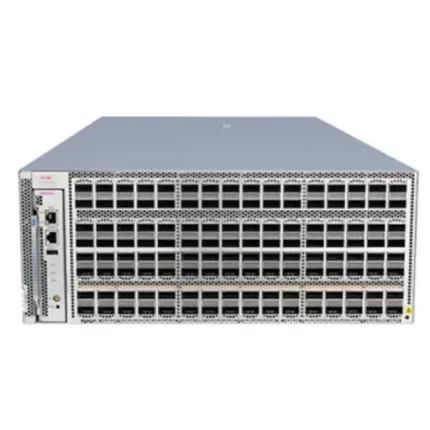
The H3C S9855 Series represents a breakthrough in high-performance data center networking, specifically engineered to meet the demanding requirements of artificial intelligence and high-performance computing environments. These next-generation Ethernet switches deliver exceptional capabilities with support for up to 32×400G QSFP-DD ports and comprehensive RoCEv2 (RDMA over Converged Ethernet version 2) implementation, providing the zero packet loss, ultra-low latency, and high throughput connectivity that modern computational workloads absolutely require.
Built upon H3C’s innovative Intelligent Lossless Network technology, the S9855 series integrates hardware-accelerated Priority-based Flow Control (PFC), Explicit Congestion Notification (ECN), and advanced buffer management systems to create a unified, lossless networking fabric. This sophisticated architecture accelerates AI model training processes, enhances HPC simulation performance, and optimizes distributed storage operations, making it an ideal solution for organizations seeking to maximize their computational infrastructure investments.
Product Overview & Model Variants
The S9855 series offers multiple configurations to address diverse deployment scenarios and workload requirements. Each model has been carefully designed to provide optimal performance characteristics for specific use cases within modern data center architectures.
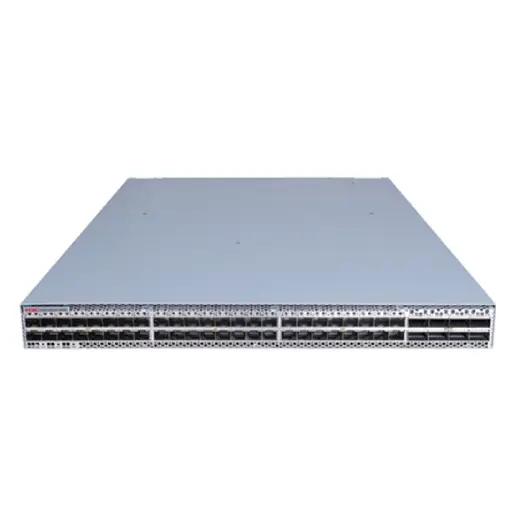
The S9855-48CD8D features 48×100G DSFP ports combined with 8×400G QSFP-DD uplink ports, making it an excellent choice for high-density server connectivity in top-of-rack deployments. This configuration provides exceptional flexibility for organizations transitioning from 100G to 400G infrastructure while maintaining backward compatibility.
The S9855-24B8D offers 24×200G QSFP56 ports alongside 8×400G QSFP-DD ports, delivering balanced performance for environments requiring higher per-port bandwidth without the density of the 48-port model. This variant excels in scenarios where moderate server counts require substantial bandwidth per connection.
The S9855-40B provides 40×200G QSFP56 ports in a streamlined configuration optimized for GPU server connectivity and AI training clusters. This model eliminates the complexity of mixed port speeds while delivering consistent 200G performance across all connections.
The flagship S9855-32D delivers 32×400G QSFP-DD ports plus 2×SFP/SFP+ management interfaces, representing the ultimate in switching capacity with 25.6 Tbps throughput and sub-microsecond latency. This model serves as the ideal spine switch in large-scale fabric architectures.
Technical Specifications Overview
| Model | Port Configuration | Switching Capacity | Latency | Power Consumption | Weight |
|---|---|---|---|---|---|
| S9855-48CD8D | 48×100G DSFP + 8×400G QSFP-DD | 16 Tbps | <1.2 µs | 125-748W | ≤12.2 kg |
| S9855-24B8D | 24×200G QSFP56 + 8×400G QSFP-DD | 16 Tbps | <1.2 µs | 238-748W | ≤12.2 kg |
| S9855-40B | 40×200G QSFP56 | 16 Tbps | <1.2 µs | 713W max | ≤12.2 kg |
| S9855-32D | 32×400G QSFP-DD + 2×SFP/SFP+ | 25.6 Tbps | <1 µs | 1265W max | ≤15 kg |
Detailed Hardware Architecture
The S9855 series incorporates enterprise-grade hardware components designed for sustained high-performance operation in demanding data center environments. At the heart of each switch lies a powerful 2.9 GHz quad-core processor that manages control plane operations, protocol processing, and system management functions with exceptional efficiency.
Memory subsystems have been carefully engineered to support the intensive requirements of modern networking protocols and large-scale deployments. Each switch includes 16 GB of DRAM for operational data structures and 240 GB of flash storage for system software, configuration files, and logging capabilities. The generous buffer allocation—82 MB for most models and 132 MB for the flagship S9855-32D—ensures smooth traffic flow even during burst conditions and prevents packet loss during congestion events.
The forwarding architecture delivers impressive packet processing capabilities, with forwarding rates reaching 2,680 Mpps for standard models and an exceptional 5,346.7 Mpps for the S9855-32D. This processing power ensures line-rate performance across all ports simultaneously, eliminating bottlenecks that could impact application performance.
Network intelligence features include support for 144K MAC address entries, accommodating large-scale virtualized environments and container deployments. The ARP table capacity of 128K entries provides ample headroom for dynamic address resolution in complex network topologies. VLAN support extends to the full 4,096 VLAN range, enabling comprehensive network segmentation and isolation strategies. Access control capabilities include 18,000 ACL entries, providing granular traffic filtering and security policy enforcement.
Environmental Specifications and Reliability
The S9855 series has been engineered to operate reliably within standard data center environmental parameters, supporting operating temperatures from 0°C to 40°C and humidity levels from 5% to 95% non-condensing. This broad operating range ensures consistent performance across diverse deployment scenarios and geographic locations.
Reliability metrics demonstrate the exceptional build quality and component selection that characterize the S9855 series. Mean Time Between Failures (MTBF) ranges from 34.9 to 56.07 years across the product line, indicating extraordinary long-term reliability. When maintenance is required, the Mean Time To Repair (MTTR) of less than 0.5 hours minimizes service disruption and ensures rapid restoration of full operational capacity.
Redundancy features include dual power supply slots in standard S9855 models and quad power supply support in S9825 variants, providing protection against power supply failures. The cooling architecture incorporates six fan modules in a 5+1 redundant configuration, ensuring continuous operation even in the event of individual fan failures. Physical dimensions of 44×440×660 mm for most models facilitate standard rack mounting, while the weight of ≤12.2 kg for most variants and ≤15 kg for the S9855-32D simplifies installation and maintenance procedures.
RoCEv2 Implementation & Intelligent Lossless Networking
The H3C S9855 series distinguishes itself through comprehensive implementation of RoCEv2 protocols and H3C’s proprietary Intelligent Lossless Network technology. This sophisticated approach creates a network environment that delivers zero packet loss, ultra-low latency, and sustained high throughput—the critical performance characteristics required by modern AI, distributed storage, and HPC applications.
Traditional Ethernet networks employ a “best effort” delivery model that accepts occasional packet loss as an inevitable consequence of network congestion. While this approach works adequately for many applications, it creates severe performance problems for workloads that depend on reliable, in-order delivery of large data volumes. AI model training, for example, requires synchronization of gradient updates across multiple GPU nodes. Even a single lost packet can stall the entire training process while the missing data is retransmitted, resulting in GPU idle time and wasted computational resources.
H3C’s Intelligent Lossless Network technology addresses these challenges through a multi-layered approach combining hardware acceleration, intelligent algorithms, and advanced network control methods. The foundation of this technology rests on hardware-accelerated Priority-based Flow Control (PFC) and Explicit Congestion Notification (ECN), working in concert to prevent packet loss before it occurs while maintaining optimal network utilization.
Priority-based Flow Control (PFC) Deep Dive
Priority-based Flow Control represents a fundamental departure from traditional flow control mechanisms by enabling selective pause functionality on a per-traffic-class basis. Rather than halting all traffic when congestion occurs, PFC allows the network to pause only the affected traffic classes while permitting other traffic to continue flowing unimpeded. This selective approach prevents congestion in one application from impacting unrelated traffic flows.
The S9855 series implements PFC with carefully tuned default thresholds optimized for different link speeds. For 100GE connections, the default threshold of 491 cells provides appropriate headroom for typical burst patterns. 200GE links use a 750-cell threshold, while 400GE connections employ a 1000-cell threshold. These defaults have been established through extensive testing and real-world deployment experience, though they can be adjusted to accommodate specific workload characteristics.
H3C recommends configuring the PFC trigger threshold at 5% of buffer capacity rather than the default 3% for most AI and HPC deployments. This adjustment provides additional buffer headroom before triggering pause frames, reducing the frequency of pause events and improving overall network efficiency. The precise threshold values should be determined through careful analysis of application traffic patterns and buffer utilization metrics.
A critical feature of the S9855 PFC implementation is the PFC deadlock watchdog mechanism. PFC deadlocks can occur when circular dependencies develop in pause frame propagation, potentially causing permanent traffic stalls. The watchdog actively monitors for deadlock conditions and automatically implements recovery procedures when detected, ensuring continuous network operation even in complex failure scenarios.
The S9855 series supports PFC on all 802.1p priority levels except 0, 6, and 7, which are reserved for control plane traffic and network management functions. This approach ensures that critical management and control protocols remain operational even during severe congestion events affecting user data traffic.
Explicit Congestion Notification (ECN) Implementation
While PFC provides a reactive mechanism to prevent packet loss, Explicit Congestion Notification operates proactively by marking packets before buffer overflow occurs. This forward-looking approach enables receiving systems to reduce their transmission rates before congestion becomes severe enough to trigger PFC pause frames, maintaining higher overall network efficiency.
The S9855 series implements ECN with enhanced capabilities including AI ECN and IPCC (In-band Packet Congestion Control) algorithms. These advanced features use machine learning techniques to predict congestion patterns and adjust marking thresholds dynamically, optimizing network behavior for varying traffic conditions without manual intervention.
ECN operates in two directions: the NP (notification point) direction where congestion is detected and packets are marked, and the RP (response point) direction where marked packets trigger transmission rate adjustments. The S9855 series supports ECN in both directions, enabling comprehensive congestion management across the entire network fabric.
Configuration best practices require that ECN thresholds be set higher than PFC trigger thresholds to ensure proper interaction between the two mechanisms. ECN should activate first, allowing rate-based congestion control to prevent buffer buildup. If ECN proves insufficient to control congestion, PFC serves as a backup mechanism to prevent packet loss. This layered approach maximizes network utilization while maintaining the zero-loss guarantee required by RDMA protocols.
Best Practices for RoCEv2 Deployment
Successful RoCEv2 deployment requires careful attention to configuration details across the entire network path, from server network interface cards through access switches, aggregation layers, and core infrastructure. Inconsistent configuration at any point can compromise the lossless guarantee and degrade application performance.
Network configuration begins with establishing consistent priority handling across all devices. Every interface in the RDMA path must be configured to trust either 802.1p or DSCP priority markings—mixing trust modes along the path will cause priority remapping and potentially violate QoS guarantees. Priority mapping tables must be identical across all devices to ensure that traffic maintains its designated priority class as it traverses the network.
Data Center Bridging Exchange (DCBX) protocol should be enabled on all server-facing interfaces to facilitate automatic negotiation of PFC, ETS (Enhanced Transmission Selection), and other DCB parameters between switches and network interface cards. This automation reduces configuration errors and ensures consistent settings across large server populations.

Enhanced Transmission Selection configuration provides bandwidth guarantees for different traffic classes, preventing any single class from monopolizing link capacity during congestion. ETS should be configured to allocate appropriate bandwidth percentages based on application requirements and expected traffic patterns. A common configuration reserves 50% of bandwidth for RDMA traffic, 30% for storage protocols, and 20% for management and control plane traffic, though these allocations should be adjusted based on actual workload characteristics.
Server-side configuration focuses on network interface card settings that complement switch-side configurations. PFC must be enabled for all RoCE traffic queues, typically configured through vendor-specific tools such as Mellanx’s mlnx_qos utility. ECN should be enabled in both NP and RP directions to support proactive congestion management. NICs must be configured to trust DSCP priorities to ensure proper interaction with switch QoS policies.
Modern high-performance NICs such as the Mellanox ConnectX-6 Lx provide hardware acceleration for RDMA protocols and sophisticated traffic management capabilities. These advanced features significantly reduce CPU overhead for network operations while delivering the consistent low latency required by demanding applications. When selecting NICs for RoCEv2 deployments, organizations should prioritize models with comprehensive RDMA offload capabilities and proven compatibility with their chosen switch platforms.
AI & HPC Workload Optimization
The S9855 series has been specifically optimized to address the unique networking requirements of artificial intelligence and high-performance computing workloads, which differ substantially from traditional enterprise applications in their traffic patterns, latency sensitivity, and throughput requirements.
AI Model Training Acceleration
Modern AI model training employs distributed computing techniques that partition large neural networks across multiple GPU nodes, enabling training of models with billions or even trillions of parameters. During training, each GPU computes gradients for its portion of the model, and these gradients must be synchronized across all participating nodes through a process called all-reduce. This synchronization operation generates massive east-west traffic flows that can easily saturate network links if not properly managed.
The lossless networking capabilities of the S9855 series eliminate packet loss during gradient synchronization operations, ensuring that all-reduce operations complete as quickly as possible without retransmission delays. Even a single lost packet during synchronization can stall all participating GPUs while the missing data is retransmitted, resulting in GPU idle time that directly translates to wasted computational resources and extended training time.
Beyond eliminating packet loss, the ultra-low latency characteristics of the S9855 series minimize synchronization overhead, allowing GPUs to spend more time computing and less time waiting for network operations to complete. For large-scale training jobs involving hundreds or thousands of GPUs, these latency reductions compound across multiple synchronization rounds, potentially reducing total training time by significant percentages.
The high throughput capabilities of the S9855 series ensure that network bandwidth doesn’t become a bottleneck limiting GPU utilization. Modern GPUs like NVIDIA’s A100 and H100 can generate hundreds of gigabits per second of network traffic during training operations. The 200G and 400G port options available in the S9855 series provide sufficient bandwidth to keep pace with these high-performance accelerators, preventing network congestion from limiting training throughput.
HPC Simulation Enhancement
High-performance computing simulations employ tightly coupled parallel computing techniques where multiple compute nodes work together to solve complex problems in fields such as computational fluid dynamics, molecular dynamics, weather modeling, and financial risk analysis. These applications generate frequent, small message exchanges between compute nodes, making them extremely sensitive to network latency.
The sub-microsecond latency delivered by the S9855 series minimizes communication overhead in HPC applications, allowing compute nodes to spend more time performing calculations and less time waiting for data from neighboring nodes. For applications where communication patterns involve many small messages, even microseconds of additional latency per message can accumulate into substantial performance impacts across millions of message exchanges.
RDMA operations enabled by the S9855 series’ RoCEv2 implementation provide direct memory access between compute nodes without CPU involvement, further reducing latency and eliminating CPU overhead for network operations. This capability is particularly valuable for memory-intensive applications that require frequent access to data stored on remote nodes, as it allows the CPU to remain focused on computational tasks rather than managing network transfers.
The lossless characteristics of the S9855 series prove especially important for HPC applications that employ collective communication operations such as barriers, broadcasts, and reductions. These operations require coordination across all participating nodes, and packet loss affecting any participant can stall the entire operation while retransmissions occur. By guaranteeing zero packet loss, the S9855 series ensures that collective operations complete with predictable, minimal latency.
Distributed Storage Optimization
Modern distributed storage systems built on NVMe-over-Fabric (NVMe-oF) and distributed file systems such as Lustre, GPFS, and Ceph depend critically on network performance to deliver the high IOPS and throughput that applications expect from local NVMe storage. The S9855 series provides the lossless, high-throughput connectivity required to build storage networks that approach the performance characteristics of directly attached storage.
NVMe-oF protocols leverage RDMA to provide remote access to NVMe storage devices with latency and throughput characteristics approaching local PCIe-attached storage. The lossless networking capabilities of the S9855 series ensure that NVMe-oF operations complete without retransmissions, maintaining the low, predictable latency that NVMe protocols require. Even brief periods of packet loss can cause NVMe-oF timeouts and error conditions that impact application performance and stability.
Distributed file systems generate complex traffic patterns combining metadata operations, data transfers, and cache coherency protocols. The large buffer capacity of the S9855 series—82 MB for most models and 132 MB for the flagship variant—accommodates the burst traffic characteristics typical of distributed storage workloads without triggering congestion events. This buffer capacity proves particularly valuable during checkpoint operations when multiple compute nodes simultaneously write large datasets to storage, creating temporary traffic spikes that smaller buffers might not accommodate without packet loss.
The integration of H3C’s iNOF (Intelligent Network Operating Framework) technology with the S9855 series provides advanced visibility into storage traffic patterns and performance metrics. This visibility enables storage administrators to identify performance bottlenecks, optimize data placement strategies, and ensure that storage infrastructure delivers consistent, predictable performance to applications.
Performance Impact Analysis
The performance benefits delivered by the S9855 series’ lossless networking capabilities translate directly into measurable improvements in application performance and infrastructure efficiency. Organizations deploying the S9855 series for AI training workloads typically observe 30-50% reductions in training time compared to traditional Ethernet networks, depending on model architecture and training methodology. These improvements result from eliminating GPU idle time caused by packet loss and reducing synchronization overhead through ultra-low latency RDMA operations.
HPC applications demonstrate similar performance gains, with simulation runtime reductions of 20-40% commonly observed after migrating to lossless networking infrastructure. The magnitude of improvement depends on application communication patterns, with tightly coupled applications showing larger benefits than embarrassingly parallel workloads that require minimal inter-node communication.
Distributed storage systems benefit from both improved throughput and reduced latency variability. Organizations typically observe 2-3x improvements in storage IOPS and 40-60% reductions in tail latency after deploying lossless networking infrastructure. These improvements enable storage systems to support more demanding workloads and deliver more consistent performance to applications.
Competitive Analysis & Market Positioning
The H3C S9855 series competes in a market segment dominated by established networking vendors including Cisco, Arista, and Juniper, each offering high-performance switches targeting AI and HPC deployments. Understanding the competitive landscape helps organizations make informed decisions about networking infrastructure investments.
Comparative Feature Analysis
| Feature | H3C S9855-48CD8D | Arista 7280R3 | Cisco Nexus 9300 | Dell S5224F-ON |
|---|---|---|---|---|
| Port Configuration | 48×100GE + 8×400GE | 48×100GE + 4×400GE | 48×100GE + 6×400GE | 48×100GE |
| Switching Capacity | 16 Tbps | 6.4 Tbps | 7.2 Tbps | 3.2 Tbps |
| Latency | <1.2 µs | Sub-microsecond | Sub-microsecond | Sub-microsecond |
| RoCEv2 Support | Full PFC + ECN + AI ECN | Standard | Standard | Limited |
| Buffer Size | 82 MB | 32 GB (shared) | 128 MB | 12 MB |
| Price Positioning | Competitive | Premium | Premium | Budget |
Key Competitive Advantages
The S9855 series distinguishes itself through several key advantages that provide compelling value propositions for organizations building or upgrading AI and HPC infrastructure. Port density represents a significant differentiator, with the S9855 series offering more 400G uplink ports than most competing solutions. This additional uplink capacity reduces oversubscription ratios and provides greater bandwidth for north-south traffic flows, particularly important in architectures where compute nodes access centralized storage or external data sources.
RoCEv2 implementation in the S9855 series goes beyond basic PFC and ECN support to include H3C’s proprietary AI ECN algorithms and comprehensive lossless networking features. These advanced capabilities provide superior congestion management and more predictable performance compared to standard implementations found in competing products. The integration of RDMA monitoring and analytics capabilities directly into the switch operating system eliminates the need for separate monitoring tools and provides unprecedented visibility into RDMA traffic patterns and performance metrics.
Price-performance positioning represents another significant advantage of the S9855 series. While offering feature sets and performance characteristics comparable to premium offerings from Cisco and Arista, H3C’s competitive pricing delivers substantially better value for organizations with budget constraints or large-scale deployment requirements. This pricing advantage becomes particularly significant in large deployments where equipment costs represent a substantial portion of total project budgets.
Reliability metrics demonstrate H3C’s commitment to enterprise-grade quality, with MTBF ratings ranging from 34.9 to 56.07 years across the product line. These exceptional reliability figures exceed many competing products and provide confidence in long-term operational stability. The combination of redundant power supplies, redundant cooling, and robust hardware design minimizes the risk of unplanned downtime that could impact critical workloads.
Global presence and ecosystem support provide additional competitive advantages. H3C’s 4.5% share of the global Ethernet switch market according to IDC’s Q2 2024 report demonstrates the company’s established position as a significant player in enterprise networking. This market presence translates into mature product offerings, extensive partner ecosystems, and proven deployment experience across diverse customer environments.
Market Positioning Strategy
H3C positions the S9855 series as a compelling alternative to premium offerings from established vendors, targeting organizations seeking enterprise-grade features and performance at more accessible price points. This positioning appeals particularly to organizations in price-sensitive markets, large-scale deployments where equipment costs significantly impact total project budgets, and organizations seeking to diversify their vendor relationships to reduce dependency on single suppliers.
The technical capabilities of the S9855 series support this positioning strategy by delivering performance and features that meet or exceed competing products while maintaining competitive pricing. Organizations no longer face a forced choice between premium features and budget constraints—the S9855 series demonstrates that advanced capabilities can be delivered at accessible price points without compromising quality or reliability.
Deployment Scenarios & Use Cases
The versatility of the S9855 series enables deployment across diverse network architectures and use cases, from small-scale AI development environments to massive production HPC clusters. Understanding common deployment patterns helps organizations design networks that maximize the capabilities of S9855 switches while meeting specific workload requirements.
Spine-Leaf Architecture Implementation
Modern data center networks increasingly employ spine-leaf architectures that provide non-blocking, low-latency connectivity between any two endpoints in the network. This architecture eliminates the oversubscription and latency variability inherent in traditional hierarchical network designs, making it ideal for AI and HPC workloads with demanding performance requirements.
In spine-leaf deployments, the S9855-32D serves as an ideal spine switch, leveraging its 32×400G ports to provide high-bandwidth connectivity to leaf switches. Each spine switch connects to every leaf switch in the fabric, ensuring that traffic between any two leaf switches traverses exactly two hops (leaf-spine-leaf) regardless of source and destination locations. This consistent path length delivers predictable latency characteristics essential for performance-sensitive applications.
Leaf switches in spine-leaf architectures typically employ S9855-48CD8D or S9855-24B8D models, depending on server density and bandwidth requirements. The S9855-48CD8D excels in high-density deployments where each rack contains 48 or more servers requiring 100G connectivity. The eight 400G uplink ports provide sufficient bandwidth to connect to eight spine switches, enabling full mesh connectivity in moderately sized fabrics.
For deployments requiring higher per-server bandwidth, the S9855-24B8D offers 24×200G server-facing ports, accommodating racks with fewer servers requiring greater bandwidth per connection. This configuration proves particularly suitable for GPU servers and high-performance storage nodes that generate substantial network traffic.
Uplink connectivity from spine switches to core infrastructure typically employs 400G connections to H3C S12500 series core switches or directly to WAN edge routers for multi-site deployments. The high bandwidth and low latency of these uplinks ensure that north-south traffic flows don’t become bottlenecks limiting overall network performance.
The spine-leaf architecture delivers zero oversubscription for east-west traffic when properly dimensioned, meaning that every server can communicate with every other server at full line rate simultaneously. This characteristic proves essential for GPU-to-GPU communication in AI training clusters, where gradient synchronization operations generate massive amounts of traffic between compute nodes. Even brief periods of congestion or oversubscription can significantly impact training performance by forcing GPUs to wait for network operations to complete.
High-Density Server Access Deployment
Top-of-rack (ToR) deployments represent the most common use case for the S9855-48CD8D, leveraging its 48×100G server-facing ports to provide high-density connectivity in standard 42U racks. This configuration supports up to 48 dual-socket servers with 100G network connectivity, accommodating typical rack densities in modern data centers.
The eight 400G uplink ports provide 3.2 Tbps of total uplink bandwidth, sufficient to support 48 servers generating 100G of traffic each without oversubscription. This non-blocking architecture ensures that servers can utilize their full network bandwidth simultaneously, eliminating network contention as a potential performance bottleneck.
Power efficiency represents a key advantage of the S9855-48CD8D in ToR deployments, with minimum power consumption of just 125W when lightly loaded. This low baseline power draw reduces cooling requirements and operational costs compared to competing solutions with higher idle power consumption. As traffic load increases, power consumption scales proportionally, reaching maximum ratings only under full load conditions.
The lossless RDMA capabilities of the S9855-48CD8D enable deployment of converged networks that carry both storage and compute traffic over a single physical infrastructure. This convergence eliminates the need for separate storage networks, reducing capital costs, simplifying management, and improving overall infrastructure utilization. Applications can leverage RDMA for both inter-server communication and storage access, achieving consistent low-latency performance across all network operations.
AI Training Cluster Configuration
AI training clusters present unique networking requirements driven by the massive bandwidth demands of modern GPUs and the communication patterns of distributed training algorithms. The S9855-40B provides an optimal solution for these environments with its 40×200G ports delivering consistent bandwidth across all server connections.
Each 200G port provides sufficient bandwidth to support dual-GPU servers equipped with high-performance accelerators such as NVIDIA A100 or H100 GPUs. The uniform port speed simplifies network design and eliminates the complexity of managing mixed-speed configurations, reducing operational overhead and potential configuration errors.
Sub-microsecond latency characteristics of the S9855-40B minimize synchronization overhead in distributed training operations. Modern training frameworks such as PyTorch and TensorFlow employ ring all-reduce or tree all-reduce algorithms that require multiple rounds of communication between nodes. Each round adds latency to the overall synchronization operation, so minimizing per-hop latency directly translates to faster training iterations and improved GPU utilization.
The comprehensive RoCEv2 implementation including PFC deadlock prevention ensures stable operation even during the intense traffic bursts generated by gradient synchronization operations. Training frameworks typically synchronize gradients at the end of each training iteration, creating periodic traffic spikes that can stress network infrastructure. The lossless networking capabilities of the S9855-40B absorb these bursts without packet loss, maintaining consistent training performance across iterations.
RDMA stream analysis capabilities built into the S9855 operating system provide visibility into training traffic patterns and performance metrics. Network administrators can monitor RDMA connection states, track bandwidth utilization per connection, and identify performance anomalies that might indicate configuration issues or hardware problems. This visibility proves invaluable for troubleshooting performance issues and optimizing network configurations for specific training workloads.
Distributed Storage Fabric Architecture
Distributed storage networks built on NVMe-over-Fabric protocols require lossless, high-throughput connectivity to deliver performance approaching locally attached NVMe storage. The S9855-24B8D provides an ideal platform for these deployments with its 24×200G ports supporting storage server connectivity and 8×400G uplinks for aggregation layer connections.
The 200G port speed matches the bandwidth capabilities of modern storage servers equipped with multiple NVMe drives. A typical storage server might contain 12-24 NVMe drives, each capable of several GB/s of throughput. The 200G network connection provides sufficient bandwidth to fully utilize these drives without creating network bottlenecks that would limit storage performance.
Zero packet loss capabilities prove essential for NVMe-oF protocols, which expect storage operations to complete with the same reliability as local storage access. Even occasional packet loss can trigger NVMe timeout conditions that force applications to retry operations, adding latency and reducing overall storage throughput. The lossless networking provided by the S9855-24B8D eliminates these timeout conditions, ensuring that storage operations complete with predictable, minimal latency.
The 82 MB buffer capacity of the S9855-24B8D accommodates burst traffic patterns typical of distributed storage workloads. Storage systems often experience traffic bursts during checkpoint operations, backup windows, or large data ingestion operations when multiple clients simultaneously access storage infrastructure. The generous buffer capacity absorbs these bursts without triggering congestion events or packet loss, maintaining consistent storage performance even during peak demand periods.
Integration with H3C’s iNOF technology provides advanced management capabilities specifically designed for storage networks. Network administrators can monitor storage traffic flows, track per-volume performance metrics, and implement QoS policies that prioritize critical storage operations over background tasks. This level of visibility and control enables optimization of storage network performance and ensures that critical applications receive the resources they require.
Pricing Analysis & Total Cost of Ownership
Understanding the total cost of ownership for networking infrastructure requires analysis beyond initial hardware acquisition costs to encompass power consumption, cooling requirements, maintenance expenses, and operational overhead throughout the equipment lifecycle. The S9855 series delivers compelling TCO advantages through a combination of competitive initial pricing, power efficiency, reliability, and operational simplicity.
Capital Expenditure Considerations
Initial hardware costs for the S9855 series position it competitively against similar offerings from established vendors while delivering comparable or superior technical capabilities. Organizations evaluating networking infrastructure investments should consider not only per-unit pricing but also the total number of switches required to support their deployment requirements.
The high port density of S9855 models reduces the total number of switches required compared to lower-density alternatives. For example, a deployment requiring 480×100G server connections could be implemented with ten S9855-48CD8D switches rather than fifteen 32-port switches from competing vendors. This reduction in switch count directly translates to lower hardware costs, fewer network management endpoints, and simplified physical infrastructure.
The generous uplink capacity of S9855 models similarly reduces aggregation layer switch requirements. Eight 400G uplinks per leaf switch enable connection to eight spine switches, supporting larger fabric sizes without requiring additional aggregation layers that would add cost, latency, and complexity to the network design.
Software licensing costs merit consideration when comparing networking solutions. H3C includes comprehensive software capabilities in the base hardware price, eliminating the additional licensing fees that some vendors charge for advanced features such as RDMA support, network analytics, or automation capabilities. This inclusive licensing model simplifies budgeting and eliminates unexpected costs that might arise when enabling advanced features after initial deployment.
Operating Expenditure Analysis
Power consumption represents a significant component of networking infrastructure operating costs, particularly in large-scale deployments where hundreds or thousands of switches consume substantial electricity. The S9855 series demonstrates excellent power efficiency across its operating range, with the S9855-48CD8D consuming just 125W at minimum load and scaling to 748W under full traffic load.
This variable power consumption characteristic means that switches consume power proportional to actual traffic load rather than drawing maximum power continuously regardless of utilization. In typical deployments where network utilization varies throughout the day, this dynamic power scaling significantly reduces average power consumption compared to switches that maintain constant power draw.
Cooling requirements scale directly with power consumption, meaning that the power efficiency of the S9855 series reduces both electricity costs and cooling infrastructure expenses. Data center operators typically estimate that each watt of IT equipment power requires an additional 0.5-1.0 watts of cooling power, so the power efficiency of network infrastructure impacts total facility power consumption substantially.
Maintenance costs remain low throughout the S9855 lifecycle due to the exceptional reliability demonstrated by MTBF ratings exceeding 34 years for all models. The redundant power supplies and cooling systems minimize the risk of unplanned downtime, while the rapid MTTR of less than 0.5 hours ensures that any required maintenance activities complete quickly with minimal service impact.
Operational overhead represents another significant TCO component, encompassing the staff time required to deploy, configure, monitor, and maintain networking infrastructure. The S9855 series reduces operational overhead through comprehensive management capabilities including CLI, SNMP, web interface, and modern APIs such as gRPC that enable automation and integration with orchestration platforms.
Return on Investment Acceleration
The performance capabilities of the S9855 series accelerate return on investment by improving the efficiency and throughput of applications that depend on network infrastructure. AI training workloads complete faster due to reduced synchronization overhead and eliminated packet loss, translating directly to reduced cloud computing costs or faster time-to-insight for research projects.
HPC simulations similarly benefit from reduced runtime, enabling organizations to complete more simulations in a given time period or reduce the computational resources required for specific projects. These efficiency improvements translate to either cost savings through reduced infrastructure requirements or competitive advantages through faster product development cycles.
Storage performance improvements enable organizations to support more demanding workloads on existing storage infrastructure or reduce the amount of storage hardware required to meet specific performance targets. The consistent, predictable performance delivered by lossless networking eliminates the performance variability that forces storage administrators to overprovision infrastructure to handle worst-case scenarios.
Application consolidation opportunities arise from the ability to deploy converged networks that carry multiple traffic types over a single physical infrastructure. Organizations can eliminate separate storage networks, management networks, and specialized interconnects by leveraging the lossless, high-performance capabilities of the S9855 series to support all traffic types on a unified fabric. This consolidation reduces capital costs, simplifies management, and improves overall infrastructure utilization.
Operational simplicity delivers ongoing value through reduced management overhead and faster problem resolution. The integrated monitoring and analytics capabilities of the S9855 series provide visibility into network performance and traffic patterns without requiring separate monitoring tools or platforms. This integrated approach reduces licensing costs, simplifies tool chains, and accelerates troubleshooting by providing all relevant information in a single management interface.
Future scalability protections ensure that investments in S9855 infrastructure remain valuable as requirements evolve. The 400G capabilities of the S9855 series provide substantial headroom for traffic growth, while software upgradability ensures that switches can adopt new features and protocols as they emerge. This future-proofing characteristic extends the useful life of networking infrastructure and protects against premature obsolescence.
Implementation Roadmap & Best Practices
Successful deployment of S9855 infrastructure requires careful planning, systematic implementation, and ongoing optimization to ensure that the network delivers expected performance and reliability. A phased approach minimizes risk while enabling organizations to validate designs and configurations before full-scale deployment.
Phase 1: Planning & Design
The planning phase establishes the foundation for successful implementation by defining requirements, designing network topology, and developing detailed deployment plans. This phase should begin with comprehensive analysis of application requirements, including bandwidth needs, latency sensitivity, and reliability expectations for each workload category.
Network topology design translates application requirements into specific switch configurations and interconnection patterns. Organizations should develop detailed network diagrams showing switch placement, port assignments, and uplink connectivity. Capacity planning analysis should validate that the proposed design provides sufficient bandwidth and port density to support current requirements with adequate headroom for future growth.
Requirements analysis should extend beyond technical specifications to encompass operational considerations such as management tool integration, monitoring capabilities, and automation requirements. Organizations should identify any gaps between current operational processes and the capabilities of S9855 infrastructure, developing plans to address these gaps through training, tool acquisition, or process modifications.
Phase 2: Procurement & Staging
The procurement phase focuses on acquiring hardware, preparing configuration templates, and validating designs in laboratory environments before production deployment. Organizations should procure sufficient equipment to implement a complete test environment that accurately represents the production deployment, including servers, switches, and any additional infrastructure components.
Laboratory testing should validate all aspects of the deployment design, including basic connectivity, RoCEv2 configuration, failover scenarios, and performance characteristics under various load conditions. This testing phase provides opportunities to refine configurations, identify potential issues, and develop troubleshooting procedures before encountering problems in production environments.
Configuration preparation should produce standardized templates that can be rapidly deployed across multiple switches, ensuring consistency and reducing the risk of configuration errors. These templates should incorporate best practices for RoCEv2 deployment, including appropriate PFC and ECN thresholds, QoS policies, and monitoring configurations.
Phase 3: Deployment
The deployment phase implements the validated design in production environments, typically following a phased approach that limits risk by deploying infrastructure incrementally rather than attempting complete cutover in a single maintenance window. Organizations should begin with non-critical workloads or isolated portions of the infrastructure, validating proper operation before expanding deployment scope.
Phased rollout strategies might implement new infrastructure for development and test environments before production, deploy one availability zone or fault domain at a time, or migrate workloads gradually from existing infrastructure to new S9855-based networks. Each phase should include validation steps that confirm proper operation before proceeding to subsequent phases.
RoCEv2 configuration requires particular attention during deployment, as incorrect settings can compromise the lossless guarantees that applications depend upon. Organizations should validate PFC and ECN operation on each link, confirm proper priority mapping across the entire path, and verify that DCBX negotiation completes successfully on server-facing interfaces.
Performance validation should confirm that the deployed infrastructure delivers expected throughput, latency, and reliability characteristics. Organizations should conduct comprehensive testing including throughput measurements, latency testing under various load conditions, and failover scenario validation to ensure that the infrastructure performs as designed.
Phase 4: Optimization
The optimization phase fine-tunes network configurations based on actual traffic patterns and application behavior observed in production environments. Initial configurations typically employ conservative settings and generic best practices that may not be optimal for specific workload characteristics.
Performance tuning activities should analyze buffer utilization patterns, PFC pause frame frequency, ECN marking rates, and application performance metrics to identify optimization opportunities. Organizations might adjust PFC thresholds to reduce pause frame frequency, modify ECN marking thresholds to improve congestion response, or reconfigure QoS policies to better align with actual traffic priorities.
Monitoring infrastructure should be enhanced based on operational experience to focus on metrics that prove most valuable for identifying performance issues and capacity constraints. Organizations should implement alerting for conditions that indicate potential problems, such as frequent PFC pauses, sustained high buffer utilization, or increasing ECN marking rates.
Team training should continue throughout the optimization phase as staff gain experience with S9855 infrastructure and develop expertise in troubleshooting, performance analysis, and capacity planning. Organizations should document lessons learned, develop troubleshooting guides, and establish processes for ongoing knowledge sharing among team members.
Critical Success Factors
Several factors prove critical to successful S9855 deployment and operation, spanning both technical and organizational dimensions. Organizations should assess their readiness across these factors and address any gaps before beginning large-scale deployments.
Technical Requirements
End-to-end lossless fabric design requires that every device in the RDMA path supports and properly configures PFC and ECN. Even a single misconfigured device can compromise lossless guarantees and degrade application performance. Organizations should validate configurations across the entire network path and implement processes to prevent configuration drift over time.
Consistent PFC and ECN configuration across all hops ensures that congestion management operates correctly throughout the network. Organizations should develop and enforce standardized configuration templates that maintain consistency across all switches, avoiding the configuration variations that can arise when switches are configured individually.
Proper buffer sizing and threshold tuning optimizes network performance for specific traffic patterns and workload characteristics. Organizations should monitor buffer utilization and adjust thresholds based on observed behavior rather than relying solely on default settings that may not be optimal for their specific environment.
DCBX auto-negotiation on server interfaces simplifies configuration management and ensures consistency between switch and NIC settings. Organizations should enable DCBX on all server-facing interfaces and validate that negotiation completes successfully, troubleshooting any negotiation failures before placing interfaces into production service.
Network monitoring and alerting infrastructure provides visibility into network performance and early warning of potential issues. Organizations should implement comprehensive monitoring that tracks key metrics including buffer utilization, PFC pause frames, ECN markings, and application-level performance indicators.
Operational Excellence
Staff training on RoCEv2 and lossless networking principles ensures that operations teams understand the unique characteristics and requirements of these technologies. Organizations should invest in comprehensive training programs that cover both theoretical concepts and practical troubleshooting techniques.
Standardized deployment and configuration procedures reduce the risk of errors and ensure consistency across the infrastructure. Organizations should document detailed procedures for common tasks and enforce their use through process controls and regular audits.
Performance baseline establishment provides reference points for identifying degradation and validating optimization efforts. Organizations should establish baselines immediately after deployment and update them periodically to reflect infrastructure changes and workload evolution.
Change management processes prevent unauthorized modifications that could compromise network stability or performance. Organizations should implement formal change control procedures that require testing and approval before implementing configuration changes in production environments.
Vendor support and maintenance contracts ensure access to technical assistance and replacement parts when issues arise. Organizations should establish support relationships before deployment and validate that support processes work effectively by conducting test cases during the implementation phase.
Conclusion & Recommendations
The H3C S9855 Series represents a compelling solution for organizations building or modernizing AI and HPC data center infrastructure. Through its combination of high-density port configurations, comprehensive RoCEv2 implementation, intelligent lossless networking capabilities, and competitive pricing, the series addresses the critical requirements of modern computational workloads while delivering excellent value and reliability.
Strategic Assessment
Organizations evaluating networking infrastructure for AI and HPC deployments should strongly consider the S9855 series based on its technical capabilities, competitive positioning, and proven track record. The series delivers performance characteristics that meet or exceed competing solutions while maintaining price points that provide superior value, particularly for large-scale deployments where equipment costs represent significant budget line items.
The comprehensive RoCEv2 implementation distinguishes the S9855 series from competing products that offer only basic lossless networking support. H3C’s Intelligent Lossless Network technology, including AI ECN algorithms and advanced congestion management, provides superior performance and stability compared to standard implementations, translating directly to improved application performance and reduced operational complexity.
Reliability metrics demonstrate the enterprise-grade quality of S9855 hardware, with MTBF ratings exceeding 34 years providing confidence in long-term operational stability. The combination of redundant power supplies, redundant cooling, and robust component selection minimizes the risk of unplanned downtime that could impact critical workloads and damage organizational reputation.
Key Strengths
Industry-leading port density and switching capacity enable deployment of high-performance networks with fewer switches than competing solutions require. This density advantage reduces capital costs, simplifies management, and decreases physical infrastructure requirements including rack space, power distribution, and cooling capacity.
Comprehensive lossless networking with AI ECN provides superior congestion management and more predictable performance than standard RoCEv2 implementations. The advanced algorithms employed by H3C’s Intelligent Lossless Network technology optimize network behavior dynamically based on traffic patterns, delivering better performance with less manual tuning than competing solutions require.
Proven reliability with excellent MTBF ratings demonstrates the quality and durability of S9855 hardware. Organizations can deploy these switches with confidence that they will deliver consistent, reliable operation throughout their service life, minimizing maintenance overhead and unplanned downtime.
Competitive pricing compared to Cisco and Arista alternatives provides superior value for organizations with budget constraints or large-scale deployment requirements. The S9855 series demonstrates that advanced networking capabilities need not carry premium price tags, enabling more organizations to access the performance required by modern AI and HPC workloads.
Strong ecosystem support and global presence provide assurance that H3C will continue supporting and enhancing the S9855 series throughout its lifecycle. The company’s established position in the global networking market translates to mature product offerings, extensive partner networks, and proven deployment experience across diverse customer environments.
Recommendations
Organizations planning greenfield AI or HPC data center deployments should strongly consider the S9855 series as the foundation for their networking infrastructure. The combination of advanced features, competitive pricing, and proven reliability makes these switches an excellent choice for new installations where legacy compatibility constraints don’t limit design options.
For spine layer deployment in large-scale fabrics, the S9855-32D provides optimal capabilities with its 32×400G ports and 25.6 Tbps switching capacity. This model delivers the bandwidth and port density required to build non-blocking fabrics supporting hundreds or thousands of servers without introducing oversubscription that could limit application performance.
High-density top-of-rack applications benefit from the S9855-48CD8D’s 48×100G server-facing ports and eight 400G uplinks. This configuration provides excellent value for standard server deployments while maintaining sufficient uplink bandwidth to prevent north-south traffic bottlenecks.
Organizations should implement comprehensive staff training programs to ensure that operations teams understand RoCEv2 principles, lossless networking concepts, and S9855-specific management capabilities. This training investment pays dividends through improved operational efficiency, faster problem resolution, and better optimization of network performance.
Phased deployment approaches minimize risk by validating designs and configurations in limited scope before full-scale implementation. Organizations should begin with non-critical workloads or isolated infrastructure segments, expanding deployment scope after confirming proper operation and performance.
The H3C S9855 Series delivers enterprise-grade performance, reliability, and features at a competitive price point, making it an excellent choice for organizations seeking to build or modernize AI and HPC infrastructure. Through careful planning, systematic implementation, and ongoing optimization, organizations can leverage these switches to create high-performance, lossless networking fabrics that accelerate computational workloads and deliver measurable business value.
Frequently Asked Questions (FAQ)
General Product Questions
What is the H3C S9855 Series?
The H3C S9855 Series is a high-performance Ethernet switch family designed specifically for AI and HPC data centers. It features comprehensive RoCEv2 implementation, H3C’s Intelligent Lossless Network technology, and delivers zero packet loss with sub-microsecond latency. Available in four models with configurations from 48×100G to 32×400G ports, it provides flexible options for various deployment scenarios.
Which models are available?
- S9855-48CD8D: 48×100G + 8×400G ports, ideal for high-density ToR deployments
- S9855-24B8D: 24×200G + 8×400G ports, balanced performance for moderate density
- S9855-40B: 40×200G ports, optimized for GPU server connectivity
- S9855-32D: 32×400G ports with 25.6 Tbps capacity, perfect for spine layer
What is RoCEv2 and why is it important?
RoCEv2 (RDMA over Converged Ethernet version 2) enables Remote Direct Memory Access over standard Ethernet, allowing applications to access remote server memory without CPU involvement. This dramatically reduces latency and CPU overhead, making it essential for AI training gradient synchronization, HPC parallel computing, and NVMe-over-Fabric storage systems.
What is Intelligent Lossless Network technology?
H3C’s proprietary technology that guarantees zero packet loss through hardware-accelerated Priority-based Flow Control (PFC), Explicit Congestion Notification (ECN), and AI ECN algorithms. Unlike traditional Ethernet that accepts occasional packet loss, this technology provides deterministic, zero-loss behavior essential for RDMA protocols.
Technical Specifications
What are the key performance specifications?
| Model | Switching Capacity | Latency | Buffer | Power |
|---|---|---|---|---|
| S9855-48CD8D | 16 Tbps | <1.2 µs | 82 MB | 125-748W |
| S9855-24B8D | 16 Tbps | <1.2 µs | 82 MB | 238-748W |
| S9855-40B | 16 Tbps | <1.2 µs | 82 MB | 713W max |
| S9855-32D | 25.6 Tbps | <1 µs | 132 MB | 1265W max |
What is the reliability rating?
MTBF (Mean Time Between Failures) ranges from 34.9 to 56.07 years across models, with MTTR (Mean Time To Repair) under 0.5 hours. All models include redundant power supplies and 6 fan modules in 5+1 configuration.
RoCEv2 & Lossless Networking
How does Priority-based Flow Control (PFC) work?
PFC prevents packet loss by sending pause frames for specific traffic classes when buffers fill. Unlike traditional flow control that halts all traffic, PFC pauses only affected classes while other traffic continues. Default thresholds: 491 cells (100GE), 750 cells (200GE), 1000 cells (400GE). H3C recommends 5% trigger threshold for AI/HPC deployments.
What is Explicit Congestion Notification (ECN)?
ECN proactively marks packets before buffer overflow occurs, enabling receiving systems to reduce transmission rates before congestion triggers PFC. The S9855 enhances standard ECN with AI ECN algorithms that use machine learning to predict congestion patterns and adjust thresholds dynamically.
What NICs are required for RoCEv2?
Modern RDMA-capable NICs such as Mellanox ConnectX-6 Lx/ConnectX-7, Intel E810, or Broadcom Thor2. NICs must be configured to enable PFC for RoCE queues, enable ECN in both directions, and trust DSCP/802.1p priorities.
Deployment & Configuration
What network topology is recommended?
Spine-leaf architecture is ideal: S9855-32D as spine switches, S9855-48CD8D/24B8D/40B as leaf switches. This provides non-blocking, consistent two-hop latency for any server-to-server communication, perfect for AI/HPC workloads.
Can I mix different S9855 models?
Yes, but maintain consistent RoCEv2 configuration across all switches: identical PFC/ECN settings, consistent priority mapping, and uniform QoS policies. Common deployment uses S9855-32D for spine and other models for leaf layers.
How do I configure QoS for RoCEv2?
- Configure all interfaces to trust 802.1p or DSCP (consistently)
- Ensure identical priority mapping across all devices
- Enable PFC on RDMA priority classes (avoid 0, 6, 7)
- Configure ECN with thresholds higher than PFC triggers
- Implement ETS for bandwidth guarantees (e.g., 50% RDMA, 30% storage, 20% management)
What is DCBX?
Data Center Bridging Exchange auto-negotiates DCB parameters between switches and NICs. Enable DCBX on all server-facing interfaces to simplify configuration and ensure consistency between switch and NIC settings.
Use Cases
Is it suitable for AI training clusters?
Yes, specifically optimized for AI training. Eliminates packet loss during gradient synchronization, sub-microsecond latency minimizes overhead, and high throughput prevents network bottlenecks. Organizations typically see 30-50% training time reduction.
Can I use it for HPC simulations?
Absolutely. Sub-microsecond latency minimizes communication overhead for tightly coupled parallel computing. RDMA eliminates CPU overhead for network operations. Organizations typically observe 20-40% simulation runtime reduction.
Is it appropriate for distributed storage?
Yes, ideal for NVMe-over-Fabric and distributed file systems. Lossless networking ensures NVMe-oF operations complete without retransmissions. Generous buffers (82-132 MB) handle burst traffic. Organizations typically see 2-3x IOPS improvement and 40-60% tail latency reduction.
Can I build converged networks?
Yes, comprehensive QoS enables multiple traffic types on single infrastructure: RDMA storage, RDMA compute, traditional TCP/IP, and management. Each class gets appropriate bandwidth guarantees and performance characteristics.
Comparison & Selection
How does it compare to Cisco Nexus?
- Higher uplink capacity (8×400G vs 6×400G)
- Advanced RoCEv2 with AI ECN vs standard implementation
- Better price-performance ratio
- Trade-off: Smaller ecosystem than Cisco
How does it compare to Arista?
- Higher uplink capacity (8×400G vs 4×400G in 7280R3)
- S9855-32D offers 25.6 Tbps vs most Arista offerings
- Advanced AI ECN capabilities
- More competitive pricing
- Trade-off: Arista has sophisticated NOS features
Which model should I choose?
- S9855-48CD8D: High-density racks, 40+ servers, 100G connectivity
- S9855-24B8D: Moderate density, 200G per-server bandwidth needed
- S9855-40B: GPU servers, uniform 200G connectivity
- S9855-32D: Spine layer in large fabrics
Pricing & Procurement
What’s included in base price?
Switch chassis, all fixed ports, redundant power supplies, redundant fans, and comprehensive software license (including RoCEv2). Optical transceivers sold separately.
What warranty is provided?
Limited lifetime warranty including hardware replacement and software updates. Standard includes next-business-day replacement. Enhanced support contracts available for 24×7 support and faster response times.
Where can I purchase?
Through H3C authorized distributors, value-added resellers, and system integrators. Contact H3C or use their partner locator to find authorized partners in your region.
Support & Maintenance
What technical support is available?
Phone, email, web portal, and online knowledge base. Standard warranty includes business hours support with next-business-day response. Enhanced contracts provide 24×7 availability with same-day or four-hour response options.
How do software updates work?
Available through H3C support portal for organizations with valid warranty/support contracts. Updates include bug fixes, security patches, and new features. Test in non-production before deployment.
Do I need special training?
While experienced network admins can operate S9855 switches, specialized training on RoCEv2 and lossless networking significantly improves effectiveness. H3C offers classroom, virtual, and online training programs.
What documentation is available?
Comprehensive documentation including installation guides, configuration guides, command references, troubleshooting guides, and best practices. Available through H3C support portal, regularly updated.
Last update at December 2025
Reviews
There are no reviews yet.