
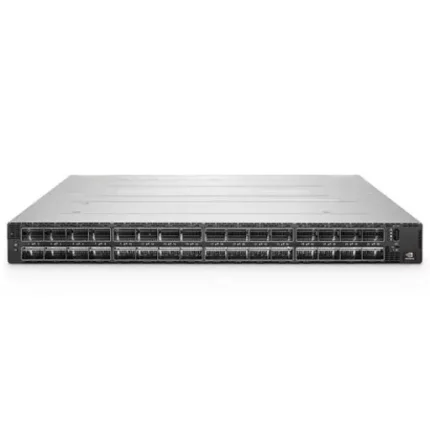
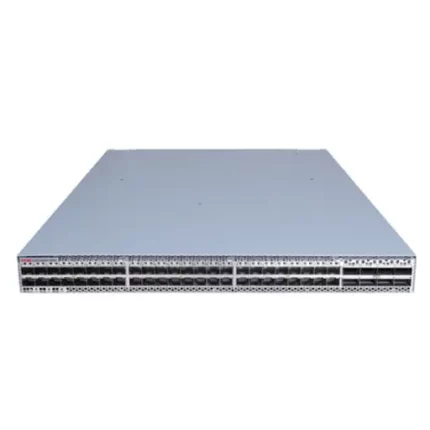
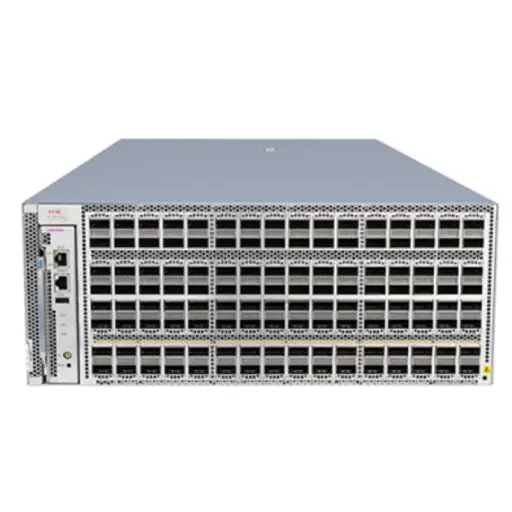
H3C S9827 Series High-Density Intelligent Data Center Switches
| Specification | Details |
|---|---|
| Product Model | H3C S9827-128DH |
| Form Factor | 1RU chassis |
| Dimensions (H x W x D) | 175 x 442 x 760 mm (6.9 x 17.4 x 29.9 in) |
| Weight (Fully Configured) | 40.2 kg (88.6 lbs) maximum |
| Processor | Quad-core 2.6 GHz |
| System Memory | 16 GB DRAM |
Price:
USD31,000 Original price was: USD31,000.USD30,000Current price is: USD30,000.
Description
Revolutionary 800G Switching Technology for Next-Generation Data Centers
The H3C S9827 Series represents a groundbreaking advancement in data center networking technology, delivering unprecedented performance through cutting-edge 800G Ethernet connectivity and innovative CPO (Co-Packaged Optics) silicon photonics architecture. Designed specifically for hyperscale cloud computing environments, artificial intelligence workloads, high-performance computing clusters, and distributed storage fabrics, this next-generation switch family provides the foundation for modern data center infrastructure that demands extreme bandwidth, ultra-low latency, and exceptional reliability.
As enterprises worldwide accelerate their digital transformation initiatives and embrace increasingly data-intensive applications including artificial intelligence generative computing, machine learning model training, real-time analytics, and cloud-native architectures, the network infrastructure must evolve to support these demanding workloads. The H3C S9827 Series addresses these critical requirements by combining massive switching capacity, high-density port configurations, advanced data center features, and intelligent network management capabilities in a compact, energy-efficient platform that scales seamlessly from small deployments to the largest hyperscale facilities.
Unparalleled Performance and Switching Capacity
The H3C S9827 Series delivers extraordinary performance characteristics that position it at the forefront of data center switching technology. With switching capacity reaching up to 102.4 Terabits per second and forwarding rates exceeding 19.53 billion packets per second, these switches provide the bandwidth and processing power required for the most demanding network environments. The flagship S9827-128DH model supports an impressive 128 QSFP112 ports, enabling flexible configurations that can accommodate up to 64 native 800GbE connections or 128 400GbE interfaces, providing unprecedented density and connectivity options for spine-leaf architectures, storage area networks, and high-performance computing interconnects.
The architecture leverages advanced silicon technology with a powerful quad-core processor running at 2.6GHz, backed by 16GB of DRAM memory and 64GB of eMMC flash storage, ensuring responsive management operations and reliable configuration storage. This computational capability enables sophisticated traffic engineering, real-time telemetry processing, and complex policy enforcement without compromising forwarding performance. The switch maintains sub-microsecond latency characteristics even under heavy load conditions, making it ideal for latency-sensitive applications including financial trading systems, real-time data analytics, and AI inference workloads where every microsecond of delay impacts business outcomes.
Advanced Port Flexibility and Connectivity Options
One of the most compelling features of the H3C S9827 Series is its exceptional port flexibility, which allows network architects to precisely tailor connectivity configurations to match specific deployment requirements. The QSFP112 ports support comprehensive breakout capabilities, enabling a single 800GbE port to be split into two 200GbE interfaces or four 100GbE connections, providing tremendous flexibility for mixed-speed environments and gradual migration paths from legacy infrastructure. This intelligent port architecture supports full-port insertion of LPO (Linear Pluggable Optics) transceiver modules, which eliminate the need for power-hungry digital signal processors, significantly reducing power consumption and heat generation while improving overall system efficiency.
The switch seamlessly accommodates intermixing of LPO and traditional DSP-based transceiver modules, allowing organizations to optimize their connectivity strategy based on distance requirements, power budgets, and performance objectives. For short-reach connections within the same data center facility, LPO modules provide exceptional power efficiency and cost-effectiveness, while DSP-based modules deliver the signal conditioning necessary for longer-distance connections or challenging cable environments. The platform supports an extensive range of transceiver types including QSFP112-400G-VR4, QSFP112-400G-DR4, QSFP112-400G-FR4, QSFP56-200G-SR4, and backward-compatible 100G QSFP28 modules, ensuring comprehensive compatibility with existing infrastructure investments and diverse connectivity scenarios.
Cutting-Edge CPO Silicon Photonics Technology
The H3C S9827 Series incorporates revolutionary Co-Packaged Optics technology, representing a fundamental shift in how optical transceivers integrate with switching silicon. Unlike traditional pluggable optics that connect to switch ASICs through electrical traces on printed circuit boards, CPO technology co-locates optical engines directly adjacent to the switching chip, dramatically reducing the electrical path length and associated signal integrity challenges. This architectural innovation delivers multiple benefits including significantly reduced power consumption, improved thermal characteristics, enhanced signal quality, and increased port density within the same physical footprint.
The CPO implementation in the S9827-64EO model achieves single-chip switching capacity of 51.2 Terabits per second while supporting 64 native 800GbE ports, demonstrating the density advantages that silicon photonics technology enables. By eliminating the electrical-to-optical conversion inefficiencies inherent in traditional transceiver designs, CPO reduces overall system power consumption by up to thirty percent compared to equivalent pluggable optics configurations, translating directly to lower operational costs and reduced cooling requirements. The technology also improves system reliability by reducing component count and eliminating numerous potential failure points associated with pluggable interfaces, electrical connectors, and discrete optical engines.
Comprehensive Data Center Feature Set
The H3C S9827 Series implements an extensive suite of advanced data center networking features specifically designed to address the operational requirements of modern cloud-scale infrastructure. The platform provides native support for VXLAN (Virtual Extensible LAN) overlay networks with MP-BGP EVPN (Multiprotocol Border Gateway Protocol Ethernet Virtual Private Network) control plane functionality, enabling massive Layer 2 domain extension across geographically distributed data centers while maintaining network segmentation and tenant isolation. This architecture eliminates traditional spanning tree limitations, enables optimal traffic flow patterns through equal-cost multipath routing, and simplifies configuration management through centralized policy definition.
For storage and high-performance computing workloads that demand ultra-low latency and lossless transport characteristics, the switches implement comprehensive RoCEv2 (RDMA over Converged Ethernet version 2) capabilities including Priority-based Flow Control, Enhanced Transmission Selection, and Explicit Congestion Notification mechanisms. These technologies work together to create deterministic, zero-packet-loss network environments that enable remote direct memory access operations to achieve performance comparable to local memory access, dramatically accelerating distributed storage systems, parallel computing frameworks, and artificial intelligence training clusters. The implementation supports granular QoS policies with multiple priority queues per port, sophisticated traffic shaping algorithms, and intelligent buffer management that prevents head-of-line blocking and ensures fair bandwidth allocation across diverse traffic classes.
Intelligent Network Visibility and Telemetry
Modern data center operations require unprecedented visibility into network behavior, performance characteristics, and potential issues before they impact application performance. The H3C S9827 Series addresses these requirements through comprehensive support for advanced monitoring and telemetry technologies including In-band Network Telemetry, which embeds real-time performance metadata directly into packet headers as they traverse the network. This approach enables continuous, line-rate monitoring of critical metrics including per-hop latency, queue depths, buffer occupancy, and forwarding path information without requiring separate monitoring infrastructure or impacting production traffic flows.
The platform implements extensive support for industry-standard monitoring protocols including sFlow for statistical packet sampling, NetStream for detailed flow-level analytics, and comprehensive SPAN/RSPAN/ERSPAN mirroring capabilities that replicate traffic to dedicated analysis tools. Network operators can configure precise mirroring policies based on packet header fields, VLAN identifiers, IP addresses, or application protocols, enabling targeted troubleshooting and security analysis without overwhelming monitoring systems with irrelevant traffic. Real-time buffer and queue monitoring capabilities provide immediate visibility into congestion conditions, allowing proactive identification and resolution of performance issues before they degrade application response times.
The switches support IEEE 1588 Precision Time Protocol for highly accurate clock synchronization across distributed systems, essential for correlating events across multiple devices, ensuring accurate logging timestamps, and enabling time-sensitive applications including financial trading systems and telecommunications infrastructure. The PTP implementation achieves sub-microsecond synchronization accuracy, maintaining precise time correlation even across large-scale network deployments with multiple hop counts.
Advanced Multi-Chassis Link Aggregation
High availability represents a fundamental requirement for mission-critical data center infrastructure, where even brief network outages can result in significant business impact and revenue loss. The H3C S9827 Series implements sophisticated Multi-Chassis Link Aggregation technology that virtualizes pairs of physical switches into a single logical device from the perspective of connected servers and upstream network elements. This architecture eliminates the need for Spanning Tree Protocol blocking of redundant links, enabling full utilization of available bandwidth while maintaining seamless failover capabilities that recover from device or link failures in sub-second timeframes.
The M-LAG implementation supports independent software upgrades of member devices within the logical chassis, allowing non-disruptive maintenance operations that keep the network fully operational throughout firmware updates and configuration changes. The system employs dedicated keepalive links between member switches to continuously validate system health and prevent split-brain scenarios where both members might simultaneously attempt to forward traffic after a failure of the inter-chassis link. Advanced detection algorithms identify multi-active collision conditions and implement automatic remediation procedures that ensure only one member device forwards traffic after a DR system partition, maintaining network consistency and preventing duplicate packet delivery.
Software-Defined Networking Capabilities
The H3C S9827 Series embraces modern software-defined networking paradigms through comprehensive support for industry-standard SDN protocols and interfaces. The platform implements flexible OpenFlow tables with extensive matching capabilities spanning Layer 2 through Layer 4 packet header fields, enabling sophisticated traffic engineering policies, dynamic service chaining, and programmable forwarding behaviors that adapt to changing application requirements and network conditions. The OpenFlow implementation leverages hardware-accelerated forwarding table resources to maintain line-rate performance even when processing complex flow rules and performing multiple table lookups per packet.
Integration with centralized network management systems occurs through multiple standardized interfaces including OVSDB for virtual switch overlay management, NETCONF for programmatic configuration management, and comprehensive YANG data models that provide machine-readable representations of device configuration and operational state. These capabilities enable automated network provisioning workflows, closed-loop remediation systems that detect and correct configuration drift, and sophisticated orchestration platforms that coordinate network state changes across hundreds or thousands of devices in response to changing business requirements. The switches support gRPC interfaces that enable efficient streaming of telemetry data to analytics platforms, reducing the overhead associated with traditional SNMP polling while providing higher-frequency updates of critical performance metrics.
Enterprise-Grade Reliability and Availability
The H3C S9827-128DH implements comprehensive redundancy mechanisms across all critical subsystems to ensure maximum uptime and minimize single points of failure. The platform supports installation of two to four hot-swappable AC or HVDC power supply modules with intelligent load sharing and N+N redundancy configurations that maintain full operational capability even if multiple power modules fail simultaneously. Each PSR2000-12A-C-A power module delivers 2000 watts of output power with wide input voltage tolerance spanning 90VAC to 264VAC or 180VDC to 320VDC, ensuring compatibility with diverse facility power infrastructure and providing resilience against utility power fluctuations.
The cooling subsystem employs eight hot-swappable fan trays with 7+1 redundancy that automatically adjust rotational speed based on ambient temperature and current thermal load, optimizing acoustic performance during periods of light utilization while ensuring adequate airflow during peak demand scenarios. The intelligent fan control system continuously monitors thermal sensors throughout the chassis, implementing coordinated fan speed adjustments that maintain optimal operating temperatures while minimizing power consumption and acoustic emissions. Front-to-rear airflow architecture simplifies data center aisle containment strategies and integrates seamlessly with standard hot-aisle/cold-aisle facility designs.
With Mean Time Between Failure exceeding 50 years and Mean Time To Repair under one hour, the S9827-128DH achieves availability ratings exceeding 99.999927 percent, translating to less than 23 seconds of unplanned downtime annually. Hot-swappable design extends across all field-replaceable units including power modules, fan trays, and management processing units, enabling non-disruptive component replacement without interrupting network traffic or requiring maintenance windows.
Flexible Management and Administration
The H3C S9827 Series provides multiple management interface options to accommodate diverse operational requirements and administrative preferences. A dedicated out-of-band management Ethernet port with 10/100/1000BASE-T connectivity enables secure administrative access that remains available even during control plane issues or configuration errors affecting production interfaces. The RJ-45 serial console port provides reliable local access for initial configuration, emergency recovery scenarios, and troubleshooting situations where network connectivity may be unavailable. A USB 2.0 port supports direct file system access for configuration backups, software image transfers, and log collection without requiring network connectivity.
The platform supports comprehensive management protocols including SNMPv1/v2c/v3 for integration with traditional network management systems, SSH 2.0 for secure command-line access, and web-based management interfaces for administrators who prefer graphical configuration tools. NETCONF APIs enable programmatic configuration management through standards-based interfaces that integrate seamlessly with automation frameworks, infrastructure-as-code toolchains, and DevOps workflows. The system implements granular role-based access control mechanisms that restrict administrative privileges based on user identity and organizational policies, ensuring proper separation of duties and maintaining comprehensive audit trails of all configuration changes.
Optical Transceiver Health Monitoring
The H3C S9827 Series implements sophisticated optical transceiver health perception capabilities that continuously monitor critical parameters including transmit and receive optical power levels, operating temperature, supply current, voltage levels, cyclic redundancy check errors, per-channel bit error rates, signal-to-noise ratios, and pre-FEC bit error statistics. This comprehensive monitoring enables proactive identification of degrading optical links, failing transceiver modules, fiber contamination, and improper connections before they result in complete link failures or intermittent packet loss that impacts application performance.
The system correlates health metrics across multiple transceivers and historical time periods to establish baseline performance profiles and detect subtle degradation trends that might indicate impending component failures. Intelligent algorithms analyze patterns in optical power variations, increasing bit error rates, and temperature fluctuations to generate early warning alerts that enable preventive maintenance before issues escalate into service-affecting outages. Integration with network management platforms enables centralized visibility across entire switch populations, allowing operations teams to identify systematic issues, track transceiver populations approaching end-of-life, and optimize preventive maintenance schedules to minimize operational disruptions.
The platform incorporates optical port protection circuits that safeguard sensitive receiver components from damage due to excessive optical input power, which can occur during fiber testing procedures or when connecting to misconfigured transmitters. These protection mechanisms detect potentially harmful optical power levels and implement automatic safeguards that prevent permanent damage while logging events for administrative review.
Energy Efficiency and Environmental Considerations
Despite delivering unprecedented performance and port density, the H3C S9827 Series maintains responsible power consumption characteristics through intelligent design choices and advanced power management technologies. The CPO silicon photonics architecture inherently reduces power requirements compared to traditional pluggable optics by eliminating inefficient electrical-to-optical conversion stages and minimizing signal path losses. The S9827-128DH achieves typical power consumption of approximately 850 watts when fully configured with copper cables at 50 percent load, rising to a maximum of 3888 watts under full load with all ports populated with transceivers operating at maximum capacity.
The platform implements sophisticated power management algorithms that dynamically adjust component operating states based on current utilization levels, disabling unused features and placing idle subsystems into low-power modes without impacting forwarding performance. The intelligent cooling system continuously optimizes fan speeds to maintain appropriate operating temperatures while minimizing power consumption and acoustic emissions, reducing operational costs while creating more pleasant working environments in co-location facilities and enterprise data centers.
The compact 1RU form factor with dimensions of 175mm height by 442mm width by 760mm depth maximizes rack density and enables efficient utilization of valuable data center floor space. With fully configured weight not exceeding 40.2 kilograms, the chassis remains manageable for installation and maintenance procedures while incorporating robust mechanical design that withstands the rigors of data center environments. The platform operates reliably across altitude ranges from sea level to 5000 meters and temperature ranges from 0 to 40 degrees Celsius, accommodating diverse facility conditions and enabling deployment in challenging environments where thermal management may be constrained.
Industry Standards Compliance and Certifications
The H3C S9827 Series maintains rigorous compliance with international safety, electromagnetic compatibility, and environmental standards, ensuring compatibility with global deployment requirements and regulatory frameworks. The platform adheres to comprehensive safety standards that govern electrical isolation, grounding requirements, and protection against hazardous conditions. Electromagnetic compatibility certifications verify that the equipment neither generates harmful interference that might disrupt nearby electronic devices nor exhibits susceptibility to external electromagnetic disturbances that could impact operational reliability.
Environmental and eco-friendly certifications demonstrate H3C’s commitment to sustainable manufacturing practices, restricted use of hazardous substances, and design-for-recyclability principles that minimize environmental impact throughout the product lifecycle. These certifications facilitate procurement processes in organizations with environmental responsibility requirements and support corporate sustainability initiatives that increasingly influence technology purchasing decisions.
Ideal Use Cases and Application Scenarios
The H3C S9827 Series excels across numerous demanding application scenarios that characterize modern data center infrastructure. In artificial intelligence and machine learning environments, the platform provides the massive bandwidth and ultra-low latency required for distributed training of large language models, computer vision systems, and deep neural networks that distribute computational workloads across hundreds of GPUs. The lossless RoCEv2 capabilities ensure that memory-intensive operations complete without the retransmissions and delays that would otherwise severely degrade training performance and extend model convergence times.
High-performance computing clusters for scientific research, financial modeling, and engineering simulation depend on the deterministic, low-latency network fabric that the S9827 Series delivers. The platform’s comprehensive support for RDMA protocols enables parallel computing frameworks to achieve near-linear scaling across massive node counts, maintaining computational efficiency even as cluster sizes grow to thousands of servers. Storage area networks benefit from the high bandwidth and lossless transport characteristics, enabling distributed storage systems to deliver local-storage-equivalent performance while maintaining the flexibility and resilience advantages of network-attached storage architectures.
Cloud service providers and hyperscale operators leverage the exceptional port density and switching capacity to build highly efficient spine-leaf fabrics that interconnect tens of thousands of servers while minimizing the number of switch tiers and associated capital expenses. The platform’s support for VXLAN overlay networks enables these organizations to provision isolated tenant environments, implement sophisticated network security policies, and enable workload mobility across geographically distributed facilities without the management complexity and scale limitations of traditional VLAN-based approaches.
Technical Specifications Overview
Hardware Specifications
| Specification | Details |
|---|---|
| Product Model | H3C S9827-128DH |
| Form Factor | 1RU chassis |
| Dimensions (H x W x D) | 175 x 442 x 760 mm (6.9 x 17.4 x 29.9 in) |
| Weight (Fully Configured) | 40.2 kg (88.6 lbs) maximum |
| Processor | Quad-core 2.6 GHz |
| System Memory | 16 GB DRAM |
| Flash Storage | 64 GB eMMC + 256 MB NOR (primary/backup) |
| QSFP112 Ports | 128 x 400GbE capable ports |
| Console Port | 1 x RJ-45 serial console |
| Management Port | 1 x 10/100/1000BASE-T Ethernet |
| USB Port | 1 x USB 2.0 |
Performance Characteristics
| Metric | Specification |
|---|---|
| Switching Capacity | 102.4 Tbps |
| Forwarding Rate | 19.53 Bpps (billion packets per second) |
| Latency | Sub-microsecond |
| Port Configuration | 128 x 400GbE or 64 x 800GbE |
| Port Breakout | 800G to 2x400G, 800G to 4x200G, 400G to 2x200G, 400G to 4x100G |
| Buffer Architecture | Shared buffer with intelligent allocation |
Power and Environmental
| Parameter | Value |
|---|---|
| Power Supply Modules | 4 hot-swappable bays |
| Power Module Type | PSR2000-12A-C-A (2000W each) |
| AC Input Voltage | 90-264 VAC @ 50/60 Hz |
| DC Input Voltage | 180-320 VDC |
| Typical Power Consumption | 850W (50% load with copper cables) |
| Maximum Power Consumption | 3888W (100% load, all transceivers) |
| Power Redundancy | 2+2 redundancy supported |
| Operating Temperature | 0°C to 40°C (32°F to 104°F) |
| Storage Temperature | -40°C to +70°C (-40°F to +158°F) |
| Humidity | 5% to 95% RH, non-condensing |
| Altitude | 0 to 5000 meters (0 to 16,404 feet) |
| Acoustic Noise | 65.5 dB(A) at 27°C |
Cooling System
| Component | Specification |
|---|---|
| Fan Tray Slots | 8 hot-swappable bays |
| Fan Redundancy | 7+1 redundancy |
| Airflow Direction | Front-to-rear (port side to PSU side) |
| Fan Model | FAN-80B-1-C |
| Maximum Airflow | 163.92 CFM per tray |
| Fan Speed Control | Automatic temperature-based adjustment |
Reliability Metrics
| Metric | Value |
|---|---|
| MTBF (Mean Time Between Failures) | > 50 years |
| MTTR (Mean Time To Repair) | < 1 hour |
| System Availability | 99.999927% |
| Hot-Swap Support | All FRUs (Power, Fans, MPU) |
Supported Protocols and Features
Layer 2 Protocols
- IEEE 802.1Q VLAN tagging and trunking
- IEEE 802.1ad Q-in-Q double tagging
- IEEE 802.1p Class of Service
- IEEE 802.3ad Link Aggregation Control Protocol
- IEEE 802.1D Spanning Tree Protocol
- IEEE 802.1w Rapid Spanning Tree Protocol
- IEEE 802.1s Multiple Spanning Tree Protocol
- LLDP (Link Layer Discovery Protocol)
- LACP (Link Aggregation Control Protocol)
- Virtual Router Redundancy Protocol (VRRP)
Layer 3 Protocols
- Static routing
- RIP v1/v2 (Routing Information Protocol)
- OSPF v2/v3 (Open Shortest Path First)
- BGP-4 (Border Gateway Protocol)
- IS-IS (Intermediate System to Intermediate System)
- Policy-based routing
- Multicast routing (PIM-SM, PIM-DM, PIM-SSM)
- IGMP v1/v2/v3 snooping and querier
- MLD v1/v2 snooping and querier
Data Center Features
- VXLAN with MP-BGP EVPN control plane
- RoCEv2 (RDMA over Converged Ethernet v2)
- Priority-based Flow Control (PFC)
- Enhanced Transmission Selection (ETS)
- Explicit Congestion Notification (ECN)
- Data Center Bridging eXchange (DCBX)
- Multi-Chassis Link Aggregation (M-LAG)
- Virtual Extensible LAN (VXLAN)
Quality of Service
- 8 priority queues per port
- Strict priority and weighted round robin scheduling
- Weighted Random Early Detection (WRED)
- Traffic shaping and policing
- DiffServ Code Point (DSCP) marking and classification
- 802.1p priority tag mapping
Security Features
- Access Control Lists (MAC, IP, IPv6)
- Port security and MAC address limiting
- 802.1X port-based network access control
- RADIUS and TACACS+ authentication
- SSH v2 secure management access
- SNMPv3 with encryption
- Dynamic ARP Inspection (DAI)
- IP Source Guard
- DHCP snooping
Management and Monitoring
- SNMP v1/v2c/v3
- RMON (Remote Monitoring)
- sFlow traffic sampling
- NetStream flow monitoring
- SPAN/RSPAN/ERSPAN port mirroring
- In-band Network Telemetry (INT)
- IEEE 1588 Precision Time Protocol (PTP)
- NETCONF/YANG configuration management
- gRPC telemetry streaming
- REST API
Frequently Asked Questions About H3C S9827 Series Switches
What makes the H3C S9827 different from previous generation switches?
The H3C S9827 Series represents a generational leap in data center switching technology through its support for 800 Gigabit Ethernet connectivity, which doubles the per-port bandwidth compared to previous 400GbE platforms. The innovative CPO silicon photonics architecture co-locates optical engines directly with switching silicon, dramatically reducing power consumption while increasing port density. Enhanced buffering capabilities and advanced telemetry features enable better traffic management and network visibility compared to legacy platforms.
Can the S9827 Series support mixed 800G, 400G, and 100G connectivity simultaneously?
Yes, the H3C S9827 Series provides exceptional flexibility for mixed-speed deployments. The QSFP112 ports support comprehensive breakout configurations that allow single 800GbE ports to be split into multiple lower-speed interfaces. Network administrators can configure the switch to simultaneously support native 800GbE connections for spine uplinks, 400GbE connections for high-performance server access, and 100GbE connections for legacy infrastructure, all within the same chassis. The platform supports both LPO and DSP transceiver modules, enabling optimization based on specific distance and power requirements.
What are the primary use cases for 800G switching technology?
The 800 Gigabit Ethernet capabilities of the S9827 Series address the bandwidth requirements of increasingly demanding applications including artificial intelligence model training, which distributes workloads across hundreds of GPUs requiring massive inter-GPU communication bandwidth. High-performance computing clusters benefit from the reduced latency and increased throughput when running parallel simulations and computational workloads. Cloud service providers leverage 800GbE for spine-leaf interconnections that aggregate traffic from thousands of servers while maintaining non-blocking architectures. Large-scale storage systems utilize the bandwidth for distributed storage protocols that enable local-storage performance characteristics from network-attached storage.
How does RoCEv2 support improve application performance?
RDMA over Converged Ethernet version 2 enables applications to access memory on remote servers as efficiently as local memory access by bypassing operating system kernel processing and eliminating TCP/IP protocol stack overhead. The H3C S9827 implements comprehensive RoCEv2 features including Priority-based Flow Control to prevent packet loss during congestion, Enhanced Transmission Selection for bandwidth allocation across traffic classes, and Explicit Congestion Notification for proactive congestion management. These mechanisms create deterministic, lossless network environments where RDMA operations complete reliably without retransmissions, dramatically accelerating distributed storage, parallel computing, and AI training workloads that depend on high-frequency memory operations across the network.
What is the advantage of CPO silicon photonics over traditional pluggable optics?
Co-Packaged Optics technology fundamentally reimagines the relationship between optical transceivers and switching silicon by integrating optical engines directly adjacent to the switch ASIC rather than mounting them in pluggable cages at the faceplate. This architectural change eliminates lengthy electrical traces between the switch chip and optical components, reducing power consumption by approximately thirty percent while improving signal integrity and enabling higher port densities. CPO also reduces system complexity by eliminating numerous connectors, cables, and discrete components, improving overall reliability and reducing potential failure points. The technology represents a critical enabler for sustainable scaling to 800GbE and beyond.
How does the M-LAG feature enhance network availability?
Multi-Chassis Link Aggregation virtualizes two physical switches into a single logical device from the perspective of connected endpoints, enabling servers and network devices to establish link aggregation groups that span both switches. This architecture provides device-level redundancy where failure of an entire switch results in sub-second failover to the surviving member without disrupting active connections or requiring protocol reconvergence. M-LAG eliminates Spanning Tree Protocol blocking of redundant links, enabling full utilization of available bandwidth while maintaining seamless failover capabilities. The feature supports independent software upgrades of member devices, allowing non-disruptive maintenance operations that preserve network availability throughout firmware updates.
What SDN capabilities does the S9827 Series provide?
The H3C S9827 Series implements comprehensive software-defined networking features including OpenFlow protocol support with flexible flow table architectures that enable programmatic traffic steering and dynamic service insertion. OVSDB integration enables overlay network management for virtual switch configurations, while NETCONF APIs provide standardized interfaces for automated configuration management. YANG data models deliver machine-readable representations of device state that integrate with infrastructure-as-code toolchains. The platform supports seamless integration with the H3C SeerEngine-DC Controller for centralized network orchestration, policy management, and automated provisioning workflows that reduce operational complexity while enabling rapid deployment of new services.
How does In-band Network Telemetry improve network operations?
In-band Network Telemetry revolutionizes network monitoring by embedding real-time performance metadata directly into packet headers as they traverse the network, enabling continuous line-rate visibility without requiring separate monitoring infrastructure. The technology captures critical metrics including per-hop latency, queue depths, buffer occupancy, and forwarding path information, providing unprecedented insight into actual packet experiences rather than statistical sampling. This approach enables precise identification of congestion points, asymmetric routing conditions, and performance anomalies that traditional monitoring methods might miss. Integration with analytics platforms enables closed-loop automation systems that detect degraded conditions and implement automatic remediation without human intervention.
What power and cooling considerations should be evaluated when deploying S9827 switches?
The H3C S9827-128DH requires careful power planning with maximum consumption reaching 3888 watts when fully populated with transceivers operating at capacity, though typical deployments consume substantially less power. The platform supports 2+2 power supply redundancy requiring four PSR2000-12A-C-A modules for full redundancy, each drawing up to 12 amps at 100-240VAC. Cooling infrastructure must accommodate front-to-rear airflow with adequate cold aisle supply air and hot aisle exhaust capacity. The intelligent fan speed control system adjusts airflow based on temperature, but maximum acoustic output reaches 65.5 dBA which may require consideration in co-location environments. Facilities should provide operating temperatures between 0-40 Celsius with proper airflow management to prevent heat accumulation.
Can the S9827 integrate with existing network management systems?
The H3C S9827 Series provides comprehensive compatibility with industry-standard network management platforms through support for SNMPv1/v2c/v3 protocols, enabling integration with existing NMS deployments without requiring specialized controllers. NETCONF and YANG model support enables integration with modern automation frameworks including Ansible, Python network automation libraries, and infrastructure-as-code toolchains. The platform supports sFlow, NetStream, and SPAN/RSPAN/ERSPAN traffic monitoring capabilities that integrate with flow collectors and traffic analysis platforms. gRPC streaming telemetry provides high-frequency metric updates to time-series databases and analytics platforms. This multi-protocol approach ensures compatibility across diverse operational environments and administrative preferences.
Related Products Available at ITCTShop.com
When building comprehensive AI and HPC infrastructure, the H3C S9827 Series integrates seamlessly with other high-performance components available through ITCTShop.com. Consider these complementary products for complete data center solutions:
The H3C S9855 Series High-Density RoCEv2 Ethernet Switch provides additional high-performance networking options specifically optimized for AI workloads and high-performance computing environments, offering complementary port configurations that may better suit specific deployment scenarios requiring different bandwidth and density characteristics.
The NVIDIA Quantum-2 QM9790 InfiniBand Switch delivers cutting-edge InfiniBand connectivity for applications requiring absolute minimum latency and maximum bandwidth efficiency, particularly well-suited for tightly-coupled parallel computing workloads and AI training clusters where InfiniBand’s RDMA capabilities provide performance advantages over Ethernet-based alternatives.
For GPU infrastructure that connects to these high-performance network fabrics, the NVIDIA H200 Tensor Core GPU represents the latest generation of AI accelerators with 141GB of HBM3e memory delivering exceptional performance for large language model training and inference applications that benefit from the massive bandwidth provided by 800GbE networking.
Complete system solutions like the HGX H200 Optimized X13 8U 8GPU System integrate multiple NVIDIA H200 GPUs with appropriate networking infrastructure to create turnkey AI training and inference platforms that leverage the full capabilities of next-generation network switches like the S9827 Series.
Conclusion: Leading the Evolution of Data Center Infrastructure
The H3C S9827 Series High-Density Intelligent Data Center Switches represent a transformative advancement in network infrastructure technology, delivering the performance, density, and advanced features required for next-generation applications including artificial intelligence, high-performance computing, cloud services, and distributed storage systems. Through innovative CPO silicon photonics architecture, comprehensive RoCEv2 support, extensive SDN capabilities, and exceptional reliability characteristics, these switches provide the foundation for data center networks that scale to meet increasingly demanding requirements while maintaining operational efficiency and energy responsibility.
Organizations deploying AI infrastructure, building hyperscale cloud platforms, or modernizing data center networks will find the S9827 Series delivers exceptional value through its combination of 800 Gigabit Ethernet capabilities, flexible port configurations, advanced telemetry features, and proven H3C reliability. The platform’s support for mixed transceiver types, comprehensive protocol implementation, and standards-based management interfaces ensure seamless integration with existing infrastructure while providing a clear migration path to future technologies.
For more information about the H3C S9827 Series and to discuss specific deployment requirements, contact the networking specialists at ITCTShop.com, your trusted source for enterprise AI hardware solutions and data center infrastructure components.
Last update at December 2025
Reviews
There are no reviews yet.