

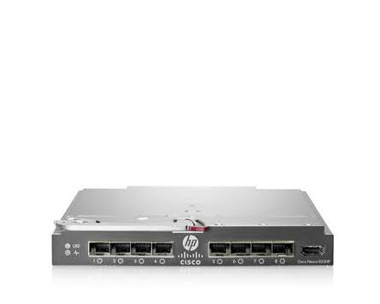
Cisco B22HP Expansion Module – 16 Ports
Part Number:655897-001
| Specification | Details |
|---|---|
| Model Number | N2K-B22HP-P |
| Device Type | Expansion Module – Blade Fabric Extender |
| Host Interfaces | 16 x 1/10GBASE-KR internal ports |
| Fabric Interfaces | 8 x 10 Gigabit Ethernet SFP+ ports |
Price:
USD180
1 in stock
Description
The Cisco B22HP Expansion Module (Model: N2K-B22HP-P) represents a paradigm shift in data center blade server networking architecture. This 16-port expansion module is specifically engineered to simplify network infrastructure while dramatically reducing management complexity in enterprise environments utilizing HP BladeSystem enclosures. As part of the Cisco Nexus B22 Blade Fabric Extender family, this expansion module functions as a remote line card for Cisco Nexus parent switches, creating a distributed modular system that combines the management simplicity of a centralized switch with the cabling efficiency of integrated blade networking.
Designed for organizations seeking to consolidate their network infrastructure without sacrificing performance or scalability, the Cisco B22HP delivers exceptional value through its zero-touch installation capabilities, automatic configuration inheritance from parent switches, and seamless integration with existing HP BladeSystem c3000 and c7000 enclosures. This expansion module eliminates traditional blade switch management overhead while providing enterprise-grade 10 Gigabit Ethernet connectivity with unified fabric support for both Ethernet and Fibre Channel over Ethernet (FCoE) traffic.
Revolutionary Fabric Extender Architecture
The Cisco B22HP Expansion Module fundamentally transforms how data centers approach blade server connectivity. Unlike traditional blade switches that require independent management, configuration, and software maintenance, this fabric extender operates as an extension of the parent Cisco Nexus switch. This architectural innovation means that all device configurations, policies, and software updates are centrally managed on the upstream Cisco Nexus switch and automatically propagated to the B22HP module through in-band communication channels.
This distributed modular design delivers transformative operational benefits. When you insert a Cisco B22HP Expansion Module into an HP BladeSystem enclosure, it automatically discovers the parent Cisco Nexus switch, downloads the appropriate software image, and configures itself based on predefined policies—all without manual intervention. This zero-touch installation capability dramatically accelerates blade server deployment timelines while simultaneously eliminating configuration errors that commonly plague traditional networking architectures.
The fabric extender architecture also enables unprecedented scalability. A single Cisco Nexus parent switch can support multiple Cisco B22HP modules across different blade chassis, creating a unified management domain that can scale to hundreds of blade servers under a single administrative entity. For organizations operating large-scale virtualized environments or high-density compute clusters, this management consolidation represents a tenfold reduction in network management points compared to traditional discrete blade switch architectures.
Comprehensive Technical Specifications
Port Configuration and Connectivity
| Specification | Details |
|---|---|
| Model Number | N2K-B22HP-P |
| Device Type | Expansion Module – Blade Fabric Extender |
| Host Interfaces | 16 x 1/10GBASE-KR internal ports |
| Fabric Interfaces | 8 x 10 Gigabit Ethernet SFP+ ports |
| Uplink Connectivity | 8 x SFP+ uplink ports for network expansion |
| Total Fabric Bandwidth | 160 Gbps full-duplex (80 Gbps each direction) |
| Oversubscription Ratio | 2:1 |
| Switching Performance | 400 Gbps hardware forwarding / 297 Mpps |
| Supported Protocols | Ethernet, 10GbE, FCoE, iSCSI |
| Distance to Parent Switch | Up to 3 km (300m for FCoE traffic) |
Physical and Environmental Specifications
| Specification | Details |
|---|---|
| Form Factor | Plug-in Module for HP BladeSystem |
| Dimensions (L x W x D) | 10.5 x 7.5 x 1.1 inches (267.7 x 192.79 x 27.94 mm) |
| Weight | 2.8 lb (1.27 kg) |
| Power Supply | Provided by blade chassis (12V @ 6A) |
| Typical Operating Power | 56 watts |
| Maximum Input Power | 70 watts |
| Heat Dissipation | 239 BTU/hour |
| Operating Temperature | 50 to 104°F (10 to 40°C) |
| Storage Temperature | -40 to 140°F (-40 to 60°C) |
| Humidity Range | 10 to 95% (non-condensing) |
| Operating Altitude | 0 to 10,000 ft (0 to 3,000m) |
| MTBF | 291,523 hours |
| Cooling System | Provided by blade chassis |
Advanced Networking Features
The Cisco B22HP Expansion Module inherits its comprehensive feature set from the parent Cisco Nexus switch, providing enterprise-class networking capabilities without the complexity of managing discrete switches. This feature inheritance model ensures consistent policy enforcement across all blade servers while simplifying operations.
Layer 2 Switching Capabilities
The expansion module provides robust Layer 2 switching functionality optimized for blade server environments. Full IEEE 802.1Q VLAN encapsulation support enables network segmentation and traffic isolation across blade servers, while support for up to 4,096 VLANs allows fine-grained network partitioning for multi-tenant environments. The module supports Layer 2 VLAN trunking on both host and fabric interfaces, enabling flexible network topology designs that can adapt to evolving application requirements.
Cisco EtherChannel technology on uplink ports enables link aggregation for increased bandwidth and redundancy, while PortChannel support on server-facing ports allows blade servers to bond multiple network adapters for higher throughput. Advanced PortChannel hashing algorithms ensure optimal traffic distribution across member links, maximizing bandwidth utilization and preventing individual link saturation. The module also supports jumbo frames up to 9,216 bytes on all ports, reducing CPU overhead and improving throughput for large data transfers common in storage and backup operations.
Virtual PortChannel (vPC) Technology
One of the most powerful features of the Cisco B22HP Expansion Module is its support for virtual PortChannel (vPC) technology, which enables unprecedented levels of redundancy and bandwidth utilization in blade server environments. With vPC, blade servers can establish active-active network connections to two separate Cisco B22HP modules, eliminating single points of failure while doubling available bandwidth.
Traditional blade networking architectures rely on Spanning Tree Protocol (STP) for loop prevention, which blocks redundant links and wastes half of the available network infrastructure. The Cisco B22HP eliminates STP dependency between the fabric extender and parent switch, creating a large, multi-path, loop-free topology that utilizes all available links simultaneously. This architecture delivers fast convergence during failure scenarios—typically sub-second—while maintaining full bandwidth utilization under normal operating conditions.
The module supports multiple vPC deployment scenarios including Server vPC (dual-homed servers to fabric extenders), Fabric Extender vPC (dual-homed fabric extenders to parent switches), Enhanced vPC (combining both server and fabric extender vPC), and vPC+ for integration with Cisco FabricPath networks. This flexibility allows network architects to design resilient blade server connectivity that matches specific availability requirements and failure domain considerations.
Unified Fabric with FCoE Support
The Cisco B22HP Expansion Module delivers true unified fabric capabilities by supporting both Ethernet and Fibre Channel over Ethernet (FCoE) traffic over the same physical infrastructure. This convergence eliminates the need for separate LAN and SAN connectivity to blade servers, dramatically reducing cable complexity, switch port requirements, and overall infrastructure costs.
FCoE support enables blade servers equipped with Converged Network Adapters (CNAs) to consolidate Ethernet and Fibre Channel traffic onto a single 10 Gigabit Ethernet connection. The module supports IEEE Data Center Bridging (DCB) protocols including Priority Flow Control (PFC) and Enhanced Transmission Selection (ETS), which provide the lossless transport characteristics required for storage traffic. This unified fabric architecture is particularly valuable in virtualized environments where virtual machines require both network and storage connectivity, as it reduces adapter requirements and simplifies network topology.
The module also supports iSCSI protocol for IP-based storage connectivity, providing organizations with flexibility in their storage networking strategy. Whether deploying native Fibre Channel SAN using FCoE, IP-based storage using iSCSI, or hybrid environments combining both protocols, the Cisco B22HP provides the necessary infrastructure foundation.
Quality of Service (QoS) and Traffic Management
Enterprise blade server environments frequently host mixed workloads with varying performance and latency requirements. The Cisco B22HP Expansion Module addresses these diverse requirements through comprehensive Quality of Service (QoS) capabilities that enable administrators to prioritize critical traffic and ensure consistent application performance.
The module provides Layer 2 IEEE 802.1p Class of Service (CoS) support with eight hardware queues per port, enabling fine-grained traffic classification and prioritization. Per-port QoS configuration allows different policies for various blade servers based on their workload characteristics, while CoS trust settings preserve priority markings as traffic traverses the network. Local policing capabilities enforce bandwidth limits on individual flows, preventing misbehaving applications from consuming excessive network resources.
Egress scheduling combines strict-priority queuing for latency-sensitive traffic with Weighted Round Robin (WRR) for fair bandwidth allocation among best-effort flows. Configurable tail-drop thresholds provide flow control during congestion scenarios, preventing buffer overflow and subsequent packet loss. These QoS mechanisms are essential for environments running real-time applications, storage replication, or latency-sensitive workloads alongside general-purpose computing.
Compatible Blade Server Platforms
The Cisco B22HP Expansion Module is specifically designed for seamless integration with HP BladeSystem infrastructure, supporting both c3000 and c7000 enclosure families. This compatibility ensures that organizations with existing HP blade server investments can upgrade their networking infrastructure without requiring chassis replacement or major architectural changes.
HP BladeSystem c3000 Enclosure
The c3000 enclosure represents HP’s single-enclosure blade solution designed for branch offices, departmental deployments, and small to medium-sized data centers. The Cisco B22HP integrates into the c3000 enclosure’s I/O module bay, providing 10 Gigabit Ethernet connectivity to up to 16 blade servers through the enclosure’s midplane. This integration allows c3000 deployments to leverage enterprise-class Cisco networking capabilities while maintaining the compact footprint and simplified management characteristics that make the c3000 attractive for distributed IT environments.
HP BladeSystem c7000 Enclosure
The c7000 enclosure serves as HP’s flagship blade server platform for enterprise data centers, supporting up to 16 half-height blade servers or 8 full-height blade servers in a single 10U chassis. The Cisco B22HP expansion module occupies a single interconnect bay within the c7000 enclosure, connecting to blade servers via the high-speed midplane using 1/10GBASE-KR technology. Multiple Cisco B22HP modules can be installed in a single c7000 enclosure for redundancy, with each module providing independent connectivity paths to different Cisco Nexus parent switches.
The c7000’s advanced power and cooling infrastructure ensures the Cisco B22HP operates within optimal environmental parameters, while the enclosure’s Onboard Administrator integrates with the module’s health and status LEDs for unified infrastructure monitoring. This tight integration between HP’s blade chassis management and Cisco’s network management creates a cohesive administration experience.
Parent Switch Compatibility and Scalability
The Cisco B22HP Expansion Module operates in conjunction with Cisco Nexus parent switches, which provide the actual switching intelligence, policy enforcement, and management interface. Understanding parent switch compatibility is essential for planning deployments and ensuring optimal performance.
Cisco Nexus 5000 Series Switches
The Nexus 5000 Series represents Cisco’s purpose-built data center access switches optimized for server connectivity. The Cisco B22HP is compatible with Nexus 5010, 5020, 5548P, 5548UP, and 5596UP switches running NX-OS Software Release 5.0(3)N2(2) or later. Nexus 5010 and 5020 switches support up to 12 fabric extenders per switch, while the more advanced 5548P, 5548UP, and 5596UP models support up to 24 fabric extenders for Layer 2 configurations (16 for Layer 3 configurations). This scalability enables large blade server deployments spanning multiple blade chassis under unified management.
Cisco Nexus 6000 Series Switches
The Nexus 6000 Series provides higher density and performance for demanding data center environments. Compatible models include the Nexus 6001 and 6004 Series switches running NX-OS Software Release 6.0 or later. These switches support up to 48 fabric extenders in Layer 2 configurations or 24 fabric extenders in Layer 3 configurations, making them ideal for large-scale blade server deployments requiring extensive compute density. The Nexus 6000 Series also provides advanced features including 40 Gigabit Ethernet uplink support, comprehensive telemetry capabilities, and enhanced programmability through APIs.
Cisco Nexus 7000 Series Switches
For organizations requiring maximum scalability and advanced data center services, the Cisco Nexus 7000 Series provides modular chassis-based switching with exceptional port density and feature richness. The Cisco B22HP is compatible with specific Nexus 7000 line cards including N7K-M132XP-12, N7K-M132XP-12L, N7K-M224XP-23L, N7K-F248XP-25, and N7K-F248XP-25E running NX-OS Software Release 6.2(2) or later. Nexus 7000 deployments support up to 32 fabric extenders with Supervisor 1/2 modules or up to 64 fabric extenders with Supervisor 2E modules, enabling massive blade server environments with centralized management and consistent policy enforcement.
Simplified Operations and Management
One of the most compelling value propositions of the Cisco B22HP Expansion Module is the dramatic simplification of operations and management compared to traditional blade networking architectures. This operational efficiency translates directly into reduced staffing requirements, faster provisioning times, and lower error rates.
Single Point of Management
Traditional blade server networking architectures require administrators to individually configure each blade switch in every chassis—a time-consuming process prone to configuration drift and inconsistencies. The Cisco B22HP eliminates this complexity by centralizing all configuration on the parent Cisco Nexus switch. Administrators define VLANs, QoS policies, access control lists, and other networking parameters once on the parent switch, and these configurations automatically propagate to all connected B22HP modules.
This single point of management model provides several critical advantages. Configuration consistency is guaranteed across all blade servers because policies originate from a single authoritative source. Provisioning new blade servers becomes nearly instantaneous—simply connect the server to the blade chassis midplane, and it automatically inherits the appropriate network configuration. Troubleshooting is simplified because network policies can be verified in one location rather than across dozens of discrete blade switches.
Software Maintenance Simplification
Software maintenance represents one of the most time-consuming aspects of managing traditional blade switch infrastructure. Each discrete switch requires individual software upgrades, often necessitating maintenance windows and complex change control procedures. The Cisco B22HP transforms this process through its embedded software model, where the fabric extender software is integrated into the parent Cisco Nexus switch software image.
When you upgrade the NX-OS software on the parent Nexus switch, the new fabric extender software is automatically downloaded to connected B22HP modules as part of the upgrade process. This automatic software distribution eliminates the need to individually upgrade each blade chassis, dramatically reducing maintenance windows and minimizing the risk of software version inconsistencies. Furthermore, In-Service Software Upgrade (ISSU) capabilities enable transparent software upgrades with minimal or zero downtime, allowing organizations to deploy security patches and feature updates without disrupting production workloads.
Zero-Touch Installation and Configuration
The Cisco B22HP implements a sophisticated zero-touch installation capability that accelerates blade chassis deployment while eliminating common configuration errors. When you physically install a B22HP module into an HP BladeSystem chassis, it performs the following automated sequence:
First, the module completes Power-On Self-Test (POST) procedures to verify hardware functionality. Next, it automatically discovers upstream Cisco Nexus parent switches via the fabric interfaces and establishes in-band management connectivity. The parent switch recognizes the newly connected fabric extender and consults its configuration database to determine the appropriate settings for this module. Finally, the parent switch downloads the correct software image (if different from the currently installed version) and pushes the configuration to the fabric extender, which then becomes operational and ready to serve blade server traffic.
This entire process occurs automatically without administrator intervention, transforming blade chassis commissioning from a multi-hour configuration exercise into a simple plug-and-play operation. For organizations deploying multiple blade chassis or frequently reconfiguring blade server infrastructure, this automation delivers substantial time savings and operational efficiency.
Comprehensive Monitoring and Management Tools
While the Cisco B22HP operates as a remote line card to the parent switch, it maintains its own health monitoring capabilities and integrates with Cisco’s comprehensive management ecosystem. The module features multiple LED indicators including health status, unit identification (UID), and per-port status LEDs that provide at-a-glance operational visibility. Green port LEDs indicate established link connectivity, amber indicates no transceiver detected, and off states indicate either boot-in-progress or no link establishment.
The module fully supports industry-standard management protocols including SNMPv1, v2, and v3 for integration with third-party network management systems, Syslog for centralized logging and event correlation, and RMON for statistical monitoring. Cisco-specific management interfaces include CLI access through the parent switch, XML/NETCONF for programmatic configuration, and Cisco Discovery Protocol (CDP) for automated topology discovery.
Cisco Data Center Network Manager (DCNM) provides a unified management interface for the entire fabric extender ecosystem, allowing administrators to configure, monitor, and troubleshoot Cisco B22HP modules alongside other Nexus switches and fabric extenders. DCNM’s topology visualization capabilities graphically display the relationships between parent switches, fabric extenders, and connected blade servers, simplifying capacity planning and troubleshooting workflows.
Use Cases and Deployment Scenarios
The Cisco B22HP Expansion Module excels in diverse deployment scenarios where simplified management, high performance, and operational efficiency are paramount.
Enterprise Virtualization Platforms
Virtualized data centers running VMware vSphere, Microsoft Hyper-V, or KVM hypervisors benefit tremendously from the Cisco B22HP’s unified fabric capabilities and vPC redundancy. Virtual machine mobility requirements demand consistent network policies across blade servers, which the B22HP delivers through centralized configuration on the parent switch. The module’s support for IEEE 802.1Q VLAN trunking enables virtual machine network segmentation, while jumbo frame support optimizes vMotion and live migration performance. Organizations can confidently implement blade-based virtualization clusters knowing that network infrastructure provides both the bandwidth and redundancy required for demanding virtualized workloads.
High-Performance Computing Clusters
HPC environments executing scientific simulations, financial modeling, or engineering analysis applications generate intensive east-west traffic patterns between compute nodes. The Cisco B22HP’s 10 Gigabit Ethernet connectivity and low-latency switching performance (hardware forwarding at 400 Gbps) support these demanding communication requirements. The fabric extender architecture eliminates STP blocking, ensuring all available bandwidth can be utilized for inter-node communication. QoS capabilities allow HPC administrators to prioritize cluster management traffic or separate computational flows from storage traffic, optimizing application performance.
Private Cloud Infrastructure
Organizations building private cloud platforms using technologies like OpenStack, CloudStack, or Kubernetes require networking infrastructure that supports multi-tenancy, dynamic provisioning, and API-driven automation. The Cisco B22HP integrates seamlessly into these environments through its parent switch’s support for automation frameworks. RESTful APIs and support for configuration management tools enable cloud orchestration platforms to programmatically create VLANs, apply QoS policies, and provision network connectivity as cloud resources are instantiated. The unified management model simplifies network operations in dynamic cloud environments where blade server workloads frequently change.
Converged Infrastructure Deployments
Converged infrastructure solutions combining compute, storage, and networking into pre-validated reference architectures represent a growing deployment model for enterprise IT. The Cisco B22HP serves as a key component in these solutions, providing the network fabric that interconnects blade servers with storage arrays and aggregation switches. Its FCoE support enables storage traffic convergence, reducing the component count and simplifying the overall solution architecture. Organizations deploying converged infrastructure benefit from the B22HP’s zero-touch installation, which aligns with the simplified deployment model that makes converged infrastructure attractive.
Optical Transceiver and Cable Compatibility
The eight SFP+ fabric interfaces on the Cisco B22HP Expansion Module support a comprehensive range of optical transceivers and direct-attach copper cables, providing deployment flexibility for various distance and budget requirements.
Fiber Optic Transceivers
Cisco Fabric Extender Transceiver (FET-10G): Cisco’s purpose-built fabric extender transceiver supports multimode fiber connections up to 100 meters using OM3 fiber or 25 meters with OM2 fiber. The FET-10G delivers approximately 0.1 microsecond latency while consuming only 1 watt per transceiver, making it ideal for high-density deployments where power and cooling are constrained. Note that FET-10G transceivers must be used in pairs (one on the B22HP and one on the parent switch) and are supported exclusively on Cisco Nexus 5000 and 7000 Series fabric links.
Standard 10GBASE Optics: For flexibility and interoperability, the Cisco B22HP supports industry-standard SFP+ transceivers including 10GBASE-SR for short-reach multimode fiber (up to 300 meters with OM3/OM4 fiber), 10GBASE-LR for long-reach single-mode fiber (up to 10 kilometers), and 10GBASE-ER for extended-reach single-mode fiber (up to 40 kilometers). These standard optics enable the B22HP to integrate into existing fiber infrastructure and support longer distances required for multi-building campus deployments or geographically dispersed data centers.
Direct-Attach Copper Cables
For cost-effective short-distance connectivity, the Cisco B22HP supports various Twinax copper cable options that eliminate the need for optical transceivers. Passive copper cables (SFP-H10GB-CU1M, CU3M, CU5M) provide 10 Gigabit Ethernet connectivity for distances up to 5 meters at the lowest cost and power consumption. Active copper cables (SFP-H10GB-ACU7M, ACU10M) extend the distance to 10 meters by incorporating signal amplification, though at slightly higher cost and power consumption.
The module also supports QSFP to SFP+ breakout cables (QSFP-4SFP10G-CU1M through ACU10M variants), which enable a single 40 Gigabit Ethernet QSFP port on the parent switch to connect to four separate 10 Gigabit Ethernet fabric extender uplinks. This capability is particularly valuable when parent switch port density is constrained, as it quadruples the number of supported fabric extenders per parent switch port.
Security Features and Access Control
Network security remains paramount in enterprise blade server environments, particularly in multi-tenant deployments or environments subject to compliance requirements. The Cisco B22HP Expansion Module provides essential security capabilities through features inherited from its parent Cisco Nexus switch.
The module supports local packet classification with up to 256 access control list (ACL) entries applied directly at the fabric extender. These ACLs enable administrators to implement micro-segmentation strategies that restrict communication between blade servers based on application requirements or security policies. While more complex security policies are typically enforced at the parent switch or data center firewall, the B22HP’s local ACL capability provides a critical first line of defense against unauthorized lateral movement within the blade chassis.
Private VLAN (PVLAN) support on uplink ports enables service provider-style network isolation for multi-tenant blade server environments. In PVLAN configurations, blade servers in the same VLAN cannot communicate directly with each other but can communicate with designated gateway ports, preventing malicious or compromised blade servers from attacking neighbors. This feature is particularly valuable in hosting environments or research computing clusters where mutually distrusting workloads share common infrastructure.
The module integrates with Cisco TrustSec technology when deployed with compatible parent switches, enabling role-based access control and encrypted inter-blade communication. TrustSec uses Security Group Tags (SGTs) to classify traffic based on user or device identity, then enforces policy consistently across the network regardless of IP address changes or virtual machine mobility events. For organizations with stringent data protection requirements, TrustSec provides defense-in-depth security without the performance penalty of traditional packet-by-packet encryption.
Power Efficiency and Environmental Considerations
Data center power consumption and cooling requirements directly impact operational expenses, making energy efficiency a critical consideration for networking equipment selection. The Cisco B22HP Expansion Module demonstrates strong environmental performance through multiple design choices and operational characteristics.
With typical operating power consumption of only 56 watts and maximum input power of 70 watts, the Cisco B22HP consumes significantly less power than traditional blade switches with comparable port density. This reduced power draw translates directly into lower electricity costs and reduced cooling requirements. The module’s 2.8-pound weight and compact form factor (10.5 x 7.5 x 1.1 inches) minimize material usage while simplifying installation and maintenance procedures.
The fabric extender architecture delivers additional power savings at the overall infrastructure level by reducing the total number of managed switching devices required in blade server environments. Because multiple B22HP modules are managed through a single parent Cisco Nexus switch, organizations avoid the power consumption associated with running redundant supervisor modules, management processors, and control plane functions in every blade chassis. This consolidation can reduce data center-wide networking power consumption by 20-30% compared to traditional architectures.
Heat dissipation of 239 BTU/hour per module remains well within the capabilities of standard HP BladeSystem chassis cooling systems, allowing the B22HP to operate within optimal temperature ranges (50-104°F operating, -40-140°F storage) without requiring supplemental cooling. The module supports operation at altitudes up to 10,000 feet and humidity levels between 10-95% non-condensing, ensuring reliable operation across diverse data center environments. With a mean time between failures (MTBF) of 291,523 hours (approximately 33 years), the Cisco B22HP delivers exceptional reliability that minimizes replacement costs and operational disruptions.
The module complies with RoHS 6 (Restriction of Hazardous Substances) directives, ensuring environmentally responsible manufacturing that minimizes toxic materials. Cisco’s comprehensive environmental sustainability programs extend throughout the product lifecycle, from energy-efficient design and responsible manufacturing to end-of-life recycling programs that recover valuable materials and prevent electronic waste from entering landfills.
Why Choose ITCT Shop for Cisco B22HP Expansion Modules
When selecting a partner for enterprise networking infrastructure, organizations require more than simply product availability—they need comprehensive expertise, reliable support, and demonstrated commitment to customer success. ITCT Shop has established itself as a premier provider of enterprise IT solutions specializing in AI Computing, data center infrastructure, and professional networking equipment.
Our deep expertise in AI Network infrastructure and blade server deployments positions us uniquely to guide organizations through complex technology decisions. We understand that deploying Cisco B22HP Expansion Modules represents a strategic architectural decision that impacts data center operations for years. Our technical specialists work closely with customers to assess existing infrastructure, identify compatibility requirements, and design optimal fabric extender deployments that align with business objectives.
ITCT Shop maintains extensive inventory of Cisco networking equipment including complementary GPU Cards for AI workloads, AI Edge devices for distributed computing, AI Storage solutions, and complete blade server infrastructure. This comprehensive portfolio enables us to supply complete solutions rather than individual components, ensuring all elements work together seamlessly.
Our global shipping capabilities ensure fast, reliable delivery anywhere in the world, backed by rigorous quality control processes and genuine Cisco product guarantees. We recognize that data center infrastructure deployment timelines are often compressed, and equipment delays can derail project schedules. Our streamlined logistics operations and strategic supplier relationships enable us to meet aggressive delivery requirements without compromising product authenticity or quality.
Beyond product supply, ITCT Shop provides value-added services including pre-configuration, compatibility validation, and post-deployment support. Our technical resources include comprehensive guides such as our AI Workstations and GPU Servers: Enterprise Solutions Guide and How to Configure a Multi-GPU Training Server for Deep Learning, which demonstrate our commitment to customer education and successful technology adoption.
We also understand the evolving nature of data center technology and help customers navigate strategic decisions through resources like AI Workstation vs GPU Server: Which is Right for Your Business? Our blog provides ongoing technical insights and best practices that empower customers to maximize their infrastructure investments long after initial deployment.
Frequently Asked Questions
What is the difference between the Cisco B22HP and traditional blade switches?
The Cisco B22HP Expansion Module fundamentally differs from traditional blade switches through its fabric extender architecture. While traditional blade switches operate as independent devices requiring individual management, configuration, and software maintenance, the B22HP functions as a remote line card for a parent Cisco Nexus switch. All configuration, policy enforcement, and software updates occur on the parent switch and automatically propagate to the B22HP modules. This architecture reduces management points by up to 10x compared to discrete blade switches while ensuring configuration consistency across all blade servers. Traditional blade switches typically cost more due to their independent supervisor modules and management processors, whereas the B22HP leverages shared intelligence from the parent switch, reducing both capital and operational expenses.
Which Cisco Nexus switches are compatible with the B22HP Expansion Module?
The Cisco B22HP (Model N2K-B22HP-P) is compatible with multiple Cisco Nexus switch families. For Cisco Nexus 5000 Series, supported models include Nexus 5010, 5020, 5548P, 5548UP, and 5596UP running NX-OS Software Release 5.0(3)N2(2) or later. The Nexus 6000 Series including 6001 and 6004 switches running NX-OS 6.0 or later are also supported. Additionally, Cisco Nexus 7000 Series switches with specific line cards (N7K-M132XP-12, N7K-M132XP-12L, N7K-M224XP-23L, N7K-F248XP-25, N7K-F248XP-25E) running NX-OS 6.2(2) or later can serve as parent switches. Compatibility requirements must be verified for specific deployment scenarios, and software versions should be validated against Cisco’s compatibility matrices to ensure full feature support.
Can the Cisco B22HP support FCoE and converged networking?
Yes, the Cisco B22HP Expansion Module fully supports Fibre Channel over Ethernet (FCoE) for converged networking deployments. The module can simultaneously carry both standard Ethernet and FCoE traffic over the same physical 10 Gigabit Ethernet uplinks, enabling unified fabric architectures that consolidate LAN and SAN connectivity. The B22HP supports IEEE Data Center Bridging (DCB) protocols including Priority Flow Control (PFC) and Enhanced Transmission Selection (ETS), which provide the lossless transport characteristics required for storage traffic. This unified fabric capability reduces cable complexity, switch port requirements, and overall infrastructure costs. The module also supports iSCSI protocol for IP-based storage connectivity, providing flexibility for organizations using different storage networking approaches. Note that FCoE traffic distances are limited to 300 meters between the B22HP and parent switch, while standard Ethernet traffic can traverse up to 3 kilometers depending on optical transceiver selection.
How does zero-touch installation work with the B22HP?
The Cisco B22HP implements sophisticated zero-touch installation capabilities that dramatically simplify blade chassis deployment. When you physically install the B22HP module into an HP BladeSystem chassis I/O bay and power on the system, the module automatically initiates a discovery and configuration sequence. First, it completes Power-On Self-Test (POST) procedures to verify hardware functionality. Next, it automatically discovers upstream Cisco Nexus parent switches via the eight SFP+ fabric interfaces and establishes in-band management connectivity. The parent switch recognizes the newly connected fabric extender through its unique identifier and consults its configuration database to determine appropriate settings for this specific module. The parent switch then automatically downloads the correct NX-OS software image (if different from the module’s current version) and pushes the complete configuration including VLANs, QoS policies, and ACLs to the B22HP. This entire process occurs without administrator intervention, transforming blade chassis commissioning from hours into minutes.
What cable options are available for connecting the B22HP to parent switches?
The Cisco B22HP’s eight SFP+ uplink ports support diverse cable and transceiver options to accommodate different distance and budget requirements. For short-distance, cost-effective connectivity, Twinax passive copper cables are available in 1-meter (SFP-H10GB-CU1M), 3-meter (SFP-H10GB-CU3M), and 5-meter (SFP-H10GB-CU5M) lengths, providing 10 Gigabit Ethernet at minimal cost and power consumption. Active Twinax cables extend distances to 7 meters (SFP-H10GB-ACU7M) and 10 meters (SFP-H10GB-ACU10M) through signal amplification. For fiber optic connectivity, the Cisco Fabric Extender Transceiver (FET-10G) supports multimode fiber up to 100 meters with OM3 fiber. Standard industry transceivers including 10GBASE-SR (300m multimode), 10GBASE-LR (10km single-mode), and 10GBASE-ER (40km single-mode) provide longer distance connectivity. QSFP to SFP+ breakout cables (QSFP-4SFP10G-CU1M through ACU10M) enable a single 40G QSFP port on the parent switch to connect to four B22HP uplinks simultaneously, maximizing parent switch port efficiency.
How many B22HP modules can a single parent switch support?
The number of Cisco B22HP Expansion Modules supported by a parent switch varies based on the specific Nexus model and configuration. Cisco Nexus 5010 and 5020 switches support up to 12 fabric extenders per switch. More advanced Nexus 5548P, 5548UP, and 5596UP models support up to 24 fabric extenders in Layer 2 configurations or 16 fabric extenders when Layer 3 features are enabled. Cisco Nexus 6000 Series switches provide even greater scalability with support for up to 48 fabric extenders in Layer 2 mode or 24 in Layer 3 mode. For maximum density, Cisco Nexus 7000 Series switches support up to 32 fabric extenders with Supervisor 1 or Supervisor 2 modules, or up to 64 fabric extenders with Supervisor 2E modules. These scalability limits enable large blade server deployments spanning multiple HP BladeSystem chassis while maintaining unified management through a single parent switch. Organizations should carefully consider bandwidth requirements and oversubscription ratios when planning high-density fabric extender deployments.
What level of redundancy does the B22HP provide?
The Cisco B22HP Expansion Module supports multiple redundancy models through virtual PortChannel (vPC) technology, enabling organizations to implement appropriate availability levels for their specific requirements. In a Server vPC deployment, blade servers establish active-active connections to two separate B22HP modules installed in redundant I/O bays within the same HP BladeSystem chassis, eliminating single points of failure at the module level. Fabric Extender vPC (FEX vPC) creates redundant uplink connections from each B22HP module to two different parent Cisco Nexus switches, providing resilience against parent switch failures. Enhanced vPC (EvPC) combines both approaches, creating fully redundant connectivity from blade servers through fabric extenders to parent switches with no single point of failure in the network path. Unlike traditional redundancy architectures that rely on Spanning Tree Protocol and block half the available bandwidth, vPC enables active-active configurations where all links carry traffic simultaneously, doubling effective bandwidth while providing sub-second failover during component failures. This architecture is particularly valuable for mission-critical applications requiring both high availability and maximum bandwidth utilization.
Is the B22HP compatible with existing HP blade server infrastructure?
Yes, the Cisco B22HP Expansion Module (Model N2K-B22HP-P) is specifically engineered for compatibility with HP BladeSystem infrastructure. The module is certified for HP BladeSystem c3000 and c7000 enclosures, which represent the majority of deployed HP blade server environments. The B22HP physically integrates into standard HP Interconnect Module bays within these chassis, drawing both power and cooling from the enclosure’s infrastructure. The module connects to blade servers through the chassis midplane using 1/10GBASE-KR technology, supporting both 1 Gigabit Ethernet and 10 Gigabit Ethernet speeds depending on blade server NIC capabilities. Up to 16 blade servers within a single HP BladeSystem chassis can connect to a single B22HP module through the internal host interfaces. The module integrates with HP’s Onboard Administrator for chassis-level monitoring while providing advanced Cisco networking features for data center connectivity. Organizations with existing HP blade server deployments can upgrade their networking infrastructure by replacing traditional HP blade switches with Cisco B22HP modules, preserving blade server investments while gaining Cisco Nexus capabilities.
Last update at December 2025
Reviews
There are no reviews yet.