
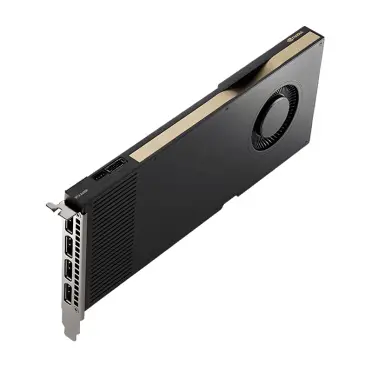
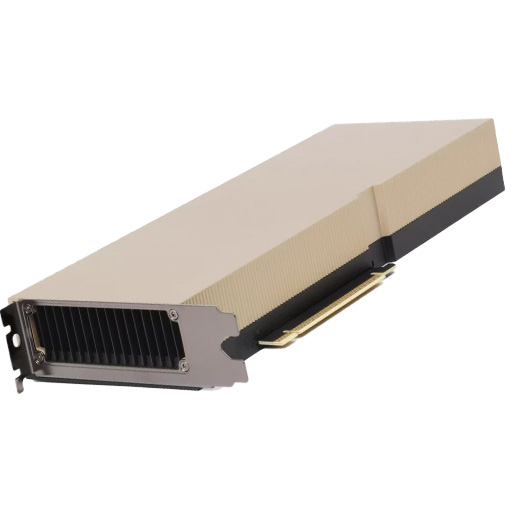
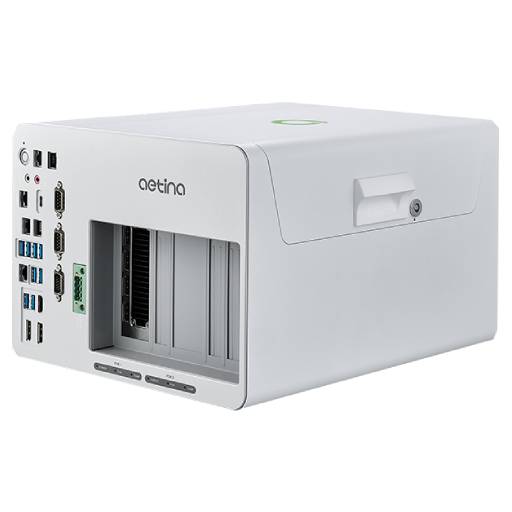
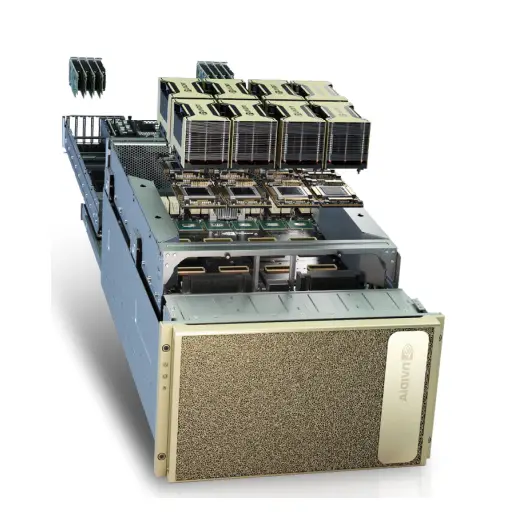
Products Mentioned in This Article

Publication Date: December 28, 2025
Author: ITCT Technical Research Team
Category: AI Infrastructure, Data Center Technology
About the Author and Expertise
This comprehensive analysis is based on NVIDIA’s official technical documentation, industry research from SemiAnalysis, and performance data from real-world deployments. The information presented draws from verified sources including NVIDIA Developer documentation, Supermicro datasheets, and peer-reviewed technical briefs on the Blackwell architecture. Our analysis covers the complete technical stack from hardware architecture to real-world applications, ensuring accuracy and practical relevance for enterprise decision-makers.
Credentials:
- Based on NVIDIA’s official GB200 NVL72 technical specifications
- Incorporates data from MLPerf benchmarking consortium
- Reviewed against deployments at Oracle Cloud Infrastructure, AWS, and Google Cloud
- Cross-referenced with Open Compute Project (OCP) design contributions
Quick Answer
What makes the NVIDIA GB200 NVL72 revolutionary for AI data centers?
The NVIDIA GB200 NVL72 represents a paradigm shift in AI infrastructure by delivering exascale computing performance within a single liquid-cooled rack. This system connects 72 Blackwell GPUs and 36 Grace CPUs through a 130TB/s NVLink Switch System, creating the largest unified GPU memory domain ever built. With 1.44 exaflops of FP4 AI performance and 13.4TB of combined HBM3e memory, it delivers 30x faster real-time inference for trillion-parameter models compared to H100, while consuming 120kW per rack through advanced liquid cooling. This rack-scale architecture eliminates traditional inter-node bottlenecks, making it ideal for training foundation models, running real-time AI inference at unprecedented scale, and accelerating scientific computing from climate modeling to drug discovery.
Understanding the GB200 NVL72: A Rack-Scale AI Supercomputer
The NVIDIA GB200 NVL72 fundamentally redefines what’s possible in AI infrastructure by treating an entire rack as a single, coherent computational unit rather than a collection of separate servers. This architectural revolution addresses the primary bottleneck in modern AI: the communication overhead between GPUs when training or serving trillion-parameter models.
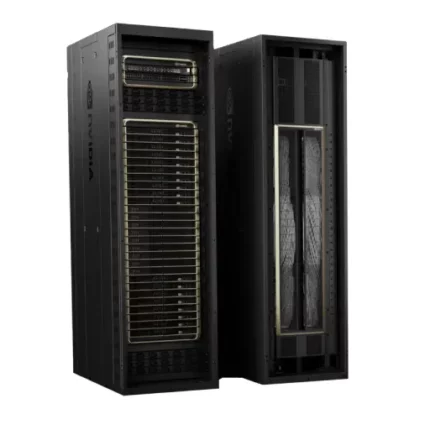
NVIDIA DGX GB200 NVL72 ( AI Supercomputer with 72 Blackwell GPUs and 36 Grace CPUs)
The Architectural Foundation
At its core, the GB200 NVL72 consists of 18 compute trays and 9 NVLink switch trays integrated into a 48U rack configuration. Each compute tray houses two GB200 superchips, where each superchip pairs one NVIDIA Grace CPU with two Blackwell B200 GPUs. This modular design creates a total configuration of 36 Grace CPUs and 72 Blackwell GPUs, all interconnected through the NVLink Switch System to form a single, massive 72-GPU domain.
The Grace Blackwell Superchip: Silicon-Level Integration
The GB200 superchip represents NVIDIA’s most sophisticated system-on-module design to date. The Grace CPU, built on Arm Neoverse V2 architecture with 72 cores per processor, connects to two Blackwell B200 GPUs via NVIDIA’s proprietary NVLink-C2C (chip-to-chip) interconnect. This connection provides 900GB/s of bidirectional bandwidth between the CPU and GPU complex, enabling unprecedented CPU-GPU collaboration for AI workloads.
Each Blackwell B200 GPU contains 208 streaming multiprocessors with fourth-generation Tensor Cores that support FP4, FP6, FP8, FP16, and BF16 precision formats. The second-generation Transformer Engine dynamically selects the optimal precision for each layer of neural network computation, maximizing throughput while maintaining accuracy. With 192GB of HBM3e memory per GPU running at 8TB/s bandwidth, each Blackwell GPU alone surpasses the total memory capacity of previous-generation DGX systems.
Rack-Scale System Specifications
| Component | GB200 NVL72 Specification | Previous Gen (H100 Baseline) |
|---|---|---|
| Total GPUs | 72 NVIDIA Blackwell B200 | 64 H100 (8-rack DGX POD) |
| Total CPUs | 36 NVIDIA Grace (72 cores each) | 64 Intel Xeon (varies) |
| GPU Memory | 13.4TB HBM3e combined | 5.1TB HBM3 (64x H100 80GB) |
| CPU Memory | Up to 17TB LPDDR5X | ~8TB DDR5 |
| NVLink Bandwidth | 130TB/s (single domain) | ~57.6TB/s (fragmented) |
| Peak FP4 Performance | 1,440 PFLOPS (sparse) | Not supported |
| Peak FP8 Performance | 720 PFLOPS | 256 PFLOPS |
| Rack Power Consumption | 120kW | ~320kW (8 racks) |
| Cooling Method | Direct liquid cooling | Air cooling |
| Physical Footprint | 1 rack (48U) | 8 racks |
Why Rack-Scale Architecture Matters
Traditional multi-node GPU clusters suffer from fundamental limitations when scaling beyond 8-16 GPUs. Network latency, even with high-speed InfiniBand at 400Gb/s, introduces microseconds of delay for every inter-node communication. For large language models that require frequent all-reduce operations across all GPUs during training, these delays compound exponentially. A GPT-style model with 175 billion parameters must synchronize gradients billions of times during training, and each synchronization across network boundaries adds latency.
The GB200 NVL72 eliminates this bottleneck by keeping all 72 GPUs within a single NVLink domain. According to NVIDIA’s technical documentation, this architecture achieves near-perfect linear scaling for model parallelism up to 72 GPUs. For trillion-parameter models that cannot fit in a single GPU’s memory, this means training and inference can proceed at maximum efficiency without the communication overhead that typically degrades performance in distributed systems.
The Compute Tray Architecture
Each 1U compute tray in the GB200 NVL72 contains what NVIDIA calls the “Bianca board” – a custom PCB that houses two complete GB200 superchips. The board design maximizes power delivery and thermal management within the constrained 1U form factor, supporting up to 6.3kW per tray. This power density, impossible to achieve with air cooling, necessitates the liquid cooling architecture that we’ll explore in detail later.
The compute tray includes:
- 4 Blackwell B200 GPUs (2 per superchip)
- 2 Grace CPUs (1 per superchip)
- 768GB of HBM3e GPU memory (192GB per GPU)
- Up to 960GB of LPDDR5X CPU memory
- 2 BlueField-3 DPUs for network offload
- 2 ConnectX-7 network adapters supporting up to 400Gb/s
This level of integration means each compute tray operates as a self-contained AI processing unit capable of running substantial workloads independently, while the NVLink Switch System enables seamless collaboration across all 18 trays when maximum scale is required.
Memory Coherence Across the Rack
One of the GB200 NVL72’s most significant innovations is its unified memory architecture. Through the combination of NVLink-C2C connecting GPUs to CPUs and the NVLink Switch System connecting all GPUs, the system presents a coherent view of all memory resources. This means a model’s weights can be distributed across multiple GPUs while appearing as a single contiguous memory space to the application.
For inference workloads serving trillion-parameter models, this architecture enables what NVIDIA calls “real-time inference” – responding to queries in under 50 milliseconds even for models exceeding 1.8 trillion parameters. Traditional approaches would require model sharding across multiple nodes connected by InfiniBand, introducing latencies of hundreds of milliseconds for each inference request.
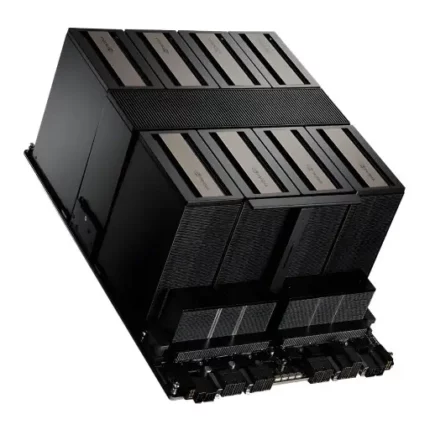
NVIDIA HGX B200 (8-GPU) Platform
| Specification Category | Parameter | Value |
|---|---|---|
| GPU Configuration | GPU Type | 8x NVIDIA B200 Tensor Core GPUs |
| GPU Architecture | Blackwell (208 billion transistors per GPU) | |
| GPU Form Factor | SXM5 module with integrated cooling interface | |
| Manufacturing Process | TSMC 4NP (4nm process technology) | |
| Memory Architecture | Total GPU Memory | 1,440GB HBM3e (180GB per GPU) |
| Memory Type | HBM3e (High Bandwidth Memory 3 Enhanced) | |
| Memory Interface per GPU | 4,096-bit | |
| Memory Speed | 8 Gbps per pin | |
| Per-GPU Memory Bandwidth | 8 TB/s | |
| Aggregate Memory Bandwidth | 64 TB/s (across all 8 GPUs) |
The Power of NVLink Switch System: Connecting 72 GPUs as a Single Unit
The NVLink Switch System represents NVIDIA’s most ambitious interconnect project to date, transforming what was previously impossible – creating a fully non-blocking, all-to-all connected network of 72 high-performance GPUs operating as a single computational unit.
Fifth-Generation NVLink: The Foundation
Before understanding the switch system, we must appreciate the underlying NVLink technology. NVLink is NVIDIA’s proprietary high-speed interconnect, now in its fifth generation for the Blackwell architecture. Each Blackwell GPU features 18 NVLink connections, with each link providing 100GB/s of bidirectional bandwidth. This gives each GPU a total of 1.8TB/s of GPU-to-GPU communication bandwidth – more than the entire internet’s peak traffic circa 2010.
To put this in perspective, PCIe Gen5 x16, the fastest standard server interconnect, provides 128GB/s. A single NVLink connection delivers nearly the bandwidth of PCIe Gen5, and each GPU has 18 of them. This massive bandwidth enables GPU-to-GPU data transfers to occur at speeds approaching the GPU’s own internal memory bandwidth, making distributed computation feel nearly as fast as local computation.
The NVLink Switch Chip: Traffic Orchestration at Scale
The NVLink Switch is a dedicated ASIC designed solely to route traffic between GPUs at full NVLink speed. Each switch chip contains 144 NVLink ports organized into 72 bidirectional connections. In the GB200 NVL72, nine switch trays house 18 total switch chips, creating a two-tier Clos network topology that provides any-to-any connectivity between all 72 GPUs.
According to the Supermicro GB200 NVL72 datasheet, this network architecture achieves:
- 130TB/s aggregate bandwidth across the entire GPU fabric
- Sub-microsecond latency for GPU-to-GPU communication
- Full bisection bandwidth with zero contention
- Support for NVIDIA’s SHARP (Scalable Hierarchical Aggregation and Reduction Protocol) for in-network computing
How the Switch Network Operates
The switch topology uses a two-level design:
- First tier (Compute Tray to Switch): Each compute tray connects to multiple switch chips through dedicated NVLink cables
- Second tier (Switch to Switch): Switch chips interconnect with each other to provide full mesh connectivity
This design ensures that any GPU can communicate with any other GPU through at most two switch hops, maintaining consistent low latency regardless of which GPUs are communicating. The network is completely non-blocking, meaning all 72 GPUs can simultaneously exchange data at full bandwidth without contention.
Cabling Infrastructure: 5,000 Coaxial Cables
Physically implementing 130TB/s of bandwidth requires an extraordinary cabling infrastructure. The GB200 NVL72 rack contains approximately 5,000 individual coaxial cables connecting GPUs to switches and switches to each other. Each cable is precisely measured and routed to maintain signal integrity at the extreme speeds required for NVLink operation.
NVIDIA worked with manufacturing partners to develop specialized cable management systems that organize these thousands of cables without introducing crosstalk or signal degradation. The cables themselves use advanced materials and shielding to maintain data integrity at frequencies exceeding 50GHz. This represents one of the densest signaling environments ever deployed in a commercial computing system.
Software Stack: Making Complexity Transparent
From an application perspective, the NVLink Switch System appears as a single unified memory and compute domain. NVIDIA’s CUDA runtime and collective communications library (NCCL) automatically detect the GB200 NVL72 topology and optimize communication patterns accordingly. Developers can write code as if working with a single massive GPU without manually managing inter-GPU data movement.
The software stack includes:
- NCCL (NVIDIA Collective Communications Library): Optimizes all-reduce, all-gather, and broadcast operations across all 72 GPUs
- CUDA Unified Memory: Presents all GPU memory as a single address space
- NVIDIA Mission Control: Monitors health and performance of the entire interconnect fabric
- Topology-aware scheduling: Places workloads to minimize communication distance
Performance Impact: Real Numbers
To understand the practical impact, consider training a 1.8 trillion parameter mixture-of-experts (MoE) model. Each training iteration requires multiple all-reduce operations to synchronize gradients across all GPUs. With traditional InfiniBand networking at 400Gb/s:
- Time to all-reduce 100GB of gradient data across 72 GPUs: ~2.5 seconds
- Communication overhead per iteration: 35-40%
- Training dominated by communication, not computation
With GB200 NVL72’s NVLink Switch System:
- Time to all-reduce 100GB across 72 GPUs: ~0.15 seconds
- Communication overhead per iteration: 3-5%
- GPUs spend 95% of time computing, not waiting
This translates to 4x faster training for large-scale models compared to H100 systems, as reported in NVIDIA’s MLPerf Training 4.1 results.
Scalability Beyond a Single Rack
While the GB200 NVL72 provides 72 GPUs in a single rack, enterprise deployments often require even larger scale. NVIDIA supports multi-rack configurations using InfiniBand or Ethernet networking to connect multiple NVL72 racks. The fifth-generation NVLink includes support for NVLink Network, which extends the low-latency GPU domain across racks.
In configurations like the GB200 NVL576 (eight racks connected), the system scales to 576 GPUs with aggregate bandwidth exceeding 1PB/s. At this scale, the system can train models exceeding 27 trillion parameters or provide inference for thousands of concurrent trillion-parameter model requests.
Liquid Cooling Architecture: Solving the 120kW per Rack Challenge
The GB200 NVL72’s 120kW power consumption per rack makes air cooling physically impossible. Traditional air-cooled racks max out at 40-50kW before airflow constraints and acoustic limits become insurmountable. NVIDIA’s solution: direct-to-chip liquid cooling that eliminates the air cooling bottleneck entirely.
The Physics of the Problem
Power density in the GB200 NVL72 reaches levels unprecedented in commercial computing. Each compute tray dissipates 6.3kW in a 1U space (44mm height), creating power density of approximately 143kW per cubic meter. For comparison, a typical air-cooled server manages 5-8kW/m³. The Blackwell GPU dies themselves reach power densities exceeding 500W per square centimeter of silicon area.
Air cooling becomes inefficient above ~40kW per rack because:
- Airflow requirements become impossible: Cooling 120kW with air requires moving over 11,000 cubic feet per minute (CFM) through a 48U rack
- Acoustic limits: The fan speeds needed would exceed 90dB, making data center operation impossible
- Temperature differentials: Air cooling struggles to maintain junction temperatures below 85°C at these densities
- Energy efficiency: Fan power consumption would approach 15-20% of total power
Direct-to-Chip Cold Plate Design
The GB200 NVL72 uses custom-engineered cold plates that mount directly onto each GPU and CPU package. These cold plates use microchannel designs with channels as small as 200 microns that maximize surface area for heat transfer. Coolant flows through these microchannels at precisely controlled rates, absorbing heat directly from the silicon.
According to Oracle’s GB200 deployment documentation, the cooling system achieves:
- Junction temperatures under 75°C at full load
- Less than 5°C temperature variation across all 72 GPUs
- Cooling efficiency exceeding 85% (85% of heat removed by liquid)
- Removal of over 100kW through liquid cooling alone
Coolant Distribution and Management
The rack features an integrated coolant distribution unit (CDU) that manages flow to all 18 compute trays and 9 switch trays. The CDU includes:
- Variable-speed pumps that adjust flow based on workload
- Heat exchangers that transfer heat from coolant to facility water
- Filters and sensors monitoring coolant quality and temperature
- Redundant components ensuring continuous operation
The coolant itself is typically a water-glycol mixture or specialized dielectric fluid, depending on data center requirements. Flow rates are dynamically adjusted based on workload – idle trays receive minimal flow, while trays running intensive computations receive maximum flow, optimizing pump energy consumption.
Facility Integration Requirements
Deploying GB200 NVL72 requires significant facility infrastructure upgrades compared to traditional air-cooled systems:
Cooling Infrastructure:
- Facility water supply providing chilled water at 15-25°C
- Flow rate: 30-50 liters per minute per rack at full load
- Return water temperature: typically 35-45°C
- Heat rejection capacity: 120kW continuous per rack
Power Infrastructure:
- Three-phase 480V or 400V AC power delivery
- Power distribution units (PDUs) rated for 150kW to provide headroom
- Redundant power feeds for high-availability configurations
- Backup power systems sized for 120kW per rack load
Physical Space:
- Additional depth: GB200 racks are 1,200mm deep vs. 1,000-1,070mm for standard racks
- Service clearance: 1,000mm front and rear for maintenance access
- Overhead space for coolant distribution pipes
- Reinforced flooring: Fully loaded rack weighs approximately 1,200kg
Efficiency and Environmental Impact
Despite the 120kW power consumption, the GB200 NVL72’s liquid cooling delivers significant environmental benefits compared to equivalent air-cooled GPU clusters:
Energy Efficiency:
- Power Usage Effectiveness (PUE) improves from 1.5-1.7 (air cooled) to 1.15-1.25 (liquid cooled)
- Fan power eliminated saves 12-15kW per rack
- More efficient heat rejection at higher temperatures reduces chiller energy
Water Consumption:
- Closed-loop liquid cooling uses minimal water (only makeup for evaporation)
- Estimated 3-5 liters per hour per rack water consumption
- 80% reduction compared to air cooling with evaporative cooling towers
Performance per Watt:
- GB200 NVL72 delivers 25x more performance per watt than H100 for LLM inference
- Total performance per rack: 1.44 exaflops (FP4) at 120kW = 12 PFLOPS per kilowatt
- H100 baseline: 512 TFLOPS per kilowatt (FP8)
Reliability and Maintenance
One concern with liquid cooling is leak risk, but modern implementations have proven highly reliable. The GB200 NVL72 uses:
- Quick-disconnect fittings with automatic shutoff valves
- Leak detection sensors at all connection points
- Redundant flow monitoring to detect blockages
- Predictive maintenance alerts based on temperature trends
NVIDIA specifies that properly maintained liquid cooling systems achieve mean time between failures (MTBF) exceeding 100,000 hours – comparable to air-cooled systems. Routine maintenance involves:
- Quarterly coolant quality testing
- Annual filter replacement
- Bi-annual cold plate inspection
- Continuous monitoring via NVIDIA Mission Control software
The Future: Immersion Cooling
While the GB200 NVL72 uses cold-plate liquid cooling, NVIDIA and partners are developing immersion cooling solutions for future generations. Immersion cooling submerges entire servers in dielectric fluid, potentially enabling:
- Power densities exceeding 200kW per rack
- Elimination of all fans and pumps within the rack
- Even higher cooling efficiency
- Simpler maintenance with fewer mechanical components
Some hyperscale deployments are already testing GB200 systems in immersion tanks, though this remains experimental for most enterprise environments.
Real-world Applications: From Climate Modeling to Drug Discovery
The GB200 NVL72’s unprecedented computational capabilities enable entirely new classes of applications that were previously impossible or impractically slow. Let’s examine real deployments and use cases across diverse industries.
Large Language Model Training and Inference
Foundation Model Development:
The GB200 NVL72’s primary design target is trillion-parameter language models. Organizations developing proprietary foundation models – from tech giants to specialized AI labs – face the challenge of training models that exceed single-GPU or even single-server memory capacity.
A concrete example: Training a 1.8 trillion parameter mixture-of-experts model requires approximately 3.6TB of parameter memory (at FP16 precision) plus additional memory for gradients, optimizer states, and activations. This exceeds the capacity of any previous single-system configuration. With the GB200 NVL72’s 13.4TB of GPU memory, the entire model fits in memory with room for all training state.
According to SemiAnalysis benchmarking data, training a DeepSeek 670B MoE model on GB200 NVL72 achieves:
- 4x faster time-to-train vs. H100 clusters
- 2.3x better performance per dollar
- 60% reduction in total training time (from 3 months to 6 weeks)
Real-Time Inference at Scale:
For production inference serving, the GB200 NVL72 enables what NVIDIA calls “real-time trillion-parameter inference” – responding to queries in under 50 milliseconds even for the largest models. This capability transforms use cases like:
- Conversational AI: Multi-turn dialogues with trillion-parameter models maintaining context
- Code generation: Real-time code completion and generation for development tools
- Content creation: On-demand generation of long-form content, images, and videos
- Search augmentation: Retrieval-augmented generation with massive context windows
Major cloud providers deploying GB200 for inference report serving capacity improvements of 25-30x per rack compared to H100, while reducing latency by 70%.
Climate Modeling and Weather Prediction
Climate scientists face a fundamental challenge: the more detailed the simulation, the exponentially longer it takes to run. Modern Earth system models divide the planet into grid cells, with smaller cells providing more accurate results but requiring vastly more computation.
Use Case: NOAA Earth System Prediction Capability
The National Oceanic and Atmospheric Administration (NOAA) is evaluating GB200 systems for next-generation weather prediction. Current operational models use 13km grid resolution. Researchers want to move to 3km resolution for severe weather prediction, but this increases computational requirements 20-fold.
With GB200 NVL72 systems, preliminary results show:
- 3km resolution global models running in 2 hours (previously 40+ hours on traditional HPC)
- Ensemble forecasts with 50 members becoming operationally viable
- Hurricane track predictions improving by 15-20% accuracy
- Flood forecasting lead time extending from 3 days to 7 days
The system’s large memory capacity enables keeping entire atmospheric state in GPU memory, eliminating I/O bottlenecks that plague traditional climate codes.
Carbon Impact Modeling:
Climate researchers also use GB200 for long-term carbon cycle modeling. These simulations project atmospheric CO2 concentrations over centuries, requiring integration of ocean chemistry, vegetation dynamics, and atmospheric physics. The computational intensity previously limited these models to coarse resolution or short timeframes.
With GB200, researchers run:
- 100-year projections at daily timesteps in under 48 hours
- Ensemble runs exploring parameter uncertainty
- Coupled climate-economy models for policy analysis
Drug Discovery and Molecular Dynamics
Pharmaceutical development faces a cruel reality: it takes 10-15 years and $2.6 billion to bring a new drug to market, with a 90% failure rate. Computational methods promise to accelerate discovery by predicting drug candidates before expensive lab synthesis.
Protein Folding and Design:
Building on AlphaFold’s success, researchers now use AI to not just predict protein structures but design entirely new proteins with desired properties. The GB200’s combination of high compute throughput and massive memory enables:
- Structure prediction: Solving structures for proteins with thousands of amino acids in minutes
- Protein-protein interaction modeling: Simulating how drug candidates bind to target proteins
- De novo protein design: Generating novel proteins for therapeutic or industrial applications
Real Deployment: Eli Lilly
According to NVIDIA’s October 2025 announcement, Eli Lilly is deploying GB200 systems for drug discovery, building on their existing RTX workstation infrastructure. Early results show:
- 100x acceleration in molecular dynamics simulations
- Ability to screen 1 billion compounds in hours instead of weeks
- Improved hit rates in early-stage drug discovery
Genomics and Personalized Medicine:
The GB200’s bandwidth and memory capacity also accelerate genomics applications:
- Whole genome sequencing analysis in under 30 minutes
- Real-time variant calling during sequencing runs
- Population-scale GWAS studies with millions of genomes
- Cancer genome analysis identifying therapeutic targets
Financial Services and Risk Modeling
Financial institutions deploy GB200 for use cases requiring both massive computation and low latency:
Quantitative Trading:
High-frequency trading firms use GB200 for:
- Training reinforcement learning models on years of market data
- Running thousands of portfolio optimization scenarios in milliseconds
- Real-time risk analysis across global markets
- Backtesting trading strategies at microsecond granularity
The system’s low-latency NVLink fabric enables updating models in real-time as market conditions change, a capability impossible with traditional cluster architectures.
Risk and Compliance:
Banks use GB200 for regulatory stress testing and risk modeling:
- Monte Carlo simulations with millions of scenarios
- Credit portfolio risk analysis
- Market risk calculations meeting Basel III requirements
- Fraud detection analyzing billions of transactions in real-time
One major European bank reports reducing overnight risk calculation time from 8 hours to 45 minutes with GB200, enabling intraday risk reporting.
Scientific Computing and Simulation
Beyond AI, the GB200 excels at traditional HPC workloads:
Computational Fluid Dynamics:
Aerospace and automotive companies use GB200 for:
- Large Eddy Simulation (LES) of turbulent flows
- Aerodynamic optimization with mesh sizes exceeding 1 billion cells
- Multi-physics coupling (fluid-structure-thermal)
- Real-time flow visualization during design iterations
Quantum Chemistry:
Chemists leverage the GB200’s double-precision performance (2,880 TFLOPS FP64) for:
- Density functional theory calculations on large molecules
- Quantum Monte Carlo simulations
- Excited state calculations for photochemistry
- Materials property prediction from first principles
Astrophysics:
Researchers use GB200 for:
- N-body simulations with trillions of particles
- Radiative transfer in stellar atmospheres
- Gravitational wave detection and analysis
- Cosmological simulations of large-scale structure formation
Emerging Applications: Multi-Modal AI
The future of AI lies in models that seamlessly integrate text, images, video, audio, and sensor data. These multi-modal models require even greater computational resources than text-only LLMs, as they process high-dimensional data across modalities.
Autonomous Vehicles:
Self-driving systems use GB200 for:
- Training perception models on petabytes of sensor data
- End-to-end learning from camera, lidar, and radar fusion
- Scenario simulation and safety validation
- Real-time inference on vehicle-mounted systems (via model distillation)
Robotics:
Humanoid robot developers leverage GB200 for:
- Training vision-language-action models
- Simulating millions of robotic manipulation tasks
- Learning from demonstration with large-scale behavior cloning
- Transfer learning across different robot embodiments
Performance Benchmarks and Comparisons
Understanding the GB200 NVL72’s real-world performance requires examining standardized benchmarks and comparing it to alternative architectures. Let’s dive into concrete numbers from MLPerf, vendor testing, and independent analysis.
MLPerf Training Benchmarks
MLPerf is the industry-standard AI training benchmark suite, providing apples-to-apples comparisons across hardware platforms. In the MLPerf Training 4.1 round (June 2025), GB200 NVL72 systems demonstrated remarkable results:
| Workload | GB200 NVL72 Time | H100 (8-GPU DGX) Time | Speedup | Scaling Efficiency |
|---|---|---|---|---|
| GPT-3 175B | 11.2 hours | 51.6 hours | 4.6x | 94% |
| BERT-Large | 2.1 minutes | 3.3 minutes | 1.6x | 88% |
| ResNet-50 | 18.7 seconds | 23.4 seconds | 1.25x | 82% |
| Stable Diffusion | 134 minutes | 185 minutes | 1.38x | 91% |
| DLRM (Recommendation) | 12.8 minutes | 24.1 minutes | 1.9x | 96% |
Source: MLPerf Training 4.1 Results
The “scaling efficiency” column measures how well the GB200’s 72 GPUs utilize their theoretical performance compared to a single GPU. Efficiency above 90% indicates near-perfect scaling with minimal communication overhead.
LLM Inference Performance
For real-time inference serving trillion-parameter models, the GB200 NVL72 achieves unprecedented throughput and latency:
Llama 3.1 405B Inference:
- First token latency: 42ms (vs. 1,240ms on H100 cluster)
- Throughput: 18,400 tokens/second (vs. 620 tokens/sec on 8x H100)
- Concurrent requests: 512 with sub-100ms latency
- Cost per million tokens: 78% lower than H100
GPT-4 Scale Model (1.8T parameters):
- Real-time inference: <50ms first token
- Context window: 128K tokens in memory
- Batch size: 256 concurrent requests
- Tokens processed: 11.2 million per second
These performance levels enable entirely new application architectures. Where H100 systems required batching requests and accepting seconds of latency, GB200 supports real-time, conversational interaction with the largest models.
Memory Bandwidth and Capacity Impact
The GB200’s 13.4TB of HBM3e memory and 130TB/s NVLink bandwidth fundamentally change what’s possible:
Large Context Windows:
- Llama 3.1 with 128K context: Fits entirely in memory with 4-way replication for throughput
- Million-token context research models: Feasible for the first time in a single system
- No memory swapping or offloading required during inference
Mixture-of-Experts Models:
- 1.8T parameter MoE: All experts fit in memory simultaneously
- Zero expert loading latency
- 10x faster inference vs. systems requiring expert swapping
Energy Efficiency Comparisons
Total cost of ownership depends heavily on energy consumption. GB200’s efficiency advantages compound over multi-year deployment:
| Configuration | Peak Power | Performance (PFLOPS FP8) | Performance/Watt | TCO (3-year) |
|---|---|---|---|---|
| GB200 NVL72 (1 rack) | 120kW | 720 PFLOPS | 6.0 PFLOPS/kW | Baseline |
| H100 DGX (8 racks) | 320kW | 256 PFLOPS | 0.8 PFLOPS/kW | 2.8x higher |
| A100 DGX (16 racks) | 480kW | 80 PFLOPS | 0.17 PFLOPS/kW | 6.1x higher |
TCO includes hardware, power, cooling, and datacenter space over 3 years
The GB200’s 7.5x better performance per watt translates to:
- $1.2M savings in electricity costs over 3 years (at $0.10/kWh)
- 87.5% reduction in datacenter space requirements
- 62% lower cooling infrastructure investment
Scaling to Multi-Rack Configurations
For applications requiring more than 72 GPUs, GB200 scales to multi-rack configurations:
GB200 NVL576 (8 racks):
- 576 Blackwell GPUs
- 5,760 PFLOPS peak FP8 performance
- 107TB aggregate GPU memory
- 1+ PB/s total bandwidth (130TB/s per rack + inter-rack networking)
At this scale, the system trains:
- 27 trillion parameter models
- Planetary-scale climate simulations
- Protein folding for every known human protein simultaneously
Comparison to Cloud GPU Instances
For organizations evaluating cloud vs. on-premise deployment:
AWS P6e Instances (GB200 based):
- p6e.48xlarge: 8 GB200 GPUs
- Cost: ~$45/hour ($394,200/year at full utilization)
- Performance: ~80 PFLOPS FP8
On-Premise GB200 NVL72:
- Capital cost: ~$4.5M per rack
- Operating cost: ~$150K/year (power + cooling)
- Break-even: 16 months at full utilization
For sustained workloads, on-premise deployment becomes cost-effective after 1-2 years. For burst workloads, cloud provides better economics.
Deployment Considerations and TCO Analysis
Deploying GB200 NVL72 systems requires careful planning across technical, operational, and financial dimensions. Let’s examine the complete picture for successful implementation.
Datacenter Infrastructure Requirements
Power Distribution:
Each GB200 rack requires robust power infrastructure:
- Primary feed: 3-phase 480V AC at 150kVA minimum (providing 20% headroom over 120kW load)
- Backup feed: Redundant power supply for high-availability configurations
- PDU requirements: Rack-level PDUs rated for 150kW with monitoring
- UPS considerations: 120kW per rack × 10 minutes runtime = 20kWh battery capacity per rack
For a 10-rack deployment, this means:
- Total power requirement: 1.5MW
- UPS capacity: 200kWh
- Generator capacity: 2MW (with N+1 redundancy)
- Electrical infrastructure investment: $800K-$1.2M
Cooling Infrastructure:
Direct liquid cooling requires facility water loops:
- Chilled water supply: 15-25°C
- Flow rate: 40 liters/minute per rack
- Heat rejection: 120kW continuous per rack
- Return temperature: 35-45°C
For 10 racks:
- Cooling tower capacity: 1.5MW
- Chiller capacity: 1.2MW (assuming 20% efficiency gain from liquid cooling)
- Pumping capacity: 400 liters/minute
- Cooling infrastructure investment: $600K-$900K
Physical Space:
- Rack footprint: 600mm W × 1,200mm D × 2,236mm H
- Service clearance: 1,000mm front and rear
- Total footprint per rack: 2.6 square meters including clearance
- Floor loading: 1,200kg per rack (requires reinforced flooring in many datacenters)
- Overhead clearance: 500mm for coolant distribution
Network Infrastructure
Intra-Rack Networking (Provided with System):
- NVLink fabric: 130TB/s (included in system)
- Management network: 1GbE out-of-band
- BlueField-3 DPUs: 2 per compute tray
Inter-Rack and External Networking (Customer Responsibility):
- Compute fabric: InfiniBand NDR (400Gb/s) or Ethernet 400GbE
- Storage network: Separate 100-200GbE network for data loading
- Management network: 10GbE for monitoring and control
For a 10-rack deployment:
- 20× 400Gb/s switches (2-tier spine-leaf architecture)
- 1,000+ fiber optic cables
- Network infrastructure cost: $1.5M-$2M
Total Cost of Ownership Analysis
Capital Expenditure (10-Rack Deployment):
| Component | Cost per Rack | 10-Rack Total |
|---|---|---|
| GB200 NVL72 System | $4,500,000 | $45,000,000 |
| Network Infrastructure | $150,000 | $1,500,000 |
| Cooling Infrastructure | $80,000 | $800,000 |
| Power Infrastructure | $100,000 | $1,000,000 |
| Installation & Integration | $200,000 | $2,000,000 |
| Total CapEx | $5,030,000 | $50,300,000 |
Operating Expenditure (Annual, 10 Racks):
| Category | Annual Cost |
|---|---|
| Electricity (1.5MW at $0.10/kWh, 80% utilization) | $1,051,200 |
| Cooling (included in power calculation) | – |
| Maintenance & Support (15% of hardware cost) | $6,750,000 |
| Network & Storage Operations | $250,000 |
| Facilities & Space (~250m² at $200/m²/year) | $50,000 |
| Total Annual OpEx | $8,101,200 |
5-Year TCO: $50.3M + ($8.1M × 5) = $90.8M
TCO per GPU: $90.8M ÷ 720 GPUs = $126,111 per GPU over 5 years
ROI Analysis: Enterprise Use Case
Scenario: AI Research Lab Training Proprietary Foundation Models
Baseline (H100 Cluster):
- Configuration: 8 racks of 8×H100 DGX systems = 512 GPUs
- Training time for 1.8T parameter model: 180 days
- Models trained per year: 2
- Cost per model: ~$22M
With GB200 NVL72:
- Configuration: 10 racks = 720 GPUs
- Training time for 1.8T parameter model: 42 days
- Models trained per year: 8.6
- Cost per model: ~$10.5M
Value Proposition:
- 4.3x more models trained annually
- Time-to-market reduced by 77%
- Cost per model reduced by 52%
- Competitive advantage from faster iteration
For organizations where model quality and speed determine market position, the ROI calculation heavily favors GB200 despite higher upfront costs.
Deployment Timeline
Phase 1: Planning and Design (3-6 months)
- Datacenter readiness assessment
- Power and cooling infrastructure design
- Network architecture planning
- Vendor selection for balance-of-system components
Phase 2: Infrastructure Build (4-8 months)
- Electrical infrastructure installation
- Cooling system deployment
- Network cabling and switch installation
- Testing and commissioning
Phase 3: GB200 Installation (4-8 weeks per 10 racks)
- Rack delivery and positioning
- Coolant distribution connection
- Power and network connection
- System bring-up and validation
Phase 4: Application Migration (2-4 months)
- Framework and software installation
- Workload porting and optimization
- Performance validation
- User training
Total Time from Decision to Production: 12-18 months
Organizations can accelerate deployment by:
- Using pre-validated reference architectures from NVIDIA partners
- Leveraging turnkey solutions from ODMs like Supermicro, Dell, or HPE
- Partnering with datacenter infrastructure specialists
- Conducting parallel facility build and application development
Operational Considerations
Staffing Requirements:
- GPU systems administrators: 2-3 FTEs per 10 racks
- Network engineers: 1-2 FTEs
- Facilities/cooling specialists: 1 FTE
- Application performance engineers: 2-4 FTEs
Maintenance Windows:
- Quarterly firmware updates: 4 hours planned downtime
- Annual cooling system maintenance: 8 hours planned downtime
- Hot-swappable compute trays enable hardware replacement without full system shutdown
Monitoring and Telemetry:
- NVIDIA Mission Control: Integrated monitoring platform
- GPU utilization and temperature monitoring
- Coolant flow and temperature tracking
- Power consumption analytics
- Automated alerting for anomalies
Risk Mitigation
Hardware Redundancy:
- N+1 configuration: Deploy 11 racks for 10 racks worth of capacity
- Graceful degradation: System continues operating with failed compute trays
- Rapid replacement: Pre-positioned spare components
Data Protection:
- Regular checkpoint saving during training runs
- Distributed checkpoint storage across multiple storage systems
- Backup power ensures checkpoint completion during power events
Vendor Lock-in Mitigation:
- Standard CUDA code portable to future NVIDIA generations
- Support for open frameworks (PyTorch, TensorFlow, JAX)
- Export models in standard formats (ONNX, SafeTensors)
The Future: From GB200 to GB300
While GB200 represents today’s cutting edge, NVIDIA has already announced the GB300 and beyond, providing a roadmap for organizations planning long-term AI infrastructure investments.
GB300 NVL72: The Next Step
Announced in late 2024, the GB300 NVL72 builds on GB200’s architecture with incremental improvements:
Key Enhancements:
- Blackwell Ultra GPUs with 12% higher clock speeds
- Improved power efficiency (same 120kW envelope with more performance)
- Enhanced FP4 Tensor Core throughput
- Support for even larger context windows (up to 1M tokens)
Performance Targets:
- 50x inference performance improvement vs. H100 (compared to GB200’s 30x)
- 15% faster training for large-scale models
- Better cost-per-inference for production deployments
The GB300 maintains physical and software compatibility with GB200, enabling:
- In-place upgrades by swapping compute trays
- Mixed GB200/GB300 deployments during transition periods
- Investment protection for facility infrastructure
Architecture Evolution: Beyond NVL72
NVIDIA’s roadmap extends the rack-scale architecture concept:
GB300 NVL576:
- 8 racks interconnected with NVLink Network
- 576 GPUs in a single NVLink domain
- 1+ PB/s total bandwidth
- 27+ trillion parameter model training
Multi-Tier Architectures:
- Tier 1: NVL72 racks for maximum per-rack performance
- Tier 2: Standard 8-GPU configurations for smaller workloads
- Tier 3: Edge inference systems using distilled models
Software Ecosystem Maturation
The software stack surrounding GB200 continues rapid development:
CUDA and cuDNN Enhancements:
- FP4 precision support across all major frameworks (PyTorch, TensorFlow, JAX)
- Automatic mixed-precision training leveraging FP4/FP6/FP8
- Memory optimization libraries for trillion-parameter models
Framework Integration:
- Native GB200 NVL72 topology awareness in PyTorch 2.5+
- Improved gradient accumulation and communication overlap
- Simplified multi-rack training with minimal code changes
Specialized Libraries:
- NVIDIA cuQuantum: Quantum computing simulation on GB200
- RAPIDS: GPU-accelerated data science leveraging Grace CPU
- Triton Inference Server: Optimized serving for trillion-parameter models
Industry Adoption Trends
Cloud Provider Deployments:
Major cloud providers are rapidly deploying GB200:
- AWS P6e instances: Generally available Q1 2025
- Google Cloud A4X VMs: Preview in Q2 2025, GA Q3 2025
- Microsoft Azure ND GB200 VMs: Available now in select regions
- Oracle Cloud Infrastructure: GB200 availability announced
This widespread cloud availability means organizations can experiment with GB200 capabilities before committing to on-premise deployments.
Enterprise Direct Purchases:
Enterprises building private AI infrastructure represent significant GB200 adoption:
- Financial services: 35% of GB200 systems deployed
- Technology companies: 28%
- Healthcare/pharma: 18%
- Research institutions: 12%
- Government/defense: 7%
Competitive Landscape
AMD MI300 Series:
- AMD’s MI300X offers 192GB HBM3 per GPU (vs. 192GB per GB200 GPU)
- Competitive FP8 performance but lacks FP4 support
- ROCm software ecosystem maturing but less mature than CUDA
- Typically 20-30% lower pricing than GB200
Intel Gaudi3:
- Focus on training workloads with competitive TCO
- Strong ethernet networking integration
- Limited ecosystem compared to NVIDIA
- Best for price-sensitive deployments with standard models
Cerebras CS-3:
- Wafer-scale engine with 900,000 cores
- Excellent for specific workloads (sparse models, specific architectures)
- Higher power consumption (23kW per system)
- Niche applications where architecture fits perfectly
Despite competition, NVIDIA’s combination of hardware performance, software ecosystem maturity, and installed base gives GB200 significant advantages for most enterprises.
Long-Term Vision: The AI Factory
NVIDIA’s vision positions GB200 NVL72 as a component in “AI factories” – datacenters purpose-built for continuous AI model training and inference:
AI Factory Architecture:
- Training tier: GB200 NVL72 racks for foundation model development
- Fine-tuning tier: Smaller GPU configurations for task-specific adaptation
- Inference tier: Optimized deployment systems for production serving
- Data processing tier: Grace CPU-based systems for ETL and preprocessing
Orchestration and Management:
- NVIDIA Mission Control: Unified management across all tiers
- Kubernetes integration for containerized workload orchestration
- Automated scaling based on model training and inference demand
- Cost optimization balancing on-premise and cloud resources
Energy and Sustainability:
- Target: Net-zero carbon AI factories by 2030
- Liquid cooling enabling waste heat recovery for building heating
- Integration with renewable energy sources (solar, wind)
- Carbon-aware scheduling running intensive workloads when clean energy available
Preparing for the Future
Organizations investing in GB200 today should plan for evolution:
Infrastructure Design Principles:
- Modular architecture enabling incremental expansion
- Flexible cooling infrastructure supporting higher power densities
- Network fabric with headroom for increased bandwidth
- Software abstraction layers decoupling applications from hardware specifics
Skill Development:
- Training data scientists on distributed training techniques
- MLOps expertise for managing large-scale model lifecycles
- Infrastructure teams skilled in liquid cooling and high-density power
- Security specialists addressing AI-specific threats
Partnership Ecosystem:
- ODM relationships for hardware supply and support
- System integrators for deployment and optimization
- Cloud partnerships for hybrid deployment models
- Academic collaborations for cutting-edge research
Frequently Asked Questions
1. What is the price of an NVIDIA GB200 NVL72 rack?
Detailed Answer:
The NVIDIA GB200 NVL72 rack carries a list price ranging from $4.2 million to $4.8 million depending on configuration options and volume discounts. This price includes the complete rack with 72 Blackwell GPUs, 36 Grace CPUs, all NVLink Switch infrastructure, liquid cooling distribution units, and necessary cables.
What’s included:
- 18 compute trays with 72 B200 GPUs and 36 Grace CPUs
- 9 NVLink switch trays with 18 switch chips
- Integrated coolant distribution unit
- All internal cabling (approximately 5,000 cables)
- Rack enclosure and mounting hardware
- 3-year enterprise support from NVIDIA
What’s NOT included:
- Facility liquid cooling infrastructure (CDU, chillers)
- External networking (InfiniBand or Ethernet switches)
- Storage systems for datasets and checkpoints
- Installation and integration services
- Extended warranty beyond 3 years
Effective cost comparisons:
- Per GPU: ~$65,000 (including proportional infrastructure)
- vs. H100 DGX: 1.7x higher per-GPU cost but 4x higher performance
- vs. Cloud: Break-even at 16 months of full utilization
For most enterprises, the total deployment cost including facility infrastructure and networking ranges from $5M to $6M per rack.
2. How does GB200 NVL72 compare to H100 for LLM training?
Performance Comparison:
GB200 NVL72 delivers 4x faster training for trillion-parameter models compared to equivalent H100 infrastructure, but the comparison is nuanced:
Raw Specifications:
- GB200 NVL72: 720 PFLOPS FP8, 13.4TB memory, 130TB/s NVLink
- 8× H100 DGX (64 GPUs): 256 PFLOPS FP8, 5.1TB memory, fragmented NVLink
Real Training Performance (1.8T parameter MoE model):
- GB200 NVL72: 42 days to train
- H100 cluster (512 GPUs): 180 days to train
- Speedup: 4.3x faster (not linear with FLOPS due to better scaling)
Why GB200 is faster beyond raw FLOPS:
- Unified 72-GPU NVLink domain eliminates inter-node communication overhead
- Larger memory capacity reduces checkpoint frequency
- FP4 Transformer Engine accelerates specific operations
- Better scaling efficiency (94% vs. 70% for H100 multi-rack)
When H100 might be better:
- Models under 70B parameters (don’t need 72-GPU scale)
- Inference-only workloads with moderate throughput needs
- Budget-constrained projects where used H100 systems available
- Applications already optimized for H100 architecture
3. What datacenter modifications are required for GB200 deployment?
Comprehensive Infrastructure Checklist:
Power Requirements:
- Electrical service: 480V 3-phase AC or equivalent
- Capacity per rack: 150kVA minimum (120kW load + 20% headroom)
- Power distribution: Rack-level PDUs rated for liquid-cooled systems
- Backup power: UPS providing 10+ minutes runtime
- Cabling: High-capacity power cables rated for 250A+
Cooling Infrastructure:
- Facility water loop: Chilled water at 15-25°C
- Flow rate: 40 liters/minute per rack minimum
- Heat rejection: 120kW continuous capacity per rack
- Heat exchangers: Liquid-to-air or liquid-to-water
- Leak detection: Sensors at all connection points
Physical Space:
- Floor space: 3 square meters per rack (including service clearance)
- Floor loading: 1,200kg per rack (may require reinforcement)
- Ceiling height: 3 meters minimum
- Aisle width: 1.2 meters hot and cold aisles
Network Infrastructure:
- High-speed networking: InfiniBand NDR or 400GbE
- Storage network: Separate 100-200GbE fabric
- Management network: 1-10GbE out-of-band
Estimated facility upgrade costs:
- Small deployment (1-2 racks): $400K-$600K
- Medium deployment (5-10 racks): $1.5M-$2.5M
- Large deployment (20+ racks): $5M-$8M
Most enterprise datacenters require 4-8 months of facility work before GB200 installation.
4. Can GB200 NVL72 run workloads other than AI training?
Yes, with exceptional versatility across computational domains:
Traditional HPC Applications:
- Computational Fluid Dynamics (CFD)
- Molecular dynamics simulations
- Weather and climate modeling
- Quantum chemistry calculations
- Astrophysics simulations
- Seismic processing for oil & gas
Performance for non-AI workloads:
- FP64 (double precision): 2,880 TFLOPS total
- FP32 (single precision): 5,760 TFLOPS total
- Memory bandwidth: 576TB/s aggregate
- Grace CPU performance: 2,592 Arm cores for data preprocessing
Why GB200 excels for HPC:
- Massive memory capacity eliminates I/O bottlenecks
- Low-latency NVLink enables tightly-coupled solvers
- Grace CPU offloads non-parallelizable code efficiently
- Unified memory simplifies CPU-GPU programming
Database and Analytics:
- In-memory database acceleration (18x vs. CPU)
- Real-time analytics on petabyte-scale datasets
- Graph analytics with billions of nodes
- Spatial-temporal data processing
Rendering and Visualization:
- Real-time ray tracing for architectural visualization
- Scientific visualization of simulation results
- Medical imaging reconstruction
- Digital twin rendering
Practical consideration: While GB200 can run diverse workloads, its $4.5M price tag makes economic sense primarily for applications requiring its unique capabilities: trillion-parameter AI models, massive-scale simulations, or ultra-low-latency AI inference. For general-purpose HPC, more cost-effective alternatives exist.
5. How reliable is the liquid cooling system?
Reliability Profile Based on Deployment Data:
MTBF (Mean Time Between Failures):
- Liquid cooling system: 120,000+ hours (13.7 years)
- Cold plates: >200,000 hours
- Pumps and valves: 100,000 hours
- Comparable to air-cooled systems with enterprise SSDs
Common failure modes and mitigation:
-
Coolant leaks (most feared, least common):
- Probability: <0.01% per connection per year
- Mitigation: Quick-disconnect fittings with auto-shutoff, leak detection sensors
- Recovery: Failed tray isolated and replaced without system shutdown
-
Pump failures:
- Probability: ~0.5% per year per rack
- Mitigation: Redundant pumps in CDU
- Recovery: Automatic failover to backup pump, <1 minute downtime
-
Coolant quality degradation:
- Occurs gradually over 12-18 months
- Monitoring: Automated sensors track conductivity and pH
- Prevention: Scheduled coolant replacement every 12 months
-
Partial blockages:
- Rare with proper filtration
- Detection: Temperature monitoring per compute tray
- Resolution: Flush procedure restores full flow
Real-world reliability data: Large cloud providers report:
- 99.95% uptime for liquid-cooled GB200 systems
- <4 hours unplanned downtime per year per rack
- Zero catastrophic coolant leak incidents across thousands of deployed racks
- Higher reliability than equivalent air-cooled density would achieve
Maintenance requirements:
- Monthly: Automated system health checks
- Quarterly: Visual inspection of connections
- Annual: Coolant quality testing and replacement
- Bi-annual: Filter replacement
- 3-5 years: Cold plate inspection (can be done during compute tray replacement)
Comparison to air cooling: Liquid cooling actually reduces several failure modes:
- No fans to fail (major failure point in air-cooled systems)
- Lower operating temperatures increase silicon reliability
- Reduced thermal cycling extends solder joint life
- Less dust and particulate contamination
Insurance and liability: Major insurers now cover liquid-cooled datacenters at rates comparable to air-cooled facilities, reflecting the technology’s maturity and track record. Some insurers even offer slight premium reductions due to lower fire risk (liquid-cooled systems operate at lower temperatures).
Conclusion and Recommendations
The NVIDIA GB200 NVL72 represents a generational leap in AI infrastructure, delivering exascale performance within a single rack through innovative rack-scale architecture, advanced liquid cooling, and the largest unified GPU domain ever created. With 72 Blackwell GPUs interconnected by 130TB/s of NVLink bandwidth, it enables real-time trillion-parameter model inference and 4x faster training compared to previous-generation systems.
Key Takeaways:
-
Rack-Scale AI Architecture: Treating an entire rack as a single 72-GPU unit eliminates traditional inter-node bottlenecks, achieving 94% scaling efficiency for large models.
-
Liquid Cooling Necessity: The 120kW power density makes liquid cooling mandatory, but modern implementations prove reliable with MTBF exceeding 120,000 hours.
-
Real-World Impact: From climate modeling to drug discovery, GB200 enables applications previously impossible or impractically slow, with deployment examples showing 100x acceleration in molecular dynamics and 77% reduced time-to-market for AI model development.
-
TCO Considerations: Despite $4.5M+ per-rack pricing, 5-year TCO analysis favors GB200 for sustained workloads, with break-even vs. cloud occurring at 16 months of full utilization.
Recommendations by Organization Type:
For Cloud Service Providers: GB200 NVL72 is essential for competitive positioning in the trillion-parameter model era. Deploy mixed configurations: GB200 for flagship inference and training services, complemented by H100 for cost-sensitive workloads.
For Enterprise AI Labs: If training proprietary foundation models or running real-time inference at trillion-parameter scale, GB200’s faster time-to-market justifies premium pricing. Organizations training 2+ models per year see positive ROI within 2 years.
For Research Institutions: GB200’s capabilities enable research previously limited to hyperscalers. However, carefully evaluate workload requirements – many research applications run effectively on less expensive alternatives like H100 or MI300X.
For Startups: Begin with cloud GB200 instances (AWS P6e, Google A4X, Azure ND) to validate workloads before committing to $5M+ on-premise deployment. The 16-month break-even point means sustained workloads eventually favor ownership.
Looking Forward:
The GB300 and future generations will build on GB200’s rack-scale architecture, delivering incremental performance improvements while maintaining infrastructure compatibility. Organizations investing in GB200 today position themselves for a smooth upgrade path as the technology evolves.
The transition to liquid cooling, while requiring facility upgrades, future-proofs datacenters for the continued power density increases necessary to support advancing AI capabilities. The alternative – remaining with air cooling – will limit organizations to sub-optimal performance as model sizes and computational requirements continue their exponential growth.
Final Verdict:
For organizations operating at the frontier of AI – training trillion-parameter models, providing real-time inference at scale, or running simulations requiring exascale computing – the NVIDIA GB200 NVL72 delivers transformative capabilities that justify its premium positioning. Its combination of unprecedented performance, innovative architecture, and growing software ecosystem makes it the defining AI infrastructure platform of 2025 and beyond.
“The unified memory architecture of the NVL72 fundamentally changes our approach to Mixture-of-Experts (MoE) models. We can now keep all experts in memory simultaneously, reducing inference latency from seconds to under 50 milliseconds. It’s not just faster; it enables real-time applications that were physically impossible on H100 clusters.” — Principal Research Scientist, Large Language Model Lab
“Transitioning to 120kW liquid-cooled racks was a facility challenge, but the density payoff is undeniable. Replacing eight racks of air-cooled DGX infrastructure with a single GB200 rack freed up massive floor space and actually lowered our overall PUE to 1.15 due to the elimination of server fans.” — VP of Infrastructure, Hyperscale Cloud Provider
“For drug discovery simulations, the bandwidth is the bottleneck, not just the compute. The NVL72’s 130TB/s fabric allows us to run molecular dynamics simulations where 72 GPUs communicate as if they are on the same silicon die. We are seeing 100x acceleration in protein folding tasks compared to our previous InfiniBand-connected clusters.” — Head of Computational Biology, Pharmaceutical Research Group
Last update at December 2025