
- Author: Lead Network Architect at ITCTShop
- Technically Reviewed By: Senior HPC Solutions Engineer (NVIDIA Certified)
- Primary Reference: NVIDIA Networking Whitepapers (Quantum-2 & Spectrum-4)
- Last Updated: December 31, 2025
- Estimated Reading Time: 12 Minutes
Quick Summary: InfiniBand or Ethernet for Your AI Cluster?
The choice between InfiniBand (Quantum-2) and RoCEv2 (Ethernet Spectrum-4) fundamentally depends on your cluster scale and organizational expertise. InfiniBand remains the gold standard for massive-scale AI training (1,000+ GPUs) and latency-sensitive workloads like Large Language Model (LLM) pre-training. Its native lossless architecture, in-network computing (SHARP), and ultra-low latency (~130ns switch latency) minimize gradient synchronization overhead, delivering predictable performance out of the box.
Conversely, RoCEv2 over Ethernet has matured significantly and is the preferred choice for organizations with deep Ethernet operational expertise and moderate-scale clusters (under 500 GPUs). While it requires meticulous configuration of Priority Flow Control (PFC) and ECN to achieve lossless behavior, it offers a lower Total Cost of Ownership (TCO) and easier integration with existing data center infrastructure. Ultimately, if maximum performance at extreme scale is the priority, choose InfiniBand; if cost efficiency and converged infrastructure are paramount, RoCEv2 is a highly capable alternative.
The exponential growth of artificial intelligence workloads has fundamentally transformed data center infrastructure requirements, placing network fabric at the center of GPU cluster performance. As organizations deploy clusters with hundreds or thousands of GPUs for training trillion-parameter foundation models, the network interconnect choice between InfiniBand and RoCEv2 (RDMA over Converged Ethernet version 2) becomes a mission-critical decision impacting training throughput, total cost of ownership, and operational complexity. This comprehensive analysis examines the technical characteristics, performance profiles, cost implications, and deployment considerations that inform network architecture decisions for large-scale AI infrastructure.

Modern GPU training workloads generate massive east-west traffic patterns fundamentally different from traditional data center applications. During distributed training, GPU nodes synchronize gradients multiple times per iteration, creating communication patterns where every microsecond of network latency directly translates to reduced training throughput. A single training job for large language models can involve thousands of GPUs exchanging terabytes of gradient data per hour, making network performance a primary determinant of cluster efficiency and return on investment.
The Networking Bottleneck: Why Your GPU Cluster Needs High-Speed Interconnects
The relationship between network performance and GPU utilization reveals why interconnect architecture matters profoundly for AI infrastructure. Modern GPUs like the NVIDIA H200 and H100 deliver extraordinary computational capabilities, with H200 providing 141GB of HBM3e memory and processing throughput measured in petaFLOPS. However, these accelerators remain idle and unproductive when waiting for network communication to complete during gradient synchronization operations.
Understanding RDMA and Lossless Fabrics
Remote Direct Memory Access technology forms the foundation of high-performance GPU cluster networking, enabling direct memory-to-memory transfers between nodes without CPU involvement. RDMA eliminates the latency and overhead associated with traditional TCP/IP networking stacks, where data must traverse multiple software layers and copy operations before reaching its destination. In RDMA-capable networks, network adapters read directly from GPU memory on the source node and write directly to GPU memory on the destination, bypassing system memory and CPU processing entirely.
Both InfiniBand and RoCEv2 implement RDMA capabilities, but through fundamentally different architectural approaches. InfiniBand was designed from inception as a lossless fabric with native RDMA support, employing credit-based flow control mechanisms that guarantee zero packet loss under all operating conditions. RoCEv2 achieves lossless operation over standard Ethernet infrastructure through Priority-based Flow Control (PFC) and Explicit Congestion Notification (ECN), requiring careful configuration to maintain RDMA guarantees.
The lossless characteristic proves critical for distributed training performance. A single lost packet requires retransmission, introducing latency measured in hundreds of microseconds while the application waits for the missing data. During all-reduce operations where every GPU must receive gradient contributions from every other GPU, packet loss creates cascading delays that severely degrade training throughput. Properly implemented lossless fabrics eliminate retransmission overhead, ensuring consistent, predictable performance even during peak traffic periods.
The Performance Impact of Network Latency
Network latency directly affects training iteration times through two primary mechanisms: the latency of individual point-to-point transfers and the amplification effect during collective communication operations. For applications employing data parallel training with frequent gradient synchronization, even microseconds of additional per-hop latency accumulate to meaningful throughput degradation at scale.
Consider a distributed training job across 512 GPUs organized in a spine-leaf topology where most communication traverses two network hops (leaf-spine-leaf). If network latency increases from 0.5 microseconds to 2.0 microseconds per hop, the round-trip communication time for gradient exchange increases from 2 microseconds to 8 microseconds. For training workloads performing gradient synchronization 100 times per second, this latency difference translates to 600 microseconds of additional overhead per second, a 0.06% reduction in effective GPU utilization that compounds over training runs measured in days or weeks.
The impact intensifies for communication-intensive workloads like large language model training where gradient synchronization occurs more frequently and involves larger data volumes. Organizations training models with hundreds of billions of parameters may perform gradient exchanges 500-1000 times per second, making network latency optimization essential for achieving acceptable training economics.
Bandwidth Requirements for Modern GPU Clusters
Bandwidth requirements scale dramatically with GPU performance improvements and cluster size expansion. A single NVIDIA H100 GPU can generate 200-400 Gbps of network traffic during gradient synchronization in distributed training scenarios, necessitating high-speed network connections to prevent communication bottlenecks. Organizations deploying 8-GPU servers typically provision dual-port 400G network adapters providing 800 Gbps total bandwidth per node, ensuring adequate capacity for simultaneous gradient exchange across all accelerators.
The aggregate bandwidth demands at the cluster level require careful network fabric design to prevent oversubscription that would limit training throughput. A 256-GPU cluster with 32 8-GPU servers, each equipped with dual 400G connections, presents 25.6 Tbps of downstream bandwidth from server-facing ports. The network spine layer must provide sufficient uplink capacity to accommodate this aggregate bandwidth without creating congestion during collective communication operations that involve all-to-all traffic patterns.
Insufficient network bandwidth manifests as reduced GPU utilization, with accelerators sitting idle while waiting for network communication to complete. The phenomenon becomes more pronounced at larger scales where the ratio of communication to computation increases. Organizations can identify bandwidth constraints through monitoring tools that show high GPU idle times correlated with network saturation metrics, indicating that additional network capacity would improve training efficiency.
NVIDIA Quantum-2 InfiniBand: The Gold Standard for Low Latency
InfiniBand technology has dominated high-performance computing and AI training clusters for over two decades, delivering performance characteristics that consistently outperform alternative networking approaches. The NVIDIA Quantum-2 InfiniBand platform represents the latest generation of this proven technology, providing 400 Gbps NDR (Next Data Rate) throughput with sub-microsecond latency that establishes the performance benchmark for AI cluster networking.
Quantum-2 Architecture and Technical Specifications
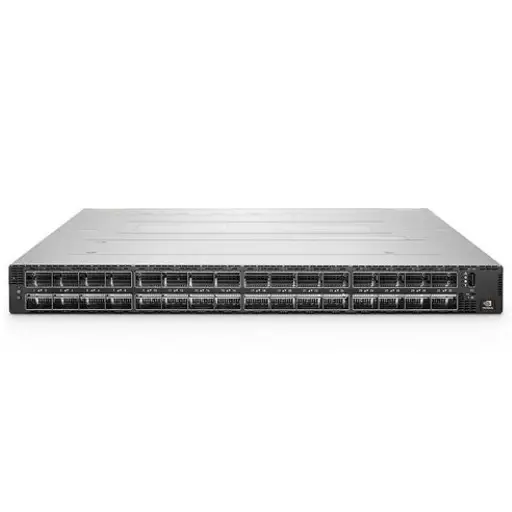
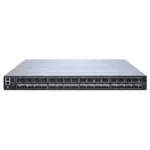
The NVIDIA Quantum-2 QM9790 switch delivers 51.2 Tbps of switching capacity across 64 ports of 400 Gbps NDR InfiniBand connectivity, enabling organizations to build non-blocking fabrics that maintain full bandwidth between any two endpoints regardless of traffic patterns. The platform processes over 66.5 billion packets per second in bidirectional operation, providing the packet processing capacity required for the small message sizes characteristic of gradient synchronization traffic.
Port-to-port latency measures approximately 130 nanoseconds for the QM9790 switch, with end-to-end fabric latency typically ranging from 400-600 nanoseconds for leaf-spine topologies when combined with NVIDIA ConnectX-7 network adapters. This exceptional latency performance stems from InfiniBand’s streamlined protocol stack and hardware-accelerated packet processing that eliminates software-based forwarding delays inherent in traditional networking approaches.
The Quantum-2 platform implements NVIDIA SHARP (Scalable Hierarchical Aggregation and Reduction Protocol) v3 technology that performs collective communication operations directly within the switching fabric. SHARP acceleration enables switches to aggregate gradient data from multiple sources as packets traverse the network, reducing the volume of traffic reaching destination nodes and accelerating all-reduce operations by up to 30% compared to host-based implementations. This in-network computing capability proves particularly valuable for large-scale distributed training where collective communications dominate application runtime.
InfiniBand Protocol Stack Advantages
InfiniBand employs a purpose-built protocol stack optimized for high-performance computing workloads, providing inherent advantages over protocols adapted from general-purpose networking. The InfiniBand architecture eliminates unnecessary protocol layers, implementing a streamlined stack that includes physical layer, link layer, network layer, and transport layer functions without the overhead of IP routing and TCP congestion control mechanisms designed for wide-area networks.
Credit-based flow control operates at the link layer, with senders tracking the number of available receive buffers on the remote end before transmitting packets. This approach guarantees lossless operation without requiring packet buffering in intermediate switches, reducing latency and enabling predictable performance characteristics. The credit mechanism updates dynamically as receivers process packets and free buffer space, maintaining continuous data flow without the pause-resume behavior characteristic of Ethernet Priority Flow Control.
Hardware-accelerated RDMA operations benefit from InfiniBand’s connection-oriented transport model that maintains state information for each communication endpoint. This connection state enables efficient memory registration and protection mechanisms that verify access permissions without software intervention for each data transfer. The result is RDMA latency measured in microseconds from application-to-application, compared to 5-10 microseconds achievable with well-tuned RoCEv2 implementations over Ethernet.
Adaptive Routing and Congestion Management
Quantum-2 switches implement adaptive routing algorithms that select optimal forwarding paths based on real-time network conditions, automatically load-balancing traffic across available routes to prevent localized congestion. Unlike static routing approaches that forward packets along predetermined paths regardless of utilization, adaptive routing monitors queue depths and link utilization, steering traffic away from congested paths toward underutilized alternatives.
This dynamic path selection proves particularly valuable during collective communication operations that generate synchronized traffic bursts from many sources. Without adaptive routing, communication patterns like all-reduce can create temporary hotspots where multiple senders simultaneously target the same destination, causing queue buildup and increased latency. Adaptive routing distributes this traffic across multiple paths, maintaining consistent latency even during burst conditions.
The platform also implements credit-based congestion control mechanisms that operate at nanosecond timescales, responding to queue buildup before it impacts application performance. Combined with priority-based Quality of Service features that segregate different traffic classes, Quantum-2 switches provide the consistent, predictable performance characteristics required for latency-sensitive AI workloads.
InfiniBand Deployment Considerations
Organizations standardizing on InfiniBand for GPU cluster networking typically deploy spine-leaf topologies that provide non-blocking bandwidth and consistent two-hop latency between any server pair. A reference architecture for 512 GPUs organized as 64 8-GPU servers might employ 16 leaf switches with 40 server-facing 400G ports each, plus 8 spine switches providing full bisectional bandwidth through 400G uplinks.
InfiniBand clusters require RDMA-capable network adapters in each server, typically NVIDIA ConnectX-7 or ConnectX-8 adapters that provide 400 Gbps InfiniBand connectivity with hardware-accelerated RDMA operations. These adapters integrate with GPU subsystems through GPUDirect RDMA technology, enabling direct data transfers between network adapters and GPU memory without CPU or system memory involvement. The integration reduces communication latency by 30-50% compared to traditional networking stacks that copy data through system memory.
The mature InfiniBand ecosystem includes comprehensive management tools like Unified Fabric Manager that provide centralized monitoring, configuration, and troubleshooting capabilities across thousands of network devices. These tools simplify operational tasks like firmware updates, topology discovery, and performance monitoring that become increasingly complex at scale. Organizations benefit from NVIDIA’s extensive validation and support infrastructure that ensures compatibility between GPU servers, network adapters, switches, and software stacks.
InfiniBand Technical Specifications Summary:
| Specification | Quantum-2 NDR | Impact on AI Workloads |
|---|---|---|
| Port Bandwidth | 400 Gbps per port | Eliminates network bottlenecks for H100/H200 GPUs |
| Switch Latency | 130 nanoseconds | Minimizes gradient synchronization overhead |
| Switching Capacity | 51.2 Tbps (QM9790) | Supports non-blocking fabrics for 1000+ GPU clusters |
| Packet Processing | 66.5 Bpps bidirectional | Handles small message traffic efficiently |
| SHARP Acceleration | v3 with in-network computing | Reduces collective operation time by up to 30% |
| Adaptive Routing | Hardware-accelerated | Prevents hotspots during synchronized communication |
Spectrum-4 Ethernet (RoCEv2): When to Choose Ethernet for AI Workloads
RDMA over Converged Ethernet has emerged as a compelling alternative to InfiniBand, leveraging advances in Ethernet switching technology to deliver lossless RDMA capabilities over standard data center infrastructure. The NVIDIA Spectrum-4 platform combined with intelligent congestion management represents the state-of-the-art in Ethernet-based AI networking, providing performance characteristics that approach InfiniBand while offering operational advantages that appeal to organizations with extensive Ethernet expertise.
RoCEv2 Architecture and Protocol Stack
RoCEv2 implements RDMA operations over standard UDP/IP/Ethernet protocols, encapsulating InfiniBand packet formats within UDP datagrams for transport across Ethernet networks. This approach enables RDMA functionality without requiring specialized network infrastructure, allowing organizations to leverage existing Ethernet switching platforms and operational processes. However, achieving lossless operation necessary for RDMA requires careful configuration of Priority-based Flow Control and Explicit Congestion Notification mechanisms that prevent packet loss during congestion.
Priority-based Flow Control operates at Layer 2 of the OSI model, creating separate virtual lanes with independent flow control for different traffic classes. RoCEv2 traffic typically operates in priority class 3, configured as a lossless priority with PFC enabled. When receive buffers begin to fill on a downstream device, it sends PFC pause frames upstream, temporarily halting transmission on the affected priority class while allowing other traffic classes to continue flowing. This selective pause mechanism prevents packet loss for RDMA traffic while maintaining bandwidth for best-effort applications.
Explicit Congestion Notification provides rate-based congestion control that operates at Layer 3, enabling endpoints to reduce transmission rates before buffers fill sufficiently to trigger PFC pause frames. ECN-capable switches mark packets when queue depths exceed configured thresholds, signaling senders to reduce their transmission rates. This proactive congestion management prevents the formation of large queues that would increase latency and potentially trigger PFC pause events that could cascade into larger-scale congestion scenarios.
NVIDIA Spectrum-4 Platform Capabilities
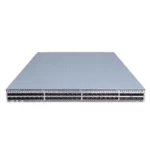
The NVIDIA Spectrum-4 Ethernet switching platform delivers 51.2 Tbps of switching capacity across 64 ports of 400 Gbps Ethernet, matching InfiniBand Quantum-2 in aggregate bandwidth while implementing comprehensive RoCEv2 capabilities optimized for AI workloads. Organizations can also explore platforms like the H3C S9855 Series that provide similar RoCEv2 implementation with competitive specifications and potentially lower acquisition costs.
Spectrum-4 switches implement NVIDIA’s What Just Happened (WJH) telemetry framework that captures detailed information about every packet drop, congestion event, and flow control operation occurring within the switch. This unprecedented visibility enables network operators to identify and resolve issues that would be invisible in traditional networking infrastructure, crucial for maintaining the consistent performance AI workloads require. WJH captures include timestamps, affected flows, packet headers, and the specific reason for any anomalous behavior, accelerating troubleshooting and root cause analysis.
The platform integrates NVIDIA’s Adaptive Routing technology that dynamically load-balances RoCEv2 traffic across available paths based on real-time congestion measurements. Unlike traditional ECMP (Equal-Cost Multi-Path) routing that hashes flows to paths without considering utilization, Adaptive Routing monitors queue depths and adjusts forwarding decisions to steer traffic away from congested links. This intelligent path selection maintains consistent latency during synchronized communication patterns characteristic of distributed training operations.
Configuring Lossless Ethernet for RDMA
Achieving reliable lossless operation for RoCEv2 requires meticulous attention to configuration details across the entire network path from source network adapter through switches to destination network adapter. Even a single misconfigured device can compromise lossless guarantees and severely degrade application performance through packet loss and retransmissions.
Priority-based Flow Control Configuration:
Enable PFC on all switch ports and network adapter queues carrying RoCEv2 traffic, typically priority class 3. Configure PFC pause thresholds at approximately 70-80% of buffer capacity to provide adequate headroom before triggering pause frames, allowing buffers to absorb short traffic bursts without immediately pausing upstream senders. Implement PFC deadlock detection and recovery mechanisms on all switches to identify and resolve circular pause dependencies that could stall traffic indefinitely.
Verify that PFC remains disabled on priority classes carrying best-effort traffic to prevent head-of-line blocking where congestion in one priority class affects other traffic classes. Most AI cluster deployments reserve priority 3 for RoCEv2 traffic while allowing remaining priorities to operate with traditional drop-based congestion management, ensuring that RDMA traffic receives lossless treatment without impacting other applications.
Explicit Congestion Notification Tuning:
Configure ECN marking thresholds higher than PFC trigger points to ensure rate-based congestion control activates before credit-based flow control mechanisms engage. Typical configurations mark packets when instantaneous queue depth exceeds 20-30% of buffer capacity, allowing endpoints to reduce transmission rates before buffers fill sufficiently to trigger PFC pause frames.
Modern platforms like H3C S9855 implement AI-enhanced ECN algorithms that dynamically adjust marking thresholds based on observed traffic patterns, optimizing congestion response without requiring extensive manual tuning. These intelligent algorithms learn normal operating characteristics and adapt ECN behavior to maintain target queue depths while minimizing marking events that would reduce throughput.
Converged Infrastructure Advantages
A primary advantage of RoCEv2 over InfiniBand lies in the ability to deploy unified network infrastructure supporting both AI compute traffic and traditional data center applications. Organizations can implement single converged fabrics that carry RoCEv2 traffic for GPU clusters, NVMe-oF traffic for storage access, and standard Ethernet for management and application traffic, simplifying infrastructure and reducing capital costs compared to separate specialized networks.
The converged approach leverages existing Ethernet operational expertise, with network teams applying familiar configuration practices, monitoring tools, and troubleshooting methodologies. Organizations need not develop specialized InfiniBand skills or maintain separate operational processes for GPU cluster networking, reducing the human resource requirements for infrastructure management.
However, converged networks require sophisticated Quality of Service implementation to prevent interference between different traffic classes. Properly configured priority queuing and traffic shaping ensure that RoCEv2 traffic receives appropriate bandwidth guarantees and lossless treatment while storage and management traffic operates with suitable service levels. Organizations must carefully design and validate QoS policies to ensure that the convergence benefits do not introduce performance unpredictability that would compromise AI workload efficiency.
RoCEv2 Implementation Checklist:
| Configuration Element | Requirement | Impact if Incorrect |
|---|---|---|
| Priority-based Flow Control | Enable on priority 3 for all RoCEv2 ports | Packet loss causes severe performance degradation |
| ECN Marking | Configure at 20-30% buffer threshold | Excessive queue buildup increases latency |
| PFC Deadlock Detection | Enable on all lossless priorities | Circular pause dependencies can stall fabric |
| Buffer Allocation | Reserve adequate buffers for lossless traffic | Insufficient buffers trigger pause frames prematurely |
| QoS Configuration | Consistent priority mappings end-to-end | Priority mismatches break lossless guarantees |
| Cable Quality | Use compliant DAC/AOC for all connections | Poor signal integrity causes bit errors |
Comparing Cost, Scalability, and Performance for 400G/800G Networks
The decision between InfiniBand and RoCEv2 extends beyond pure performance characteristics to encompass total cost of ownership, operational complexity, and alignment with organizational expertise. A comprehensive evaluation must consider both initial capital expenditure and ongoing operational costs over the infrastructure lifecycle, typically 3-5 years for GPU clusters before technology refresh becomes economically advantageous.
Capital Cost Analysis
InfiniBand infrastructure typically commands a 30-50% cost premium over equivalent Ethernet solutions when comparing switches, network adapters, cables, and optical transceivers at similar port counts and bandwidth levels. The NVIDIA Quantum-2 QM9790 64-port 400G switch carries pricing around $26,000, while comparable Ethernet platforms like the H3C S9855-32D with 32 ports of 400G connectivity retail around $16,000. The per-port cost difference narrows as port density increases, but InfiniBand consistently maintains a capital cost premium.
Network adapter costs show similar disparities, with NVIDIA ConnectX-7 InfiniBand adapters priced approximately 20-40% higher than equivalent Ethernet variants. Organizations deploying hundreds of GPU servers face aggregate adapter costs that can exceed $500,000 for InfiniBand compared to $350,000-400,000 for Ethernet at large scale. These per-component cost differences accumulate to substantial absolute cost variations for clusters with thousands of network connections.
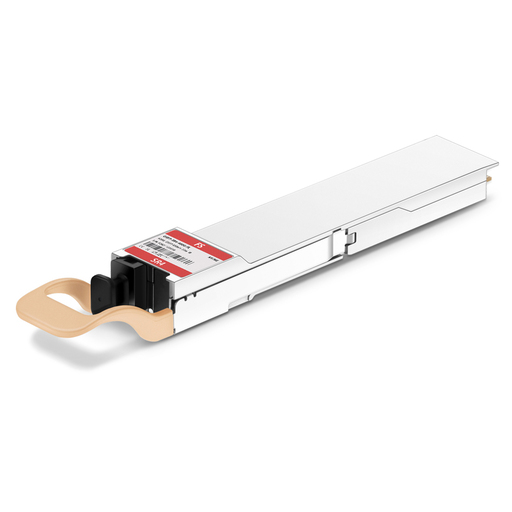
Optical transceiver expenses vary based on reach requirements and form factor. Short-reach connections within racks typically employ Direct Attach Copper cables that cost $100-300 per connection for both InfiniBand and Ethernet. Longer distances require optical transceivers, with NVIDIA/Mellanox 400G InfiniBand modules priced around $1,665 compared to $800-1,200 for equivalent Ethernet SR8 or DR4 transceivers. Organizations building large clusters with significant optical connectivity face transceiver costs that can reach $1-2 million, with InfiniBand commanding 30-40% higher expenditure.
Capital Cost Comparison for 256-GPU Cluster (32 8-GPU Servers):
| Component | InfiniBand Quantum-2 | Ethernet RoCEv2 | Cost Difference |
|---|---|---|---|
| Leaf Switches (8x) | $168,000 | $128,000 | +31% |
| Spine Switches (4x) | $104,000 | $64,000 | +62% |
| Network Adapters (64x) | $192,000 | $128,000 | +50% |
| Optical Transceivers | $180,000 | $120,000 | +50% |
| Cables | $48,000 | $40,000 | +20% |
| Total Network Infrastructure | $692,000 | $480,000 | +44% |
Operational Cost Considerations
Operational expenses extend beyond initial hardware acquisition to include power consumption, cooling costs, software licensing, and human resources for infrastructure management. These ongoing costs accumulate over equipment lifetime and can equal or exceed initial capital expenditure for long-lived infrastructure.
Power consumption for InfiniBand and Ethernet switches shows relatively minor differences, with both platforms consuming 800-1200W per 64-port 400G switch at typical operating loads. Network adapters draw similar power levels regardless of protocol, with dual-port 400G adapters consuming approximately 75-100W under load. The aggregate power difference between InfiniBand and Ethernet infrastructures represents less than 5% variance for typical deployments, translating to modest operational cost differences over equipment lifetime.
The more significant operational cost differential stems from required expertise and operational processes. Organizations with established Ethernet networking teams can leverage existing knowledge and tools for RoCEv2 deployment, minimizing incremental training and support costs. InfiniBand requires specialized expertise that may necessitate additional training, vendor support contracts, or dedicated personnel with InfiniBand experience. These human resource costs can reach $150,000-300,000 annually for large clusters requiring 24/7 operational support.
Software licensing and support costs vary by vendor and deployment scale. NVIDIA provides comprehensive UFM (Unified Fabric Manager) software for InfiniBand monitoring and management, included with switch purchases. Ethernet platforms may require separate network management software licenses, though many vendors bundle management capabilities with hardware purchases. Organizations should verify complete software cost models including monitoring, automation, and integration tools when comparing alternatives.
Performance Characteristics at Scale
Performance differences between InfiniBand Quantum-2 and properly configured RoCEv2 narrow as implementations mature, though InfiniBand maintains measurable advantages in latency-sensitive scenarios. End-to-end latency for small messages measures approximately 1.2-1.8 microseconds for InfiniBand compared to 2.0-3.0 microseconds for RoCEv2, a difference of 0.8-1.2 microseconds that compounds during collective communication operations.
For training workloads performing gradient synchronization 100-200 times per second, this latency difference translates to 80-240 microseconds of additional communication overhead per second with RoCEv2. The cumulative effect reduces effective GPU utilization by 0.008-0.024%, a relatively modest impact for most training scenarios. However, communication-intensive workloads like large language model pre-training with frequent synchronization may experience 1-3% throughput reduction with RoCEv2 compared to InfiniBand, extending training times by hours or days for large-scale jobs.
Bandwidth performance shows parity between technologies, with both InfiniBand and RoCEv2 delivering full 400 Gbps per-port throughput for large message transfers. Properly configured lossless Ethernet achieves zero packet loss comparable to InfiniBand, eliminating retransmission overhead that would otherwise degrade throughput. Organizations implementing comprehensive PFC and ECN configuration can expect RoCEv2 bandwidth performance indistinguishable from InfiniBand for large transfers.
Scalability characteristics diverge at extreme scales beyond 1000 GPUs. InfiniBand demonstrates proven deployments supporting 10,000+ node supercomputers with consistent performance, benefiting from mature multi-tier topologies and sophisticated congestion management. RoCEv2 implementations increasingly support similar scales as Ethernet platforms mature, though field validation at hyperscale remains less extensive. Organizations planning clusters exceeding 2000-3000 GPUs should carefully evaluate scalability evidence and consider proof-of-concept validation before committing to network architecture.
Total Cost of Ownership Analysis
Comprehensive TCO analysis over a typical 3-year infrastructure lifecycle reveals that operational costs can equal or exceed initial capital expenditure, making the full economic picture more nuanced than hardware price comparisons suggest. Organizations must factor in power consumption, cooling costs, maintenance expenses, software licensing, and human resources when evaluating alternatives.
3-Year TCO Model for 256-GPU Cluster:
| Cost Category | InfiniBand | RoCEv2 Ethernet | Difference |
|---|---|---|---|
| Initial Hardware | $692,000 | $480,000 | +44% |
| Power (3 years @ $0.10/kWh) | $78,000 | $75,000 | +4% |
| Support Contracts (3 years) | $138,000 | $96,000 | +44% |
| Additional Training/Staff | $300,000 | $0 (existing expertise) | N/A |
| Total 3-Year TCO | $1,208,000 | $651,000 | +85% |
The TCO model demonstrates that organizations lacking InfiniBand expertise face substantially higher total costs despite the technology’s performance advantages. Conversely, organizations with established InfiniBand operations can deploy subsequent clusters with minimal incremental training costs, improving InfiniBand’s economic position for multi-cluster deployments.
When InfiniBand Delivers Superior TCO:
Organizations training extremely large models where 1-3% performance improvement translates to days or weeks of reduced training time should strongly consider InfiniBand despite higher acquisition costs. If a 2000-GPU cluster costing $50 million in hardware trains models 2% faster with InfiniBand, the value of accelerated time-to-market and reduced power consumption during training can exceed $1 million in economic benefit, easily justifying a $500,000 network cost premium.
Existing InfiniBand deployments benefit from operational expertise and established processes that minimize incremental costs for additional clusters. Organizations operating multiple GPU clusters should leverage consistent networking platforms to maximize operational efficiency and minimize training requirements, even if absolute hardware costs favor alternatives.
When RoCEv2 Provides Better Economics:
Organizations building first-generation AI infrastructure without specialized InfiniBand knowledge achieve lower TCO through RoCEv2 deployment that leverages existing Ethernet expertise. The capital cost advantage combined with zero incremental training expenses creates compelling economics for moderate-scale clusters (under 500 GPUs) where latency differences minimally impact application performance.
Converged infrastructure strategies where GPU cluster networking shares platforms with storage and management traffic favor RoCEv2 deployment. Organizations can amortize switch costs across multiple use cases while simplifying operations through unified network management, reducing both capital and operational expenses compared to separate specialized fabrics.
Future-Proofing Considerations
Technology roadmaps indicate continuing evolution for both InfiniBand and Ethernet platforms, with 800 Gbps products currently available and 1.6 Tbps solutions emerging. NVIDIA’s Quantum-X800 InfiniBand platform delivers 800 Gbps per port, doubling bandwidth compared to Quantum-2 while maintaining sub-microsecond latency characteristics. Ethernet roadmaps similarly target 800G and 1.6T speeds through IEEE standardization efforts, ensuring both technologies provide viable migration paths as GPU bandwidth requirements increase.
Organizations should select networking platforms with bandwidth headroom to accommodate next-generation GPU servers without requiring complete network refresh. Deploying switches with 400G capability today provides comfortable headroom for H100/H200 GPU servers while enabling straightforward migration to future accelerators as they emerge. Planning for 800G capability through careful switch selection positions infrastructure for longer service life and improved return on investment.
The emergence of co-packaged optics technology promises to reduce power consumption and improve port density for both InfiniBand and Ethernet platforms at 800G and higher speeds. Organizations planning large-scale deployments beyond 2026 should evaluate CPO platforms that deliver 30-40% power savings compared to traditional pluggable optics, reducing operational costs over equipment lifetime.
Frequently Asked Questions
What is the latency difference between InfiniBand and RoCEv2 for GPU clusters?
InfiniBand Quantum-2 delivers end-to-end latency of approximately 1.2-1.8 microseconds for small messages in typical leaf-spine topologies, while properly configured RoCEv2 implementations achieve 2.0-3.0 microseconds. The 0.8-1.2 microsecond difference compounds during collective communication operations, potentially reducing training throughput by 1-3% for communication-intensive workloads. However, many AI applications show minimal performance impact from this latency differential when RoCEv2 is correctly configured with comprehensive PFC and ECN implementation.
Can RoCEv2 really achieve zero packet loss like InfiniBand?
Yes, properly configured RoCEv2 implementations achieve zero packet loss through Priority-based Flow Control mechanisms that prevent buffer overflow. However, maintaining lossless operation requires meticulous configuration across all network devices and comprehensive validation to ensure no misconfigured elements compromise lossless guarantees. Organizations must implement PFC on correct priority classes, configure appropriate buffer thresholds, enable deadlock detection, and validate end-to-end lossless operation through testing before deploying production workloads.
How much does InfiniBand cost compared to equivalent Ethernet solutions?
InfiniBand infrastructure typically costs 30-50% more than equivalent Ethernet solutions when comparing similar port counts and bandwidth levels. A 256-GPU cluster might require $692,000 in InfiniBand networking hardware compared to $480,000 for RoCEv2 Ethernet, a $212,000 capital cost difference. However, total cost of ownership analysis must also consider operational expenses including power, support contracts, and personnel training, which can favor either technology depending on organizational expertise and deployment scale.
What GPU cluster size justifies InfiniBand over RoCEv2?
Organizations deploying clusters exceeding 500-1000 GPUs for training extremely large models should strongly consider InfiniBand due to its proven scalability, lower latency, and mature ecosystem. Smaller clusters (under 500 GPUs) running diverse AI workloads often achieve excellent results with properly configured RoCEv2, especially when organizations possess existing Ethernet expertise. The decision should consider application sensitivity to network latency, organizational skill sets, budget constraints, and whether converged infrastructure provides operational advantages.
Does NVIDIA Spectrum-4 Ethernet perform as well as Quantum-2 InfiniBand?
Spectrum-4 Ethernet with comprehensive RoCEv2 implementation approaches Quantum-2 InfiniBand performance for many AI workloads, delivering equivalent bandwidth (400 Gbps per port) and achieving zero packet loss through proper configuration. However, InfiniBand maintains 0.8-1.2 microseconds lower latency and provides more mature scaling to extreme sizes beyond 2000 GPUs. Organizations can expect Spectrum-4 to deliver 95-99% of InfiniBand performance for typical training workloads when properly configured, with the gap narrowing further as RoCEv2 implementations mature.
What happens if RoCEv2 is misconfigured?
Misconfigured RoCEv2 implementations experience packet loss that triggers retransmissions, severely degrading training performance through increased latency and reduced effective bandwidth. Common configuration errors include incorrect PFC priority mappings, insufficient buffer allocation, missing ECN configuration, or inconsistent settings across network devices. Organizations deploying RoCEv2 should implement comprehensive validation procedures to verify lossless operation before production use and maintain rigorous change control processes to prevent configuration drift.
Can I mix InfiniBand and Ethernet in the same GPU cluster?
While technically possible through gateway devices, mixing InfiniBand and Ethernet within a single GPU cluster creates performance bottlenecks and operational complexity that negates most benefits of either technology. Organizations should standardize on a single networking approach for GPU-to-GPU communication within clusters. However, using Ethernet for storage and management traffic while deploying InfiniBand for GPU interconnect represents a viable hybrid architecture that leverages each technology’s strengths for appropriate use cases.
How does 800G networking compare to 400G for GPU clusters?
The transition from 400G to 800G networking provides 2x bandwidth capacity that accommodates future GPU generations with increased communication requirements, while maintaining similar or improved power efficiency through advanced signaling technologies. Organizations deploying long-lived infrastructure (5+ years) should evaluate 800G platforms like NVIDIA Quantum-X800 InfiniBand or emerging 800G Ethernet switches to ensure adequate bandwidth headroom as GPU performance continues advancing. The premium for 800G capability typically adds 30-50% to initial costs but provides superior future-proofing value.
Conclusion: Making the Right Network Choice for Your GPU Cluster
The decision between InfiniBand Quantum-2 and Spectrum-4 Ethernet with RoCEv2 represents one of the most consequential choices in GPU cluster design, impacting training performance, total cost of ownership, and operational complexity for years to come. Both technologies deliver exceptional capabilities that support demanding AI workloads, with the optimal choice depending on deployment scale, application characteristics, organizational expertise, and budget constraints.
InfiniBand maintains clear advantages for latency-sensitive applications, proven scalability to extreme sizes, and mature operational ecosystems developed over two decades of HPC deployment. Organizations training trillion-parameter foundation models across thousands of GPUs, operating environments where microseconds of latency translate to meaningful training time differences, or possessing established InfiniBand expertise should strongly consider Quantum-2 despite its capital cost premium. The technology delivers maximum performance and predictability for mission-critical AI infrastructure where training efficiency directly impacts business outcomes.
RoCEv2 implementations over Spectrum-4 or comparable Ethernet platforms provide compelling alternatives for organizations with existing Ethernet expertise, moderate-scale deployments under 500-1000 GPUs, or converged infrastructure strategies. Properly configured lossless Ethernet delivers performance approaching InfiniBand for many AI workloads while leveraging familiar operational practices and potentially lower total cost of ownership. Organizations should invest in comprehensive RoCEv2 configuration validation and maintain rigorous operational discipline to ensure lossless guarantees remain intact through infrastructure lifecycle.
The networking landscape continues evolving rapidly, with 800G and 1.6T technologies emerging to accommodate ever-increasing GPU bandwidth requirements. Organizations planning large-scale AI infrastructure investments should carefully evaluate technology roadmaps, select platforms with appropriate bandwidth headroom, and maintain flexibility to adopt advanced capabilities as they mature. Whether choosing InfiniBand or RoCEv2, success requires thorough planning, meticulous implementation, comprehensive validation, and ongoing operational excellence to extract maximum value from expensive GPU cluster investments.
For organizations building production AI infrastructure, consulting with experienced partners who have deployed both technologies at scale proves invaluable. ITCT provides comprehensive GPU cluster design and deployment services covering network architecture selection, detailed configuration planning, validation testing, and operational support. Our team has extensive field experience with both InfiniBand and RoCEv2 implementations ranging from 100-GPU research clusters to 2000+ GPU training facilities, positioning us to guide optimal architecture decisions aligned with your specific requirements and organizational context.
1. David Chen – Infrastructure Lead, GenAI Startup “We started with a 64-GPU cluster using RoCEv2 because our team was comfortable with Arista/Cisco switches. It worked fine for fine-tuning. But when we scaled to 512 GPUs for pre-training, the tail latency killed us. We switched to InfiniBand Quantum-2 for the main pod, and the training throughput improved by about 12%. The ‘plug-and-play’ lossless nature of IB is worth the premium at scale.”
2. Sarah M. – Network Reliability Engineer “The section on ‘Misconfigured RoCEv2’ hit home. We spent three weeks debugging a PFC storm that was pausing our entire fabric because of one bad cable and a misconfigured buffer threshold. InfiniBand’s credit-based flow control really saves you from these specific headaches, even if the hardware is pricier.”
3. Dr. Aris V. – HPC Researcher “Great comparison on the capital costs. I think people often overlook the cabling costs. For our new cluster, the active optical cables (AOC) for InfiniBand were actually competitively priced compared to high-quality Ethernet transceivers needed for error-free 400G. It wasn’t as big of a price gap as we feared.”
Last update at December 2025